
A sales outreach plan gives your team a repeatable way to turn prospecting into useful conversations.
Without one, outreach tends to become a collection of disconnected activities. A salesperson sends a few emails, connects with prospects on LinkedIn, makes the occasional call and follows up when they remember. It becomes difficult to tell which messages work, which prospects deserve more attention and where opportunities are being lost.
A better sales outreach strategy gives every touchpoint a purpose.
It defines who you are contacting, why they are a fit, which channel makes sense, what each message should accomplish and when a prospect should move to the next stage of the sales process.
This guide walks through that process step by step and includes a practical sales outreach plan template for email, LinkedIn and calls.
What is a sales outreach plan?
A sales outreach plan is a structured plan for contacting potential buyers through a defined combination of messages, channels and follow-ups.
It sits between your broader sales strategy and the daily work of a sales rep.
Your sales strategy answers larger questions such as which market you want to pursue, what you sell and what a successful customer relationship looks like.
The outreach plan turns those decisions into actions.
| Sales strategy decides | Sales outreach plan decides |
| Which market to pursue | Which accounts and prospects to contact |
| What the company sells | Which problem or use case to lead with |
| How the company goes to market | Which email, LinkedIn and call touches to use |
| Revenue goals | Which replies, meetings, opportunities and pipeline outcomes to measure |
This distinction matters because more outreach activity does not automatically create a better pipeline.
Woodpecker’s guide to measuring sales outreach success makes the same point from the reporting side: activity only matters when it produces useful signals and business outcomes.
Step 1: define the right prospect before writing the message
The first step in a sales outreach plan is not writing an email.
It is deciding who should receive it.
A strong plan starts with an ideal customer profile, or ICP. The ICP should describe the kind of company that is most likely to benefit from what you sell, not simply an industry and employee-count filter.
For example, a B2B software company selling sales automation may narrow its target market to SaaS businesses that:
- have a growing outbound team
- are hiring SDRs or business development roles
- recently entered a new market
- still manage parts of prospecting manually
- use several disconnected tools for outbound work
That is considerably more useful than targeting every software company with more than 50 employees.
Once the ICP is clear, use Woodpecker’s guide to finding B2B prospects or its five-step outbound prospecting process to turn those criteria into an actual prospect base.
Build a buyer list, not a job-title list
A list of job titles is not the same thing as a qualified prospect list.
“VP of Sales” tells you who someone is. It does not explain why contacting that person makes sense today.
Look for a combination of account fit and timing signals:
- a new funding round
- a leadership change
- a product launch
- a geographic expansion
- hiring connected to the problem you solve
- a visible technology or process change
The B2B buying signals guide explains how to distinguish a useful signal from a random company event.
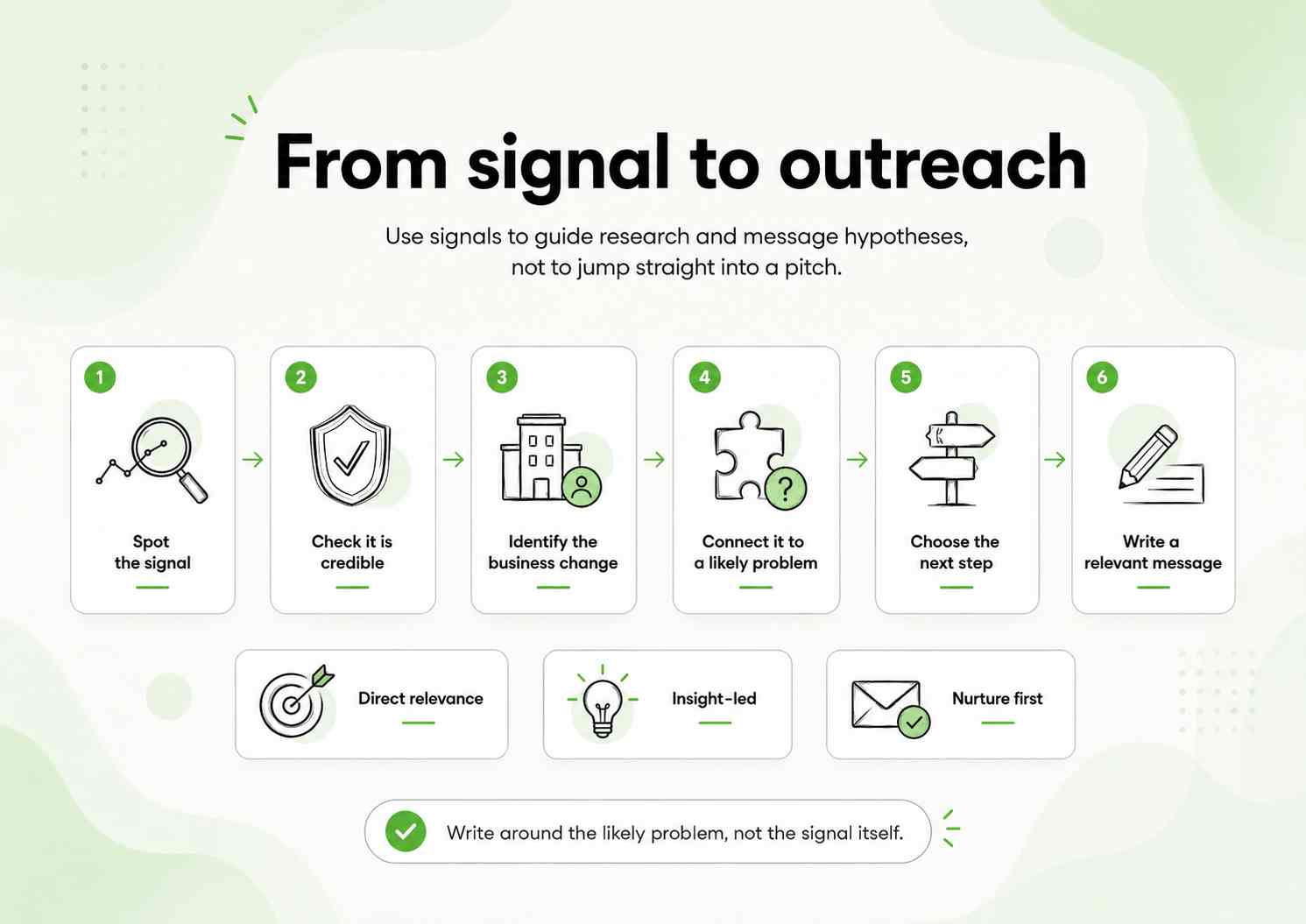
The useful part of a signal is not mentioning it in an email. The useful part is understanding the business change behind it.
Before adding a prospect to a campaign, answer three questions:
- Why this company?
- Why this buyer?
- Why now?
For larger or more complex deals, an account-based prospecting strategy can help you work from the account level rather than treating every contact as an isolated lead.
Check the compliance context too
Prospecting rules differ between jurisdictions and channels. Your outreach plan should account for where recipients are located, how their data was collected and which rules apply to the campaign.
For European outreach, Woodpecker maintains a detailed GDPR cold email guide. Use it as operational guidance rather than a substitute for legal advice specific to your business.
Step 2: give each outreach channel a job
Sales outreach does not have to happen in one channel.
Email, LinkedIn and calls can work together. The mistake is assuming a multichannel strategy means copying the same message into three places.
A prospect who ignored your email is unlikely to become interested because they receive the same pitch on LinkedIn two hours later.
A better sales outreach strategy assigns a different purpose to each channel.
| Touchpoint | Useful role | Avoid |
| Explain why you are reaching out and introduce a focused problem | A long product pitch | |
| Create familiarity or continue a relevant conversation | Pasting the email into a DM | |
| Call | Clarify a problem or continue a conversation when there is enough context | Calling only because the contact exists in the CRM |
| Follow-up | Introduce a new question, proof point, example or resource | Repeating “just checking in” |
If you are deciding which channel should lead the sequence, compare cold calling and cold emailing first.
For mixed outreach, Woodpecker also covers LinkedIn outreach and how to plan a multichannel sales cadence without overwhelming the prospect.
Step 3: personalize the reason for contacting the prospect
AI can reduce research and writing time. It cannot make weak targeting relevant.
The strongest role for AI in outreach is usually preparation: summarizing public company updates, organizing account research, classifying information or helping a salesperson create a first draft.
Woodpecker’s current guide to AI in sales outreach makes an important distinction between using AI to support research and asking it to make the judgement calls that still belong to a salesperson.
Start with research. The cold email personalization research guide shows how to collect useful context before you start writing.
If you need to apply the same principle across a larger list, see personalized outreach at scale.
Personalize more than the greeting
Adding a first name is not meaningful personalization.
You can personalize:
- the reason for contacting the account
- the problem you lead with
- the example or proof point you choose
- the question you ask
- the next step you suggest
A message does not need to contain everything you learned during research. One specific observation can be more credible than five shallow personalization fields.
Preview the message before it enters the sequence
The message also needs to work as an actual email, not only as copy inside a campaign editor.
Use Woodpecker’s free email preview tool to check the complete message before launch.
If you need a starting structure, use cold email templates as frameworks rather than scripts to copy word for word.
It is also worth reviewing how to communicate the value proposition in a cold email when the product or service is difficult to explain concisely.
Step 4: turn separate messages into a sequence
An outreach sequence should progress.
It should not be a first email followed by several reminders saying the same thing.
Woodpecker’s current cold email campaign setup guide recommends building a sequence where each follow-up adds information rather than simply nudging the recipient again.
A practical B2B sequence might look like this:
| Day | Channel | Purpose | Example angle |
| 1 | Establish relevance | Trigger + focused question | |
| 3 | Create familiarity | Profile visit or short connection request | |
| 5 | Add context | Relevant observation or example | |
| 8 | Call | Continue when a live conversation makes sense | Focused question about the current process |
| 12 | Test another angle | Proof point, useful resource or alternative problem | |
| 18 | Close the loop | Simple final question or permission to stop |
This is a starting point, not a universal rule.
For the mechanics, see Woodpecker’s guide to building a cold email sequence.
For the later touches, use the more recent guide to cold email follow-ups that add context and these sales follow-up email examples.
Do not treat every tracking event as buying intent
A sequence should react to meaningful responses, but not every recorded engagement event means somebody wants to buy.
Open tracking can be affected by privacy protection and automated image loading. That makes open rate useful for broad diagnosis, but much less reliable as proof of buyer interest.
A direct reply, a useful question or several consistent engagement signals give you stronger context.
Once a prospect is ready to talk, prepare better discovery call questions and use a consistent process for qualifying sales leads.
Step 5: measure conversations, not vanity metrics
A sales outreach plan needs targets, but the easiest metrics to collect are not always the most useful.
Open rate can help you notice unusual changes. It should not be treated as the final score for a campaign.
For most B2B outbound campaigns, stronger measures include:
- reply rate
- positive reply rate
- qualified meetings booked
- meetings held
- opportunities created
- pipeline generated
- bounce rate
- negative replies and opt-outs
The cold email reply rate guide explains why replies give you a more useful view of genuine recipient response than raw opens.
For broader context, Woodpecker publishes updated cold email statistics based on its own sending data and other benchmark sources.
Compare a campaign with the right benchmark
A benchmark is useful when it gives you context, not when it becomes an arbitrary target for every campaign.
Use Woodpecker’s free cold email benchmarks to compare your results with recent platform data.
Then compare the campaign with your own historical performance for a similar audience, offer and campaign type.
For broader sales reporting, the sales metrics guide can help connect outreach activity with later pipeline outcomes.
Review performance by segment
| Question | What it can tell you |
| Which segment replied most? | Your ICP may need to become narrower |
| Which message created positive replies? | One problem or value proposition resonates more strongly |
| Where do prospects stop engaging? | The cadence may be too long, repetitive or poorly timed |
| Which meetings become opportunities? | Your qualification criteria may need adjustment |
Run A/B tests when the sample supports them
Testing two subject lines, opening angles or CTAs can help you improve a campaign, but small differences do not always mean one version is truly better.
Use the free cold email A/B test calculator to check whether the difference between variants is statistically meaningful.
Where possible, change one meaningful variable at a time. If the subject line, opening, offer and CTA all change at once, you can identify a winning email without learning what made it win.
Step 6: include deliverability and sending capacity in the plan
A sales outreach plan can have excellent targeting and copy and still fail if the messages do not reach inboxes.
That is why the technical side belongs in the plan before launch.
Woodpecker’s cold email infrastructure guide covers the domains, mailboxes, authentication and sending setup behind outbound email.
Your outreach plan should account for:
- the number of prospects you want to contact
- the number of email steps per sequence
- daily sending capacity
- sending domains and mailboxes
- domain and mailbox reputation
- email authentication
- address verification
- warm-up and sending ramp
Calculate the infrastructure before scaling the campaign
You do not need to guess how many domains and accounts a planned campaign may require.
Use Woodpecker’s cold email infrastructure calculator to estimate the setup based on campaign goals and sending capacity.
This is particularly useful before buying additional domains or mailboxes.
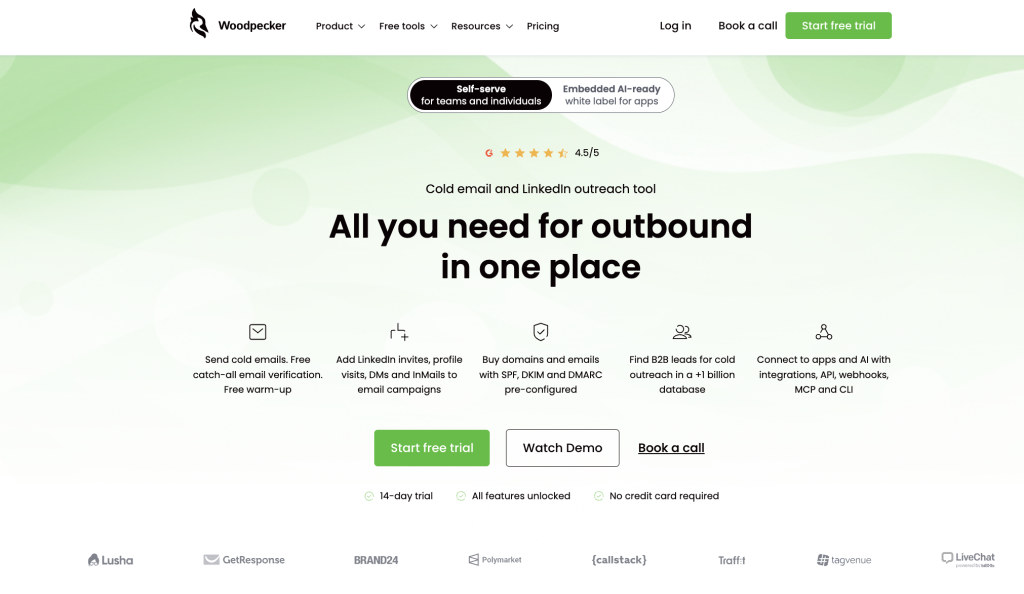
New or lightly used sending accounts also need preparation. Read the email warm-up guide before increasing real campaign volume.
Authentication matters as well. Woodpecker’s guide to SPF, DKIM and DMARC explains the main authentication mechanisms.
You can also use Woodpecker’s domain reputation check to review important domain-level signals connected with your sending setup.
If campaign volume changes over time, adaptive sending can help teams manage sending behavior rather than relying on one static volume rule.
A sales outreach plan template you can copy
Use this template as a working document before launching a campaign.
1. Campaign strategy
| Field | What to add |
| Campaign name | A clear internal name |
| ICP | Industry, company type, size, stage and fit criteria |
| Buyer | Primary buyer and other likely stakeholders |
| Trigger | Why outreach makes sense now |
| Problem | The problem or working hypothesis the campaign will lead with |
| Proof | Relevant customer result, example or evidence |
| Goal | Reply, meeting, referral or another defined next step |
| Owner | Person responsible for replies and next actions |
2. Messaging plan
| Message | Purpose |
| First email | Explain the reason for contacting this buyer |
| Follow-up one | Add context, proof or a new observation |
| Follow-up two | Test another angle or objection |
| LinkedIn touch | Create familiarity without duplicating the email |
| Call | Ask a focused question when live conversation makes sense |
| Final email | Close the loop without manufactured urgency |
3. Infrastructure plan
| Field | Plan |
| Prospects | Number of prospects in the campaign |
| Sequence steps | Number of planned email touches |
| Sending accounts | Accounts assigned to the campaign |
| Domains | Sending and backup domains |
| Verification | How prospect addresses will be checked |
| Authentication | SPF, DKIM and DMARC status |
4. Success measures
| Metric | How to use it |
| Delivery and bounce data | Diagnose list and infrastructure problems |
| Reply rate | Compare with similar campaigns and segments |
| Positive reply rate | Measure useful interest rather than every response |
| Meetings booked | Track progression from reply to conversation |
| Opportunities created | Measure qualification and sales impact |
| Pipeline generated | Connect outreach with commercial outcomes |
Four free Woodpecker tools for your outreach plan
You can use four free Woodpecker resources at different stages of the campaign.
| Tool | When to use it |
| Cold email infrastructure calculator | Before launch, to estimate domain and mailbox requirements |
| Email preview tool | Before launch, to review the actual message |
| Cold email benchmarks | After gathering data, to put campaign performance into context |
| Cold email A/B test calculator | When comparing campaign variants and deciding if the difference is meaningful |
Sales outreach best practices
Start with relevance
Do not contact somebody simply because you found their email address.
A useful prospect has a credible connection to the problem your product solves. Strong targeting makes personalization, copy and qualification easier.
Woodpecker’s B2B sales prospecting checklist can help teams tighten this part of the process before automation begins.
Keep the first message focused
The first outreach email does not need to explain the full product.
Give the prospect enough context to understand why you contacted them and make the next step easy to evaluate.
Give every follow-up something new
“Just following up” is not a new reason to reply.
Introduce a detail, question, customer example, objection, resource or observation instead.
Do not confuse automation with strategy
Automation can schedule messages, coordinate follow-ups and reduce repetitive work.
It cannot decide that a prospect is genuinely relevant or that continuing the campaign still makes sense.
Woodpecker’s guide to outbound sales automation is useful when you are deciding which parts of the process should be automated and which still need human judgement.
Use the reply as the beginning of the sales conversation
Cold outreach does not need to close the entire deal inside the email.
The cold email sales funnel guide is useful here: a reply can be the point where the real sales conversation starts.
Once that conversation begins, a consultative selling approach can help the sales rep understand the buyer’s situation before rushing into a product pitch.
Sales outreach plan FAQ
What should a sales outreach plan include?
A sales outreach plan should include the ideal customer profile, target prospects, buying signals, outreach channels, message angles, sequence timing, campaign infrastructure, owner and success metrics. It should also define when outreach stops and what happens after a prospect replies.
How many touches should an outreach sequence have?
There is no universal number that works for every campaign. Sequence length depends on the buyer, sales cycle, channel mix and quality of each follow-up. Use several touches when they add useful context, but do not extend a sequence only to increase activity.
How long should a sales outreach sequence run?
A B2B outreach sequence often runs for several weeks. The right timing depends on the audience and sales cycle. Enterprise accounts may need a slower cadence, while a simpler offer may justify a shorter one. Review your own response data instead of treating one cadence as permanent.
What makes sales outreach effective?
Effective outreach combines accurate targeting, a credible reason for contact, a focused message and sensible follow-up. Deliverability and data quality also matter because strong messaging cannot produce replies when the email does not reliably reach the intended recipient.
Which sales outreach metrics matter most?
Reply rate, positive replies, qualified meetings, opportunities and pipeline usually tell you more about commercial progress than open rate alone. Track bounce and negative-response trends as diagnostic signals too.
Can AI create a sales outreach plan?
AI can help summarize research, organize prospect information, draft message variants and analyze campaign patterns. A salesperson should still confirm that the account is relevant, the research is accurate and the final message reflects a real reason to contact the prospect.
Build outreach around useful conversations
A sales outreach plan gives your team a repeatable framework for prospecting without turning outreach into a volume contest.
Start with the right accounts. Define why contacting them makes sense. Give every channel a clear role and build follow-ups that move the conversation forward rather than repeat the opening pitch.
Then connect the messaging plan with the operational side of outreach: infrastructure, deliverability, measurement and testing.
The result should be a system your sales team can learn from after every campaign.
Start with one clearly defined audience, run the sequence, review the replies and qualified conversations, then update the plan before scaling it to more prospects.