


Consultative selling is a sales approach built around understanding a buyer’s situation before proposing a product or service.
That may sound obvious. Yet plenty of sellers still lead with their company, feature list or pitch deck before they understand what the buyer is trying to solve.
A consultative seller does the opposite. They start with context. They ask better questions, listen for the real pain point and tailor the next step around what the buyer actually needs.
For outbound teams, that matters from the first cold email. You are not walking into a conversation with a prospect who asked to hear from you. You have to earn attention first, then prove that the conversation is worth continuing.
A strong cold email strategy can help you start that process. Consultative selling helps you make the conversation useful once a prospect responds.
What is consultative selling?
Consultative selling is a sales method where the salesperson acts more like an advisor than a presenter.
Instead of pushing products or services, the seller works to uncover the buyer’s goals, current solution, constraints and decision-making process. Only then do they recommend a path forward.
Consultative selling is a sales approach that puts diagnosis before prescription.
The goal is not to become a buyer’s friend. It is to build trust by showing genuine interest in the problem and bringing relevant insights to the conversation.
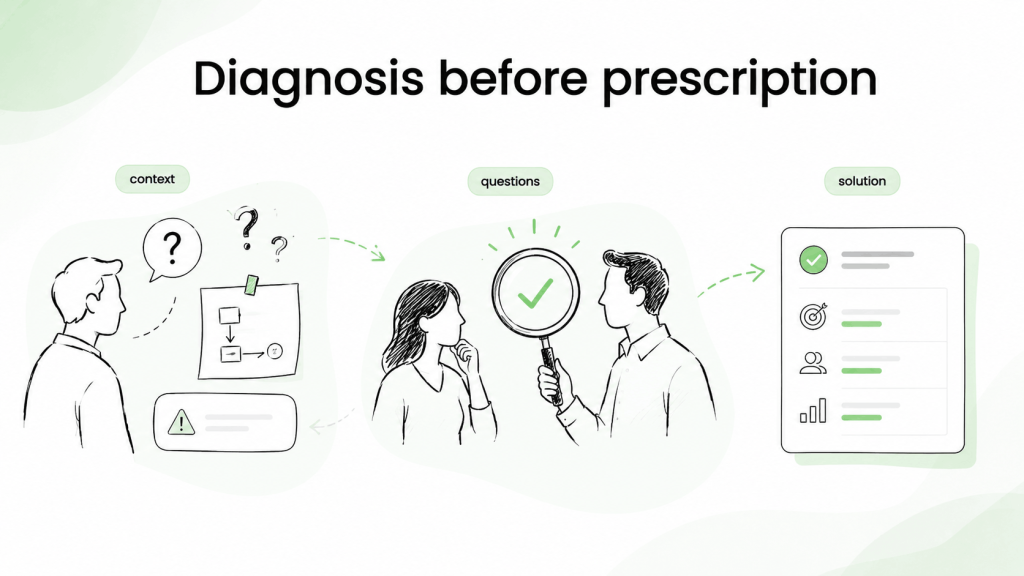
A consultative sales approach usually involves:
- researching the account before outreach,
- asking open-ended questions,
- listening for pain points,
- understanding the customer’s needs,
- tailoring the recommendation,
- helping the buyer make a better decision.
This differs from traditional sales, where the salesperson may focus on presenting a standard pitch as quickly as possible.
The consultative approach takes more preparation. In return, it gives sales professionals a stronger basis for meaningful connections, a more credible sales conversation and a better chance of building a long-term customer relationship.
Consultative selling vs traditional sales
Traditional sales often begins with the seller’s product.
The seller explains what the product does, lists the benefits and asks for a meeting or purchase.
Consultative selling begins with the buyer’s context.
The seller asks what is changing, what is not working and what success needs to look like. The product comes later, when it is clear that there is a relevant problem to solve.
| Traditional sales | Consultative selling |
|---|---|
| Starts with the product | Starts with the buyer’s situation |
| Uses one standard pitch | Uses a personalised approach |
| Focuses on features | Focuses on business impact |
| Pushes toward a fast close | Helps the buyer evaluate options |
| Treats objections as barriers | Treats objections as useful information |
| Measures activity first | Measures deal quality and progress |
Traditional sales is not always wrong. A simple, low-cost product with a short sales cycle may not need deep discovery.
But when a purchase affects several teams, involves multiple decision-makers or creates implementation risk, the buyer needs more than a polished product demo.
They need a seller who understands the consequences of the decision.
The principles of consultative selling
The principles of consultative selling are simple. Applying them consistently is harder.
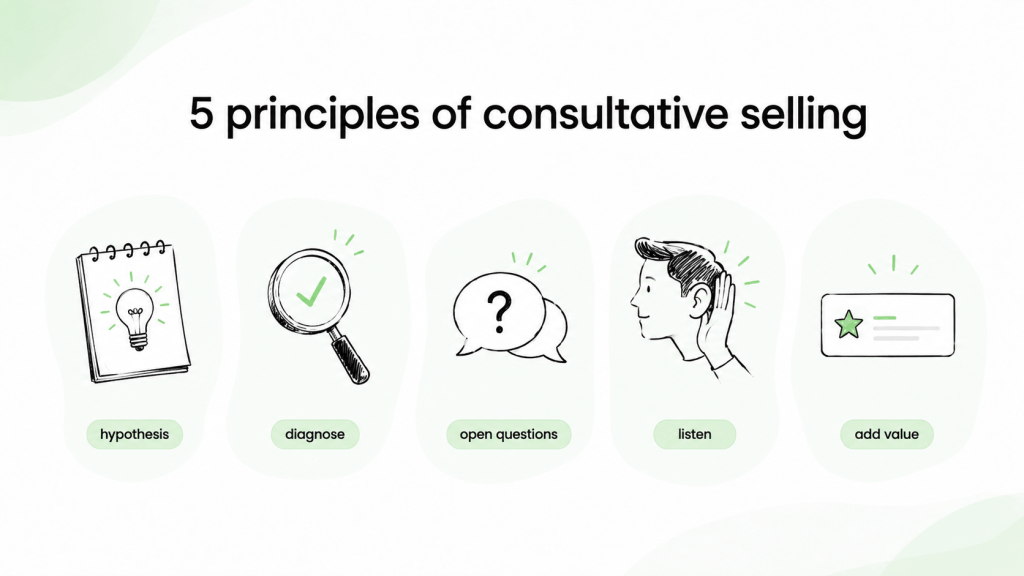
Start with a hypothesis, not an assumption
A consultative seller does not pretend to know the buyer’s business after five minutes of LinkedIn research.
They form a hypothesis.
For example:
Your company is hiring SDRs in a new region. Are you trying to standardise outbound before the new team starts?
That is different from saying:
I know your team struggles with outbound consistency.
The first message creates room for correction. The second can make the prospect feel like they are being pushed into a generic campaign.
Research gives you a useful starting point. It should not replace curiosity. Use this guide to prospect research before cold outreach to find signals that make your first message more relevant.
Diagnose before you pitch
The cornerstone of consultative selling is resisting the urge to pitch too early.
A buyer may ask what your product does. That does not mean they are ready for a full product tour.
Start with the problem behind the question.
For example:
Happy to show you. Before I do, what part of your current process is taking the most time?
That one question can uncover whether the buyer cares about setup, reporting, handoffs, deliverability, data quality or something else entirely.
A good sales rep does not hide the product. They simply make sure the product is connected to something that matters.
Ask open-ended questions
Open-ended questions create room for detail.
They are especially useful when you need to uncover the customer’s needs without making the buyer feel interrogated.
Examples:
- What changed that made this a priority now?
- How are you handling this today?
- What is working well with the current solution?
- Where does the process break down?
- Who else is affected when this takes longer than expected?
- What would a better outcome look like?
You can use open-ended questions in sales emails before a call, during follow-ups or after a prospect gives you a vague positive reply.
The point is not to ask more questions. It is to ask questions that move the conversation forward.
Listen for the problem behind the first answer
Active listening means paying attention to what the buyer says, but also to what they leave out.
A prospect may say, “We need more leads.”
That could mean:
- they need a larger target account list,
- their reps are not getting replies,
- their follow-up process is inconsistent,
- their ideal customer profile is too broad,
- they have leads but cannot qualify them well.
The first statement is rarely the whole story.
A consultative seller listens for the language buyers use around urgency, frustration, priorities and business goals. Then they refine the next question.
Add value before asking for commitment
A consultative sales process should add value before it asks the buyer to spend more time.
That value can be small.
It may be a relevant observation, a benchmark, a useful question, a short teardown of the current workflow or a better way to frame the issue internally.
It does not need to be a 20-page report.
The buyer should feel that the conversation helped them think more clearly, even if they do not buy from you.
The benefits of consultative selling
The key benefits of consultative selling come from better fit, not clever persuasion.
It helps sellers build trust
Buyers can spot a standard sales pitch quickly.
A consultative seller stands out because they are willing to slow down, listen and discuss the buyer’s current reality.
That does not mean every prospect will agree to a meeting. It means the prospects who do engage are more likely to see the conversation as useful.
It improves deal quality
The consultative selling process helps reps uncover important context earlier.
They can learn:
- how serious the pain point is,
- who owns the problem,
- what the buying process looks like,
- what the current solution cannot do,
- who else needs to be involved.
That makes qualification more accurate and helps sales teams avoid chasing conversations that will not move.
For a structured way to assess those details, read our guide to MEDDPICC sales methodology.
It makes sales messaging more relevant
When a seller understands the buyer’s situation, their emails, calls and follow-ups become more specific.
Instead of saying:
We help teams improve sales productivity.
They can say:
You mentioned that new reps are building campaigns from scratch. Would it be useful to look at how you could shorten that setup time without losing control of deliverability?
That is a more useful sales approach because it connects the offer to a confirmed problem.
It helps teams close more deals
Consultative selling does not guarantee that every opportunity will close.
It does help sellers focus on buyers who have a real problem, a reason to change and a path to a decision.
That usually produces healthier opportunities than a process built around volume alone.
How to be consultative in cold outreach
Cold outreach is where many teams get consultative selling wrong.
They assume being consultative means writing a long email full of research.
It does not.
A consultative cold email is usually short. It gives the buyer one reason to care and one easy way to respond.
Use a relevant trigger
Look for an event or signal that may have changed the prospect’s priorities.
Examples include:
- hiring for a sales role,
- entering a new market,
- launching a product,
- expanding into a new customer segment,
- changing sales leadership,
- announcing funding,
- publishing a job post that points to a process gap.
AI can help you gather and sort those signals faster. AI can scan company sites, job posts, news and public profiles for likely triggers.
But AI should not decide what matters to the buyer.
Use AI for research support. Use human judgement to decide whether the observation is relevant enough to include.
Lead with a problem hypothesis
A strong cold email does not open with “We help companies like yours.”
It gives the buyer a specific thought to react to.
For example:
Saw you are building an SDR team in the US after expanding in Europe. Teams at that stage often find that campaign quality becomes inconsistent across regions. Is standardising the process something you are working on this quarter?
The message is short, but it is consultative because it starts with a plausible business issue rather than a feature list.
For more examples, see these cold email templates and this guide on how to write a cold email that works.
Ask one question that is easy to answer
Do not turn the first email into a discovery form.
Ask one low-pressure question.
Good options include:
- Is this already on your radar?
- How are you handling that today?
- Is the team trying to solve this before the next hiring round?
- Would it be useful to compare notes on what other teams do at that stage?
Avoid asking for fifteen minutes before you have earned a reason for the call.
A clear cold email CTA should make the next step feel small and relevant.
Use follow-ups to add context, not pressure
A follow-up should not simply say, “Just checking if you saw this.”
Add something new.
You might share a different observation, clarify the problem you were referring to or ask a simpler question.
AI can help a rep prepare follow-up variants based on the account’s public activity. AI can also summarise a thread before the next touch.
Still, AI-generated follow-ups need review. A generic AI message with the prospect’s name added at the top is not a consultative selling approach. It is just faster generic outreach.
Use this guide to sales follow-up emails when planning the next touch.
Use LinkedIn to add familiarity
LinkedIn can support consultative outreach when it is used to make the interaction feel more familiar, not more automated.
A rep might view a profile, engage with a relevant post or send a short connection request after a useful email.
AI can help identify recent posts or themes worth mentioning. But the outreach should still sound like a person noticed something specific.
Read more about LinkedIn outreach automation tools and use them carefully. The goal is continuity across channels, not a flood of automated touches.
A consultative discovery flow across an outbound sequence
Consultative selling works best when each touch has a job.
Here is a simple consultative sales process for outbound teams.
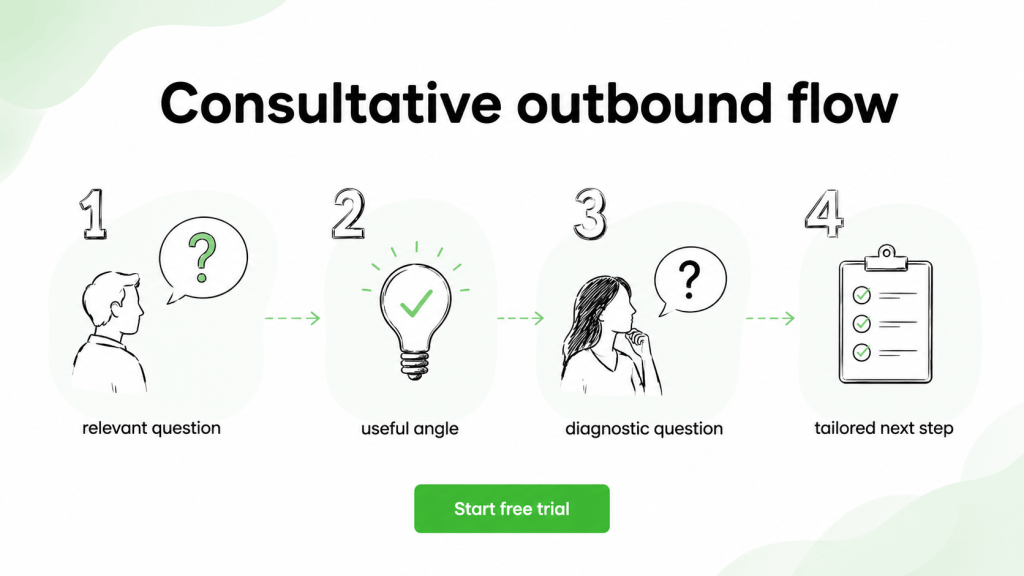
Touch 1: raise a relevant question
Use a trigger, observation or pain hypothesis.
Your goal is not to sell the product. Your goal is to earn a response.
Touch 2: add a useful angle
Share a short insight that makes the original message more concrete.
For example:
The issue usually is not volume. It is that every rep creates a different process, so managers cannot tell which campaign patterns are working.
This shows that you understand the likely problem without forcing the buyer into a demo.
Touch 3: ask a diagnostic question
Now ask something that helps you uncover the buyer’s current solution.
For example:
Is the bigger challenge getting campaigns live quickly, or keeping results consistent once more reps are involved?
This gives the prospect a simple choice while still inviting detail.
Touch 4: offer a tailored next step
Only after you have some context should you suggest a call, walkthrough or resource.
For example:
Based on what you said about ramp time, I can show you how teams centralise campaign setup without adding more admin. Worth a quick look next week?
This is where a personalised approach pays off. You are no longer asking for a meeting because you need one. You are offering a next step tied to the buyer’s stated priority.
A well-built cold email sequence makes it easier to keep that flow consistent across reps.
Consultative selling vs solution selling vs SPIN
Consultative selling, solution selling and SPIN are related, but they are not the same thing.
Consultative selling
Consultative selling is the broader approach to sales.
The seller learns about the customer’s needs, goals and constraints before recommending a solution.
Solution selling
Solution selling focuses on connecting a defined problem to a solution.
It can be part of consultative selling, but it can also become product-led if the seller assumes they already know the answer.
SPIN selling
SPIN is a question framework built around Situation, Problem, Implication and Need-payoff questions.
It is useful for structuring discovery, but it is not a full consultative sales process on its own.
A strong sales professional can use all three:
- consultative selling as the approach,
- SPIN as a questioning structure,
- solution selling when it is time to connect the problem to the right product or service.
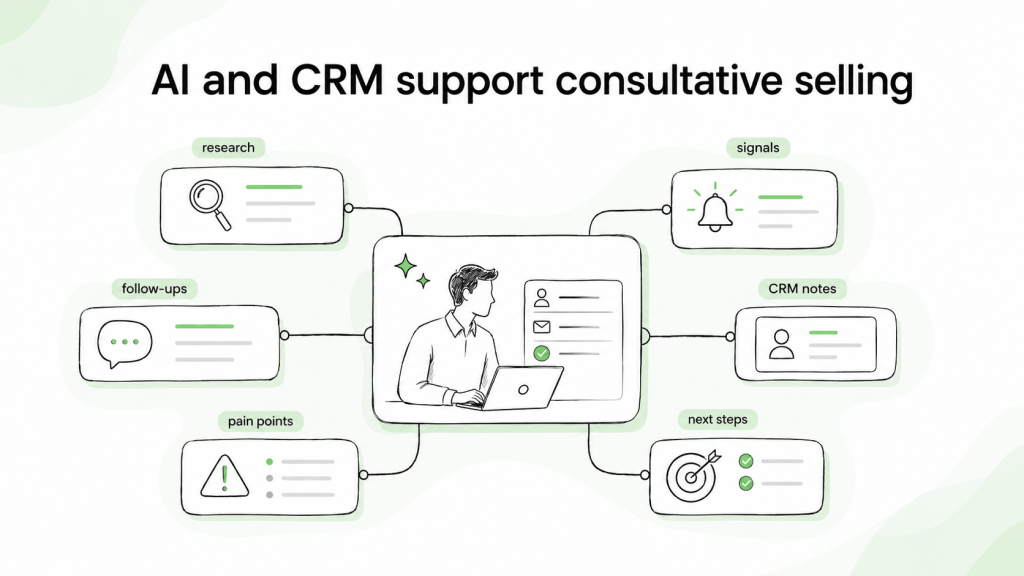
How AI can support consultative sales without replacing the seller
AI is changing the sales process, but it is not replacing the need for a consultative seller.
Used well, AI can help reps prepare faster and follow up with more context.
AI can help with:
- summarising account research,
- identifying relevant company changes,
- grouping similar buyer pain points,
- drafting first-pass outreach ideas,
- preparing call notes,
- suggesting follow-up questions,
- pulling themes from CRM data,
- analysing sales analytics,
- spotting weak areas in a sales sequence.
AI can also support sales enablement by helping managers create call-review summaries, coaching prompts and account briefs.
The risk is obvious: AI can make poor sales habits faster.
AI cannot build trust on its own. AI cannot know which pain point matters most without reliable context. AI cannot replace active listening in a live sales conversation.
The best use of AI is to remove repetitive prep work so the sales rep can spend more time thinking, listening and tailoring the conversation.
How CRM and sales tools support a consultative seller
Consultative selling becomes harder when information is scattered.
A CRM gives the sales team a shared view of the buyer’s situation, previous conversations, key stakeholders and agreed next steps.
Use your CRM to record:
- pain points,
- goals,
- objections,
- buying timeline,
- current solution,
- relevant stakeholders,
- next actions,
- notes from discovery calls.
Woodpecker can support the outreach side of that workflow. You can keep conversations moving through personalised sequences, then sync relevant campaign activity with your CRM.
For example, the Pipedrive integration can help teams keep prospect data and campaign outcomes connected instead of moving information manually between tools.
The right sales tools should reduce admin, not create more places where context gets lost. Explore these sales tools by category before adding more software to your stack.
Common mistakes that weaken consultative selling efforts
Asking questions without listening
Probing questions are useful. Asking one after another without responding to the answer feels scripted.
A sales conversation should adapt to what the buyer says.
Using fake personalisation
Mentioning a recent funding round, then sending the same pitch to every company that raised money, is not a consultative selling approach.
The personalisation should change the message, not just the first line.
Giving advice before understanding the problem
A seller who rushes to explain the compelling solution may miss the actual issue.
The buyer may need a different workflow, different stakeholder alignment or a different sales strategy altogether.
Treating AI output as customer insight
AI can generate plausible ideas. Plausible is not the same as true.
Always verify AI-generated account notes before using them in a live conversation.
Confusing activity with progress
A long sequence, several LinkedIn touches and a polished presentation do not prove that the buyer is moving forward.
Use a clear qualification process. Track the evidence that matters.
The future of consultative selling
The future of consultative selling is not less human. It is more selective.
Buyers have more access to information than ever. They can compare products, read reviews, use AI to research vendors and ask peers for recommendations before speaking to a salesperson.
That means sellers add less value by repeating basic product information.
They add more value by helping buyers interpret the situation, see hidden trade-offs and make better decisions.
AI will make basic outreach faster. It will also make generic outreach more common.
That creates an opportunity for sales teams that do the harder work: research the right accounts, ask better questions, build relationships and tailor every important conversation.
Successful consultative selling will depend on sales skills that AI cannot automate well:
- curiosity,
- judgement,
- empathy,
- active listening,
- business understanding,
- clear communication,
- the ability to challenge assumptions without being pushy.
Build a consultative sales process around real buyer problems
Consultative selling is not about being softer.
It is about being more useful.
The best seller does not push a product before they understand the buyer’s world. They uncover the pain point, clarify the business goals and help the prospect evaluate what needs to change.
For outbound teams, that starts with better research, relevant emails and follow-ups that add value instead of pressure.
Woodpecker helps you run the outreach side of that process. Use it to create targeted campaigns, maintain consistent follow-ups and give reps more time for the conversations that actually matter.
Start with our guide to B2B sales prospecting techniques, see how to prospect high-ticket clients and explore practical cold email tips.