


AI in sales outreach means something different this year than it did two years ago. In 2024, “AI-powered” was mostly a marketing label slapped on features that already existed under different names. In 2026, there’s a real separation between AI capabilities that meaningfully improve outbound performance and AI capabilities that look impressive in demos but don’t hold up under daily use.
The difference matters because AI tool costs have risen. Teams buying AI sales outreach platforms in 2026 are paying $50-200 per seat per month for AI features on top of their existing sales stack. At that price point, the “is this actually working” question matters more than the “does this sound cool” question.
This guide covers the five applications of AI in sales outreach that genuinely improve results in 2026, what’s still overhyped, how to think about combining AI tools with existing outreach infrastructure, and where Woodpecker fits for teams that want AI-assisted outbound without rebuilding their entire stack.
The honest summary: AI is excellent at augmenting specific steps in the outreach workflow – research, personalization at the opener level, reply classification, and list enrichment. It’s still mediocre at generating entire cold emails that convert. And AI can’t solve the fundamentals – targeting, timing, and offer – which still require human judgment.
However, teams that understand where AI helps and where it doesn’t are the ones getting real ROI from it.
The five AI applications that actually work in 2026
These are the places where AI genuinely moves the needle in B2B outreach. Each one is well-validated in production at enough teams to separate from hype.
1. Prospect research at scale
Before 2023, researching a prospect meant 5-10 minutes per contact – reading their LinkedIn, checking their company’s recent news, finding a conversation angle. Manually done, this scaled badly; most teams skipped it for anything beyond their top accounts.
AI changed the economics. Tools that pull a prospect’s LinkedIn, company website, recent posts, and news coverage, then synthesize a short “why this person, why now” brief, deliver 80% of the value of manual research in 30 seconds. The research isn’t as deep as a senior AE’s manual read, but it’s enough to write a specific opener or personalized cold emails instead of a generic one.
The winning pattern: AI generates the research brief, the rep writes the email, quality stays high because the human makes the judgment calls the AI can’t. This is the highest-ROI AI application in outreach right now.
2. Personalized opener generation
Building on research: AI can now generate subject lines and the first 1-2 sentences of a cold email with real specificity – referencing the prospect’s recent post, their company’s recent announcement, or a specific detail from their profile.
This is the single biggest deliverability and reply-rate lever available in 2026. A cold email with a specific, observed opener outperforms a generic one by 2-3x on reply rate, and AI makes this possible at volume.
The caveat: AI-generated openers fail when the research data is thin. If the prospect has no recent LinkedIn activity and a generic company page, the AI’s opener collapses to “I saw your company is in the SaaS space” – which is worse than no personalization. Quality-control your inputs, not just your outputs.
3. Reply classification and sentiment analysis
When a cold email gets a response, what kind of response is it? Positive interest? Polite no? Out-of-office auto-reply? Unsubscribe request? Question? Referral to someone else?
Older systems needed human review for each reply. AI-based reply classification handles this automatically, routing positive replies to the AE’s inbox, suppressing negative replies from the rest of the sequence, and flagging ambiguous ones for review.
AI-based reply detection automatically stops the sequence when a prospect responds, classifies the reply type, and keeps the outreach workflow clean without requiring manual review of every message.
Learn also how to measure success of sales outreach strategy or get inspired with our 11 cold email templates.
For teams running sequences at any real volume, this isn’t optional – manual reply review at 100+ daily replies breaks down quickly.
4. List enrichment and data completion
Given a partial record (name + company, say), AI can fill in the gaps: job title, LinkedIn URL, likely email pattern, reporting structure, tech stack, recent company activity. Good enrichment tools in 2026 combine AI inference with live web data to produce contact records significantly more complete than what any single data provider offers.
The quality varies by provider and segment, but the best enrichment pipelines produce contact data that’s 85-95% accurate on current role and 70-85% accurate on email address – enough that cold email campaigns built on enriched lists outperform lists from a single data source.
5. A/B test analysis and pattern detection
AI shines at finding patterns in outreach data that humans miss – which subject lines work for which segments, which time-of-day improves response rates for which roles, which sequence structures outperform others.
Traditional A/B testing requires large sample sizes and clear hypotheses. AI-driven analysis can spot patterns across dozens of variables simultaneously with less data. The caveat: the signals AI surfaces need human validation before they drive strategy changes. “AI says emails sent at 2:47pm get 12% higher response rates” is the kind of noise-looks-like-signal finding that destroys campaigns if acted on without scrutiny.
What’s still overhyped in AI sales outreach
The other half of the honesty check. These are the AI applications that get heavy marketing coverage but don’t deliver proportional value in practice.
AI-generated full cold emails
The pitch: upload your ICP, click a button, AI writes unique cold emails for 10,000 prospects that all get replies. The reality: fully AI-generated cold emails – openers + body + CTA, all from AI – still read as AI-generated to most human recipients in most contexts.
The uncanny-valley problem is structural, not tooling. AI optimizes for probabilistic plausibility; the emails that convert optimize for specific insight, specific judgment, specific understanding of the reader’s situation. The two aren’t the same thing. Teams that have tried end-to-end AI email generation typically end up with emails that sound polished but don’t convert.
The winning pattern remains hybrid: AI for research and openers, humans for the value proposition and the ask. This isn’t a limitation AI will “outgrow” in the next 12 months – it’s structural to how generative AI works.
“AI SDRs” that run fully autonomous campaigns
Multiple tools now market themselves as “AI SDRs” – autonomous agents that identify prospects, write emails, handle replies, book meetings, and do the full SDR job end-to-end.
The marketing is aggressive; the actual performance is mixed. In production, these tools tend to produce high-volume, low-quality outreach that damages sender reputation, generates complaints, and books few real meetings. The prospects who respond are typically either bots or people willing to take any call; neither converts well downstream.
The deeper issue is that judgment-intensive parts of the SDR job (prioritization, timing, offer framing, handling objections) require context AI doesn’t have access to. Autonomous outreach without human judgment is a path to scale bad decisions, not good ones.
Want to future-proof your sales email outreach 2026? Then read our article or save it for later.
AI “predictive” features that aren’t really predictive
“AI predicts the best time to send your email.” “AI predicts which leads are most likely to convert.” Many of these features are statistical pattern-matching on data too thin to support real prediction. The 2-3% lift they claim is usually within the noise floor of A/B testing at normal outbound volumes.
Features like these aren’t harmful, but they’re not the reason to pay for an AI platform. The real AI value is in the applications above – not in “predictive” features with weak underlying models.
How to structure AI in your outreach stack
The question isn’t usually “should we use AI?” – it’s “where should AI sit in our stack?” Three patterns work well in 2026.
Pattern 1: Standalone AI research tool feeding existing outbound platform. AI generates prospect briefs and opener drafts; your outbound platform (Woodpecker or similar) handles the sequencing and sending. This keeps the AI layer lightweight and doesn’t require replacing your existing infrastructure. Best for teams with a working outreach motion who want to add AI assistance incrementally.
Pattern 2: AI-native outreach platform. Platforms that build AI throughout the workflow – research, generation, sending, replies. Convenient if you’re starting from scratch; expensive and risky if you’re replacing a working stack. Works best for new teams without existing tooling commitments.
Pattern 3: AI as enrichment layer on a reliable base. Your outreach platform handles the deliverability-critical parts (warmup, inbox rotation, sequencing, reply detection); AI tools layer on top for research and personalization. This is the most common pattern for established teams and typically the best ROI.
The mistake to avoid: layering AI on top of bad fundamentals. If your sender reputation is damaged, if your list is unverified, or if your targeting is wrong, AI won’t save the campaign – it’ll just fail faster.
What AI can’t fix in sales outreach
Worth naming explicitly, because a lot of teams reach for AI when the actual problem is elsewhere.
Targeting. AI can find prospects matching your ICP faster. It can’t tell you if your ICP is right. If your targeting is off, AI makes the failure scale better.
Deliverability infrastructure. AI doesn’t authenticate your domain, warm up your mailbox, or manage your sender reputation. Those require actual infrastructure – SPF/DKIM/DMARC, warmup protocols, inbox rotation, bounce management. Inbox placement covers why deliverability infrastructure is the layer that has to work before AI adds any value on top.
Offer-market fit. If prospects don’t want what you’re selling, AI-written emails describing it more eloquently won’t change their minds. AI is a distribution amplifier; it can’t fix the upstream problem of a weak value proposition.
Follow-through after reply. Once a prospect responds positively, the AE who takes the call still needs to understand the prospect’s situation, handle objections, and close. AI helps with context and preparation but doesn’t replace the human sales conversation.
Sender reputation recovery. Once a domain has been flagged, AI outreach from that domain still lands in spam. Recovery requires volume pause, list cleanup, and patience – not smarter emails.
How Woodpecker fits for AI-assisted outreach
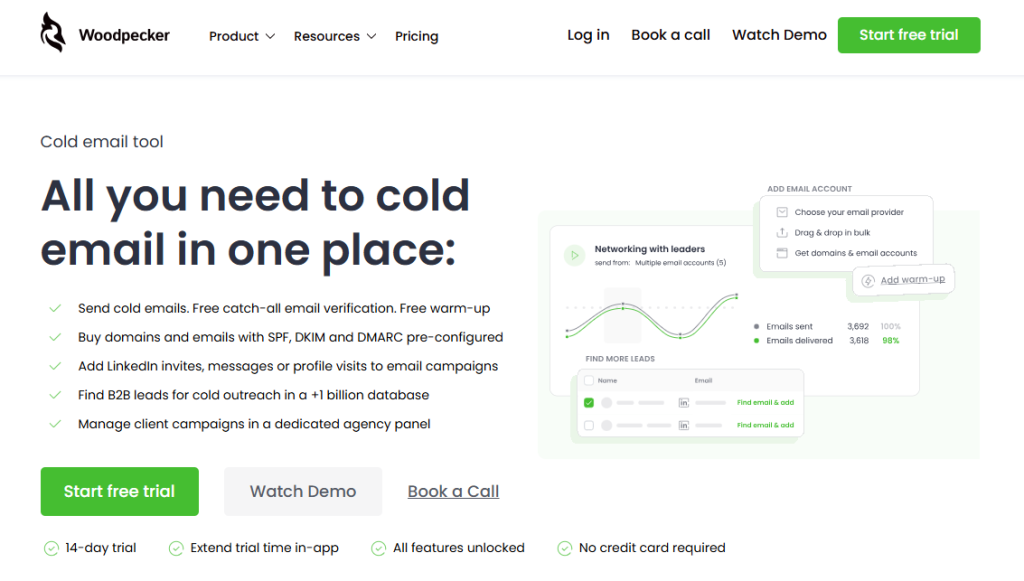
Woodpecker is built for teams that want AI-assisted outreach without replacing their core stack. The platform handles the deliverability-critical infrastructure that AI-native tools often neglect, and integrates with external AI tools for the research and personalization layer where AI actually helps.
Specifically, Woodpecker provides:
AI-based reply detection and sentiment analysis. Automatically classifies replies (positive, negative, out-of-office, question) and stops sequences appropriately. One of the AI features that genuinely saves rep time at volume.
Merge fields and conditional logic for AI-personalized content. The AI-generated research and openers from external tools feed into Woodpecker merge fields; conditional sequences (if/then branching based on opens, clicks, replies) work alongside AI-personalized content so every prospect gets the right next email regardless of how they engaged.
Deliverability infrastructure AI can’t replace. Free email warmup via Warmy and Mailivery partnerships, Adaptive Sending for inbox rotation, Deliverability for continuous reputation tracking, free catch-all email verification. The infrastructure layer that makes AI-personalized emails actually reach the inbox.
Integration with the rest of the stack. Woodpecker syncs bi-directionally with HubSpot, Pipedrive, and Salesforce – so AI-enriched contact data from your CRM flows into campaigns, and campaign activity flows back into the CRM as proper pipeline data. Automated lead generation covers how these pieces fit together operationally.
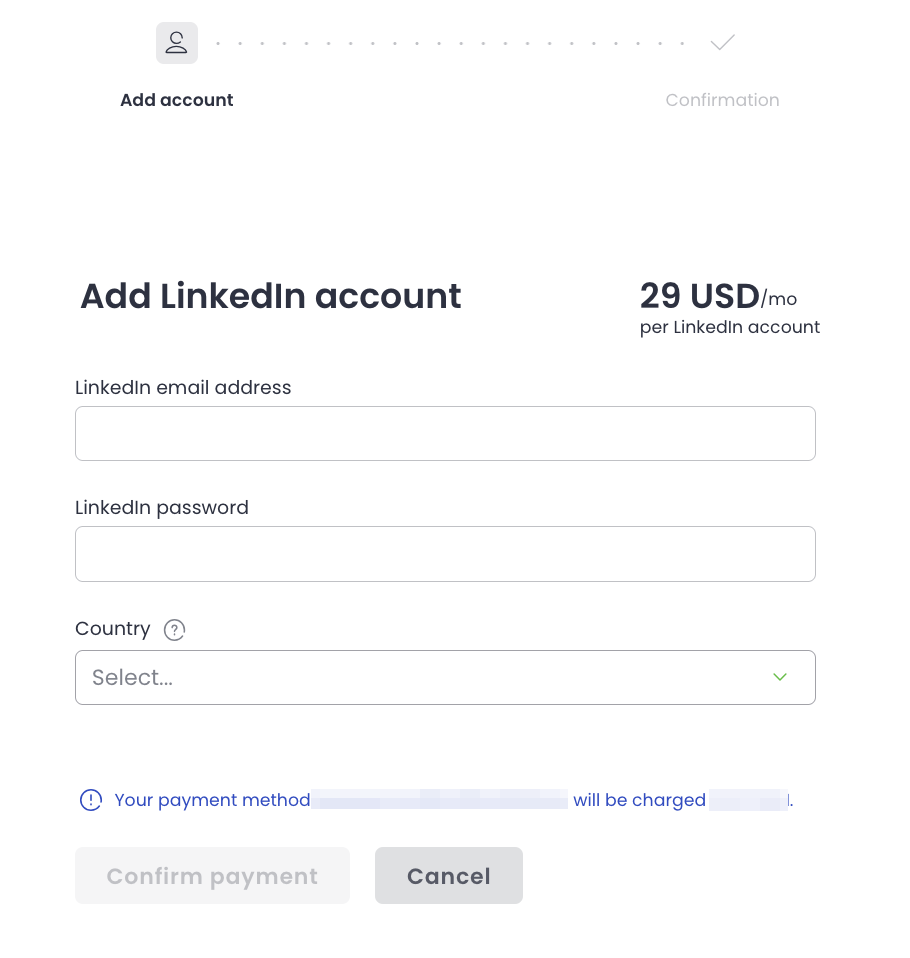
LinkedIn integration. Profile visits, connection requests, and messages as sequence steps – multi-channel outreach in one platform, complementing AI-generated personalization with multi-touch reinforcement.
What Woodpecker doesn’t do: generate full cold emails from scratch via built-in AI copywriting, run autonomous “AI SDR” campaigns, or include phone dialer and conversation intelligence. The platform focuses on the parts of outreach where automation and AI actually deliver ROI – sequencing, deliverability, reply management, and infrastructure – and leaves the AI copywriting layer to specialized tools that do it well.
For teams running cold email with AI-assisted research and personalization, sign up to Woodpecker for the deliverability and sequencing layer that makes AI outreach actually convert.
FAQ
What is AI sales outreach?
AI sales outreach uses artificial intelligence to augment parts of the outbound sales workflow – prospect research, personalized opener generation, reply classification, list enrichment, and pattern analysis. AI works well for these specific tasks; it’s less effective at fully autonomous end-to-end outreach, which still requires human judgment for targeting, value proposition, and sales conversations.
Does AI-generated cold email actually work?
Partially. AI-generated openers and personalization (first 1-2 sentences based on prospect research) work well and meaningfully improve reply rates. Fully AI-generated cold emails (complete message generated end-to-end) still tend to read as AI-written and convert poorly. The winning pattern in 2026 is hybrid: AI for research and openers, humans for the value proposition and ask.
What’s the difference between AI sales tools and AI SDRs?
AI sales tools augment specific tasks in the outreach workflow. AI SDRs are positioned as autonomous agents that handle the full SDR job end-to-end. In practice, AI sales tools deliver real ROI when used alongside human judgment; AI SDRs that run fully autonomous campaigns typically produce high-volume, low-quality outreach that damages sender reputation and books few real meetings.
How does Woodpecker use AI?
Woodpecker uses AI for reply detection and sentiment analysis – automatically classifying responses and stopping sequences appropriately. The platform also supports AI-personalized content via merge fields, so AI-generated research and openers from external tools integrate into sequences without rebuilding the workflow. Woodpecker doesn’t include native AI copywriting; it focuses on the deliverability and sequencing layer that makes AI-personalized outreach actually reach the inbox.
Is AI going to replace human sales reps?
Not for complex B2B sales in the foreseeable future. AI meaningfully augments specific parts of the sales workflow – research, personalization at scale, reply triage, pattern detection. The judgment-intensive parts (targeting, prioritization, objection handling, closing) still require human context AI doesn’t have access to. The practical shift is that AI-augmented reps are more productive than non-augmented reps, not that AI is replacing the role.