
A lead can be qualified, interested and ready to talk — then sit in the wrong queue for hours because nobody is sure who owns it.
That is a lead routing problem.
Lead routing decides what happens after a prospect enters your sales system. It determines which rep, team, campaign or next step should receive the lead based on factors such as geography, account ownership, company size, product interest or buying intent.
Good routing feels almost invisible. The right person gets the right lead with the context needed to act. Poor routing creates duplicate outreach, slow responses, territory arguments and prospects who fall between systems.
What is lead routing?
Lead routing is the process of assigning a new or existing lead to the appropriate sales owner, workflow or next action.
The lead may come from a demo request, free trial, webinar, contact database, cold outreach reply, referral or another source. Routing uses known information about that lead to decide what should happen next.
That makes routing different from lead qualification. Qualification asks whether a lead is worth pursuing. Routing asks where a qualified or potentially useful lead should go.
It is also different from lead prioritization. Two leads may both belong to the same rep while one deserves immediate attention and the other can wait. Routing decides ownership; prioritization decides order.
Where lead routing fits in the sales workflow
Routing sits between information and action.
Before routing, the system needs enough context to make a useful decision. That can include ICP fit, contact role, source, geography, account ownership, product interest and recent buying signals.
After routing, something should happen: a rep receives a task, a prospect enters a campaign, an existing account owner gets notified or a low-fit lead moves into a different workflow.
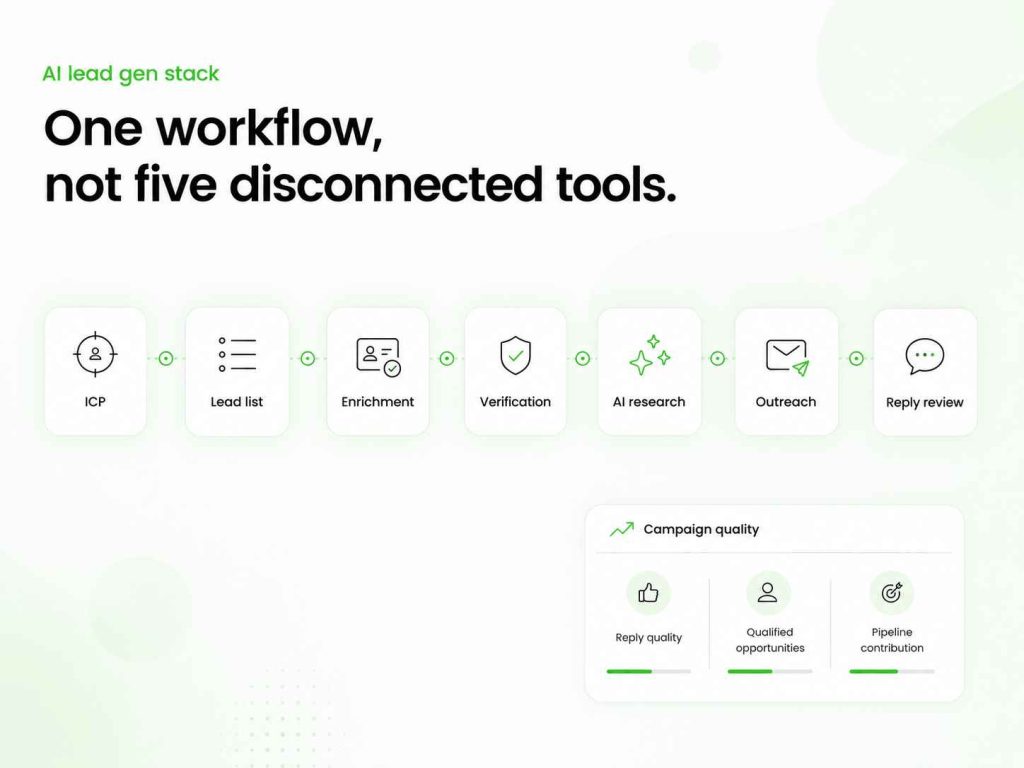
That full workflow matters because routing cannot repair bad inputs. A lead with an outdated employer, wrong country or missing account owner will still take the wrong path if the rule engine receives incorrect information.
Start upstream with a clear ideal customer profile and accurate prospect data. If you are still building the list, compare lead finder software before adding more automation downstream.
Five routing models cover most B2B sales teams
Round-robin routing
Round robin distributes leads across eligible reps in rotation. Rep A receives the first lead, Rep B the next and so on before the cycle repeats.
It works best when reps sell similar products to similar customers and the team wants a relatively even lead distribution. It becomes weaker when territories, skills or existing account relationships differ substantially.
Territory routing
Territory routing uses a field such as geography, industry, segment or company size to choose an owner.
A German enterprise account may go to one team while a US SMB lead goes to another. The routing field should represent a real sales ownership rule, not simply a convenient CRM column.
If several territories use different messages or sales motions, connect routing with your sales outreach plan rather than sending every routed segment through the same sequence.
Account-owner routing
If the company already exists in the CRM, new contacts should often go to the existing account owner.
This prevents an SDR from starting a cold conversation with someone at a company where an AE is already working an active opportunity. It also matters for account-based prospecting and multithreaded sales, where several people may belong to one account story.
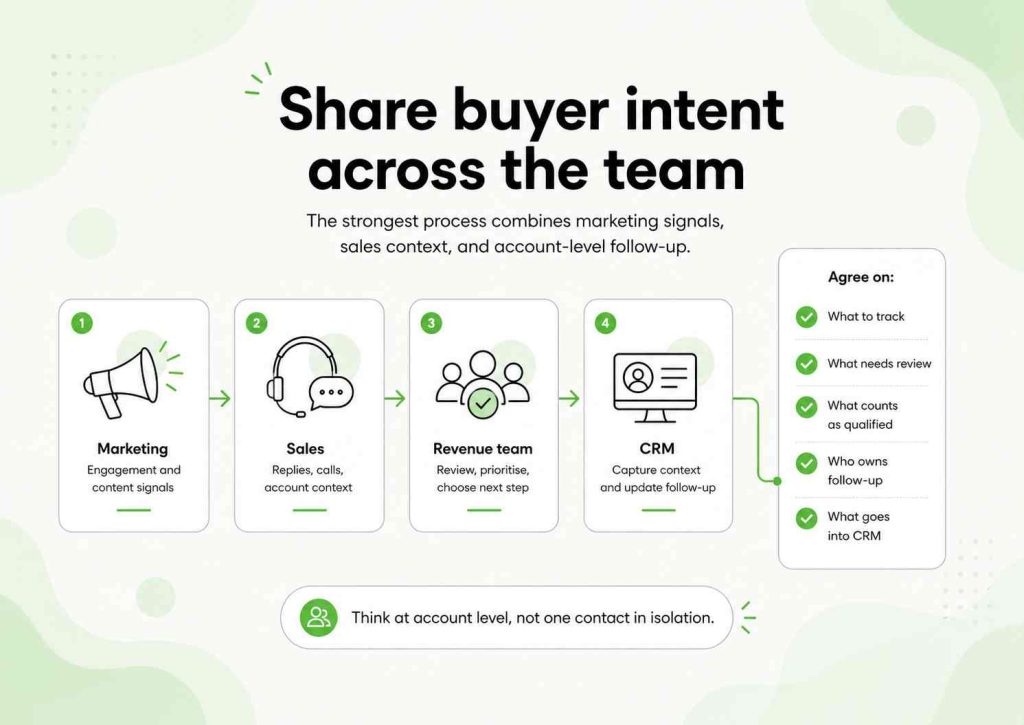
Account-level context is especially important once several contacts begin engaging. Routing each contact independently can split one buying process across different reps.
Skill or product routing
Some leads need a specialist.
An enterprise security request may need a different rep from a small-business free trial. A lead asking about a specific product line, language or technical integration may be better served by someone who handles that area regularly.
Weighted or capacity-based routing
Equal distribution is not always fair distribution.
A new rep may receive fewer leads while they ramp. Another rep may be on leave or already carrying a heavy pipeline. Weighted routing changes allocation based on available capacity instead of sending exactly the same number to everyone.
The routing rule should follow the strongest known context
Problems appear when several rules compete.
Imagine a lead from France requests a demo. The account already belongs to an AE in the UK. The contact selected an enterprise plan and the form indicates a security review is required.
Should the lead go to the French territory owner, existing AE or enterprise specialist?
There is no universal answer. Your team needs a hierarchy.
Existing account ownership → active opportunity → customer status → specialist requirement → territory → round robin
That hierarchy is only an example, but writing one down prevents routing logic from depending on whichever automation happens to fire first.
Lead score can influence routing without controlling it
Lead scoring can add another layer. A high-fit account with strong intent may deserve a faster or more senior route than a low-intent contact with similar firmographics.
The score should still remain interpretable. A prospect should not automatically jump into an enterprise AE’s calendar simply because an opaque model generated a high number.
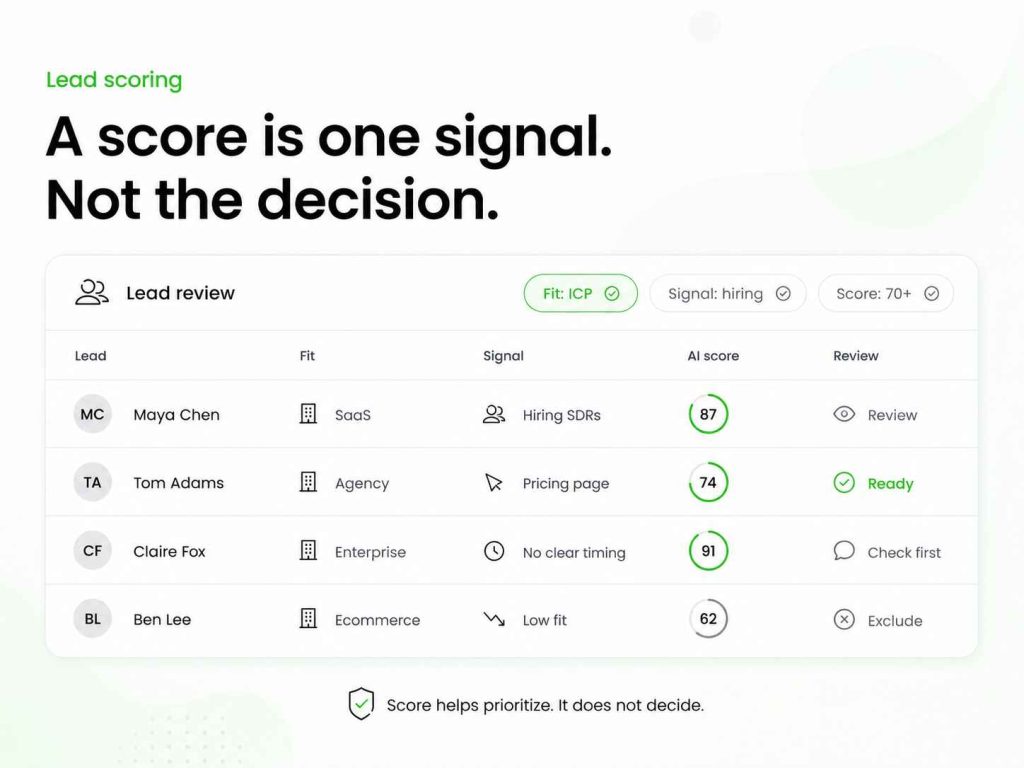
Use the underlying evidence. A recent demo request, clear ICP fit and relevant role tell a stronger story than three weak website signals added together.
For timing context, B2B buying signals can help distinguish useful intent from activity that should remain background information.
Lead Routing Stress Test: does your system actually work?
Answer the seven questions below with yes or no. Give yourself one point for every yes.
- Can a high-fit lead sit unassigned because nobody knows who owns it?
- Do reps sometimes contact different people at the same company without knowing another rep already owns the account?
- Can two automation rules assign the same lead to different people or workflows?
- Do routing rules depend on fields that are often blank, stale or entered inconsistently?
- Does a positive outbound reply ever remain inside an automated sequence after a salesperson has started talking to the prospect?
- Could a lead be assigned to someone who is away, overloaded or no longer responsible for that territory?
- Would it take more than a few minutes to explain why a specific lead was routed to its current owner?
0–1 points: routing is probably under control
Your ownership rules are likely clear enough for normal operation. The next useful check is exception handling: test what happens when an existing customer submits a demo form, a rep goes on leave or two contacts from one account enter through different channels.
2–4 points: routing friction is costing time
The system probably works most of the time but still depends on manual cleanup. Fix the ambiguous rules first. A small number of clear ownership decisions usually produces more value than adding another automation layer.
5–7 points: rebuild the routing logic before adding volume
More leads will magnify the problem. Map the existing workflow, define ownership precedence, repair required fields and decide where human review belongs before scaling acquisition or outbound campaigns.
Run four test leads through the system before trusting it
The easiest way to audit routing is not to stare at workflow diagrams. Create realistic test cases and see what the system actually does.
Test case A: clean inbound lead
A new company matches the ICP, has no existing account owner and requests a demo. The expected result should be obvious. If the team cannot predict who receives it before the form is submitted, the routing rules are too ambiguous.
Test case B: existing account, new person
Someone from an account already owned by an AE downloads a resource or requests contact. The workflow should recognize the company relationship before assigning the person independently.
Test case C: low-fit but high-intent lead
A company outside your core ICP requests a demo. The lead may deserve a fast response, but it should not automatically receive the same sales motion as a strong-fit enterprise account.
Test case D: positive reply from outbound
A prospect replies positively to a cold sequence. The automated follow-ups should stop, the reply should reach the appropriate owner and the next step should move from campaign logic to actual sales conversation.
That transition is where positive reply handling becomes more important than the original sequence. Negative replies need their own treatment too, especially when the answer is a clear rejection or opt-out. Negative reply handling should be part of the routing map, not an afterthought.
A reply is a routing event
Routing does not stop after initial assignment.
A reply can change the next owner or next action. “Talk to procurement,” “My colleague Priya handles this,” “Contact me in January” and “Can you send the security documentation?” all contain routing information.
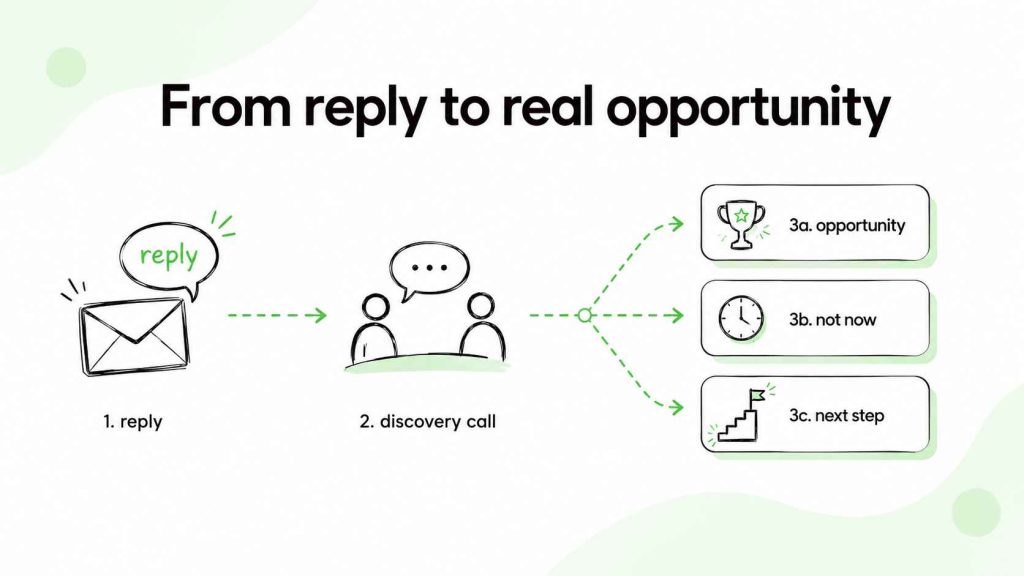
The system should capture that change rather than continuing as though the lead had never responded.
Once the prospect moves into a real conversation, useful discovery questions provide better routing and qualification context than the original form fields.
Where AI helps with lead routing
AI can help classify information that traditional rules struggle with.
A conventional router works well with structured fields such as country, company size or account owner. AI becomes more useful when the important information appears inside a form response, email reply, call summary or account description.
For example, a prospect may write:
“We need to replace our current outbound platform before our contract renews in November. Security and RevOps will both need to review alternatives.”
AI can identify the timeline, current solution, buying roles and urgency, then suggest a routing action. A person should still review high-impact or ambiguous cases.
That balance is central to AI-assisted lead generation. Automation is useful for organizing evidence, while people retain control where business context matters.
Keep routing logic visible
Routing becomes dangerous when nobody knows why it behaves the way it does.
Document the rules in plain language. You should be able to describe each important branch without opening six automation builders.
For example:
- Existing customer → customer success owner
- Existing open opportunity → current AE
- New enterprise inbound → enterprise team based on territory
- New SMB inbound → round robin among available reps
- Positive outbound reply → sequence stops and owner is notified
- Clear opt-out → marketing outreach stops
When the workflow becomes more complex, outbound sales automation should reduce manual handoffs rather than hide them.
CRM and outreach routing need to agree
A CRM can say one rep owns the account while an outreach platform sends the next campaign from somebody else. That is how duplicate contact begins.
The CRM should remain the source of broader account and pipeline ownership, while the outreach layer executes the correct communication workflow.
Woodpecker’s current CRM integrations support bidirectional workflows with major CRM systems, allowing campaign activity and CRM context to stay connected. The practical point is less about the integration logo and more about preventing account state from becoming stale in one system while another keeps sending.
For a deeper look at that data loop, see how CRM data connects with outbound.
Outbound leads need routing too
Lead routing is often discussed as an inbound problem, but outbound teams need ownership rules before a campaign starts.
If several reps build overlapping lists, the same company can enter multiple sequences. If one account has several stakeholders, each contact can accidentally be assigned independently. If an SDR gets a reply and an AE already owns the account, the handoff can become unclear.
Segment the audience before outreach and define account ownership before sending. A good multichannel outreach plan should also define who owns replies when email, LinkedIn and calls are used together.
The same applies to timing. Once routed, prospects should enter a sales cadence that matches the sales motion instead of a generic sequence used for every lead source.
Data quality is part of routing quality
A rule can be perfectly written and still fail because the fields feeding it are wrong.
Country entered as “United States,” “US” and “USA” may create separate logic. Old job titles can send leads to the wrong segment. Duplicate company records can create two account owners. Invalid addresses can move poor-quality records into active campaigns.
Run email verification before outreach and normalize the fields that routing depends on. Prospect data from different sources should not be trusted simply because it appears inside the CRM.
If your team is evaluating the wider stack, sales prospecting tools should be compared partly on how cleanly they move information into the systems that own the next step.
Measure routing as a workflow, not a dashboard feature
The most useful routing metrics describe friction.
- Unassigned leads: How many leads enter the system without an owner?
- Reassignment rate: How often does the first owner turn out to be wrong?
- Duplicate ownership: How often do several reps touch the same account unintentionally?
- Time to first useful action: How long does a qualified lead wait before a rep actually does something?
- Route-to-opportunity rate: Which routing paths produce qualified sales conversations?
For outbound campaigns, compare downstream routing quality with cold email benchmarks and your own positive reply and opportunity data rather than measuring only how many contacts were assigned.
Make the routed campaign ready before the lead arrives
Routing becomes much more useful when every destination already has a defined next action.
If enterprise inbound goes to a specific team, that team should know what message or task appears next. If a positive outbound reply stops automation, somebody should own the human response. If a low-intent account enters nurture, that workflow should already exist.
Before a routed email sequence launches, use the email preview tool to check the actual message and personalization fields.
When comparing two message variants inside the same route, the cold email A/B test calculator can help separate a real performance difference from random variation.
And if several routing paths will trigger outbound sequences at scale, calculate combined sending volume with the cold email infrastructure calculator before the workflows start feeding hundreds of new contacts into active campaigns.
A good routing rule should be boring
The best lead routing system is not the one with the most branches. It is the one your team can predict.
A rep should know why a lead arrived in their queue. RevOps should know which field triggered the assignment. Marketing should know what happens to leads that are not sales-ready. Existing accounts should stay with the right owner and positive replies should leave automation at the right moment.
Build that basic reliability first. Then add scoring, AI classification and more advanced routing only where they solve a real exception.
If the system needs a 40-step diagram to explain who owns a normal demo request, simplifying the routing logic may create more value than adding another tool.