


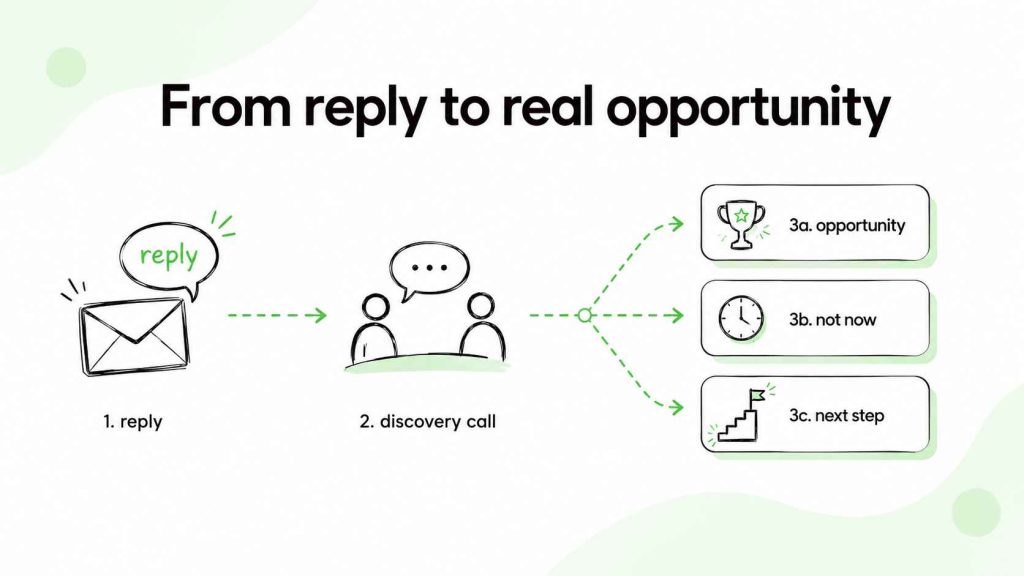
A discovery call is where a promising reply either becomes a real sales opportunity or stays what it was: polite interest.
That is why good sales discovery is not about running through a fixed script or proving how well you know your product. It is about asking questions to uncover what is happening in the prospect’s world, what is not working and whether there is a reason to continue.
The best discovery call questions help a sales rep understand the problem before they offer a solution. They also make the prospect feel heard. That matters in outbound, where the first conversation started because you earned attention, not because the buyer came looking.
Every discovery call should leave both sides clearer about one thing: what needs to happen next.
A relevant cold email intro can open the door. The sales discovery call tells you whether it is worth walking through it.
Why discovery calls are important in B2B sales
Discovery calls are important because a booked meeting does not tell you much on its own.
A prospect may be curious. They may be comparing options for later. They may have a real pain point but no authority to act. They may have replied because the timing was good, not because they are ready to buy.
Sales discovery helps you separate those situations.
In B2B sales, this is the step in the sales process where you begin to understand the current solution, the underlying problem, the decision-making process and the sales cycle around it. It is also where a rep can uncover whether a conversation has enough substance to become a sales opportunity.
That is why discovery calls are important for more than qualification. They help sales teams avoid wasting time on generic demos and help prospects avoid sitting through a pitch that does not match their actual needs.
The objectives for the call should be simple: understand the current state, identify the pressure behind a possible change and agree on a sensible next step. Not every call needs to create a deal. Some should lead to another call. Some should lead to a future follow-up. Some should lead to a respectful “not now”.
For a stronger view of what makes a lead worth pursuing, see how to qualify new sales leads and how to manage a sales pipeline.
How to run a discovery call after a prospect replies
To run a discovery call well, start with the reason the prospect agreed to speak.
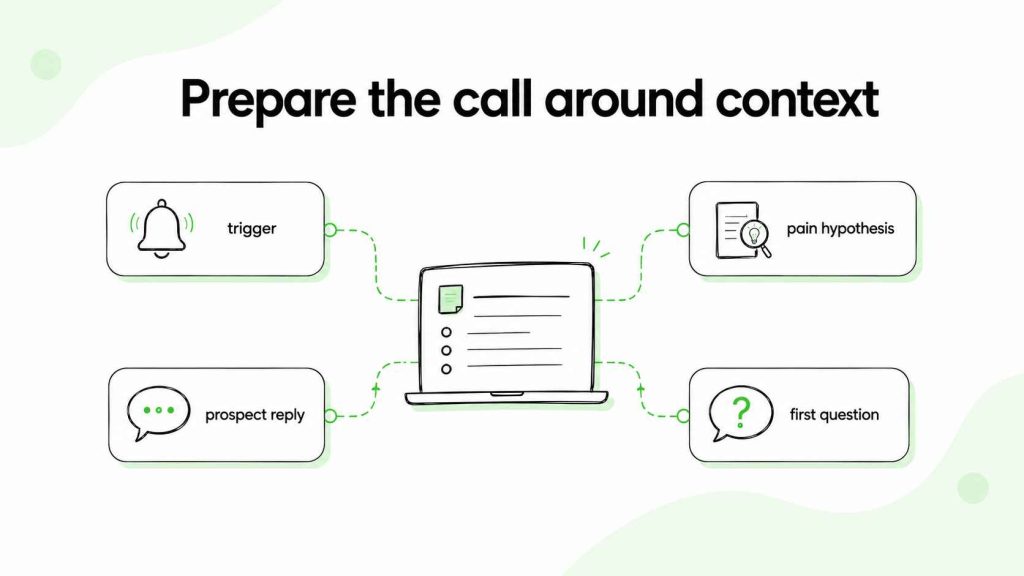
Go back to the original outreach. Look at the trigger you used, the pain hypothesis you raised and the words the prospect used in their reply. That context should shape the first few minutes.
A Head of Sales who says, “We want to improve outbound consistency,” needs a different discovery call from a founder who says, “We need more qualified meetings.” Treating both as the same conversation makes it harder to ask the right questions.
What a sales rep should prepare before the first call
A sales rep does not need a huge research document. They need enough context to avoid asking questions that Google could answer.
Look at the account’s target market, sales team structure, visible growth signals and recent activity. Review the prospect’s role. Check the ideal customer profile that brought them into your outreach in the first place. Then revisit your prospect research and decide what you want to test.
You should have a short working theory, not a conclusion.
For example: “They are hiring SDRs, so they may be trying to standardise outbound before new reps start.” That gives you a good opening. It does not give you permission to assume they have a ramp-time problem.
The best questions are the ones that make it easy for the prospect to correct, expand or sharpen your theory.
Sales discovery questions for the prospect’s current state
The first part of a discovery call should give the prospect room to describe what they do now.
A useful opening can sound like this:
In your reply, you mentioned that the sales team wants more consistency. What does the current process look like today?
That is better than asking, “Do you have a problem with consistency?” The first question invites a story. The second one invites a yes or no.
A prospect may say that each rep builds their own campaigns, uses different data sources and handles follow-ups in separate inboxes. Do not jump to your product pitch. Stay with their answer.
You might ask, “Where does that create the biggest issue for the team?” or “What part of the process takes the most manual effort?”
These discovery questions to ask are not there to collect facts for your CRM. They help you understand the prospect’s working reality.
This is where asking open-ended questions matters. The prospect should have enough room to explain the issue in their own language. Woodpecker’s guide to open-ended questions in sales emails is useful here too, because the same rule applies on calls: one thoughtful question is better than a list of questions every sales rep asks by habit.
Discovery call questions that uncover a pain point
Once you know the current state, the next job is to uncover why it matters.
A process can be messy without being urgent. A prospect may dislike a workflow but have no business reason to change it. Your discovery call questions should help distinguish inconvenience from a pain point with consequences.
Picture this scenario.
The prospect says: “Our new SDRs take a while to get campaigns live.”
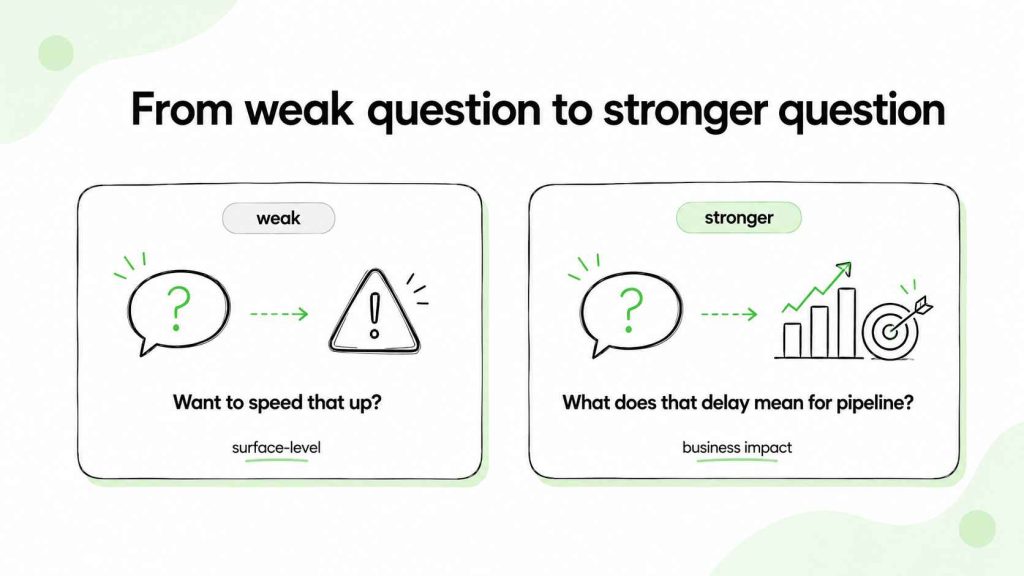
A weak follow-up would be: “Would you like to speed that up?”
A stronger question is: “What does that delay mean for your pipeline targets this quarter?”
Now you are moving from an operational frustration to business impact.
Other questions that help in this part of the sales discovery process include: “Who feels the impact most when that happens?”, “What tends to break when the team grows?” and “What happens if the process stays the same for another six months?”
These are probing questions, but they should not feel like interrogation. The point is not to force urgency. It is to understand whether urgency already exists.
A great discovery call lets the prospect make the case for change in their own words.
That is also why questions that lead are risky. “So you need a better tool, right?” points them towards your answer before they have fully described the problem. Questions that can be answered with a simple “yes” are useful later, when you need to confirm a detail. Early on, they often close the conversation too quickly.
Sales discovery calls: mapping impact, stakeholders and timing
After you understand the pain point, use the discovery call to identify what surrounds it.
This is where many sales professionals rush into budget questions or jump to a demo. Both moves can feel premature.
Instead, ask questions that help you map how the buyer thinks about the issue.
You could say:
When you look at fixing this, what would a better outcome actually look like for the team?
Or:
Who else tends to care when a process like this affects ramp time or reporting?
Or:
Is this something you are trying to solve before a specific deadline, or is it a longer-term improvement?
The answers help you understand the decision-making process without turning the call into a form.
They also help you tailor your sales follow-up. A prospect focused on reporting needs a different next step from one focused on lead quality. A buyer who needs RevOps involved needs a different next call from one who can decide alone.
This is where the MEDDPICC sales methodology becomes useful. The discovery call may not give you every answer, but it can surface the Metrics, Identify Pain and Decision Process signals you need for a healthier sales pipeline.
For more on running a broader sales engagement process, connect each call to a clear stage and a clear next action.
A scenario: how to run a discovery call without turning it into a pitch
Imagine a prospect replies to your cold email after you mention that their company is expanding its SDR team.
They write:
We are growing, but the current outbound setup is hard to manage. Happy to have a quick chat.
You begin the first call like this:
Thanks for making time. You mentioned the setup is hard to manage as the team grows. Before I show you anything, could you walk me through what that looks like today?
The prospect explains that every SDR builds their own sequence, follow-up quality varies and managers struggle to compare results.
You ask:
Where does that create the most friction: getting campaigns live, keeping messaging consistent or understanding what is working?
They say the biggest problem is ramp time. New reps take two weeks to build a usable workflow.
You follow with:
What does that mean for the sales leaders trying to hit pipeline targets this quarter?
Now you have a clearer business problem.
Only then do you ask:
When you decide to improve a process like this, who else needs to be involved?
That is a much better path than opening with a dashboard walkthrough.
The prospect has told you what matters. You can tailor your sales pitch around their actual situation instead of guessing. You also know that the next call should probably include the person responsible for process design or reporting.
This is what makes a different discovery call feel useful. The structure stays familiar, but the questions change based on the prospect, their role and their unique sales environment.
Sales discovery questions for pain, impact and buying context
You do not need a massive question bank. You need a few important discovery questions that you can use naturally.
- For the current state, you might ask: “How are you handling that today?” or “What has the team tried so far?”
- For pain, you might ask: “Where does the process break down most often?” or “What has this stopped the team from doing?”
- For impact, you might ask: “How does that affect the wider sales funnel?” or “What would improve if the issue disappeared?”
- For buying context, you might ask: “Who else needs to be comfortable with a change?” or “What would need to happen before a next call makes sense?”
These questions for sales work because they build on one another. You are not trying to use every question from a list of open-ended questions. You are listening for the answer that gives you the most useful next question.
That is the skill new to sales reps often miss. They prepare standardised questions, then try to get through them. More experienced reps ask fewer questions, follow the prospect’s language and know when to pause.
Discovery call questions for a sales rep who needs to qualify, not convince
There is a difference between qualification questions and disqualifying questions.
Qualification questions help you understand whether the problem, timing and buying context are real.
Disqualifying questions help you recognise when there is no workable next step.
For example, “What happens if you leave the current process as it is?” can reveal urgency. “Is there an initiative or budget attached to solving this?” can reveal whether the topic is active or simply interesting.
Do not use these questions to corner the prospect. Use them to protect both sides from a pointless sales cycle.
A good discovery call may end with, “It sounds like this is not a priority until Q4. Would it be more useful for me to send a short summary now and reconnect closer to that point?”
That is better than pushing for another call when no one has a reason to take it.
It also makes future follow-up easier. Use guidance on responding to an interested reply when a prospect is open but not ready, and handling negative replies when it is clear that the fit is not there.
Discovery call template: from answers to a useful next call
A discovery call template should support the conversation, not control it.
Start by setting the frame. Explain why you are speaking and what you hope to understand. Then spend most of the call on the prospect’s current state, pain point and priorities. Save your product explanation for the moment when it can connect to a real need.
Near the end, call to review what you heard.
You could say:
Let me check I have this right. New SDRs take too long to get live, managers cannot compare outreach performance and you want to sort that before the next hiring group starts. Is that accurate?
Then use this call to agree on the next one:
It sounds like the next conversation should focus on standardising campaign setup and reporting. Would it make sense to bring your RevOps lead into that discussion?
This is a better discovery call script than a rigid set of questions because it gives the prospect a chance to correct your understanding.
It also creates a useful follow-up call. The prospect knows why they are coming. You know who should attend. The sales team knows what they need to prepare.
For follow-up language, see sales follow-up email examples and cold email CTA ideas.
Discovery call tips for different sales cycles
Not every discovery call needs the same depth.
In a short sales cycle, the prospect may already know the problem and simply need to confirm fit. You can ask fewer questions and move towards a practical next step faster.
In a longer B2B sales cycle, you may need to spend more time on stakeholders, current solution, timing and buying process. You might ask more follow-up questions because the risk of assuming too much is higher.
That is why reps should not treat every sales conversation as identical.
A founder buying a simple tool may want a direct answer. A sales leader changing a team-wide process may need to involve multiple decision-makers. A larger account may need a technical review before any commercial discussion.
Craft questions around the complexity of the decision. Tailor your sales approach around what the prospect needs to decide, not around the product demo you planned to give.
This is also where good prospecting matters. Start with a better-fit account using B2B sales prospecting techniques, sales prospecting tools and this guide on where to find prospects.
Do and don’t when asking these discovery questions
- Do let the prospect finish their answer. A pause does not mean you need to fill the silence with another question.
- Do use the exact words the prospect gives you. If they say “messy”, “slow” or “hard to track”, bring that language into your follow-up.
- Do ask clarifying questions when an answer is vague. “Can you walk me through the last time that happened?” often uncovers more than “Can you tell me more?”
- Do not ask questions usually reserved for later-stage qualification before you understand the basics. Budget and procurement can matter, but they are not always the right opening move.
- Do not create a digital sales room, send a deck or offer a full demo before you understand why the prospect agreed to talk.
- Do not use every question you like to ask. The goal is not a perfect script. The goal is an effective discovery conversation.
How to turn a good discovery call into sales momentum
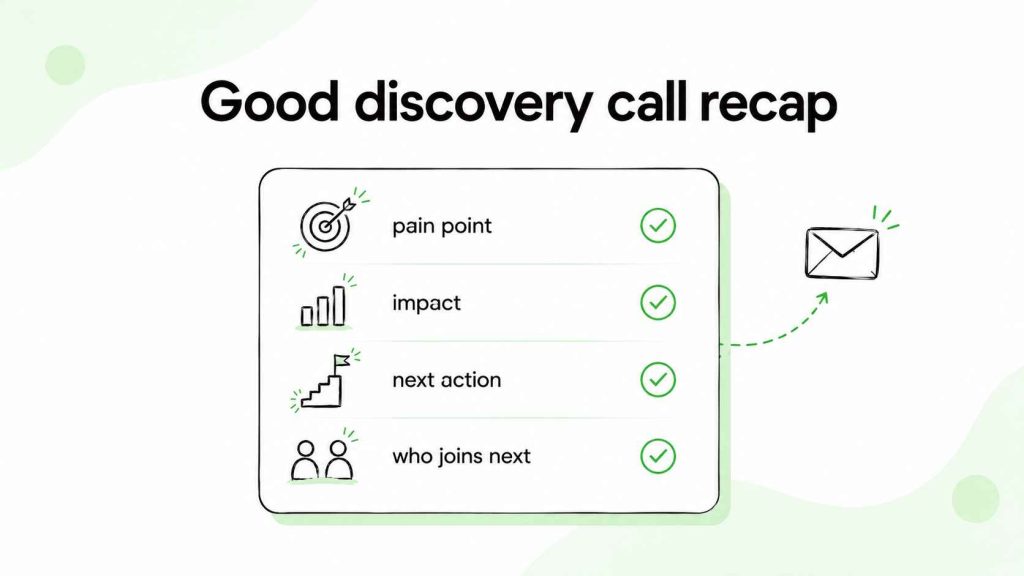
After conducting discovery calls, send a short recap while the conversation is fresh.
Mention the pain point, the impact, the agreed next action and any person who should join the next call. That makes it easier for the prospect to share context internally and easier for the sales team to keep the opportunity honest.
You can also use the discovery call to refine the rest of your outreach. The answers should improve how you talk to similar accounts, what pain hypotheses you test and what value proposition you lead with.
For help with the earlier stages, review cold email templates, how to write a value proposition in cold email, how to build a cold email sequence and how to create a sales sequence.
Woodpecker helps sales teams organise the conversations before and after the call. You can build a more focused outbound pipeline with sales pipeline guidance for outbound leads, keep messages aligned with the cold email guide and connect activity to your CRM through the Pipedrive integration, HubSpot integration or Calendly integration.
FAQ
How many discovery call questions should you ask?
There is no fixed number. Most effective discovery calls need only enough questions to understand the current process, pain point, impact, buying context and next step. Five thoughtful questions can be more useful than twenty generic ones.
What are the best discovery questions?
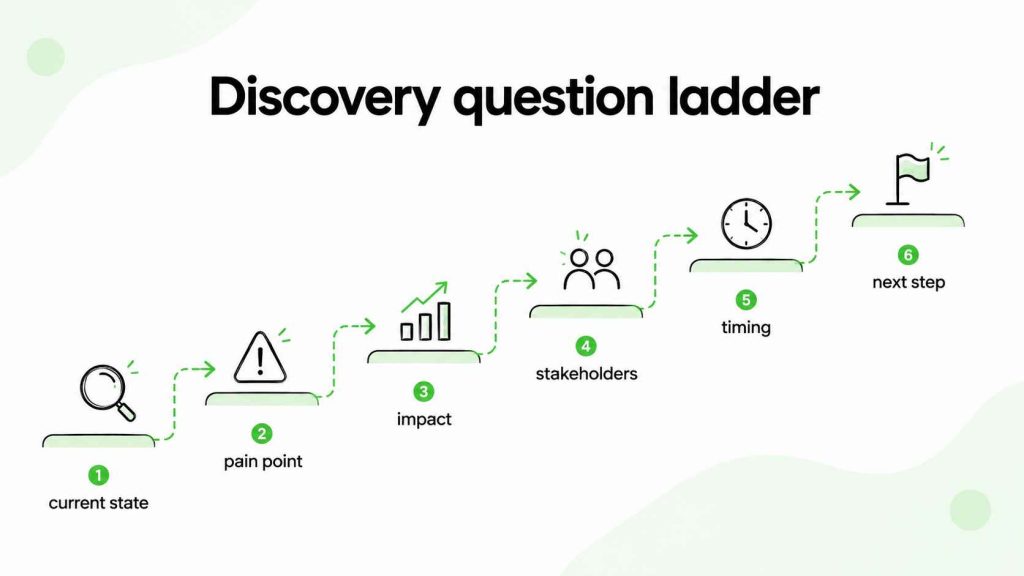
The best discovery questions are relevant to the prospect’s situation. Start with the current state, then explore pain, business impact, stakeholders, timing and the next step. Avoid questions that lead the prospect towards your product too early.
What should a sales rep do after a discovery call?
A sales rep should send a short recap, confirm the agreed next step and update the opportunity with what they learned. The follow-up should reflect the prospect’s own language and make the next conversation feel purposeful.
Use discovery calls to find the conversations worth continuing
A discovery call is not a performance. It is a chance to understand what is true before you decide what to recommend.
Ask the right questions. Listen for the problem behind the first answer. Make room for the prospect to explain the impact. Then agree on a next step that makes sense for both sides.
That is how discovery questions help sales teams qualify better, protect the sales pipeline and close more deals without turning every conversation into the same pitch.