


Account-based prospecting is a targeted B2B sales approach where you focus on a defined group of high-value accounts instead of casting a wide net.
Rather than collecting thousands of contacts and hoping that a small percentage respond, you choose the right accounts first. Then you research them, map the people involved and create outreach that reflects what may matter to that company now.
That makes account-based selling useful when a deal involves multiple stakeholders, a longer sales cycle or a product that needs more context than one generic message can provide.
The aim is not to make prospecting slower. It is to make the work more deliberate. A focused account-based prospecting strategy can help a sales team spend more time on companies with stronger potential ROI and less time chasing weak-fit prospects.
What you’ll learn
- How account-based prospecting differs from traditional prospecting
- How to build a target account list around your ICP
- How to research a high-value account before outreach
- How to align marketing and sales around the same accounts
- How to measure pipeline, account engagement and ROI
A clear B2B sales lead generation process gives you the foundation. Account-based prospecting helps you make the top of that process more focused.
What is account-based prospecting?
Account-based prospecting is a sales prospecting method that starts with the company, not the individual contact.
You identify a target account that fits your ideal customer profile, then decide which stakeholders inside that account matter. From there, you create an outreach workflow based on the account’s likely priorities, current situation and buying process.
This is closely related to account-based marketing, or ABM, but the focus is different.
Account-based marketing often uses content, paid campaigns, events or customer stories to build awareness within selected accounts. Account-based prospecting is more sales-led. It focuses on direct outreach, account research and creating a path into a live sales conversation.
The account-based approach works because most B2B buying decisions are not made by one person. One stakeholder may feel the pain point. Another may own the budget. Someone else may care about security, implementation, CRM reporting or the wider tech stack.
A single generic outreach message rarely works for all of them.
Account-based selling vs traditional prospecting: a different selling model
Account-based selling is a selling model built around a smaller number of right-fit companies rather than a large volume of individual prospects.
Traditional prospecting starts by casting a wide net. A sales rep may pull a broad list of people with a similar job title, run a campaign and hope a percentage of those contacts reply. That can work in a simple, high-volume sales motion.
Account-based prospecting takes a more targeted approach.
The sales team chooses a high-value account, looks at the company at an account level and then decides which people are worth engaging. The goal is not simply to create a reply. It is to build a credible path into the account’s buying process.
This makes account-based sales especially useful when:
- the sales cycle is longer,
- multiple stakeholders influence the decision,
- the potential ROI is high enough to justify deeper research,
- generic outreach would not stand out,
- the account needs a more tailored value proposition.
Traditional sales is not wrong. It can be effective when the product is low-cost, easy to try and sold through a short buying process.
But when the deal is strategic, the account-based model can create better conversations because it starts with a deeper understanding of the company.
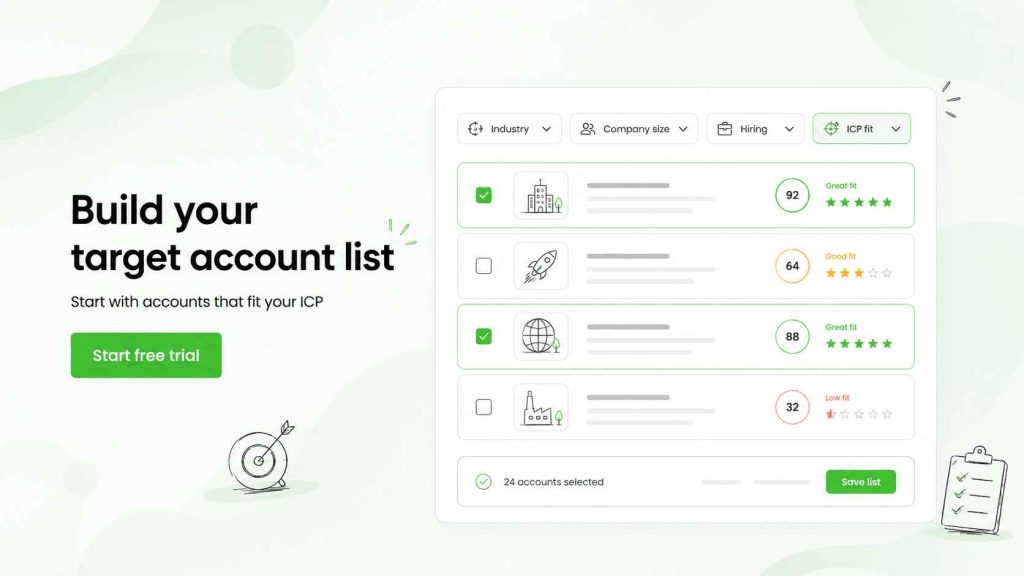
Step 1: Build a target account list for your account-based strategy
A target account list should not be a collection of companies you would simply like to work with.
It should be a focused group of companies with a credible reason to buy from you.
Start with your ideal customer profile. Look at your strongest existing customer relationships and identify the patterns. Consider industry, company size, business model, team structure, growth stage and the type of pain point your product solves best.
Your ideal customer profile gives you the first filter. But effective account-based prospecting needs more than ICP fit.
Look for account intelligence that suggests a company may have a reason to act.
That might include a leadership change, market expansion, a new product launch, recent hiring, a shift in the company’s tech stack or a visible sales-process problem.
Intent data and sales intelligence can help surface those signals. But they should not replace judgement.
“Raised funding” is not enough to build a relevant message.
“Raised funding, hired SDRs and expanded into a new market” may give you a stronger account research angle. You can then ask whether pipeline coverage, rep ramp time or outreach consistency has become a priority.
For more ways to source relevant accounts, use where to find B2B prospects, how to build a B2B email list and how to build an outbound prospect base.
Step 2: Use account research to personalize outreach
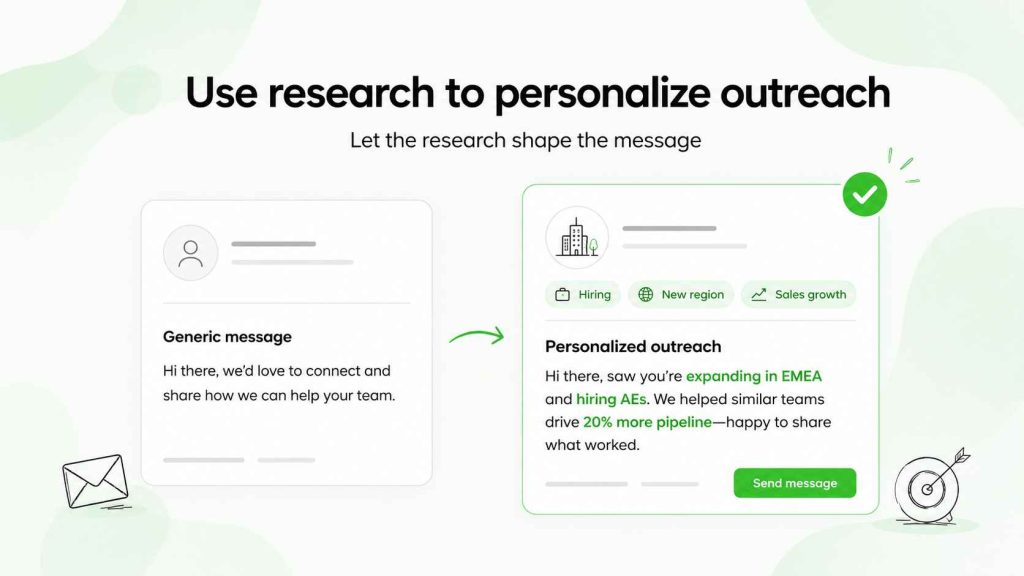
Account research should help you personalize the message, not just mention a recent company update.
The difference between a targeted approach and generic outreach is whether the research changes what you say next.
A relevant message should reflect a possible business challenge, a likely priority or a visible change inside the target account.
For example, imagine you are prospecting a SaaS company that is hiring account executives and SDRs in a new region.
A generic outreach message might say:
We help SaaS companies improve their outbound performance.
An account-based message could say:
Noticed you are growing the sales team while entering a new market. At that stage, teams often find that campaign quality starts to vary across reps. Is standardising outreach already on your radar?
The second message does not pretend to know the buyer’s world perfectly. It gives them a useful hypothesis to confirm, reject or refine.
That is what account-based prospecting is supposed to do.
For more help with writing, see how to write personalised cold emails, how to write a cold email that works and how to create a value proposition in cold email.
Step 3: Align marketing and sales around the same accounts
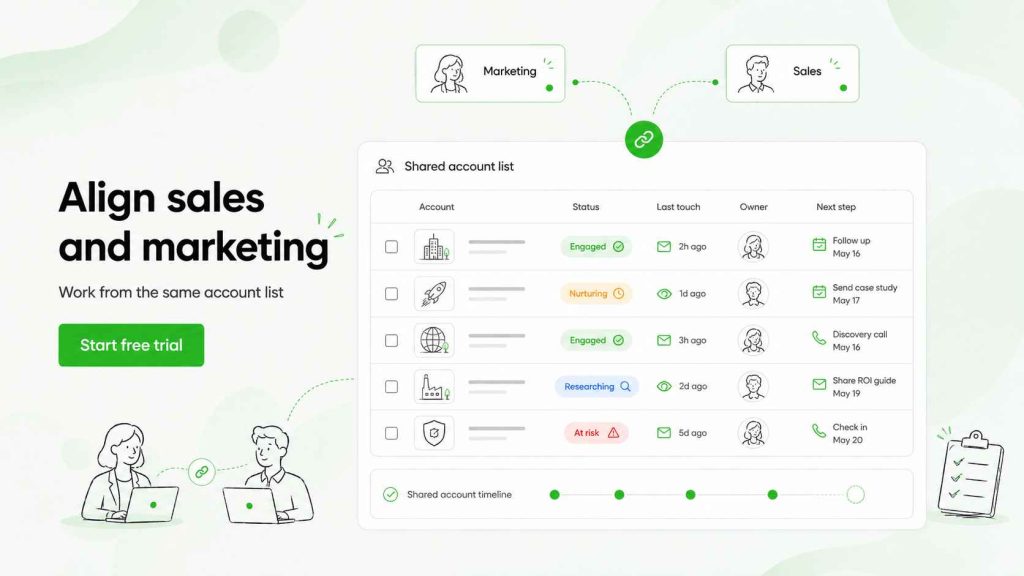
Marketing and sales should work from the same account list.
That is the practical side of alignment. Not more meetings. Not more internal slides. A shared view of which accounts matter, who has been contacted, what message is being tested and what the next action should be.
Account-based marketing may support the account with content, case studies, paid campaigns or event invitations. Sales may use direct outreach and sales calls to start a conversation with the buying committee.
Both can work well together.
But if sales and marketing operate from different data, the account may receive duplicate messages or conflicting positioning.
A CRM should hold the account tier, stakeholder map, outreach activity, notes and next action. That gives the sales team a clearer view of account engagement. It also helps marketing see where support could add value.
Woodpecker supports CRM-connected outreach through integrations including HubSpot and Pipedrive. You can also review Woodpecker’s guide to finding a CRM that works with cold email.
Step 4: Map stakeholders per account before outreach
A target account is not one prospect.
It is a company with multiple stakeholders, each with different priorities.
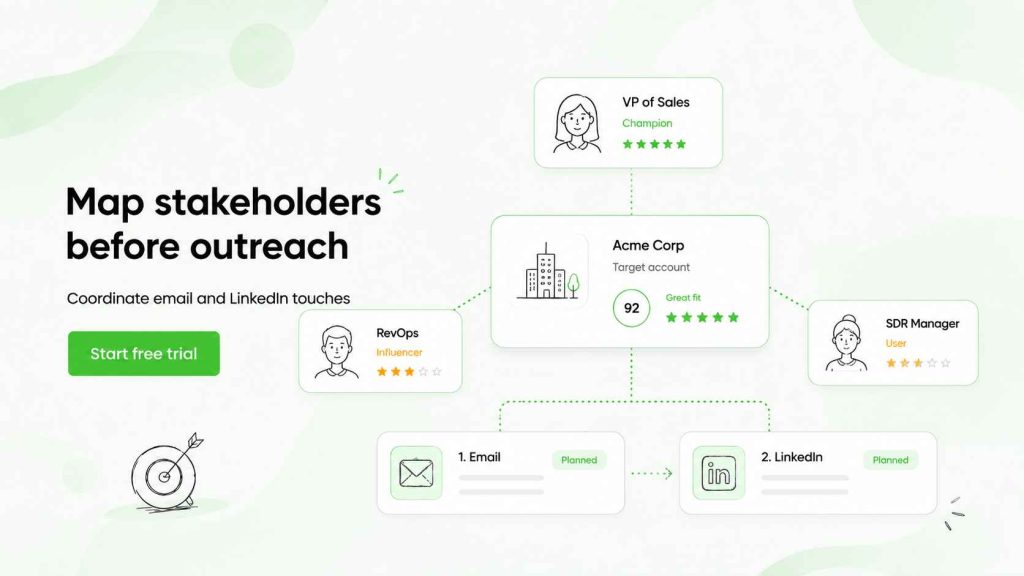
The VP of Sales may care about pipeline visibility, sales cycle length and team productivity. A RevOps leader may care about CRM accuracy, reporting and workflow control. An SDR manager may care about ramp time, message quality and consistency across the team.
Account-based prospecting works when you understand those different perspectives before you coordinate outreach.
Start with three simple questions:
Who feels the pain point?
Who can influence the decision?
Who could slow the process down?
You do not need to contact every stakeholder at the same time.
Start with the person most likely to have context. Learn from their reply. Then expand carefully.
That is how you build account penetration without turning your prospecting motion into noise.
A focused MEDDPICC sales methodology can help once the account starts engaging. It gives the sales team a structure for identifying pain, decision process, economic buyer and champion.
Step 5: Coordinate account-based outreach across email and LinkedIn
A strong account-based workflow should feel connected across channels, not repeated.
You might start with a concise cold email. Then use LinkedIn to add familiarity, follow up after a relevant interaction or reach another stakeholder with a different angle.
The messages should align around one account-level story. They should not be copies.
For example, an SDR manager may receive a message about campaign setup and ramp time. A VP of Sales may receive a message about pipeline consistency and forecast confidence.
That is where sales strategies become more deliberate.
Instead of pushing one campaign through a list, the sales team can coordinate outreach across the buying committee and learn from each response.
A sales call with one stakeholder can reveal what another stakeholder needs to see. A reply from RevOps may change the message sent to the VP of Sales. That is more useful than treating every prospect as an isolated contact.
Woodpecker lets teams combine cold email with LinkedIn actions in one outbound workflow. Use LinkedIn carefully, though. The goal is to support relevant outreach, not to automate a flood of activity.
Read practical LinkedIn outreach tips, LinkedIn automation guidance and how to create a cold email sequence before building the workflow.
Step 6: Keep account activity visible in the CRM
Account-based prospecting becomes messy when account research, outreach activity and sales notes live in separate tools.
Your CRM should show the target account, stakeholders, account tier, active outreach, replies, meetings and next step.
That gives the sales team one place to review progress. It also makes account planning easier.
A useful CRM view can answer questions such as:
- Which stakeholders have we reached?
- What message did each person receive?
- Which pain point has been confirmed?
- Who should join the next sales call?
- What is the next action for this account?
This is where account-based sales differs from a broad outbound campaign. You are not just tracking open rates or sends. You are tracking how an account moves through the sales process.
You can also use the HubSpot integration or Pipedrive integration to reduce manual work when outreach and CRM activity need to stay connected.
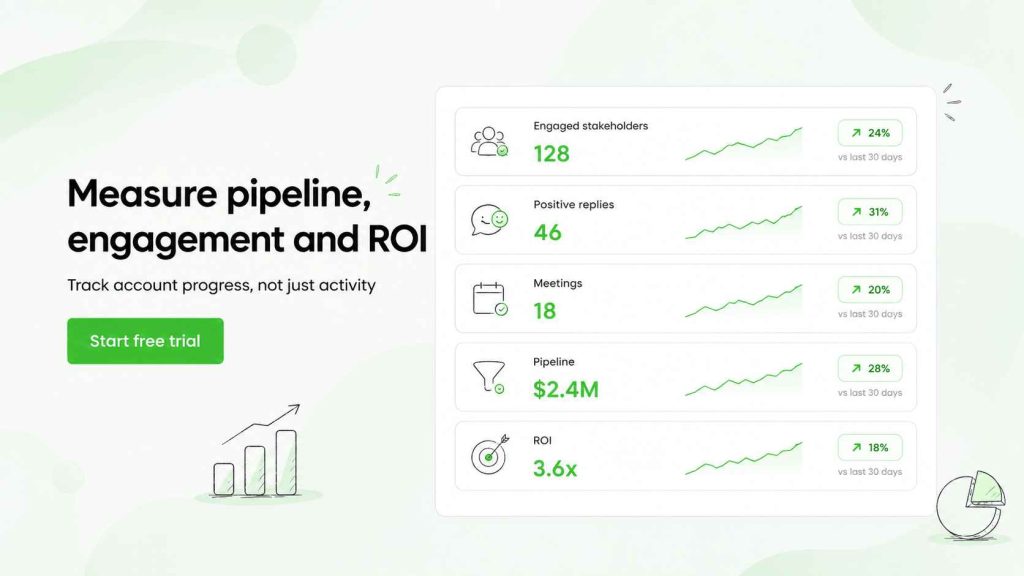
Step 7: Measure pipeline, account engagement and ROI
A useful metric for account-based prospecting should tell you whether the account is moving closer to a real opportunity.
Open rates are not enough.
They may show that a subject line worked. They do not show whether you reached the right stakeholders, built relevance or created a path through the buying process.
A better account-based scorecard looks at:
- engaged stakeholders per account,
- positive replies,
- meetings booked,
- pipeline per account,
- conversion rate from target account to opportunity,
- sales cycle length,
- revenue and ROI from the account list.
You can also measure account penetration: how many relevant people you have reached inside the company, what they responded to and where the buying committee still has gaps.
The best account-based prospecting is not always the fastest route to meetings. It may create fewer conversations than traditional prospecting, but better conversations with companies that are more likely to become customers.
Review those outcomes alongside your broader outbound sales pipeline and sales engagement process.
A modern account-based prospecting workflow in practice
Imagine a sales team selling a platform to B2B SaaS companies with 50 to 250 employees.
They identify one target account: a growing SaaS company that has recently hired a VP of Sales, opened several SDR roles and expanded into a new region.
The team scores it as a Tier 1 account because it fits the ICP, shows buying signals and could become a high-value account.
They map three stakeholders: the VP of Sales, the RevOps leader and the SDR manager.
The SDR manager receives a message about ramp time and campaign consistency. The RevOps lead receives an angle around reporting and workflow control. The VP of Sales receives a broader message about pipeline predictability and team productivity.
One prospect replies that the main issue is getting new SDRs productive without losing control of deliverability.
That changes the account plan.
The sales team now knows which pain point to explore. They can use discovery call questions to understand impact, decision-making process and timing. They can use a sales follow-up email to summarise the discussion and bring another stakeholder into the next call.
This is what modern account-based prospecting looks like.
You do not force one message through a company. You create a more informed prospecting workflow around the account.
How to implement account-based prospecting without slowing the sales team down
To implement account-based prospecting, do not rebuild your entire sales process at once.
Start with a small group of accounts that clearly fit your ICP and have a good reason to matter.
Choose a manageable number. Define the account selection criteria. Decide what research is worth doing. Map the first stakeholders. Then create a light workflow for outreach, follow-up and CRM updates.
The goal is to make the account-based strategy repeatable.
A successful account-based approach should not depend on one account executive spending hours on every prospect. Some accounts deserve deeper research. Others need a lighter version of the same process.
The best account-based prospecting strategy gives sales reps enough context to create relevant outreach without turning every contact into a custom research project.
For support on the earlier parts of the workflow, see B2B sales prospecting techniques, sales prospecting tools and how to make prospecting more productive with Google Sheets.
When account-based prospecting works better than other prospecting methods
Account-based prospecting works best when the account matters enough to justify a more focused approach.
It is a strong fit for complex B2B sales, strategic accounts and deals that involve multiple decision-makers. It can also work well when you want to expand an existing customer relationship into another team, region or use case.
Traditional prospecting may be more efficient when the product is low-cost, easy to try and sold through a short sales cycle.
The question is not whether account-based is always better.
The question is whether the potential value of the account makes a focused selling model worthwhile.
A good account-based strategy should help the sales team prioritize the right accounts, tailor the message and build stronger customer relationships. It should not make prospecting unnecessarily complicated.
FAQ
What is the difference between ABM and account-based prospecting?
ABM, or account-based marketing, is usually marketing-led and focuses on engaging selected accounts through campaigns, content, events or paid activity. Account-based prospecting is sales-led. It focuses on target account selection, stakeholder mapping and direct outreach that starts sales conversations.
How many target accounts should a sales rep work?
It depends on deal size, account complexity and available research time. A rep working a small set of Tier 1 accounts may need deeper account research and more tailored outreach. A rep targeting mid-market accounts may work a broader list with lighter personalization.
Is account-based prospecting only for enterprise sales?
No. It can work for mid-market B2B sales too. The key is whether a focused, account-level approach creates more value than broad outreach. If the deal has strong potential ROI or involves multiple stakeholders, account-based prospecting can be useful.
Build an account-based prospecting strategy around the right accounts
Successful account-based prospecting is not about making outreach more complicated.
It is about choosing the right accounts, understanding the people inside them and creating messages that give each prospect a reason to engage.
Start with a focused target account list. Use account research to form a useful hypothesis. Align marketing and sales. Coordinate outreach across channels. Then measure pipeline, account engagement and ROI instead of just activity.
Woodpecker helps sales teams find B2B leads, verify contact data, run personalized cold email campaigns and add LinkedIn touches without losing sight of the wider workflow. Explore Lead Finder, learn how email verification works, review cold email reply-rate guidance and build a stronger sales prospecting process.