


“Please find attached” is one of the most familiar phrases in business email.
It is correct. It is polite. It is not a major writing mistake.
Still, it can sound stiff when the rest of your email is direct and human. It can also leave the recipient wondering what the attachment is, why you sent it and what you would like them to do next.
That is why many people look for a less annoying way to say it.
The answer is not that you should ban the phrase forever. It is that the email should do more than announce that a file exists. It should tell the recipient why the file matters.
There is another issue in cold outreach. An attachment may create friction for a prospect who does not know you yet. In that context, the best alternative may not be a different phrase at all. It may be a short message and one relevant link.
What you’ll learn
- When “please find attached” is correct
- Alternative ways to reference an attachment without sounding overly formal
- How to write an email with an attachment that makes the next step clear
- When to use “please find enclosed”
- Why attachments can be risky in cold outreach
For broader email structure guidance, see how to write a professional business email, the proper email format and the perfect business email structure.
Is “please find attached” a correct phrase?
Yes. “Please find attached” is a correct phrase.
It is a formal way to tell someone that a document, report or other file is included with the message. You may also see versions such as “please find the attached document”, “please see attached” or “find the attached file”.
The issue is not grammar. It is clarity.
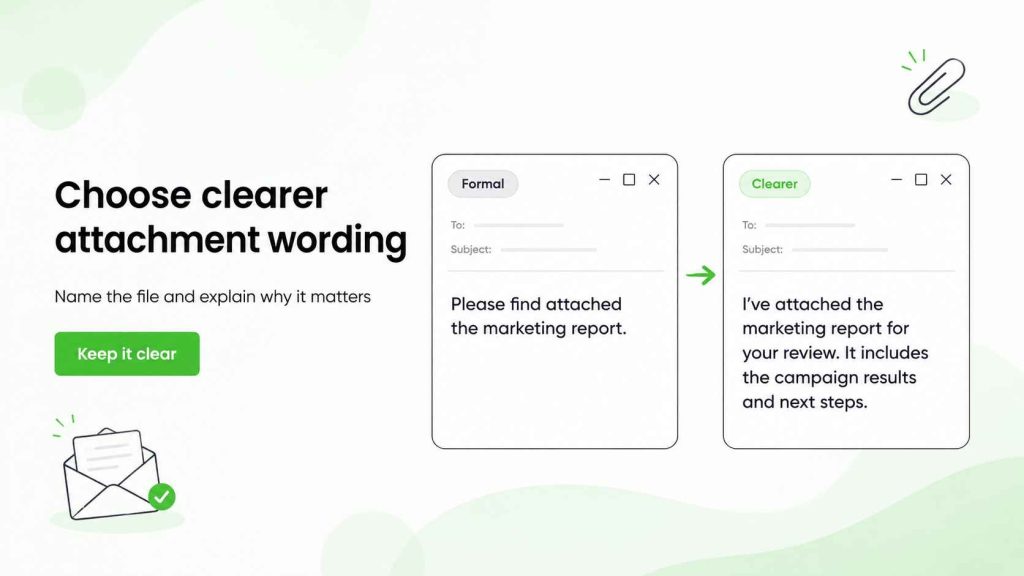
When you use this phrase on its own, the reader may need to look for the attachment before they understand why you are sending it. Compare these two examples:
Please find attached the marketing report.
I’ve attached the marketing report for your review. It includes the campaign results and recommended next steps.
The second version is easier to process because it names the attached file and explains the point.
That is a good rule for effective emails. Do not only tell the recipient that something is attached. Tell them what it is, why it matters and what action you would like them to take.
For example, “Please find attached” may be fine when you are sending formal paperwork. It is less useful when you are sending an update to a colleague who just needs the key information quickly.
20 less annoying synonyms and alternative ways to say “please find attached”
There are plenty of alternatives to “please find attached”. The best one depends on formality, the type of file and whether the recipient needs to act.
Here are 20 less annoying synonyms and alternatives, grouped by the job they need to do.
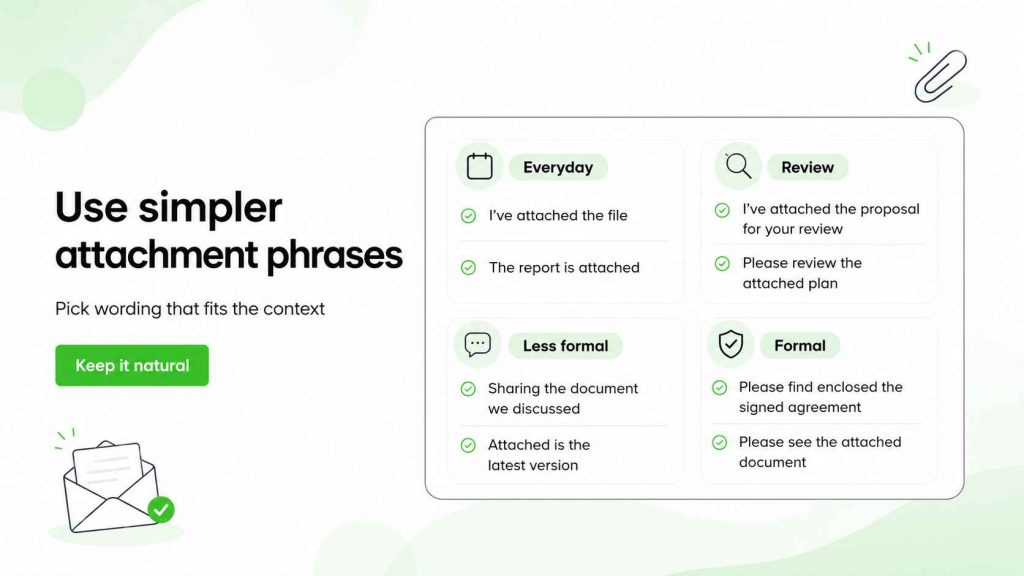
A simple phrase for everyday business communication
These are useful when you are sending an email to a colleague, client or contact you already know.
| Situation | Better phrase |
|---|---|
| General file | I’ve attached the file. |
| One document | I’ve attached the document. |
| Report | The report is attached. |
| Latest version | I’ve attached the latest version. |
| Reference material | I’ve included the file for reference. |
“I’ve attached” is usually the simplest option. It is direct and does not add unnecessary formality.
For instance:
I’ve attached the marketing report for your review.
Or:
You’ll find the budget attached to this email.
Both are clearer than “please find attached” because they name what the recipient should expect.
A way to say that review or feedback is needed
Use these phrases when you want the recipient to take action.
| Situation | Better phrase |
|---|---|
| Proposal feedback | I’ve attached the proposal for your review. |
| Approval needed | Please review the attached plan and confirm whether it works. |
| Comments requested | I’d appreciate your thoughts on the attached document. |
| Formal review | Please see the attached report for your review. |
| Specific request | Could you look at the attached file and let me know your thoughts? |
“Please review the attached” can work, but it is stronger when you say what the recipient should review.
Instead of:
Please review the attached.
Try:
Please review the attached marketing plan and let me know whether the proposed timeline works for your team.
That makes it easier for the recipient to take action.
Less formal phrases when you know the recipient
These phrases help the message feel more natural.
| Situation | Better phrase |
|---|---|
| Sharing an overview | I’ve included a quick overview here. |
| Following up | Sharing the document we discussed. |
| Sending a presentation | I’m sending over the presentation now. |
| Project update | The attached file includes the latest timeline. |
| Quick handover | Attached is the latest version. |
Phrases like “I’ve attached” work well because they get to the point. They also fit more easily into a conversational email.
For example:
Sharing the attached marketing plan ahead of Friday’s meeting. The document covers the timeline, budget and key milestones.
Formal alternatives when the context calls for it
There are times when more formal language is appropriate.
| Situation | Better phrase |
|---|---|
| Signed paperwork | Please find enclosed the signed agreement. |
| Requested documents | I have attached the requested materials. |
| Formal report | Please find the attached report for your consideration. |
| Administrative request | Please see the attached document for further details. |
| Contract or invoice | Please find the attached file relating to your request. |
The phrase “please find enclosed” is more traditional than “please find attached”. It still works in formal business communication, particularly for contracts, compliance documents or administrative requests.
The key is to match the phrase to the tone. “Please find enclosed” can sound natural in a formal email to a legal team. It may feel strange in a quick message to a colleague.
When to enclose a file: “please find enclosed” and other formal phrases
To enclose something traditionally meant putting it inside a physical letter or package.
That is why “please find enclosed” often appears in older business communication and formal correspondence. It is still understandable in email, but it carries more formality than most everyday messages need.
You might use it when the attached document is important enough to warrant a formal tone:
Please find enclosed the signed agreement and supporting paperwork.
Or:
Please find the attached document relating to your request.
You do not need to use “please find enclosed” just because you attach a file.
Think of it like a dress code. The phrase is useful for a formal context. It is unnecessary for a routine update.
If you are writing a normal business email, “I have attached the requested file” or “You’ll find the requested documents attached” is often easier to read.
For more help with email tone, see email greetings for every situation, how to introduce yourself in an email and how to end an email professionally.
How to write an email with an attachment and help the recipient find the attachment
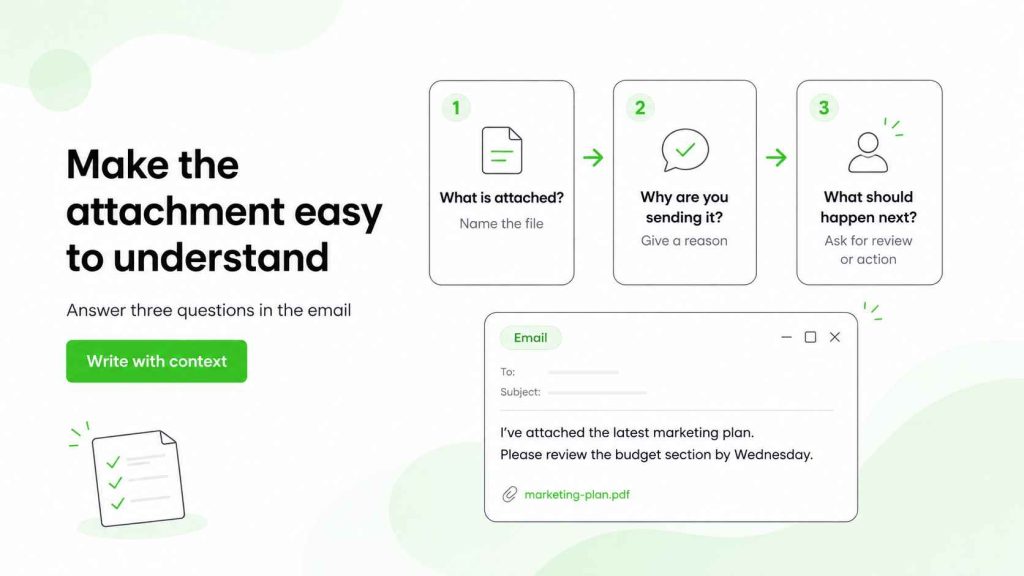
A good email with an attachment should answer three questions quickly:
What is attached?
Why are you sending it?
What would you like the recipient to do next?
That is more useful than using “please find attached” as a standalone line.
Think of the email as a short introduction to the file.
For example:
Hi Maya,
I’ve attached the latest marketing plan. Page two outlines the campaign priorities, while page four includes the revised budget.
Please review the budget section and let me know your thoughts by Wednesday.
Best,
Alex
The recipient knows what the attachment is, where to look and what action is needed.
The file name matters too. “Q2 marketing plan” is easier to find than “final_v7_new.pdf”.
If you are sending multiple files, tell the reader exactly what you have included:
I’ve attached the meeting notes, the updated timeline and the revised proposal. The timeline includes the key milestones we agreed on.
That prevents the recipient from having to look for the attachment or guess which file matters most.
You can also write:
You’ll find the budget attached to this email.
I’ve included the proposal as an attachment for more information.
The attached document outlines the next step.
I attached a document with the final recommendations.
The file attached to this email includes the full breakdown.
Please see the attached file and let me know your thoughts.
These phrases are all better than a vague “please find” or “attached” on its own.
Phrases like “please find attached”: what to avoid
Some phrases are grammatically correct but too vague to help the recipient.
For example:
Please.
Attached.
Please find.
Find attached.
These do not explain the main message. They also make the email feel incomplete.
The same applies when you write “document attached” without context. The reader still does not know why the document matters.
A better phrase when sending a file should connect the attachment to the email’s purpose.
Instead of:
Attached marketing plan.
Try:
I’ve attached the marketing plan so you can review the proposed budget before Thursday’s meeting.
Instead of:
Please find attached my CV.
Try:
I’ve attached my CV and portfolio for the sales manager position.
Instead of:
Please find the attached.
Try:
Please find the attached report for your review. It includes the latest campaign results.
The goal is not to make every sentence longer. It is to make the message useful.
When “please find attached” is actually fine
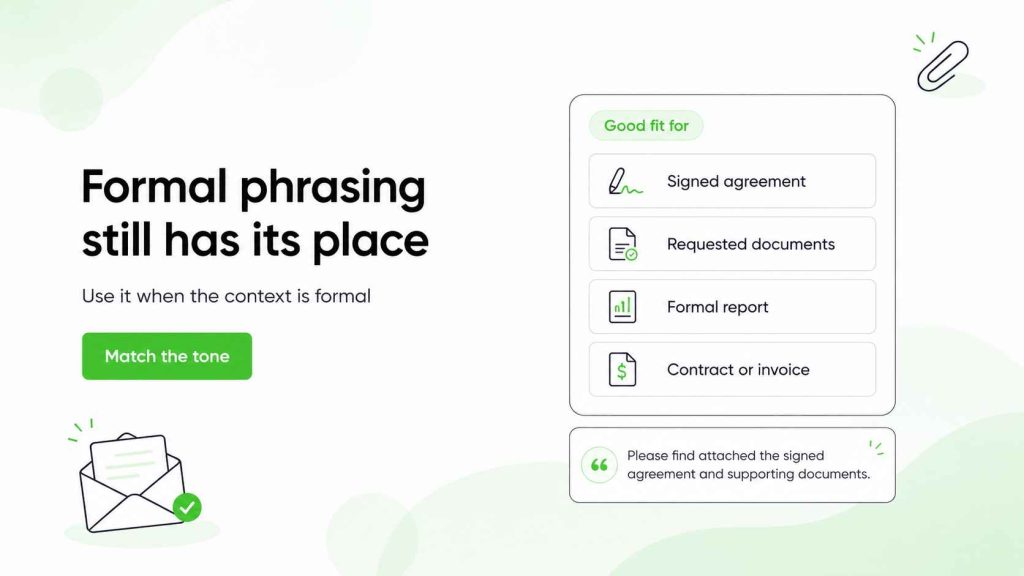
You can use this phrase when the tone is formal and the attachment is the main purpose of the message.
For example:
Dear Ms Patel,
Please find attached the signed agreement and supporting documents requested in your previous email.
Kind regards,
[Name]
This works because the attached file has clear legal or administrative importance.
It can also fit when you are:
- sending a formal proposal,
- providing a report for your review,
- submitting documentation,
- sharing multiple files after a request,
- attaching a contract, invoice or compliance document.
The phrase becomes weaker when it is filler.
For instance:
Hi John,
Please find attached.
Best,
Sarah
This tells John almost nothing.
A clearer version would be:
Hi John,
I’ve attached the updated marketing report. The attached report includes the revised paid-search budget and the key changes for next month.
Let me know your thoughts before Thursday.
Best,
Sarah
That is still professional, but it gives the recipient a reason to open the file.
How to reference an attachment in cold outreach
In cold outreach, attachments create a different problem.
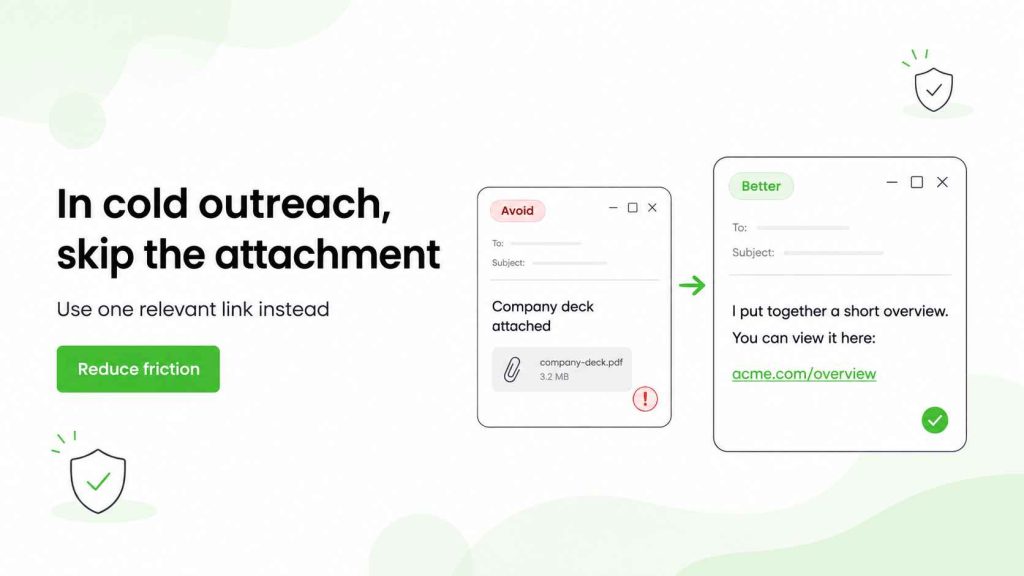
The prospect does not know you yet. An attached file can look suspicious, even when the email itself is relevant. That means “please find attached” is rarely the best phrase when you are contacting a new prospect.
Emails with attachments may also create deliverability concerns. In cold outreach, sender reputation, message format and recipient trust all matter.
Rather than sending an attachment, consider sharing one relevant link.
Instead of:
Please find attached our company deck.
Try:
I put together a short overview of how teams use this workflow. You can view it here: [link].
Or:
You mentioned ramp time as a challenge. I wrote up a one-page example that may be useful: [link].
This gives the prospect more control. They can decide whether to open the resource.
A link is not automatically risk-free, though. Do not overload the email with several URLs, images and tracking elements. Keep the message focused.
Woodpecker recommends avoiding attachments in cold-email campaigns because they can negatively affect deliverability and sender reputation. Read more about attachments in cold email, links and formatting in cold email, how to track links safely and how to reduce spam score.
Examples: alternative ways to reference an attached file
Sending a proposal after a sales call
Hi Sam,
I’ve attached the proposal based on our conversation yesterday. It includes the rollout plan, expected timeline and pricing options.
Please let me know if you would like us to walk through any part of it together.
Best,
Leah
This works because it tells the reader why you are sending the proposal and what they can do next.
Sharing a marketing report with a client
Hi Nina,
The attached report covers this month’s campaign performance and the marketing strategies we recommend for June.
You’ll find the budget breakdown on page three and the next-step recommendations on page five.
Best,
Oliver
This is more useful than “please find attached the marketing report” because it directs the recipient to the relevant parts.
Applying for a sales manager position
Dear Hiring Manager,
I’ve attached my CV and a short portfolio relevant to the sales manager position.
My recent work focused on B2B outreach, sales process design and pipeline reporting.
Thank you for your consideration.
Kind regards,
Jordan Lee
“Find attached my CV” is understandable, but “I’ve attached my CV” usually sounds more natural.
Sending an update with multiple files
Hi team,
I’ve attached the meeting notes, the updated timeline and the latest marketing plan.
The timeline includes the key milestones we agreed on. Please review it at your convenience and let me know if anything needs changing.
Best,
Priya
This helps the recipient find the attachment and understand what they should review.
How to make your emails less awkward
The easiest way to make your emails less awkward is to stop treating the attachment as the entire message.
The attachment is supporting material.
The email should explain why you are sending it, what the recipient should notice and whether they need to respond.
That is a subtle way to communicate more clearly without sounding like you are writing a legal notice.
If you use this phrase, make sure it does not replace useful context. If you say “please find attached”, follow it with a sentence that names the document and explains why it is relevant.
For example:
Please find attached the latest proposal. It reflects the scope we discussed and includes the revised timeline.
That works better than using the phrase on its own.
When you are sending a business email, keep your emails focused on the main message. Use the attachment to support that point, not hide it.
For cold outreach, the message matters even more. A prospect should understand the reason for your email before you expect them to click a link or open a document.
Use cold email templates, how to write a cold email that works, cold email format guidance and how to personalise cold emails to make the message itself strong first.
FAQ
Is it “please find attached” or “please find the attached”?
Both are correct.
“Please find attached” is the more common traditional version. “Please find the attached document” is more specific because it tells the reader what they should look for. In most modern emails, “I’ve attached the document” is clearer.
Is “please find attached” outdated?
Not exactly. It is still widely used in formal business communication.
However, it can sound overly formal in everyday emails. A direct phrase like “I’ve attached the report” often feels more natural.
How do you say “please find attached” formally?
You can say “Please find attached the requested documents”, “Please find enclosed the signed agreement” or “Please see the attached document for further details”.
Choose a formal phrase when the context calls for it. Otherwise, a direct sentence is often more effective.
Keep the attachment secondary to the message
“Please find attached” is not bad English.
It is simply more formal than many emails need to be.
Use it when the tone fits. Replace it when another phrase makes the message clearer. The right wording tells the recipient what the file is, why you are sending it and what action you would like them to take.
For regular business communication, that may mean writing “I’ve attached the report for your review.”
For cold outreach, it often means skipping the attachment altogether and using a concise message with one relevant link.
Woodpecker helps teams create more effective emails, run follow-ups and protect the sending setup behind their outreach. Explore how to avoid the spam folder, SPF and DKIM for email deliverability, how to build a cold email sequence, sales follow-up email examples and cold email best practices.