


The first line of your email sets the tone for everything that follows. Get it wrong and the reader is already half-checked-out before you make your point. Get it right and you’ve already done a third of the persuasion work – before saying a single word about why you’re writing.
This is a reference guide. Use it however it’s useful: scan the categories, copy what fits, and adapt the rest to your voice.
Why your email greeting matters
Most people treat the greeting as a formality. Something to get through. That’s a mistake.
The opening line is the first thing someone reads after deciding to open your email at all – which means it’s the moment you either confirm that decision was worth their time, or make them regret it. In cold emailing, it’s even more loaded. There’s no prior relationship to fall back on. The greeting is doing real work.
Three things a good email greeting accomplishes:
- It signals that you know who you’re writing to. Personalizing beyond just a first name – referencing context, shared ground, or the right level of formality for the relationship – tells the reader you didn’t mass-blast this.
- It sets register. Formal vs. casual isn’t a binary. There’s a spectrum, and landing in the right spot matters. “Dear Mr. Chen” and “Hey Marcus” both work – in completely different situations.
- It affects how your request lands. A warm, appropriately casual opener softens an ask. A crisp, formal one signals that what follows requires focus.
The 4 types of email greetings (and when to use each)
Before the list, a quick map of what you’re actually choosing between.
- Formal – when you’re writing to someone you haven’t met, a senior stakeholder, legal or financial contexts, or any situation where the stakes of getting the tone wrong are high.
- Professional but warm – the default for most business email. You know the person, or the context is collaborative. Polished but not stiff.
- Casual – colleagues, teammates, people you’ve worked with before. The kind of email you’d also send on Slack.
- Cold outreach – its own category. The goal is to feel like neither spam nor an awkward attempt to fake familiarity. More on this below.
Formal email greetings
Use these when the relationship, the stakes, or the context calls for it. Job applications, first contact with executives, legal matters, academic correspondence.
For a named recipient:
- Dear [First Name Last Name],
- Dear Mr./Ms./Dr. [Last Name],
- Dear Professor [Last Name],
- To Whom It May Concern, (only when you genuinely don’t have a name – avoid if you can)
- Good morning/afternoon, [Name], (adds warmth without losing formality)
When you know the title but not the full name:
- Dear Hiring Manager,
- Dear [Department] Team,
- Dear [Company Name] Team,
A note on “Dear”: It reads stiff to some people, standard to others. In legal, academic, or very senior corporate contexts, it’s still the norm. Everywhere else, you can usually skip it.
Professional email greetings
This is the register most business email lives in. Polished enough to be taken seriously, warm enough to not feel robotic.
- Hi [First Name],
- Hello [First Name],
- Hi [First Name] – (the em dash is a small stylistic signal that something direct follows)
- Good morning, [First Name],
- Good afternoon, [First Name],
- Hope your week is going well, [First Name] –
- Thanks for getting back to me, [First Name] –
- Following up on our conversation –
- Great speaking with you earlier –
- It was good to connect at [Event] –
The last three aren’t traditional greetings – they’re context openers that double as greetings. They signal immediately that this isn’t a cold email and give the reader something to orient around.
Casual email greetings
For people you work with regularly, teammates, or anyone where formality would create unnecessary distance.
- Hey [First Name],
- Hey [First Name]!
- Hi there,
- Hey –
- Morning!
- Hope you had a good weekend –
- Quick one –
- Happy [day of week] –
“Happy Monday” and its variants: divisive. Some people love them, some roll their eyes. Know your audience.
Cold email greetings
Cold email greetings have a specific job: they need to feel like a real person wrote them for a real reason – without forcing familiarity that isn’t there yet.
The single biggest mistake in cold outreach openers is fake warmth. “Hope this finds you well” is the canonical example. Everyone knows it means nothing. It’s become the fastest signal that what follows wasn’t written for them specifically.
What actually works:
- Hi [First Name], (simple, direct, nothing to roll your eyes at)
- Hi [First Name] – (that dash again – signals something worth reading follows)
- [First Name], (no greeting at all – abrupt, but sometimes that’s the point)
Context-led openers that replace the greeting:
- I came across your [post/talk/article] on [topic] –
- We share a connection through [mutual person/group] –
- I noticed [Company] recently [did X] –
- Quick question about [specific thing] –
These work because they skip the social noise and lead with something that proves you did actual research. They’re not traditional greetings, but in cold outreach they consistently outperform “Hope you’re doing well”.
What to avoid in cold email greetings:
- “Hope this finds you well” or any variation
- “I know you’re busy, but–” (pre-apologizing is a weak opener)
- “My name is [X] and I work at [Y]” as the first line (nobody cares yet – earn that before you introduce yourself)
- First-name + exclamation point: “Hi Sarah!” (the exclamation reads as either a sales pitch or a scam)
For more on what separates cold emails that get replies from the ones that don’t, the 10 golden rules of cold email is worth the read.
But we can enumerate many other types of email greetings:
Email greetings for groups
Writing to more than one person introduces a specific problem: how do you address people without either going overly formal or accidentally leaving someone out?
Formal group greetings:
- Dear all,
- Dear team,
- Dear [Department Name] team,
- To the [Company] team,
- Good morning, everyone,
Professional group greetings:
- Hi everyone,
- Hi all,
- Hi team,
- Hello everyone,
- Hi [First Name] and [First Name], (for two people – naming both is a small but noticed gesture)
Casual group greetings:
- Hey everyone,
- Hey team,
- Hey all –
What to avoid with groups: “Hi guys” – broadly used, but not universally comfortable. “Dear Sir or Madam” – formally obsolete and comes across as generated. “To all stakeholders” – unless you’re in a legal or compliance context, this reads as corporate filler.
Email greetings by relationship type
Sometimes the situation is the variable, not the formality level.
Reconnecting after a long time:
- It’s been a while – hope you’re well.
- We haven’t connected in [timeframe] –
- Reaching back out after some time –
Writing to someone who referred you:
- [Mutual contact] suggested I reach out –
- [Name] thought we should connect –
Following up on a previous email:
- Following up on my last message –
- Circling back on this –
- Wanted to check in on [topic] –
- Any update on [topic]? –
💡 Tip: For how to handle follow-ups after no responses specifically, this guide will help you.
Writing to someone after a meeting or call:
- Great talking earlier –
- Thanks for the time today –
- Good to connect this morning –
Responding to an inbound:
- Thanks for reaching out –
- Thanks for getting in touch –
- Good to hear from you –
Email greetings to avoid – and why
Some greetings are technically fine but carry baggage worth knowing about.
“To Whom It May Concern” – not wrong, but signals you couldn’t find a name. In cold outreach, that’s a problem. Even “Hi [Company] team” reads better.
“Dear Sir or Madam” – formally extinct. Even in legal contexts, this is being phased out. Use a job title if you don’t have a name.
“I hope this email finds you well” – the most parodied greeting in professional email. It means well but says nothing. Skip it.
“Per my last email” – technically a greeting context sometimes, but universally reads as passive-aggressive. Only use if that’s exactly what you mean.
“Just wanted to” – not a greeting but often appears in the first line: “Just wanted to follow up.” “Just” softens the message in a way that undercuts your credibility. Cut it.
Emojis in the greeting line – context-dependent. In a close team, fine. In business development or any formal context, it shifts register in a way that’s hard to recover from in the same email.
Funny and creative email greetings
These belong in a narrow set of contexts: internal team emails, brands with a deliberately casual voice, or established relationships where humor is already part of the dynamic. Use them knowingly.
- Greetings, human –
- Salutations –
- Ahoy –
- A question, if I may –
- Interrupting your inbox to say –
- Your friendly neighborhood [role] here –
- [First Name], I come bearing [good news/a question/a request] –
If you use these in cold outreach, the hit rate is either unusually high or catastrophically low, with very little in between. Test before you scale.
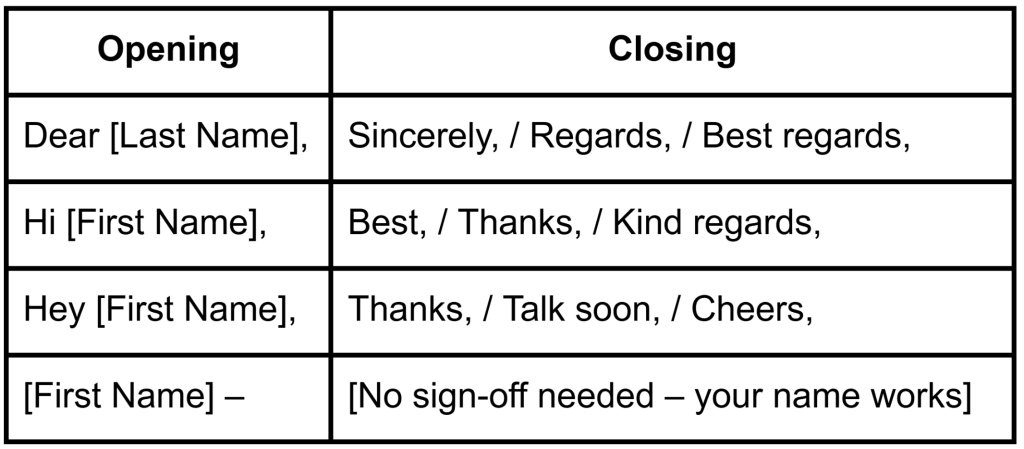
Email greetings & closings should match
A quick note on consistency. The register you set at the top of an email creates an expectation for everything that follows – including how you close it. A “Dear Mr. Smith” opener followed by “Cheers!” at the end creates a small but noticeable dissonance.
Rough matching guide:
Read a complete breakdown which covers how to end a business email.
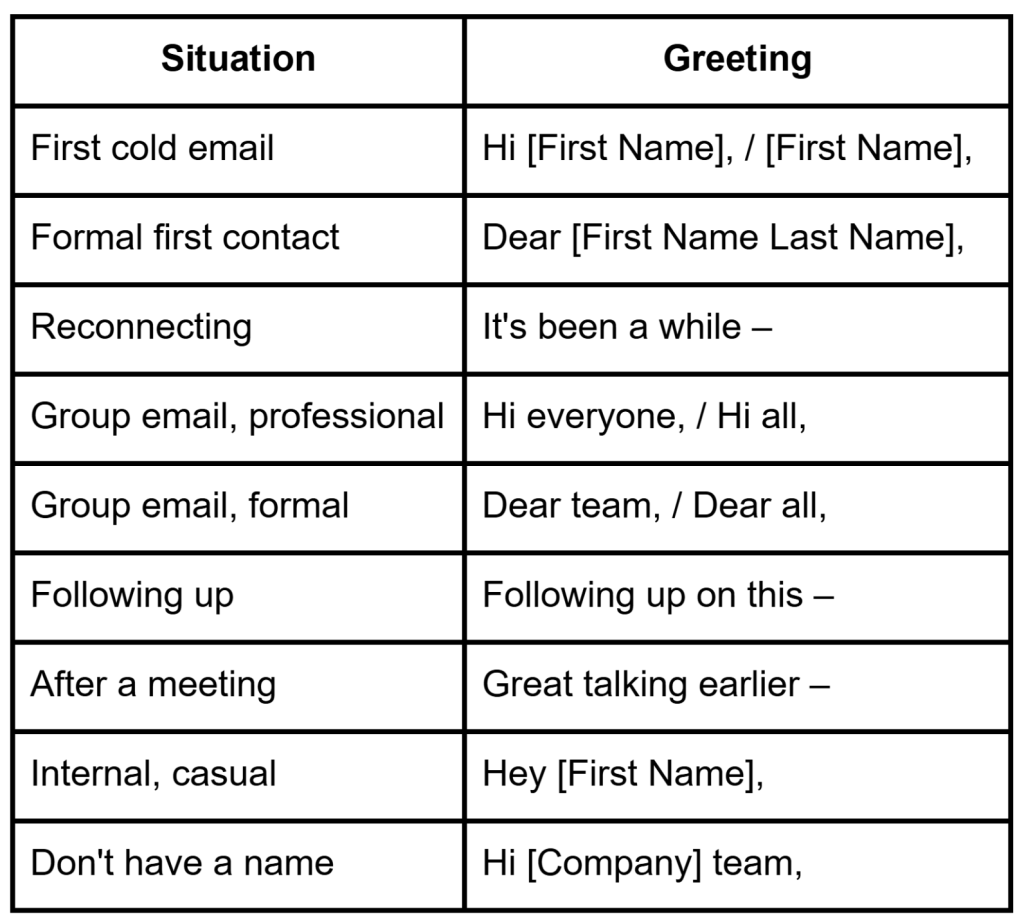
Quick reference: greetings by situation
The one thing that makes any greeting work better
Every greeting on this list is a starting point, not a formula. What makes them land isn’t the specific phrasing – it’s whether what follows is worth the opener.
A perfectly chosen greeting paired with a generic, unfocused email body doesn’t help you. The greeting earns you the next sentence. After that, you’re on your own.
If you’re doing any volume of outreach – cold email, follow-up sequences, sales prospecting – the decisions compound fast. Which greetings to use, how many follow-ups, at what intervals. That’s where a tool like Woodpecker handles the sequencing so the only variable you’re actually managing is whether your writing is good enough.
Sign up here and see how the first campaign runs.
FAQ
How do I start an email greeting?
Start with a greeting that matches your relationship with the recipient and the level of formality. The safest default is:
- “Hi [Name],”
- “Hello [Name],”
If it’s more formal:
- “Dear [Name],”
Good email greetings are simple, direct, and respectful. No need to overthink them.
What are the best email opening lines?
After your email greeting, your first line should quickly set context. Strong options include:
- “I hope you’re doing well.”
- “I’m reaching out regarding…”
- “Following up on our last conversation…”
- “I wanted to connect about…”
They flow naturally into a clear purpose. Also, don’t stall too long with small talk. Everyone want to know what are you here for.
What are 5 ways to greet?
Here are five versatile options you can rotate between:
- Hi [Name],
- Hello [Name],
- Dear [Name],
- Good morning [Name],
- Hey [Name], (only for casual contexts)
In this way, using varied email greetings keeps your communication from feeling repetitive.
How to start a good professional email?
A strong structure looks like this:
- Greeting
- Opening line with context
- Purpose of the email
Example: Hi Sarah,
I hope you’re doing well. I’m reaching out to discuss the timeline for the upcoming project.
Professional email greetings should feel natural but still polished–clarity always matters more than cleverness.