


“How to introduce yourself in an email” sounds like one question. It’s actually at least six. The email you send to a new colleague on day one looks nothing like the email you send to a potential client you’ve never met. The introduction that works for a mutual connection you’ve been referred to falls flat if you use it on a cold prospect. And the way you introduce yourself to a senior executive is a completely different register than how you’d write to a peer.
Most guides on this topic skip the decision tree and jump straight to templates. The result is generic advice that sort-of applies to everything and doesn’t nail anything. This one starts differently: with the single question that determines everything else about your email introduction.
That question is: who are you to the reader, right now, at this moment?
The answer shapes the subject line, the greeting, the first sentence, the level of detail you share, and even the ask at the end. Get the answer right, and the rest of the email almost writes itself. Get it wrong, and no amount of polished language will save you from sounding like you’re emailing the wrong person.
This guide covers: the four relationship types that determine your introduction style, the anatomy of a strong email introduction, nine complete templates for the most common situations (new colleague, new client, cold prospect, mutual connection, returning contact, job application, network follow-up, introducing two other people, and reaching out to a senior executive), the most common mistakes with specific rewrites, and when automation makes sense for high-volume introductions.
The one question that changes everything
Before you write the first word, answer this: from the reader’s perspective, which of these four are you?
- Stranger. They don’t know you, haven’t heard of you, and have no context about why you’re emailing. You’re cold. Your introduction has to establish both who you are and why they should care, in the same email, in under 150 words.
- Connected. You have a shared connection they trust – a mutual contact, a mutual employer, a mutual client, a shared industry event. The connection earns you a warm opening. Your introduction references it early and lets you skip some of the credibility work a stranger would need to do.
- Expected. They know you’re coming. You were introduced by someone, you met briefly at an event, they asked you to email them, or you’re the new hire they were told to expect. The tone here is lighter – you’re confirming what they already half-know, not starting from zero.
- Known. They know who you are but haven’t had direct contact in a while, or are about to change relationship to you (new colleague, new client, new role). The introduction is less about establishing identity and more about resetting context for the current moment.
These four cover roughly every professional email introduction you’ll ever write. The structural difference between them is the first sentence. A stranger gets a “who I am and why I’m reaching out.” A connected contact gets a “via X” reference. An expected contact gets confirmation. A known contact gets context reset.
Figure out which bucket you’re in before you start writing. If you don’t know, the email you write will try to serve all four and will end up doing none of them well.
The anatomy of a strong email introduction
Every email introduction has five working parts. Understanding what each one does helps you write faster and edit harder.
- Subject line. Signals the reason for the email before they open it. The introduction emails that land badly almost always have generic subject lines (“Introduction”, “Hello”, “Quick intro”). The ones that work name the specific reason: “Introduction from [mutual contact]”, “New [role] joining the [team] team”, “Following up after [event]”.
- Greeting. Matches the formality of the relationship. First contact with someone you don’t know gets “Dear [First Name]” or “Hi [First Name]” depending on industry register. Expected contacts or warm intros can use “Hi [First Name]” directly.
- Identity line. One sentence that establishes who you are and why they’re hearing from you. This is the line that separates good introductions from bad ones. The bad ones say “My name is [name] and I’m reaching out because…” The good ones front-load the specific reason: “I lead marketing at [Company] – [mutual contact] mentioned you’d be a good person to talk to about…”
- Context or ask. Depends on the bucket. Strangers need to offer value or a specific reason. Warm introductions can move directly to the ask. Known contacts are often sharing news or making a request.
- Sign-off and signature. Should match the register of the greeting. “Best regards” with a clean signature block for formal introductions; “Thanks” or “Cheers” for warmer ones.
For the full sign-off breakdown, how to end an email professionally goes deeper.
The five parts aren’t equally important. The identity line (part 3) does more than any other line. A sharp identity line with a mediocre body often lands better than a polished body with a weak or generic identity line. Spend most of your editing time there.
9 email introduction templates for every situation
Each template below is built for a specific scenario. Copy the pattern, adapt the content. The templates aren’t scripts – they’re working structures you can rewrite for your situation.
1. Introducing yourself to a new colleague
You’ve joined a new company. The colleague doesn’t know you yet but works adjacent to what you’re doing. You want to establish contact early without overloading their inbox on your first day.
Subject: New [role] on the [team] team – quick intro
Hi [First Name],
I joined [Company] last week as the new [role] on the [team] team. [Manager’s name] mentioned we’d probably end up working together on [specific project/area], so I wanted to introduce myself directly rather than wait for our paths to cross.
Quick background: I spent the last [X years] at [previous company] working on [specific thing relevant to them]. Most recently I focused on [specific project or skill].
No ask right now – just wanted to put a name to the role. Happy to grab 15 minutes in the next week or two if that’s useful. Otherwise I’ll see you around.
Thanks, [Your name]
Why this works: The subject line immediately signals what the email is about. The identity line puts the role first (which is what they care about) rather than your name. The “no ask right now” line removes pressure. The “see you around” close is warm without overreaching.
2. Introducing yourself to a new client
You’ve just been assigned to work with them, or they just signed on. Either way, this is the first email they’ll get from you and it’s setting the tone for the relationship.
Subject: Hi from your new [role] at [Company]
Dear [First Name],
Welcome aboard – I’m [your name], and I’ll be your [role] at [Company] going forward.
Quick context on how I work: [one sentence about your approach or your role]. For what it’s worth, I’ve handled similar [work/accounts] for [X years] and most recently worked with [relevant-sounding example of another client or type of project].
I’d love to set up a 20-minute call in the next week or two to walk through the account, hear your priorities, and make sure we’re aligned on the first 30 days. [Calendar link or “let me know a few times that work”].
Looking forward to working together.
Best regards, [Your name]
Why this works: Opens with a welcome, which reverses the emotional direction (they feel welcomed rather than pitched). The role comes first, the name second. The one-sentence background establishes credibility without over-explaining. The ask is specific (20 minutes, in the next week or two, with clear purpose).
3. Introducing yourself to a cold prospect
You have no prior relationship, no mutual contact, and they haven’t expressed interest. This is the hardest introduction and the one most guides get wrong. The key: skip the “let me introduce myself” opener entirely and lead with what’s in it for them.
Subject: Question about [Company]’s [specific thing]
Hi [First Name],
Noticed [Company] recently [specific observation – launched, hired, announced]. In my experience, that usually creates [specific downstream consideration] for teams at your stage.
I work with [type of company] on exactly this – my team at [Company] has helped [3–5 relevant examples] with the same transition. The short version of what we do: [one sentence].
Worth 15 minutes to compare notes? Happy to share what we’ve seen work whether or not it turns into anything else.
Thanks, [Your name]
Why this works: The introduction happens implicitly – they learn who you are from context, not from a “let me introduce myself” preamble. The specific observation shows you’re writing to them specifically. The offer to share value regardless of outcome lowers the perceived stakes of replying.
Find out more by reading:
4. Introducing yourself after a referral (warm intro)
Someone introduced you, or someone’s name opens the door. Highest-converting email introduction you’ll send. The shared connection does most of the heavy lifting.
Subject: [Mutual contact] suggested I reach out
Hi [First Name],
[Mutual contact’s name] mentioned you’d be a good person to talk to about [specific topic]. We worked together on [brief context] last year, and they thought the work we’re doing on [specific thing] might be relevant to [Company]’s [specific situation].
Quick background: I run [role/function] at [Company], and most recently worked on [specific thing that makes the connection make sense].
Would a short call make sense in the next couple of weeks? Happy to work around your schedule. If [mutual contact] read the situation wrong, no offense taken.
Thanks, [Your name]
Why this works: The subject line name-drops the mutual contact before the email is even opened, which typically pushes open rates above 70%. The “if they had the wrong read” close protects the relationship in case it’s not a fit. The credibility comes from the mutual contact, so your self-introduction can stay short.
5. Introducing yourself after meeting at an event
Brief real-world encounter – a conference, a networking event, a client dinner. You want to turn a 90-second introduction into a conversation. Timing matters here: within 24–48 hours of the event.
Subject: Following up from [Event name]
Hi [First Name],
Enjoyed our conversation at [Event name] earlier this week – particularly your point about [specific thing they said].
Wanted to follow up because [specific reason tied to that conversation]. On my end, I’ve been working on [related thing] and thought there might be overlap worth exploring.
Would a 20-minute call next week work for digging into it? I can send a calendar link or work around your availability.
Thanks again for the conversation, [Your name]
Why this works: Specific reference to what they said proves you were paying attention. The “wanted to follow up because” line gives a reason tied to the actual conversation, not a pivot to a pitch. Specific time ask (20 minutes, next week) lowers friction.
6. Introducing yourself for a job application
You’re applying cold (or semi-cold) for a role. The email introduces you as a candidate and accompanies your resume. This email is often skimmed, so clarity matters more than polish.
Subject: Application for [exact role] – [your name]
Dear [Hiring manager name or “Hiring team”],
I’m writing to apply for the [role] position posted on [where you saw it]. I’ve attached my resume and a brief cover letter.
Three quick reasons I’m interested: [1] [specific, one line] [2] [specific, one line] [3] [specific, one line].
Most recently, I [one-sentence summary of relevant accomplishment at last role]. Before that, [one-sentence summary of relevant prior work].
Happy to share any additional information you’d find useful. Thank you for considering my application.
Sincerely, [Your name] [Phone] [Email] [LinkedIn URL]
Why this works: Subject line includes the exact role title and your name so it’s findable later. The three reasons give the hiring manager quick signal on whether you’re aligned. The two-sentence background establishes pattern without turning the email into a resume.
7. Introducing yourself after being out of touch
You and the recipient know each other, but it’s been a while. This introduction is really a reintroduction. The register is warmer, the stakes are lower, but the opener still needs to do the work of reestablishing context.
Subject: Long time – quick catch-up?
Hi [First Name],
It’s been [roughly how long] since we last connected – hope things are going well at [Company or role if you know it].
Reaching out because [specific reason you’re emailing now: a project, an introduction, a question, a thought that made you think of them]. No rush on this – just wanted to get it on your radar.
Would love to catch up properly if you have time in the next few weeks. Either way, good to be in touch again.
Thanks, [Your name]
Why this works: Acknowledges the gap directly instead of pretending it didn’t exist. The “no rush” line respects their time. The “either way, good to be in touch” close is warm without forcing the interaction to become something specific.
8. Introducing two other people via email
Not introducing yourself – introducing two people who should know each other. Structurally different from the templates above but commonly confused with them. The email needs to serve both sides.
Subject: [Person A] ↔ [Person B] (intro)
Hi both,
I wanted to connect you two directly. [Person A], meet [Person B]. [Person B], meet [Person A].
[Person A] is [one-sentence description focused on what matters to Person B]. [Person B] is [one-sentence description focused on what matters to Person A].
The reason I think you should talk: [specific reason tied to both parties’ interests].
I’ll step out of the thread and let you take it from here. Good luck – I think this will be a good one.
Best, [Your name]
Why this works: The two introductions are customized for each recipient (what matters to Person A about Person B, not a generic description). The “reason to talk” line names the shared interest. “I’ll step out of the thread” removes the awkward “wait, should I reply to the whole group?” question.
9. Introducing yourself to a senior executive
Different register from the above. Executives filter email aggressively. Short, specific, and respectful of their time is the only register that works.
Subject: [Their company] + [specific relevant topic]
[First Name] –
Short note. I run [function] at [Company]. We work with [type of company] on [specific outcome]. [Their company] fits the pattern we usually see benefit.
One sentence on why: [specific reason tied to their situation].
15 minutes on your calendar in the next few weeks? If not now, happy to check back next quarter.
[Your name]
Why this works: The terser register matches how senior executives write themselves. The em-dash after the first name signals brevity. The “if not now, next quarter” close shows patience and respect for their time horizon.
The most common mistakes + rewrites
Patterns that show up in most failed introductions. Each one followed by a specific rewrite.
Mistake 1: “Let me introduce myself…”
The most common opening line in bad email introductions. The problem: you’re introducing yourself just by sending the email. The line adds nothing and consumes the first sentence – the one the reader pays the most attention to.
Rewrite: Skip the “let me introduce myself” preamble entirely. Move directly to the identity line or the reason for reaching out.
Before: “Let me introduce myself – my name is Anna and I work at Acme Corp…” After: “Anna here from Acme Corp – reaching out because…”
Mistake 2: The “hope this email finds you well” opener
It’s become so common it’s invisible. It also signals to the reader that the email wasn’t written specifically for them.
Rewrite: Replace with a specific observation, a context line, or just skip straight to the substance.
Before: “Hi John, I hope this email finds you well. I’m reaching out to introduce myself…” After: “Hi John – saw your recent post on [topic], which is why I’m reaching out.”
Mistake 3: Generic subject lines
“Introduction”, “Hello”, “Quick intro”, “Hi!”. Tell the reader nothing. Get ignored or deleted.
Rewrite: Name the specific reason for the email. Three to seven words that pass the “if I only read the subject, would I open it?” test.
Before: Subject: “Introduction” After: Subject: “New account manager – intro from the Acme team”
Mistake 4: Over-explaining your background
Five paragraphs about your career history in a cold introduction. The reader didn’t ask. This is the single most common way good introductions turn into long, boring emails.
Rewrite: Two sentences of background, maximum. One describing what you do now. One describing the relevant experience that connects to this email.
Before: “I started my career at X, then moved to Y where I did Z for three years, and then…” After: “I run [specific function] at [Company]. Most recently worked with [relevant example] on [relevant thing].”
Mistake 5: No clear ask
You introduce yourself, provide context, and then… end. The reader doesn’t know what you want them to do. They default to nothing, which means they don’t reply.
Rewrite: End with a specific, small ask. A 15-minute call. A short question they can answer in one line. A small commitment you’d appreciate.
Before: “Looking forward to connecting!” After: “Would a 20-minute call in the next two weeks work? Happy to work around your schedule.”
Mistake 6: Mismatching register
Using “Dear Ms. Chen” with “Cheers!” as the sign-off. Or “Hey!” with “Sincerely,”. The reader may not articulate why the email feels off, but they notice.
Rewrite: Pick a register and stay there. Formal greeting → formal sign-off. Warm greeting → warm sign-off. Don’t stack them.
Mistake 7: Writing for yourself instead of the reader
“I’m really excited to…” “I’ve been wanting to reach out because…” “I’d love to connect…” All the sentences start with “I”. The reader’s interests aren’t in the email.
Rewrite: Flip every other “I” sentence into something about them or the situation.
Before: “I’d love to chat about how we can help you with X.” After: “Your team’s work on X caught my attention – 15 minutes to compare notes?”
Mistake 8: Closing with “please let me know if you have any questions”
Passive. Signals the reader is in charge of generating the next step. They won’t – people rarely reply to unclear prompts.
Rewrite: Specific close with a concrete ask.
Before: “Let me know if you have any questions.” After: “Happy to answer anything specific – or jump on a 15-minute call if that’s easier.”
Get more ideas from our article: How to End a Cold Email (So It Gets Answered)
Subject lines for email introductions
The subject line is the only part of the email that affects whether the reader opens it. A good introduction with a generic subject line underperforms a mediocre introduction with a specific subject line. Spend disproportionate time here.
For warm introductions (via mutual contact):
- “[Mutual contact] suggested I reach out”
- “Intro via [mutual contact]”
- “[Mutual contact] thought we should connect”
For new colleague or new client introductions:
- “New [role] on the [team] team”
- “Hi from your new [role] at [Company]”
- “Quick intro from the [team] side”
For cold prospects:
- “Question about [Company]’s [specific thing]”
- “[Company] + [specific topic]”
- “[Their goal/concern] – thought this might be relevant”
For event follow-ups:
- “Following up from [Event name]”
- “Great talking at [Event name]”
- “[Specific topic we discussed at Event]”
For reconnection with past contacts:
- “Long time – catch up?”
- “Blast from the past – quick question”
- “Been a minute – [specific reason]”
For introducing two people:
- “[Person A] ↔ [Person B] (intro)”
- “Intro: [Person A] and [Person B]”
- “Quick introduction between two people I admire”
For job applications:
- “Application for [exact role] – [your name]”
- “[Role] candidate – [your name]”
- “[Your name] – applying for [role]”
Generic subject lines to avoid: “Introduction”, “Hello”, “Hi!”, “Quick question”, “Connecting”, “Nice to meet you”. These tell the reader nothing and land in the “probably skip” mental bucket before the email is even opened.
What to do differently for email introductions at volume
The templates above work for one-off introductions. The problem some teams face is different: they’re sending 30, 50, or 100 introduction emails a week – to new inbound leads, new signups, new prospects, new partners. At that volume, writing each one from scratch isn’t practical, but using a single generic template kills reply rates.
The solution isn’t more templates. It’s smarter tooling around the templates.
For sales and business development specifically – which is where most volume-introduction scenarios live – a few things matter.
Personalized openers at scale. The identity line and the first context sentence are the highest-leverage parts of any introduction. Those need to be personalized to the specific recipient (their company, their situation, their recent activity). The rest of the email can be templated. AI-assisted research tools combined with cold email platforms let you automate the personalization on the opener while keeping the template on the body – so every introduction feels written to the specific person without requiring 20 minutes per email.
Auto-stop on reply. If you’re sending introductions as part of a sequence (introduction → follow-up 1 → follow-up 2), the sequence has to stop the moment someone replies. Otherwise you’re introducing yourself, getting a reply, and then sending another introduction three days later – which undercuts the relationship you just started.
Deliverability that holds at volume. Fifty introduction emails a day from a new sending domain will land in spam no matter how well the emails are written. Volume-friendly introductions require warmed-up sending infrastructure, authenticated domains, inbox rotation – the deliverability layer that makes the writing matter in the first place.
Woodpecker is built for exactly this: cold email sequencing with AI-assisted personalization, Adaptive Sending for inbox rotation across multiple mailboxes, free email warmup via partnerships with Warmy and Mailivery, free catch-all email verification, auto-stop on reply, and LinkedIn integration if multi-channel introductions are part of the motion.
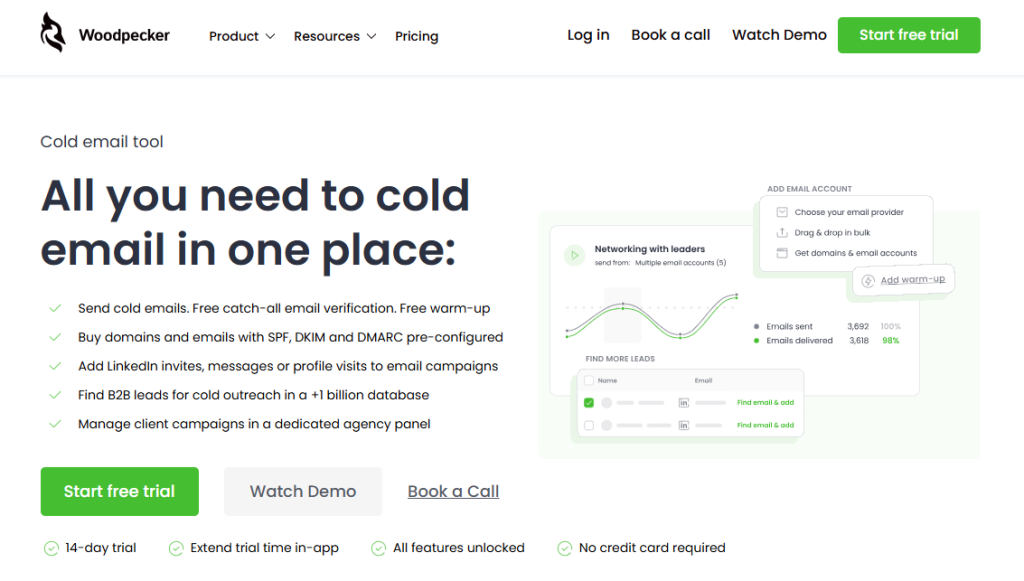
→ For teams doing volume introductions as part of outbound sales, BD, recruiting, or agency outreach, the platform handles the mechanical parts so your attention stays on the part that actually matters: writing identity lines that land.
→ For one-off professional introductions to a specific person – new client, new colleague, mutual intro – you don’t need a tool. Just a good template and five minutes of thought.
For volume, sign up to Woodpecker and run the motion properly.
FAQ
How do you introduce yourself in an email?
Start with the one question that determines everything: who are you to the reader? If you’re a stranger, lead with a specific reason for the email. If you have a mutual connection, name it in the opening. If you’re known to them already, reset context briefly. The template follows: specific subject line, matched greeting, one-sentence identity, relevant context or ask, matched sign-off. Skip “let me introduce myself” entirely – the email already does that.
How do you introduce yourself in an email example?
For a cold introduction: “Hi [Name] – I run [function] at [Company]. Noticed [Company] recently [specific thing]. In my experience, that usually creates [specific consideration] for teams at your stage. We’ve helped [examples] with exactly this. Worth 15 minutes to compare notes?” For a warm introduction: “Hi [Name] – [mutual contact] suggested I reach out. We worked together on [context] last year. [One sentence about you]. Would a short call make sense in the next few weeks?”
What’s the best opening line for an email introduction?
Depends on your relationship to the reader. For cold outreach: a specific observation about the reader’s company or situation. For warm introductions: the name of the mutual contact. For new colleagues or clients: a welcoming or context-setting line. The worst opening line – regardless of situation – is “I hope this email finds you well” because it signals the email wasn’t written for them specifically.
How do you introduce yourself professionally in an email?
Three things: match the formality of the relationship (formal for first contact with senior external stakeholders, warm for established colleagues or referrals), be specific about your role and why you’re reaching out (not generic background), and end with a clear, small ask. “Professional” doesn’t mean stiff – it means deliberate. A direct, well-structured introduction reads more professional than a flowery one.
Is “Let me introduce myself” a good way to start an email?
No. It’s become the most common generic opener in email introductions, which means it adds no information and signals the email wasn’t written specifically. The email itself introduces you – the phrase is redundant. Replace it with your identity line or the specific reason for reaching out.
How long should an email introduction be?
Most effective email introductions are 80–150 words. Cold introductions tend to be shorter (80–120 words); warm introductions can go slightly longer (100–150 words); introductions to senior executives should be the shortest (50–80 words). Beyond 200 words, reply rates drop sharply across most contexts.
What’s the best subject line for an introduction email?
Specific, under 7 words, and signals the reason for the email. For warm intros: “[Mutual contact] suggested I reach out”. For cold outreach: “Question about [Company]’s [specific thing]”. For new colleague emails: “New [role] on the [team] team”. Avoid: “Introduction”, “Hello”, “Hi!”, “Quick intro” – they tell the reader nothing.
How do you introduce yourself in an email to a new client?
Welcome them, establish your role and context, name your relevant experience in one or two sentences, and ask for a specific next step (usually a short intro call). Tone is warm but professional. The client is already committed at this point, so the email is setting the working relationship rather than pitching them.
How do you introduce yourself to someone you met briefly?
Send within 24–48 hours of the meeting. Reference a specific thing they said during the conversation (proves you were paying attention). Connect that reference to the reason you’re following up. Ask for a specific small next step. The shorter the original encounter, the shorter the follow-up email should be.
Is it okay to introduce yourself over email rather than in person?
Yes, in almost all professional contexts in 2026. Email introductions are now the default for new colleagues across time zones, new clients in B2B SaaS, cold prospecting, and most remote-first organizations. The question isn’t whether to use email – it’s whether your email does the job well enough to earn the reply or next step.