
Lead scoring looks objective because it produces a number.
Give a prospect points for company size, job title, website activity and a few engagement signals, then sort the list from hottest to coldest. The problem is that a precise-looking score can still be built on weak assumptions.
A pricing-page visit does not automatically mean somebody is buying. A VP title does not guarantee decision authority. A predictive AI model cannot rescue incomplete CRM data. And a lead with 92 points is not necessarily more valuable than one with 71.
This guide takes a different route. Instead of giving you another generic scoring formula, it breaks down nine lead-scoring myths and shows what a useful model should do instead.
What is lead scoring?
Lead scoring assigns values to characteristics or behaviors that may indicate sales relevance. The resulting score helps a team sort, prioritize or route prospects.
A B2B score can combine company fit, contact relevance, engagement, buying signals and CRM history. Traditional models use predefined rules. Predictive or AI lead scoring can analyze historical data and identify combinations that correlate with previous outcomes.
Lead scoring is not the same thing as an ideal customer profile. Your ICP describes the type of company you want. A score adds information about a specific account or contact and helps decide where sales attention belongs.
It also does not replace sales qualification. A score is built mostly from information available before or around early engagement. Qualification becomes richer once a real conversation reveals the problem, timing, stakeholders and buying process.
Myth #1: The highest-scoring lead is automatically the best lead
This is the most dangerous misconception because it turns scoring from a prioritization aid into a decision engine.
Imagine one prospect scores 91 because the company is large, the contact has a senior title and somebody from the account visited several pages. Another scores 74 but has replied directly and explained the problem they are trying to solve.
Which one deserves attention first?
Probably the prospect who gave you stronger real-world evidence, even if the formula awards fewer points.
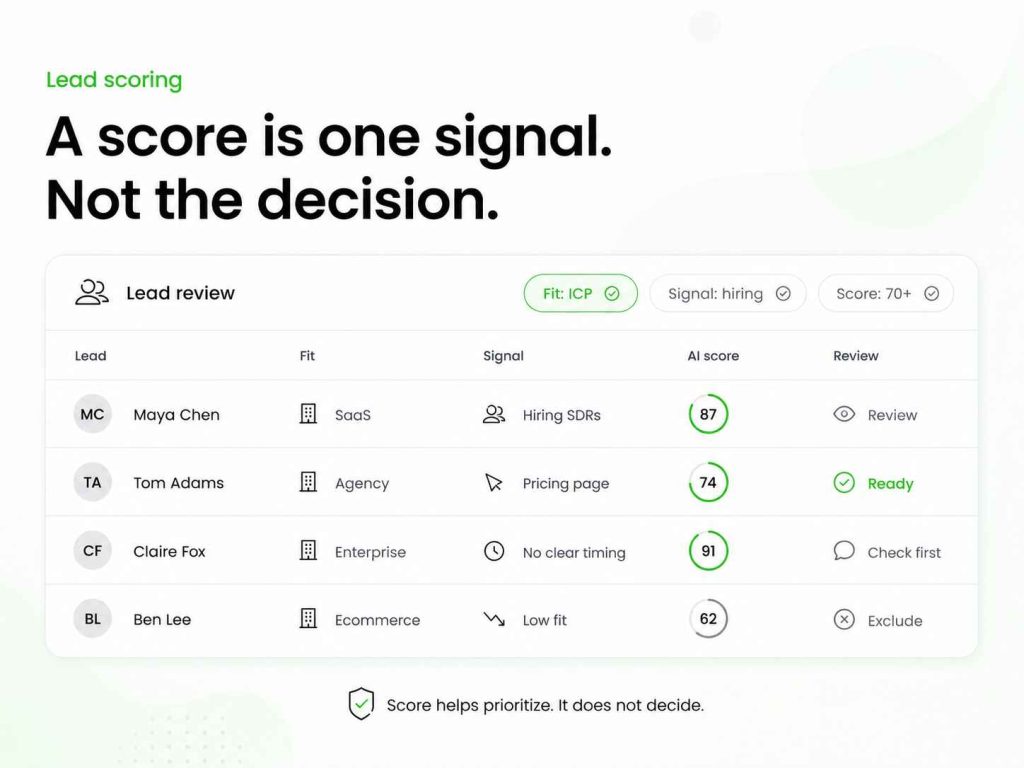
A useful score helps a salesperson understand the queue. It should not prevent them from overriding the queue when better information appears.
Myth #2: ICP fit and buying intent are the same thing
A company can be an outstanding fit and have no current reason to buy.
Suppose your core customer is a 100–500 employee B2B SaaS company with an outbound sales team. Finding another company with exactly those characteristics tells you that the account belongs in your market. It does not tell you that a purchase is under consideration this quarter.
Keep fit and timing separate inside the model.
Fit asks: Should we want this company as a customer?
Intent or timing asks: Is there evidence that the problem may matter now?
Recent hiring, a leadership change, product evaluation, a trial start or a direct reply can add timing context. Woodpecker’s B2B buying signals framework is useful here because it separates weak observations from stronger combinations of evidence.
Myth #3: Every activity signal should add points
More activity is not always more intent.
A prospect can read three blog posts because they are researching an industry report. An employee can visit a pricing page because they are a competitor. A marketing intern can download an ebook without having any connection to a purchasing decision.
Scoring models become inflated when every measurable action automatically means “warmer lead.”
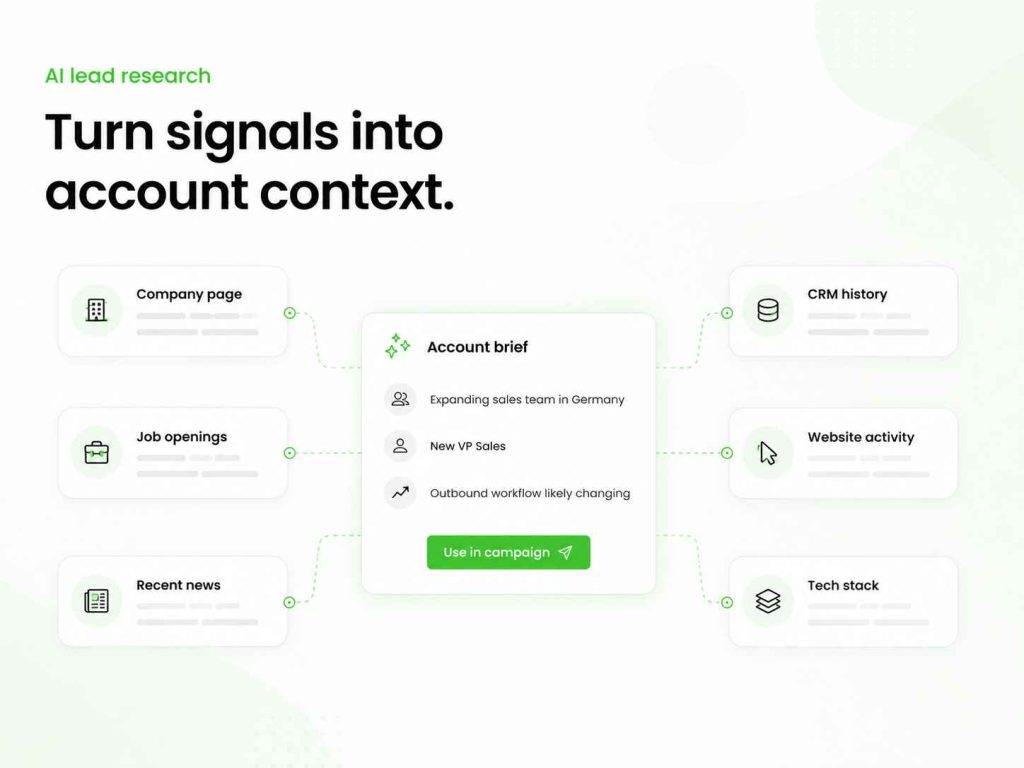
Signals become more useful when they form a coherent account story. A new VP Sales, several open SDR roles and CRM history showing an earlier outbound discussion tell you far more together than another anonymous page view.
That is also why account context matters in account-based prospecting. The team is trying to understand what is happening around the company, not simply add up isolated events.
Myth #4: Email opens and clicks are reliable intent scores
They can be useful campaign signals, but they are poor evidence when treated as proof of individual buying intent.
Open tracking depends on remote image loading. Privacy features, automated security systems and email clients can create recorded opens that do not map neatly to a person actively reading the message.
A click gives you more information, but context still matters. Someone opening a case study is different from someone explicitly replying, “Can you send pricing?”
Use engagement data as one layer rather than the center of your scoring model. Woodpecker’s email open tracking guide explains how tracking works, while the current cold email statistics put more emphasis on replies and downstream conversation quality.
Quick test: Which lead should sales work first?
Before reading the answer, rank these four prospects from 1 to 4.
Lead A
A 300-person SaaS company fits your ICP almost perfectly. You found the right Head of Sales, but there are no recent buying signals and no previous interactions.
Lead B
A 60-person professional services company is only a partial ICP match. Its founder submitted a demo form and wrote that the team needs a replacement for its current system before November.
Lead C
A strong-fit SaaS account has several pricing-page visits and two relevant content downloads. The contact attached to the activity is a junior employee and you do not yet know who owns the problem.
Lead D
A strong-fit account received outbound last week. The RevOps lead replied, explained that the company is rebuilding its prospecting process and copied the VP Sales into the conversation.
How I would read the evidence
Lead D has the strongest evidence. Fit, problem context, direct engagement and another stakeholder all point in the same direction.
Lead B deserves a fast response despite weaker fit. The prospect has explicitly described a project and timeline. Sales can qualify fit during the conversation rather than making the buyer wait because the company lost points on firmographics.
Lead C deserves research before outreach. Account-level activity is interesting, but the current contact may not be the buyer. Use sales prospecting tools or a lead finder to identify the relevant stakeholder before acting on the signal.
Lead A remains valuable, but there is less urgency. It is still a good outbound account. The lack of intent does not mean “do not contact.” It means the message needs to create relevance rather than pretending the buyer is already in-market.
If your scoring model produces a very different order, ask which assumption caused it.
Myth #5: Senior job titles deserve the most points
Seniority can matter, but influence does not always follow the organization chart.
A VP may control budget while a manager owns the day-to-day workflow. A RevOps specialist may understand the integration requirements better than either of them. In some deals, the person experiencing the problem becomes the internal champion even though they cannot approve the purchase alone.
Score contact relevance to the problem rather than seniority in isolation.
This becomes especially important in complex deals where several people participate in the decision. Discovery should uncover those roles rather than assuming the C-suite is always the correct first contact. Woodpecker’s discovery call questions help move from surface-level fit toward real buying-process information.
Myth #6: Good lead scoring only adds points
A scoring model that only moves upward eventually makes almost everybody look attractive.
Negative evidence matters too.
A company may be in the wrong geography. The contact may have left. An account may fall below your viable customer size. A previous opportunity may have been disqualified for a structural reason that still exists.
Some signals should subtract points. Others should work as hard exclusions rather than small deductions.
For example, an invalid address should not become “-3 points but still send.” It should stop email outreach until you have better data. Use email verification as a data-quality gate rather than another scoring decoration.
Myth #7: AI lead scoring is automatically smarter than rule-based scoring
AI can find patterns a manual points system would miss. That advantage depends heavily on the data it learns from.
If CRM stages are inconsistent, closed-lost reasons are missing or your historical wins come from a sales motion you no longer use, predictive lead scoring can confidently reproduce old biases.
A model can only learn from the examples available to it.
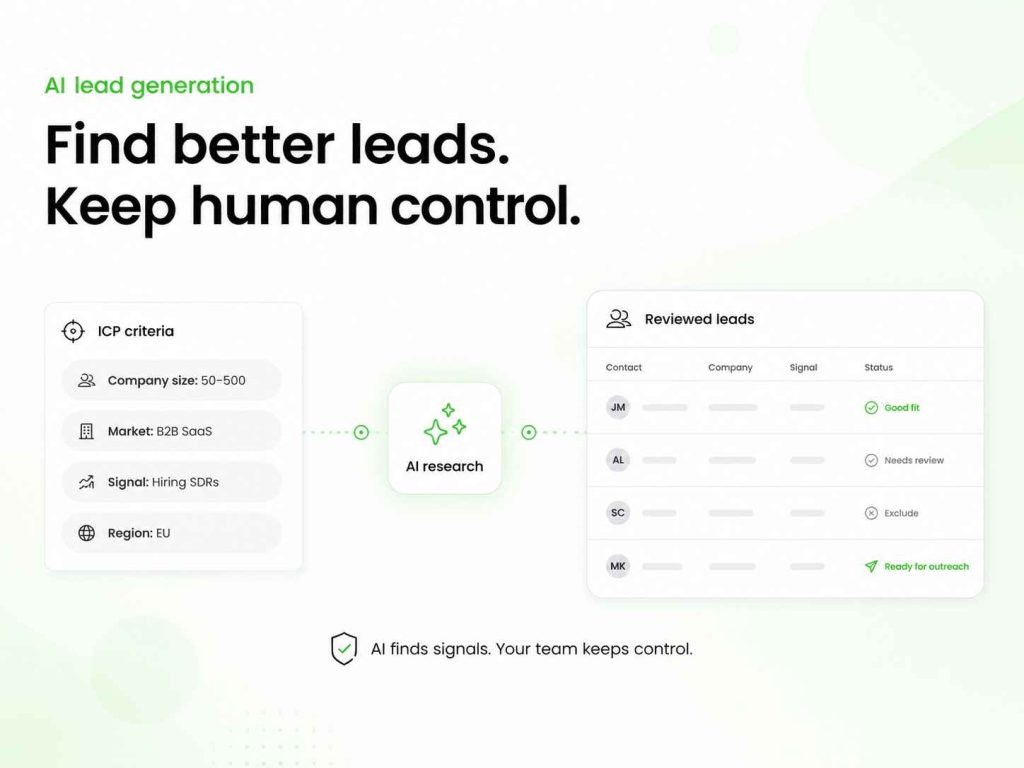
The strongest use of AI in lead generation is often helping people process more evidence, not removing people from the decision entirely.
The same principle applies inside an AI-enabled CRM. Predictive scoring becomes more useful when the underlying opportunity history is large enough and clean enough to support meaningful patterns.
Myth #8: One scoring model should work everywhere
Inbound and outbound leads arrive with different information.
An inbound demo request gives you direct behavioral intent but may come from a weak-fit company. An outbound account can be a perfect ICP match without having interacted with you at all.
Scoring them with one formula can create strange results.
The same applies across products, regions and sales motions. Enterprise sales may care heavily about account fit, stakeholder coverage and strategic timing. A transactional product may care more about direct product activity and short-term conversion behavior.
Keep a shared scoring philosophy but adjust the criteria when the buying process changes.
Your sales outreach plan should make those distinctions clear before scores start automatically feeding people into campaigns.
Myth #9: Once a scoring model works, leave it alone
A scoring system is a hypothesis about which evidence predicts useful sales outcomes.
Hypotheses need checking.
Markets change. Your product changes. A new customer segment becomes important. Sales starts targeting larger accounts. A signal that once correlated with opportunities may become common and stop telling you much.
Review the model against actual outcomes rather than its own internal logic. Do high-scoring prospects create more qualified conversations? Do they progress further? Are low-scoring accounts unexpectedly becoming strong customers?
If the answer keeps contradicting the model, change the model.
A scoring model that stays understandable
For many B2B teams, the first version does not need dozens of fields. Five categories can provide enough structure to learn from.
| Category | Example evidence | Possible weight |
| Company fit | Industry, size, geography, business model | 0–3 |
| Contact fit | Relevant role, department, buying influence | 0–2 |
| Timing | Hiring, leadership change, active project, trial, demo request | 0–3 |
| Evidence quality | Direct reply vs. inferred or anonymous signal | 0–2 |
| Negative evidence | Wrong market, stale contact, disqualification, unsupported need | Deduct or exclude |
The exact weights are not universal. Their job is to force useful distinctions.
If almost every prospect receives eight or nine points, your criteria are too generous. If a single content download can move somebody from cold to sales-ready, engagement is probably overweighted. If ideal accounts never reach the threshold unless they interact with marketing first, the model may be designed for inbound while your team is trying to run outbound.
What should happen after a lead crosses the threshold?
A score becomes valuable when it changes an action.
A high-fit outbound account might move into deeper research. An inbound lead with a clear project may need immediate human follow-up. A weaker account can stay out of active outreach until more evidence appears.
That handoff should connect with your outbound automation rather than creating another dashboard reps have to remember to check.
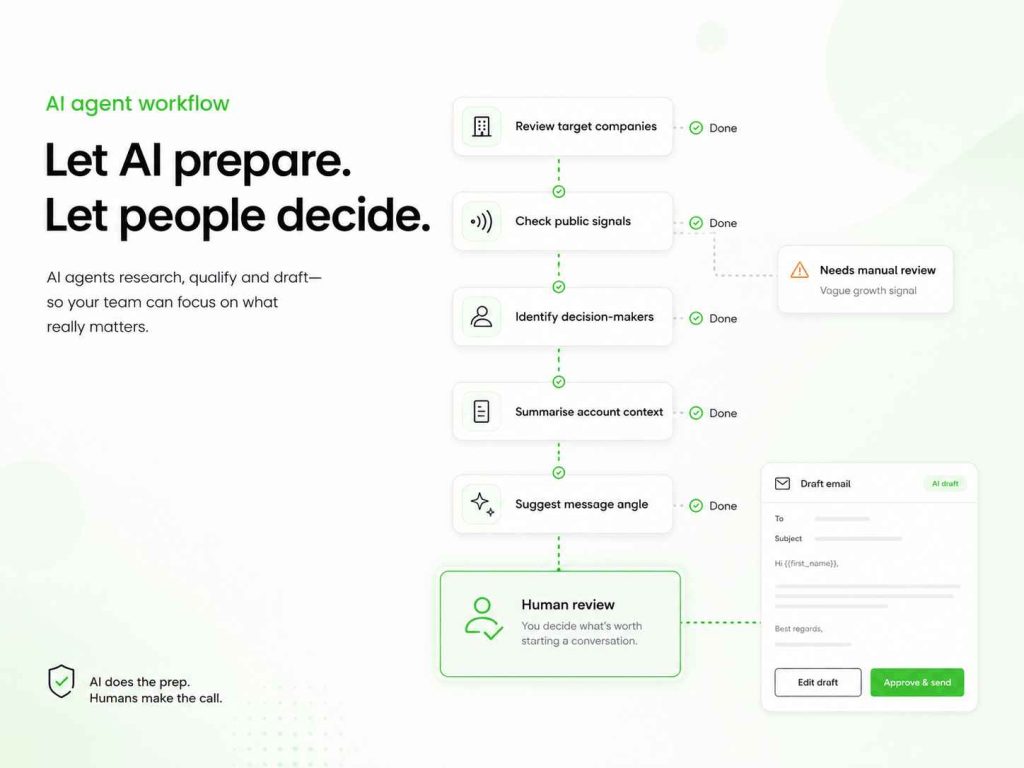
For high-scoring accounts, account research should influence the message too. A personalized cold email should reflect the evidence that made the prospect interesting rather than simply inserting the company name into a generic template.
Before a sequence goes live, the email preview tool can help catch broken personalization fields and formatting before they reach the highest-priority prospects on the list.
Judge the score against sales outcomes
Do not evaluate a scoring model because the distribution looks neat.
Compare score bands with outcomes that matter: positive replies, qualified meetings, opportunities and eventual pipeline.
The cold email benchmarks can provide external context for campaign results, but your own score-band performance is the real test of the model.
If you change messaging inside one stable scoring group, use the cold email A/B test calculator before interpreting a small difference as proof that one version performs better.
And if scoring causes several prospect groups to enter active campaigns simultaneously, account for total sending load rather than looking at each segment alone. The cold email infrastructure calculator can help estimate the mailboxes and domains required for the planned volume.
Use the score to ask a better question
The most useful lead score does not tell a salesperson, “This prospect will buy.”
It tells them something closer to: “There is enough evidence here to deserve your attention.”
From there, the next job is human. Check the account, understand the evidence, choose the right person and start a conversation that can confirm or disprove the hypothesis.
Once that conversation begins, replace assumptions with real information. Fit becomes a discussion about the actual problem. Intent becomes a timeline. Contact relevance becomes a buying committee. A score that helps you reach that point has done its job.