


AI lead generation is often sold as a shortcut: switch on an AI tool, generate a list and watch meetings appear.
That is not how strong lead generation works.
AI can help a sales team find better-fit accounts, enrich a lead list, prioritise prospects and prepare more relevant outreach. It can also make a weak process noisier by producing more contacts, more generic messages and more work for the people who still need to qualify every new lead.
The best AI lead generation setup starts with a clear definition of a good prospect. Then it uses AI for the work that is repetitive, slow or difficult to do consistently at scale.
This guide explains how to use AI for lead generation without treating automation as a replacement for judgement.
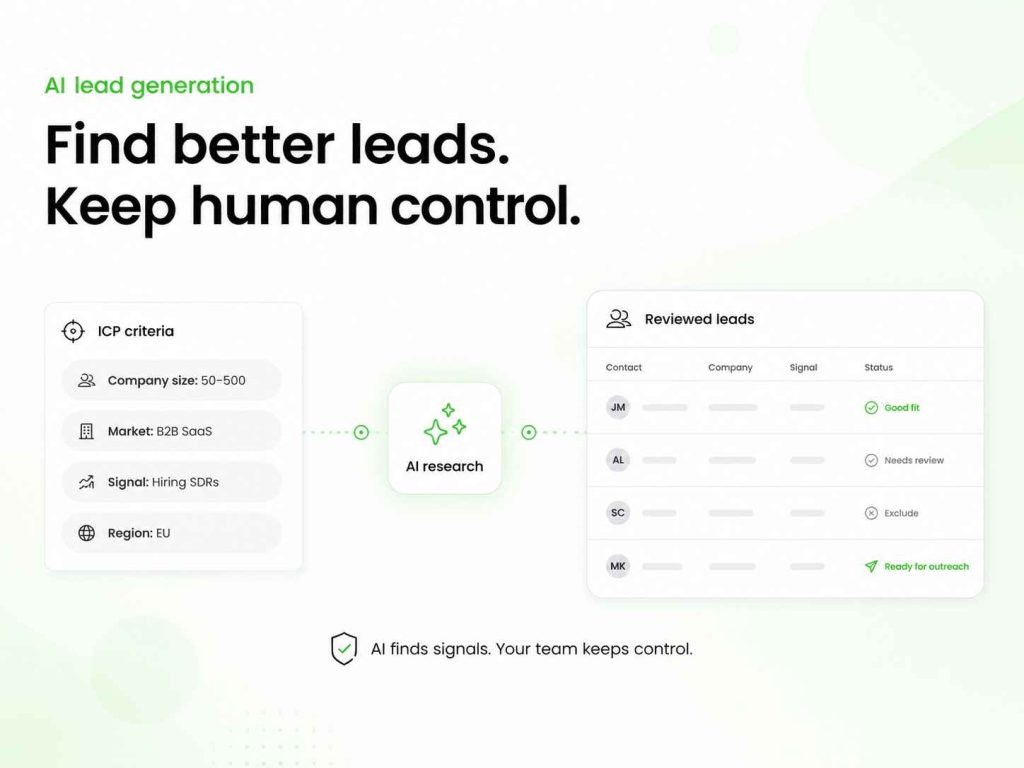
What is AI lead generation?
AI lead generation uses artificial intelligence to support the process of finding, researching, qualifying and routing potential buyers.
An AI tool can analyse firmographic data, review public company signals, score a lead, summarise account activity or suggest a next step. Some AI-powered tools can also draft outreach, enrich contact records and flag prospects that may be more likely to engage.
In a B2B setting, AI lead generation usually sits between prospecting and sales outreach.
The workflow often looks like this:
- Define the right account profile.
- Build or import a lead list.
- Add account data and buying signals.
- Use AI to prioritise the strongest prospects.
- Review the output before outreach begins.
- Route the right lead to the right person or campaign.
That is different from buying a huge contact database and assuming the AI will solve the targeting problem afterwards.
A useful lead generation process starts with the people you want to reach. Woodpecker’s guide to ideal customer profiles can help you define that before you use AI to expand the list.
How to use AI for lead generation without creating more noise
The easiest mistake is to use AI as a volume machine.
A tool can automate lead research, suggest hundreds of accounts and generate outreach ideas in minutes. But the sales team still has to decide whether those accounts are relevant.
Use AI to reduce manual effort, not to remove the criteria behind your targeting.
For example, AI can help identify companies that:
- fit your company-size range
- use a relevant technology
- are hiring for a role connected to your offer
- are expanding into a new market
- recently changed leadership
- show a recurring problem your product or service can solve
An AI-driven lead is still only a hypothesis.
A company hiring sales reps may be building a new outbound team. It may also be replacing people who left. A business that raised funding may have a larger budget. It may also be focused on product development, not sales tooling.
Before a prospect enters an outreach campaign, someone should be able to answer:
Why is this company on the list, and why should they hear from us now?
AI lead generation tools for research and account discovery
AI lead generation tools are strongest when they shorten research without hiding the source of the insight.
A good tool should help you understand the prospect, not simply give you a lead score with no explanation.
For example, AI can support lead research by pulling together:
- company descriptions
- product pages
- job openings
- recent company news
- public posts
- CRM history
- website activity
- technology data
That can give a sales rep a quick account brief instead of making them search across multiple tabs.
The goal is not to collect every possible fact about a company. The goal is to find a few useful signals that can shape your outreach.
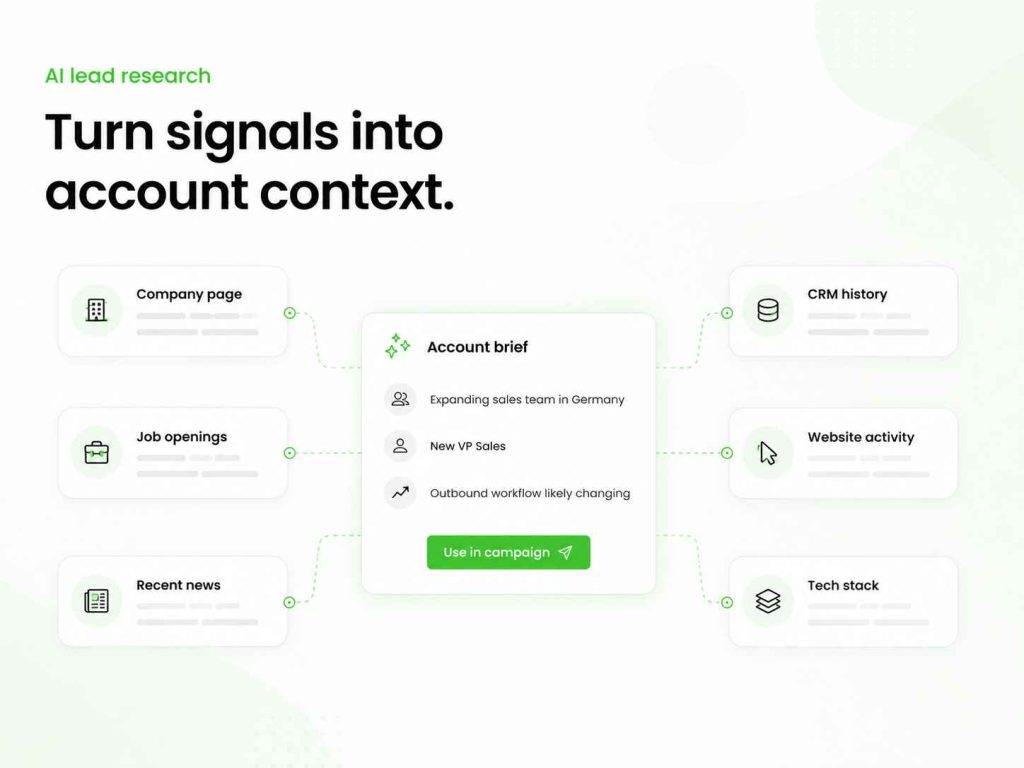
For example, “the business has 300 employees” may be helpful background. “The company is building a sales team in a new region after launching a new product line” gives you a possible reason to contact them.
Woodpecker’s guide to sales prospecting tools is useful here because it separates account research from message creation and campaign sending.
AI-powered lead generation and a better lead list
A lead list should not be a long spreadsheet of people who fit a broad job-title filter.
It should be a working list of accounts and contacts that have a plausible reason to hear from you.
AI-powered lead generation can help make the list more useful in several ways.
It can group accounts by industry, size, role mix or growth signal. It can suggest missing contacts. It can identify patterns across your best customers. It can help you find similar companies that may fit the same problem profile.
AI-powered lead generation tools can also help sales and marketing teams identify accounts that resemble successful customers without relying on a fixed list of manual filters.
That does not mean AI should create the final lead list without review.
A strong sales team still needs to decide:
- which accounts are worth pursuing
- who the right contact is
- what pain point may be relevant
- when a prospect should be excluded
- whether the lead belongs in outbound or inbound follow-up
For a more focused account strategy, see Woodpecker’s guide to account-based prospecting. It shows why a shorter, better-researched list can outperform a large collection of weak-fit contacts.
AI agent workflows for lead research
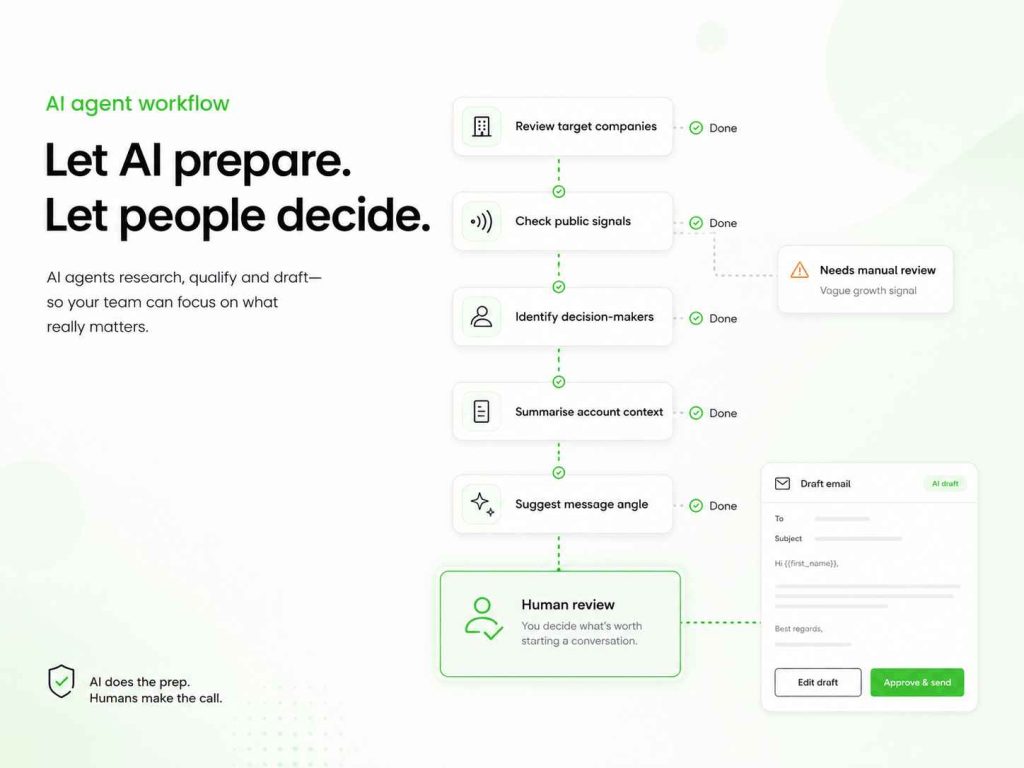
An AI agent can take a sequence of research tasks and complete them based on rules.
For lead generation, that could mean the AI agent:
- Reviews a list of target companies.
- Checks recent public signals.
- Identifies likely decision-makers.
- Summarises account context.
- Suggests a message angle.
- Flags accounts that need manual review.
This can save time for a modern B2B lead generation team.
But AI agents need boundaries.
You do not want an AI agent deciding that every company with a vague growth signal should receive cold outreach. You do not want it inventing a pain point because it has been prompted to create a personalised opening line.
A better setup is to use an AI agent for preparation, then give the sales rep a clear review step.
That keeps the workflow useful without turning it into blind automation.
AI for lead generation and lead scoring
Lead scoring helps teams prioritise prospects based on fit, engagement or likely buying intent.
Traditional lead scoring may assign points manually. For example, a company in your target industry gets points. A decision-maker role gets more. A website visit or form submission adds another score.
AI lead scoring can go further by finding patterns in historical data.
An AI model may look at your best customers, closed-won opportunities or past outreach results. It can then identify traits that appear more often among successful leads.
That can be useful.
It can also be misleading when the underlying data is weak.
If your CRM has incomplete deal records, inconsistent lifecycle stages or only a small number of closed opportunities, predictive lead scoring may create false confidence.
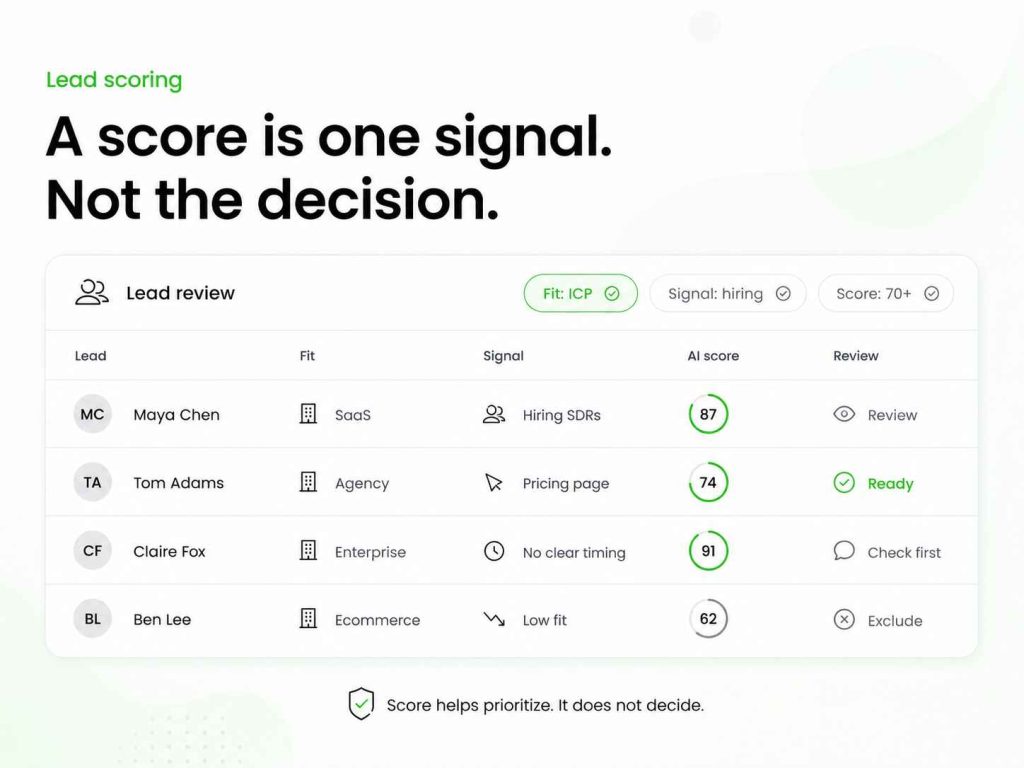
Use AI scoring as one signal, not the whole decision.
The sales team should still understand why a lead score is high. Is it because the company fits your ICP? Because the contact has shown engagement? Because the account matches a pattern from your existing customer base?
Lead behavior can be useful context, but it should not automatically override direct qualification.
A score should help prioritise work. It should not replace lead qualification.
Lead qualification: where AI can help and where people stay involved
Lead qualification is about deciding whether a prospect is worth further sales attention.
AI can help with the early layer of that work.
It can check whether email addresses are valid. It can enrich company data. It can flag accounts that match your target profile. It can summarise prior activity and suggest which contacts may be worth reviewing first.
That gives the lead generation team more context.
But automating lead qualification does not mean fully automating judgement.
A lead can fit the right industry, have the right title and show a positive signal, while still having no current reason to buy. A sales rep needs to understand timing, ownership, priorities and the real problem behind the inquiry or response.
For outbound, the early goal is usually not to fully qualify the buyer before the first message. It is to identify enough relevance to earn a conversation.
Woodpecker’s guide to discovery call questions can help when the prospect engages and you need to move from surface-level interest to a real sales conversation.
AI-powered tools for outbound preparation
AI-powered tools can help the sales team prepare outreach faster.
They can generate account summaries, draft message angles, propose subject lines and turn rough notes into more concise sales emails.
That can be useful when you already know why the prospect belongs on the list.
For example, AI can help you turn this research note:
Hiring five SDRs after expanding into Germany. New VP Sales joined in January. Existing reps use different workflows.
into a draft like:
Hi Maya,
I noticed you are scaling the SDR team while expanding into Germany. When new reps join quickly, keeping outreach workflows consistent can become difficult. Is that something you are working through at the moment?
That is a starting point, not final copy.
The sales rep should check every claim, remove generic language and make sure the message sounds like a real person wrote it.
Woodpecker’s guide to personalised cold emails is useful here because one researched detail should change the message itself, not sit as decoration in the first sentence.
How to use AI for lead generation and cold email outreach
AI can support cold email outreach in four useful places:
- account selection
- research preparation
- copy drafting
- reply management
It should not become a shortcut around relevance.
A cold email only works when the prospect can understand why they received it. That means the lead generation process and outreach process need to connect.
If AI identifies an account because it is hiring SDRs, the email should not suddenly pitch a completely unrelated feature. If the lead score is high because the company visited a pricing page, the sales rep should know whether that activity is reliable enough to mention or simply useful as internal context.
Use AI to build a better bridge between research and outreach.
Then use a clear cold email structure. Woodpecker’s guide to writing cold emails is a good reference when you need to keep a personalised message short.
Inbound lead routing and AI in your lead generation workflow
Lead routing means getting a new lead to the right person, campaign or next step.
That sounds operational, but it has a direct effect on lead quality.
A high-fit inbound lead should not wait three days because nobody knows who owns the territory. A prospect responding positively to a campaign should not receive another automated follow-up. A contact who is not a fit should not be pushed into a sales sequence because their score looks good.
AI can support lead routing by classifying responses, identifying account ownership and suggesting the next action based on the lead source.
For example:
- a high-intent inbound lead goes to the correct sales rep
- an existing customer request goes to customer success
- a low-fit inquiry enters a lighter nurture workflow
- a positive outbound reply gets removed from automation and reviewed by a human
- an unsubscribe request is processed immediately
That can streamline lead generation without making the process less personal.
Woodpecker’s guide to cold email reply rates can help you treat replies as sales signals rather than simple campaign metrics.
AI lead generation stack: how a lead generation team can choose the right AI lead generation tool
The right AI lead generation tool depends on how your team currently finds, qualifies and routes leads.
A small lead generation team may need one platform that speeds up research and campaign preparation. A larger sales team may need deeper CRM integration, more advanced lead routing and clearer ownership rules across territories.
Before you compare tools like enrichment platforms, AI sales assistants or outreach software, map the current workflow. Look for the point where work slows down or quality drops.
For example, you may need help with:
- building a more relevant lead list
- identifying high-fit accounts
- understanding lead behavior
- automating lead qualification
- preparing personalised outreach
- routing an inbound lead quickly
- keeping account information consistent
The right tools should support that work without stitching together multiple tools that create duplicate records and unclear handovers.
B2B lead generation, inbound lead routing and AI sales
B2B lead generation usually combines inbound and outbound work.
An inbound lead may arrive through a demo form, webinar signup or content download. AI can help score that lead based on company data, previous activity and known intent signals. It can then route the contact to the right sales rep before interest fades.
For outbound, AI sales workflows can help tools to identify target accounts, enrich contacts and suggest a reason to reach out. The sales rep should still check the context before sending anything.
That is one of the most practical ways to use AI: not to replace the sales team, but to help them focus on the leads most likely to deserve attention.
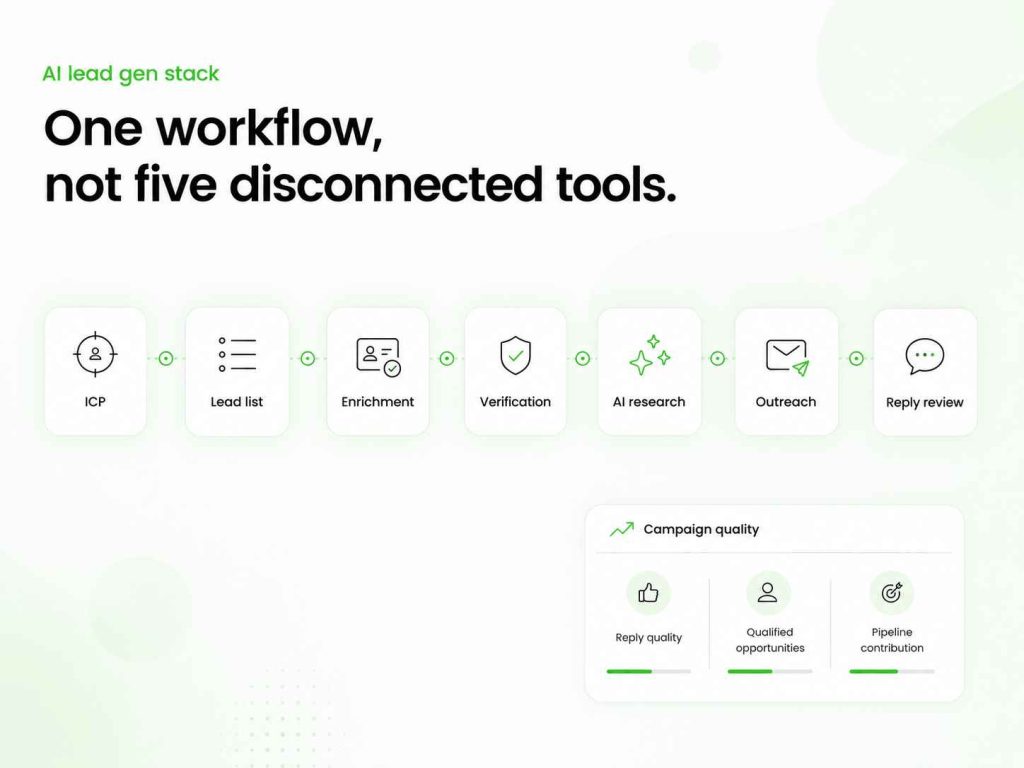
Build an AI lead generation stack around one workflow
An AI lead gen stack does not need every new AI feature on the market.
A useful setup may include a CRM, an enrichment tool, email verification, an outreach platform and AI-powered lead generation tools for research, scoring or message preparation.
The goal is to move from research to outreach without stitching together multiple tools every time a campaign starts.
For example, a lead generation workflow could look like this:
- Use AI algorithms to compare accounts against your ideal customer profile.
- Add relevant firmographic data, company news and lead behavior.
- Apply lead scoring and personalized outreach rules.
- Route the best accounts to the right sales rep or campaign.
- Review replies and update the CRM based on what happens next.
Generative AI can help turn account research into drafts, while automation improves lead handling after the first response. But no AI feature will fix a vague offer, an outdated lead list or unclear ownership between sales and marketing.
Ways to use AI without overcomplicating lead generation tactics
There are several ways to use AI without rebuilding the whole process at once.
You may start with AI-powered lead generation tools for account research. You may use AI to build brief account summaries. You may test predictive scoring before introducing more advanced routing. You may use AI and automation to prepare outreach drafts, then keep human approval before messages go live.
Successfully implementing AI starts with one problem that is easy to measure.
For example:
Our reps spend too long researching accounts before outreach.
Or:
High-fit inbound leads wait too long before they reach the right person.
Once you solve that issue, you can assess whether the workflow improves lead quality, speed or sales capacity. That is a better test than adopting AI because competitors talk about it.
The best AI lead generation strategies use AI where it saves time and leave people in control where relevance, judgement and trust are required.
AI lead generation software and your sales stack
AI lead generation software rarely works alone.
Most teams already use a CRM, email tools, calendar software, reporting dashboards and some form of marketing automation. The question is how AI fits into that existing stack.
A useful AI lead generation stack may include:
- a CRM for account and contact history
- an enrichment tool for missing company data
- lead generation software for list building
- email verification for list hygiene
- an outreach platform for campaign execution
- AI support for research, scoring and draft creation
- reporting for pipeline and campaign quality
The goal is not to add an AI tool for every stage.
The goal is to avoid stitching together multiple tools that create duplicate data, unclear ownership and fragile workflows.
You should be able to move from account research to outreach without stitching together separate tools every time a new campaign starts.
Woodpecker can support the outreach layer with Lead Finder, email verification, campaign workflows and inbox-based reply management. That reduces the number of handovers between finding a prospect and contacting them.
How to implement AI in your current lead generation process
Before you implement AI, map your current lead generation process.
Look at where the sales team loses time.
Is it building lists? Researching accounts? Sorting poor leads? Writing first drafts? Updating the CRM? Following up with people who never replied?
The answer tells you where AI can help.
Do not start with “How can we use AI everywhere?”
Start with:
Which task repeats often, takes too long and does not need deep human judgement every time?
For some teams, the answer is lead research. For others, it is lead routing or CRM enrichment. For another team, it may be turning account notes into personalised outreach drafts.
When you integrate AI, test one part of the workflow first. Measure the quality of the output. Then decide whether it improves the process enough to expand.
That makes adopting AI for lead generation less risky than rolling out several automation tools at once.
Steps to implement AI in lead generation
The best steps to implement AI are practical, not dramatic.
1. Define what a qualified lead looks like
Use your best customers, strongest opportunities and ideal customer profile as the starting point.
Look at industry, company size, role, problem, buying trigger and sales cycle. Avoid scoring a lead based on one vague signal.
2. Choose one repetitive task
Start small.
You may use AI to build account briefs, enrich a lead list, suggest lead scores or prepare first-draft outreach. Do not ask one tool to rebuild the entire lead generation system on day one.
3. Keep a human review point
AI can suggest. The sales team should still approve.
That is especially important for outreach, lead routing and any automated decision that affects a prospect directly.
4. Track quality, not just activity
Look at reply quality, qualified opportunities, conversion rate and pipeline contribution.
Do not only measure how many leads were added or how many emails were sent.
5. Improve the workflow before adding more automation
If the process creates low-quality leads, adding more AI will not fix it.
Refine your ICP, prompts, routing rules and qualification criteria first.
Best AI lead generation tools in 2026: what to evaluate
The best AI lead generation tools are not always the ones that claim to find the most contacts.
The right AI lead generation tool should support the part of your workflow that currently slows the team down.
When evaluating AI lead generation tools in 2026, ask:
- Does the tool show where its lead data comes from?
- Can it enrich and verify a lead list?
- Does it support AI lead scoring with clear reasoning?
- Can your sales team review AI-generated insights?
- Does it integrate with your CRM and sales workflows?
- Does it help with lead routing or only contact discovery?
- Can it support personalised outreach without generic copy?
- Does it fit your sales motion and company size?
- Does it improve lead quality, not only lead volume?
The best AI lead generation tool for a small agency may be very different from the best option for enterprise sales teams.
A small team may need an AI tool that speeds up research and campaign setup. A larger lead generation team may need more advanced permissions, routing and reporting.
The point is not to find the most impressive feature list. It is to choose the right AI lead for the work your team actually needs to do.
AI lead generation strategies for inbound and outbound
AI lead generation strategies should look different for inbound lead flows and outbound prospecting.
For inbound, AI can help score a new lead based on content engagement, website actions, firmographic fit and known buying signals. It can help sales and marketing teams route that lead faster and personalise the first response.
For outbound, AI can help build target account lists, identify relevant triggers, research prospects and prepare outreach angles.
The shared principle is simple:
AI should help you decide where to spend attention, not encourage you to spend less attention on every prospect.
That is why AI in lead generation works best when it supports a clear strategy.
For inbound, look at speed-to-lead and fit.
For outbound, look at account relevance, reply quality and the number of conversations that move into the sales pipeline.
Woodpecker’s guide to B2B sales lead generation can help connect those activities to a broader sales motion rather than treating lead gen as a separate project.
AI lead generation tools offer speed, not automatic strategy
AI lead generation tools offer speed.
They can automate lead research, surface account signals, help score prospects and produce early drafts faster than a person can.
They do not automatically create a strategy.
A tool cannot decide your target market for you. It cannot fix an unclear value proposition. It cannot turn a traditional lead generation process built on poor data into a high-quality outbound system.
AI can help improve lead generation when the fundamentals are already in place:
- a clear ICP
- a focused lead list
- accurate data
- sensible qualification rules
- strong sales and marketing alignment
- relevant outreach
- reliable follow-up
That is where AI lead generation uses become practical.
The technology supports the existing process instead of becoming the process.
The future of AI lead generation
The future of AI will likely include stronger AI capabilities around research, signal detection, lead scoring and routing.
AI models may become better at identifying patterns across large account sets. AI agents may take on more structured research and enrichment work. Sales teams may rely less on manual spreadsheet work and more on AI-powered workflows.
But the potential of AI depends on how it is used.
The future is not a world where companies pour money into AI lead generation and remove the people who understand the buyer.
It is a world where AI handles more preparation, while people spend more time on judgement, discovery and relationship-building.
AI is revolutionizing parts of lead generation by automating slow work. But the best customers will still expect relevance, context and a real reason to engage.
FAQ
What is AI lead generation?
AI lead generation uses artificial intelligence to support prospect research, lead scoring, enrichment, qualification, routing and outreach preparation. It helps teams find and prioritise potential buyers more efficiently.
Can AI generate leads automatically?
AI can help generate and prioritise leads by analysing company data, identifying account signals, enriching contact information and suggesting prospects that fit your target profile. It still needs clear criteria and human review.
How can AI improve lead quality?
AI can improve lead quality by helping teams compare prospects against an ICP, score accounts using relevant data, identify missing information and route leads based on fit or intent. The output is only as reliable as the data and rules behind it.
What is the difference between AI lead generation and traditional lead generation?
Traditional lead generation often relies on manual list building, fixed scoring rules and individual research. AI lead generation can automate parts of that work, identify patterns in data and help teams prioritise accounts more quickly.
Should a sales team use AI for lead generation?
Most sales teams can use AI for lead generation if they start with one clear problem, such as lead research, prioritisation or enrichment. AI should support the team’s existing judgement rather than replace it.
Use AI to build a better lead generation system
AI lead generation is useful when it gives your sales team more time for the work that needs people: understanding the account, writing a relevant message and having a real conversation.
Use AI to build better account briefs. Use AI to score and route leads more consistently. Use AI to spot patterns in your best customers. Use AI-powered tools to reduce repetitive admin.
Then keep control over the parts that shape trust.
Woodpecker helps teams move from a researched lead list to thoughtful outreach without losing visibility over campaign quality. Explore how to create a cold email sequence, how to improve cold email deliverability and how to safely scale cold outreach.