


Sales is a word with a hundred definitions. Personal selling is one of the oldest and most precise ones.
It means exactly what it sounds like: a real person, making a case, directly to a prospect. No ad, no landing page, no automated drip sequence doing the work. A human being who understands what the buyer needs and is present enough to respond to it in real time.
That sounds simple. In practice, it’s the hardest type of selling to do well – and one of the most effective when you get it right.
This guide covers what personal selling actually is, where it fits in a modern sales strategy, the process steps that drive results, and real-world examples across industries and deal types.
What is personal selling?
Personal selling is a direct, two-way communication between a salesperson and a prospective buyer, with the goal of understanding the buyer’s needs and making the case that a specific product or service meets them.
The defining characteristic is that it’s interactive. Unlike advertising (which broadcasts), email marketing (which scales), or content marketing (which educates passively), personal selling responds. The salesperson adjusts in real time based on what the prospect says, asks, objects to, or hesitates about.
Personal selling is one of the four main elements of the promotional mix in marketing – alongside advertising, sales promotion, and public relations. In B2B contexts especially, it’s often the highest-converting element of that mix, because the complexity of the purchase decision usually requires human judgment on both sides of the conversation.
Personal selling vs. other sales methods
It’s worth being clear about what personal selling is not, because the term gets used loosely.
Personal selling vs. advertising: Advertising is one-to-many and non-interactive. A salesperson is one-to-one and responsive. You can’t object to an ad. You can object to a salesperson – and a good one will use that objection to move the conversation forward.
If you’re looking at how to handle objections in email or on calls, this guide on common sales objections and how to address them covers more than the fundamentals.
Personal selling vs. cold email: Cold email is personal selling’s closest digital relative – but it’s not the same thing. A cold email initiates contact and builds interest. Personal selling typically happens after that initial contact, in calls, demos, and negotiations. The two work best in combination: email gets you the meeting, personal selling closes it.
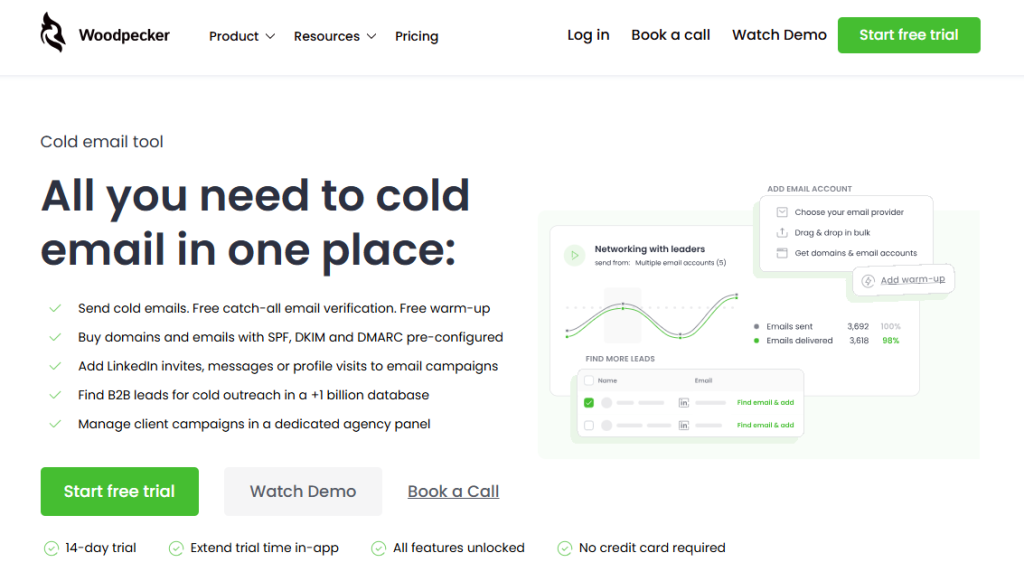
Woodpecker is built around the email side of that sequence – automating outreach so salespeople can spend more time on the selling itself.
Personal selling vs. account-based sales: Account-based approaches are often highly personal, but ABS is a strategy for targeting specific accounts. Personal selling is the execution layer – how individual reps interact with decision-makers within those accounts.
The personal selling process: 7 steps
Most sales methodologies break personal selling into a sequence of discrete steps. The exact number varies by framework, but the core stages are consistent across all of them.
1. Prospecting
Finding potential buyers who have a problem your product solves and the authority and budget to act on it. Prospecting can happen through referrals, inbound leads, events, LinkedIn, or outbound outreach. The quality of your prospect list shapes everything downstream.
2. Pre-approach (research)
Before the first conversation, a good salesperson researches the prospect: their role, their company, the problems they’re likely dealing with, and the objections they’re likely to raise. Showing up prepared is one of the clearest signals of respect in a sales context – and one of the most noticed.
3. Approach
The first direct interaction. This could be a cold call, a cold email, a LinkedIn message, or an in-person introduction. The goal is to establish credibility fast and earn the right to a longer conversation.
4. Presentation / needs assessment
A discovery conversation before a pitch. Good salespeople ask more than they tell at this stage – the goal is to understand the specific situation, not to deliver a generic product walk-through.
5. Handling objections
Every prospect has objections. Price, timing, existing solutions, internal buy-in – something will come up. The salesperson’s job is to surface objections early rather than let them kill the deal after a proposal. An objection is usually just a request for more information in disguise.
6. Closing
Asking for the business. This is the step most new salespeople delay too long. Closing isn’t manipulation – it’s a natural conclusion to a process where both parties have established that the fit is real. There are dozens of closing techniques; the most effective ones are usually just direct.
7. Follow-up
The sale doesn’t end at the signed contract. Follow-up builds the relationship that drives renewal, upsell, and referral. It’s also what separates transactional salespeople from ones who build accounts over years. For the email side of follow-up, these follow-up statistics make a clear case for persistence – most replies come after the second or third email, not the first.
Personal selling examples
Real-world examples help clarify where personal selling appears and what it actually looks like in practice.
1. B2B software demo
A SaaS account executive gets a lead from an inbound form fill. She sends a personalized outreach email referencing the company’s specific use case, books a 30-minute discovery call, and spends the first half asking questions before ever touching the demo. She finds out the real problem isn’t what the form suggested – it’s a workflow issue in a different department. She adjusts the demo accordingly. The deal closes two weeks later.
This is personal selling in its purest modern form. The product is complex enough that a general pitch wouldn’t have worked. The salesperson’s ability to listen, adapt, and address a specific problem is what drove the outcome.
2. High-ticket consulting or services sale
A strategy consultant cold emails the CFO of a mid-market company with a specific hypothesis about where they’re leaving margin on the table. The CFO responds. They get on a call. The consultant asks more questions than she answers. She sends a tailored proposal a week later.
No ad, no content funnel, no self-service checkout. The entire sale is personal. This is common across professional services, agencies, and any engagement where the scope and price require trust to be built first.
3. Retail or showroom sales
A customer walks into a car dealership. The salesperson asks about their current vehicle, what they use it for, and what frustrated them about it. Based on those answers, he takes them to three models rather than the full floor. He’s not selling – he’s matching. The close follows naturally from the match being good. This is personal selling in a consumer context, and the same principles apply whether the price is $25,000 or $250,000.
4. Real estate
A buyer’s agent shows six properties. She notices which rooms the buyer lingers in and which details they keep coming back to. She uses those signals – unconscious on the buyer’s part – to narrow the shortlist and frame her recommendation. She’s not just a listing service; she’s interpreting preference and translating it into action. That interpretive layer is the core of what personal selling does.
5. Outbound SDR-to-AE handoff
An SDR runs a targeted outbound sequence using cold email automation to book qualified meetings. The AE takes over for the actual sales conversations. The SDR’s job is personal selling compressed into email – building enough credibility and interest in a few touchpoints to earn a meeting. The AE’s job is the fuller version: discovery, demo, proposal, negotiation, close. The handoff between them is where many deals get lost, usually because the warm context the SDR built doesn’t transfer. Good documentation and CRM integration solve this.
6. Agency new business pitch
A digital agency’s business development lead identifies a company running poorly-targeted paid search ads. She sends a cold email with a specific observation – not a generic “we help companies like yours” but an actual finding. They get a meeting. She shows up with a 10-minute audit, not a 40-slide deck. She asks questions. She wins the business because she understood the problem before she walked in the door.
This pattern – research, specific insight, curiosity in the room, tailored solution – is replicable. It’s also what distinguishes personal selling that works from personal selling that feels like a pitch. See the digital marketing agency lead generation guide for more on the prospecting side of this.
7. Recruitment
A recruiter reaches out to a passive candidate – someone not actively looking, but a strong fit for a role. The first message is specific: it references her work, her likely career goals, and why this role is different from the dozens of other opportunities she probably gets messaged about. The recruiter is selling: the job, the company, the opportunity. And she’s doing it without the candidate ever having expressed interest. That’s personal selling with no inbound signal at all. Introduction email templates can help structure that first reach.
Advantages of personal selling
Personal selling is expensive relative to other sales and marketing channels. A good salesperson costs significantly more than a paid ad or an email tool. That cost is justified in specific situations.
It handles complexity. When a product has multiple stakeholders, a long evaluation process, or significant customization, a human is better equipped to navigate that than any automated system. The buyer has questions the website doesn’t answer.
It builds trust faster. A well-handled sales conversation does more for buyer confidence than ten case studies. People buy from people they trust, and trust is easier to establish in a conversation than through content.
It surfaces and closes objections in real time. An objection that kills a deal in an automated funnel can be resolved in 90 seconds by a good salesperson. That’s not inefficiency – it’s the format doing what it’s built for.
It enables customization. Personal selling allows the offer, the framing, and the proof points to be adjusted to the specific buyer. That level of relevance is impossible to achieve at scale, which is why high-ACV sales almost always involve a person somewhere in the process.
It generates intelligence. Every sales conversation produces information: what buyers care about, what language they use for their problems, what objections come up most often. That intelligence feeds product, marketing, and everything else. Automated channels generate data; personal selling generates insight.
When personal selling makes sense (and when it doesn’t)
Personal selling works best when the purchase is high-stakes, complex, or relationship-dependent. It’s the wrong choice when the product is simple, the price is low, and the buyer can self-serve without friction.
Use personal selling when:
- The deal size justifies the cost of a sales conversation
- Multiple stakeholders are involved in the decision
- The product requires configuration, customization, or significant onboarding
- The relationship is ongoing (renewal, expansion, referral potential)
- The prospect is not actively looking and needs to be convinced the problem is worth solving
Lean toward automated or self-serve channels when:
- The product is well-understood and the buyer can evaluate it independently
- The price point makes a sales conversation economically irrational
- Volume matters more than conversion rate at the individual deal level
In most B2B sales motions, these aren’t binary. Outbound email and automation handle the top of the funnel. Personal selling handles the conversations that follow. Building a sales pipeline means knowing which channel does which job – and designing the handoffs deliberately.
Personal selling in B2B vs. B2C
The mechanics are the same. The context is different in ways that matter.
In B2B, personal selling usually involves:
- Multiple decision-makers with different priorities
- Longer sales cycles measured in weeks or months
- Formal evaluation processes, RFPs, and procurement involvement
- Higher stakes for both buyer and seller
- Post-sale relationships that can span years
In B2C, personal selling tends to involve:
- A single decision-maker (or a small household unit)
- Faster decisions, often same-day
- Emotional as well as rational drivers
- Lower deal values but higher volumes
The skills overlap significantly – listening, questioning, handling objections, closing – but the timeframe and the cast of characters are different. A B2B enterprise rep and a luxury car salesperson are both doing personal selling. They just have different playbooks.
Personal selling and cold email: how they work together
Cold email isn’t personal selling. But it’s the most scalable way to create the opportunities where personal selling can happen.
The logic is straightforward. Personal selling requires a conversation. Conversations require interested prospects. Getting to interested prospects at scale requires outreach – and outbound email, done well, is the most cost-effective way to do that at volume.
The email does the work of awareness and initial interest. The salesperson takes over once there’s a reply. Personalizing cold email at scale – using real research, not just first-name merge tags – is what bridges the gap between a mass outreach tool and a personal selling approach. Woodpecker is built exactly for this.
Sign up here to run your first sequence in Woodpecker.
FAQ
What is personal selling in simple terms?
Personal selling is a direct sales interaction between one person and a potential buyer. It involves conversation, listening, and adjusting the pitch based on what the buyer actually needs – rather than delivering a fixed script. It’s the opposite of mass marketing.
What is a real-world example of personal selling?
A software account executive who books a discovery call, asks questions to understand the prospect’s specific problem, and runs a customized demo based on what they heard – that’s personal selling. So is a recruiter reaching out to a passive candidate with a specific, researched pitch. Any time a person adapts their pitch to a specific buyer in real time, that’s personal selling.
What are the 7 steps of personal selling?
The standard process is: prospecting, pre-approach (research), approach (first contact), presentation and needs assessment, handling objections, closing, and follow-up. Some frameworks combine or rename steps, but these seven cover the full arc of a sales interaction.
What is the difference between personal selling and advertising?
Advertising is one-directional and reaches many people at once. Personal selling is a two-way conversation with an individual. Advertising builds awareness at scale; personal selling converts interest into decisions by responding to the specific buyer in front of you.
What are the advantages of personal selling over other methods?
It handles complexity, surfaces objections that automated systems miss, enables customization at the individual deal level, and builds the kind of trust that closes high-stakes decisions. The trade-off is cost – personal selling doesn’t scale the way advertising or email does. It earns its place when the deal size justifies the investment.
Is cold email a form of personal selling?
Not exactly – but it’s closely related. Cold email is better understood as the outbound mechanism that creates opportunities for personal selling. The email itself is one-to-one, but it doesn’t involve real-time two-way interaction. Once a prospect replies and a conversation begins, that’s where personal selling starts.
What is B2B personal selling?
It’s personal selling in a business-to-business context. The same fundamentals apply – listening, questioning, objection handling, closing – but B2B deals typically involve multiple stakeholders, longer timelines, and more formal evaluation processes than consumer sales.