


When a founder or revenue ops manager is looking at a new sales engagement platform they aren’t just buying software, they’re choosing a framework for sales teams and marketing teams that will shape processes and revenue growth.
Two of the big names in this space are Apollo.io and Outreach. Both promise to unify prospecting and engagement, and both market themselves as AI‑powered platforms.
But the details, pricing structures and user experience differ considerably.
Below is my look at what each platform delivers, what real users say, and how these solutions stack up against Woodpecker.
Apollo.io: comprehensive sales execution platform with data enrichment
Apollo calls itself a comprehensive sales execution platform because it combines a massive B2B database with engagement capabilities.
Users can search for verified leads, build lists and launch email sequences without leaving the platform. The deliverability suite includes warmup features and guidance on sender authentication. Apollo’s knowledge base stresses that email deliverability depends on “quality over quantity” and lists an eight‑step checklist: authenticate domains, set up mailboxes, warm up emails, use good targeting and monitor domain health.
It recommends setting sending limits (50 emails per day per mailbox, six emails per hour with a 600‑second delay) and configuring unsubscribe links.
For new domains Apollo encourages a warmup email process and offers two options: an email warmup service that simulates opens and replies via a private network to build sender reputation, and an inbox ramp up feature that gradually increases outbound volume for existing mailboxes.
There is also the ability to generate new domains and mailboxes directly on the platform, with SPF, DKIM and DMARC authentication handled automatically.
Apollo’s outbound suite includes email, phone and sequence automation. The platform integrates with CRM systems and has advanced filters, intent topics and AI scoring to prioritise leads.
The dialer features call recording and analytics. Automatic email sequencing and A/B or A/Z testing help refine sales strategies, while AI personalization tools write drafts based on a 270 M+ contact database.
The option to purchase domains and mailboxes from within the platform is notable, though credits constrain sending volume. For example, the professional plan’s 48 000 credits can be consumed quickly when running high volume outreach or exporting data.
Outreach: AI‑powered sales execution with revenue intelligence
Outreach emphasises AI and machine‑learning features across email, voice and video.
Sequences use templates and snippets, with conditional logic to manage multi‑stakeholder outreach. An out‑of‑office (OOO) detector automatically pauses sequences when contacts are away.
The platform includes call and meeting scheduling tools and integrated A/B testing to find the best messages. Analytics provide team‑level insights into what content and workflows lead to meetings and opportunities.
For data sync, Outreach integrates with CRMs to update contacts and opportunities automatically, reducing manual entry.
Pricing structures and transparency
Apollo.io pricing: credits and tiers
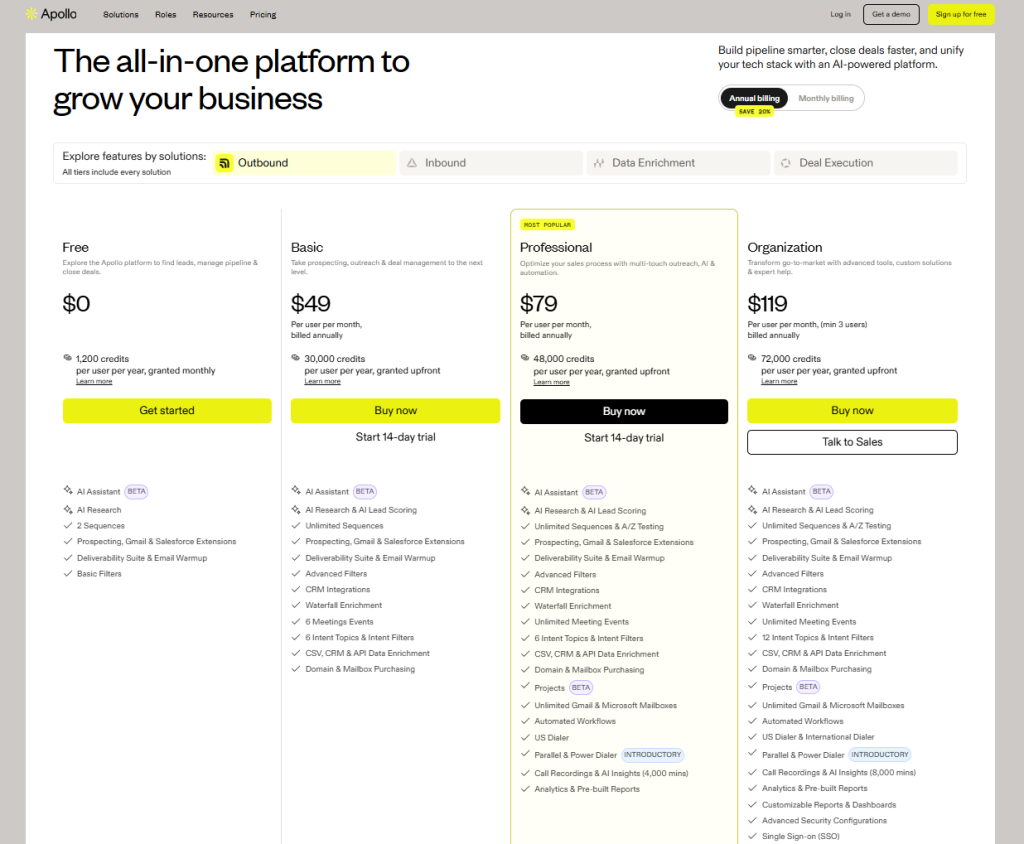
Apollo’s pricing is transparent: each paid plan lists a per‑user monthly cost and the number of annual credits.
Credits are used for data search, data enrichment and sending sequences.
- The Basic plan includes 30 000 credits and costs $49 per user per month.
- The Professional plan includes 48 000 credits for $79 per user per month and adds A/Z testing and more advanced automation.
- The Organization plan starts at $119 per user per month for at least three users with 72 000 credits, advanced security controls and parallel and power dialer capabilities.
- A Free plan grants 1 200 credits per user per month for basic prospecting and email warmup.
While Apollo’s credit system is flexible, it introduces complexity. Each credit corresponds to actions such as exporting contacts or running email sequences.
High‑volume teams may run out of credits and need to buy add‑ons. The FAQ on their wbesite notes that record selection limits and export credits apply, and additional credits can be purchased mid‑cycle.
Non‑paying users can only connect Gmail accounts; to link Microsoft or other providers, you must upgrade. For start‑ups this can be limiting when a sales cycle expands.
Outreach pricing: quote‑based and modular
Outreach does not publish exact numbers for its Engage, Call or Meet packages; users must request quotes.
The site only mentions that pricing is per user and includes support
Additional modules like Deal, Forecast and Amplify provide AI‑powered analytics, forecasting and revenue intelligence, presumably at higher tiers.
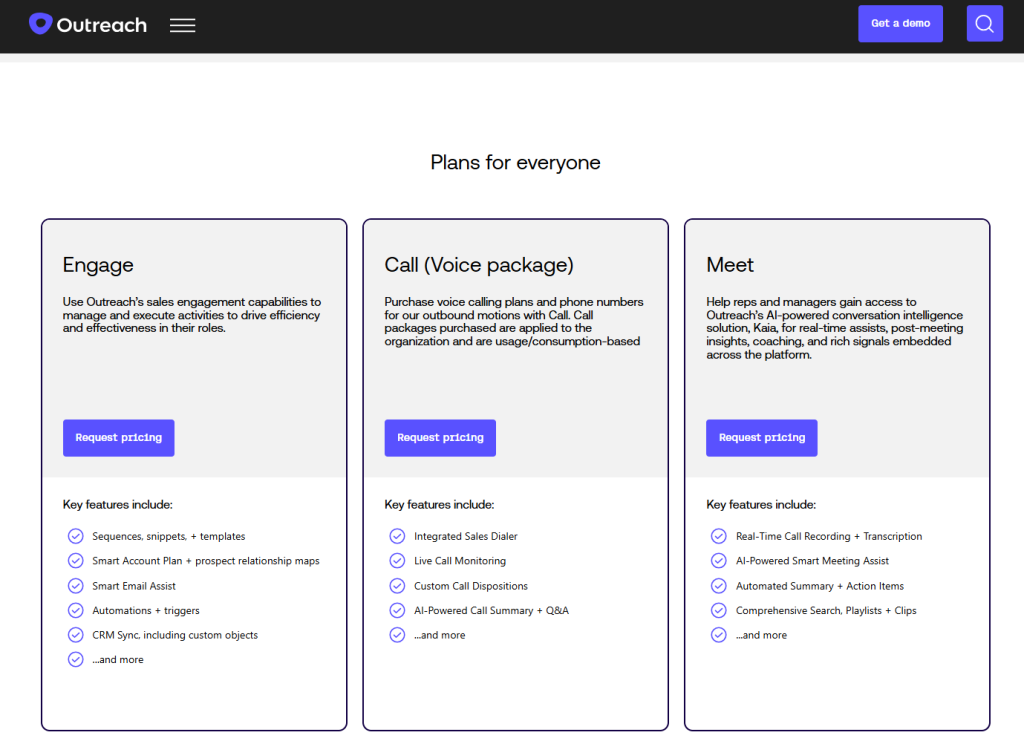
Because the pricing is opaque and there are multiple modules, budgeting can be challenging. Some user reviews complain about forced upsells and contract heavy agreements (see below).
For small businesses or sales teams with budget constraints, this lack of transparency makes it hard to evaluate the total cost of ownership.
User reviews: what people love and dislike
Apollo.io user sentiment
Positive feedback:
- Users appreciate Apollo’s large database and integrated tools.
- One reviewer wrote that Apollo “saves a lot of time when I’m searching for verified leads or building targeted lists” and praised the platform for suggesting similar leads based on existing searches.
- Another user highlighted Apollo’s “powerful search result which provides lots of information … needed for business planning and engagement” and noted that its workflow management and AI make work “faster, simpler and effective”.
- The integration between sales data and engagement tools means they don’t have to jump between platforms: “I can find contacts, build lists, and launch sequences in one place,” a reviewer said.
- Others applauded the AI research and lead scoring and the clarity of call quality when using the dialer.
- Many users credit Apollo for accelerating prospecting efforts and providing valuable insights into who is opening, clicking and replying to messages.
Criticism:
- Several reviewers mention interface complexity and outdated information. One user wrote that although Apollo is “an excellent all‑in‑one prospecting and engagement platform, one drawback is that the interface can feel slightly cluttered due to the numerous features it incorporates,” and some contact data can be outdated or incomplete.
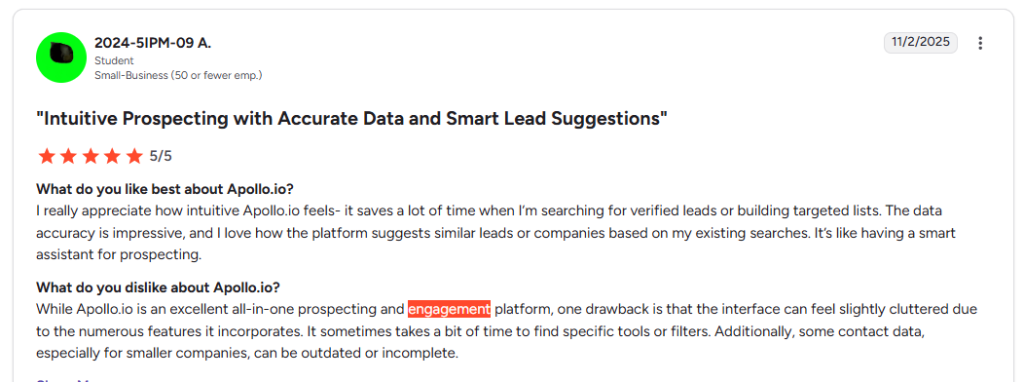
- Another said the platform “feels overwhelming at first because of the number of features” and noted that some contact data is still outdated or incomplete.
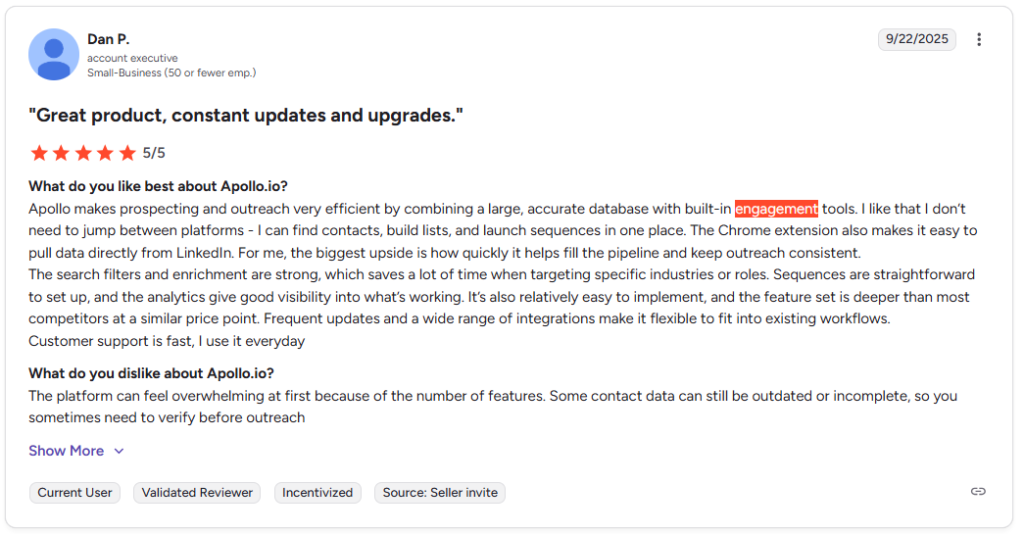
- The powerful search and data output are praised, but several users caution that using the system effectively “needs an expert eye”.
- One reviewer appreciated the robust campaign tools but complained about the daily email limit on outreach and the “not very user‑friendly” initial setup.
Such comments suggest that while Apollo’s features are extensive, onboarding and UI may intimidate new users.
Outreach user sentiment
Positive feedback:
- Outreach receives praise for its automation and multi‑channel sequences. One reviewer said the platform “boosted my team’s productivity” by scheduling emails in advance and placing prospects into automated sequences, noting that email tracking shows opens and clicks and helps identify engaged prospects.
- Another reviewer aplauded the automation of follow‑up across email, phone, LinkedIn and SMS, saying reps stay consistent across long lead lists.
- Users also appreciate templates, snippets and conditional logic that make personalization scalable.
- Email, call and task cadences are unified in one place, and built‑in open, reply and click tracking gives granular visibility into what works.
Criticism:
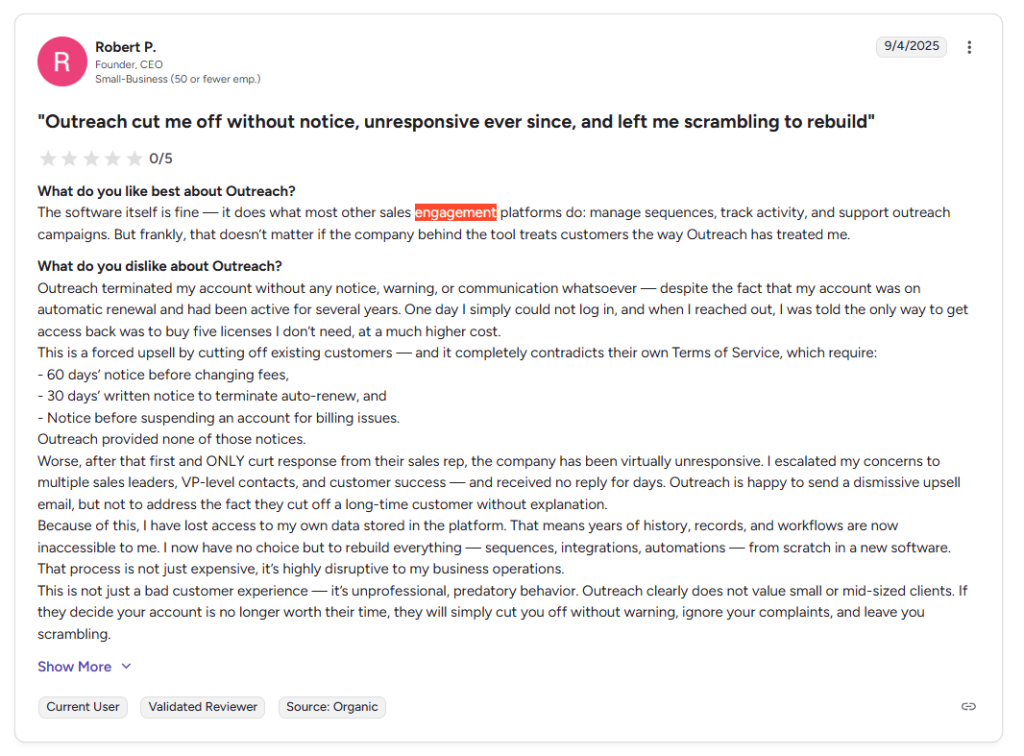
- Outreach’s biggest complaints revolve around support, pricing and complexity. A small‑business founder reported that Outreach “terminated my account without any notice … despite the fact that my account was on automatic renewal” and that the only way to regain access was to buy additional licenses at a higher cost. He described this as a forced upsell, noting that Outreach did not provide the notices required by their Terms of Service and that he lost access to years of data.
- Another reviewer liked the productivity boost but criticized the lack of simple ways to personalize emails for a handful of contacts; without separate sequences, users must manually edit emails before they send.
- An accountant said that while Outreach offers templates and AI programs, the company “has not yet configured email deliverability, which could help in spam filters” and complained about system lag with large data sets.
- A mid‑market financial‑services reviewer described Outreach as powerful but “not plug‑and‑play” – the UI and setup feel bloated, the admin configuration is dense, and new reps get overwhelmed quickly. He also noted that pricing is high, with seat‑based costs adding up and extra modules locked behind higher tiers, making the platform “not budget‑friendly” for lean or early‑stage teams.
- Additionally, Outreach works best with Salesforce; other CRMs feel duct‑taped, and you may need a dedicated ops person to keep systems aligned.
Support, interface and outdated information
Apollo’s support is generally viewed as responsive, though several reviewers caution that training is needed to fully use the advanced features.
Its user friendly interface is debated: some praise the intuitive prospecting flow, while others find the menu structure overwhelming and the data enrichment occasionally outdated.
The ability to upload unlimited contacts and link Gmail and Microsoft mailboxes across multiple accounts helps sales teams manage large lists; however, heavy data export can drain credits quickly.
Outreach’s interface is polished but heavy.
Reviews frequently mention a steep learning curve and dense admin configuration. Basic features like halting follow‑ups after a reply require workarounds.
The absence of a clear email deliverability module means users must rely on external email deliverability tools or best practices to avoid the spam folder.
The worst complaint came from the founder who lost access to his account and data due to an unexplained suspension – evidence that customer support can fail.
Distinct differences and specific needs
Selecting between Apollo and Outreach depends on your specific needs:
- If your organisation values an extensive database, integrated data enrichment and AI‑powered lead scoring, and you’re comfortable managing credits and an occasionally cluttered UI, Apollo may be appealing. Its intuitive design for prospect research and AI suggestions is praised, and the platform can handle both prospecting and outreach campaigns in one dashboard. However, outdated contact data and complexity may slow down teams.
- If your focus is on sales execution with deep revenue intelligence and multi‑channel engagement, Outreach’s modular approach provides high‑touch sequences, call and meeting tools, and AI insights. However, expect contract complexity, unknown prices and potential limitations for small businesses. The heavy setup and CRM dependence can be a barrier if you don’t have Salesforce or a dedicated ops team.
Why Woodpecker stands out
At Woodpecker we’ve learned from watching tools like Apollo and Outreach.
We built our platform to remove the very pain points that show up in user reviews:
Transparent pricing plans
Our pricing is simple. Woodpecker charges a flat rate per prospect count, not per seat. You can have unlimited email accounts connected under one subscription without buying extra licenses, and you’ll never be cut off mid‑campaign.
There are no forced upsells and you simply choose how many prospects you plan to contact and pay for that volume.
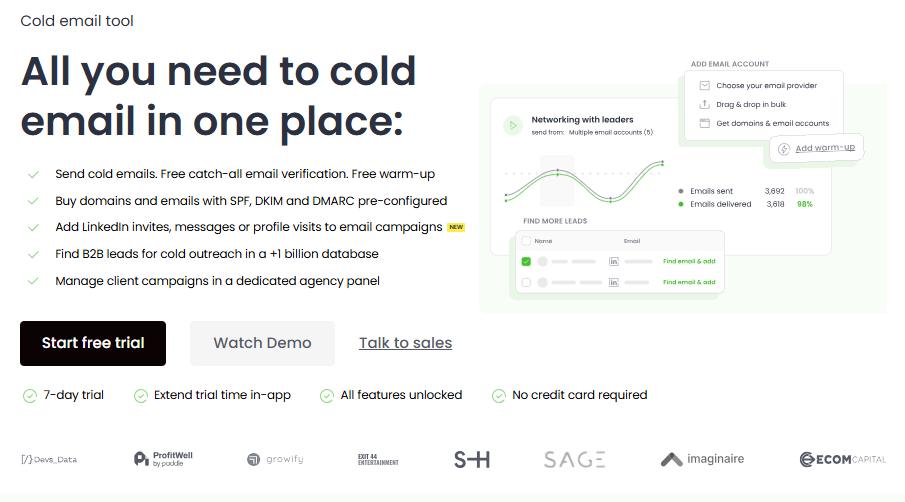
Free email verification and warm‑up feature
Every plan includes unlimited verification and a natural email warm up system so your emails land safely from day one. Our warm‑up algorithm gradually ramps up sending volumes and engages with other accounts automatically, protecting your sender reputation.
Domain and mailbox authentication (SPF, DKIM, DMARC) are handled for you. You can even purchase domains through Woodpecker with DNS records configured, ready to use.
Unified inbox and multi‑channel outreach
Woodpecker centralises all replies in a single unified inbox. You can integrate LinkedIn tasks, calls and other channels (via modules like sales navigator tasks) into the same sequence, all tracked with advanced analytics.
Each plan includes the same key features – there is no separate professional plan to unlock AI writing, templates or custom tracking. This parity reduces confusion for large teams and small agencies alike.
Scalable for agencies and growing businesses
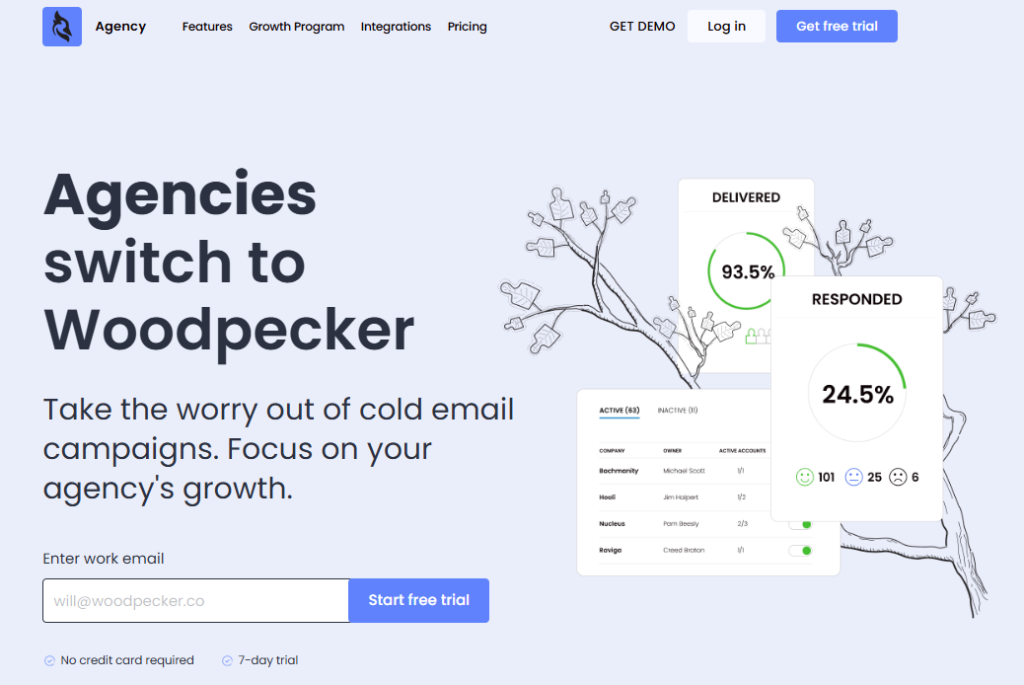
Woodpecker’s agency panel lets you manage multiple clients and keep data separate. You can add unlimited users, share templates and track client performance from one dashboard. There is no seat fee – pricing scales with prospect count, not headcount.
Comprehensive support
When customers face deliverability issues or need strategic guidance, our support team can help diagnose problems and suggest improvements. We believe in partnership rather than upselling.
Don’t wait – try it completely for free now.
Final thoughts
Choosing the right sales engagement platform requires balancing functionality, usability, support and cost.
Apollo.io brings an impressive database, integrated AI and granular credit controls but suffers from complexity and occasional data gaps.
Outreach excels at multi‑channel automation and AI‑driven sales execution, yet its opaque pricing structures, heavy learning curve and negative support experiences make some teams hesitant.
Woodpecker addresses these pain points with transparent pricing, unlimited accounts, integrated warm‑up and verification, and a unified approach to email and multichannel outreach.
If your business needs a flexible, user‑friendly tool that scales from a few cold emails to high volume outreach, Woodpecker may be the steady partner you’re looking for. Try it now and don’t look back.
FAQ
How do Apollo and Outreach handle sales processes?
Both platforms guide teams through structured steps, but many teams say the setup feels heavy when they want something clearer and faster to use.
Which tool works better for long-term outreach efforts?
Outreach is built for long sequences, while Apollo often feels more data-driven. The right pick depends on how long your team plans to run each touch pattern.
Do these platforms support growing sales efforts across multiple channels?
Yes, both support email, calls, and tasks, though some teams say the experience can get complex as volume increases.
What kind of sales tools are included?
You get dialers, inbox features, and database access, but each tool has its own mix and workflow.
Can these tools improve sales performance?
They can help with tracking and structure, but reviews show real results depend on clean data and clear internal habits.
Are they good lead generation tools?
Apollo shines here thanks to its database, while Outreach depends more on your existing sources.
Where does outreach stand in terms of usability?
Users often describe Outreach as powerful but harder to learn, especially for new sales reps.
What engagement features do these platforms include?
Things like tracking opens, clicks, and replies help teams keep prospects active through each step.
Are strong reporting tools included?
Yes, but some users say the dashboards can feel heavy or slow with large datasets.
Which platform includes more advanced features?
Outreach usually wins here, though these perks sit behind higher tiers.
Do they support advanced automation features?
Both tools support automated steps, though teams often say setup takes time and careful testing.
How expensive are the premium plans?
Both vendors use custom pricing for top tiers, making it harder for smaller teams to forecast cost.
Can these platforms help with data driven decisions?
Yes, but only if your data stays clean and updated, which many users list as a challenge.
Do they sync with Google Calendar?
Meeting features in both tools connect with calendars, making calls easier to book.
Can I run automated email sequences?
Yes, both tools support long sequences across multiple channels.
How well does each platform align with growing teams?
Apollo fits teams that want data and prospecting in one place, while Outreach fits teams that want deep workflow logic.
Do they support advanced sales cadences?
Both tools handle multi-step sequences, though some users say timing logic can get confusing.
Are they providing tools for call work as well?
Yes, both include dialers, local presence, and call logging.
How do they compare to other tools in the market?
Many teams compare them to Woodpecker or Salesloft when checking automation and deliverability.
Are they built for the scale required by fast-growing sales teams?
Outreach fits bigger teams, while Apollo fits mixed teams with strong prospecting needs.
Which tool puts a strong emphasis on coaching?
Outreach invests heavily in coaching dashboards through its AI features.
Do they follow a holistic approach to sales execution?
Yes, but their approach can feel heavy for smaller teams that want simpler habits.
Can these platforms help raise conversion rates?
Only when sequences are tested well and data accuracy stays high.
Do the tools suffer from limited features on cheaper plans?
Yes, several features sit behind higher tiers, especially in Outreach.
How do they influence response rates?
When sequences are written well, both tools help teams stay consistent and reach more prospects.
Are they suitable for larger enterprises?
Outreach tends to be the preferred choice for enterprise teams needing deep control.
What unique features does Apollo bring?
Apollo combines a large database with engagement steps in one place.
How does each compare to Salesloft’s pricing?
Both typically land in a similar high-end zone, though exact numbers depend on the quote.
What are the unique strengths of each?
Apollo stands out with data depth, while Outreach focuses on deep workflow logic.
Can these tools help create consistent workflows?
Yes, though they depend on clear internal rules to keep reps aligned.
Which tool fits different business needs?
Apollo fits mixed sales and marketing teams, while Outreach fits mature sales orgs with bigger process needs.
What should I know about Apollo.io vs Outreach as a comparison?
Apollo leans toward data and prospecting, while Outreach focuses on long sequences and deep sales execution.