


TL;DR
- Outreach.io pricing page does not publish prices on its website. Based on our research, pricing starts at approximately $100–$120 per user per month for the entry-level Amplify Core plan, with mid-tier Amplify Plus running $120–$160/user/month.
- All three Amplify plans — Core, Plus and Pro — are quote-based with mandatory annual contracts.
- The new 2026 pricing model adds a consumption-based AI credit layer on top of seat costs, making total spend harder to predict.
If you’ve spent any time researching outreach pricing, you’ve run into the same wall: the website says “request pricing” and tells you nothing else. That’s by design.
Outreach.io (Outreach.ai now) is a premium enterprise sales platform and like most in that category, it gates its total costs behind a sales demo.
We’ve pulled together what Outreach actually costs in 2026, based on real transaction data, third-party marketplace analysis and community reporting — so you can make an informed decision before sitting through a sales call.
What Is Outreach and What Does It Do for Sales Operations?
Outreach is an AI Agent Platform for Revenue teams — a sales engagement platform that gives sales reps, AEs and revenue leaders full visibility into the pipeline and AI-driven guidance at every stage of the funnel. In 2026, the platform has evolved significantly beyond its origins as a cold email sequencing tool.
It now covers the full revenue lifecycle: multi-channel outreach sequences and playbooks for top-of-funnel prospecting, deal management to track which opportunities are on track or at risk, mutual action plans for buyer-seller collaboration, conversation intelligence that transcribes and analyzes calls in real time, rep coaching tools and AI-powered revenue forecasting. The platform’s 2026 headline feature is its suite of AI Agents — including a Research Agent, Revenue Agent, Personalization Agent, Meeting Prep Agent and Deal Agent — each designed to automate a specific part of the sales workflow.
Outreach serves companies like Zoom, SAP, Adobe and Okta and is rated 4.3 out of 5 on G2 across 3,400+ reviews. It’s the platform that most enterprise B2B sales organizations benchmark against when evaluating sales engagement tools.
What Is the Challenge with Outreach Pricing for Sales Teams?
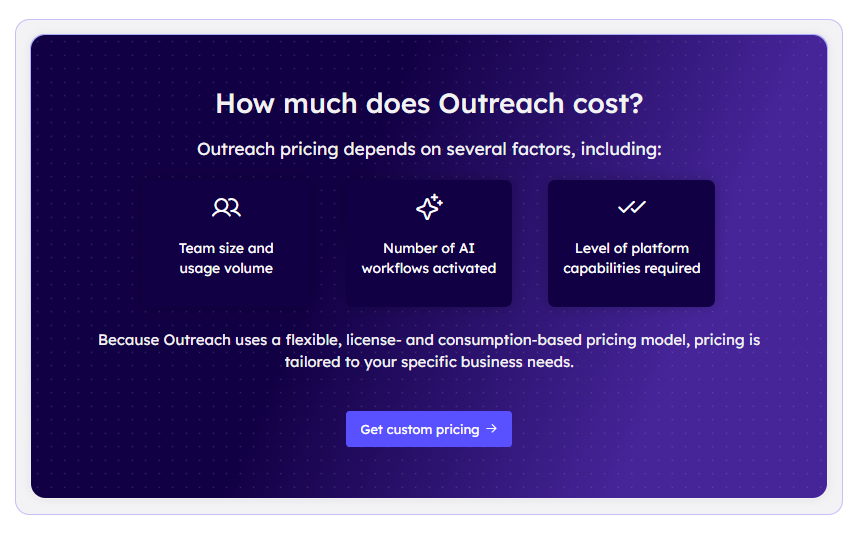
Outreach pricing has always been opaque. The platform now uses a dual pricing model: seat-based platform access combined with consumption-based AI credit usage. This means the price you negotiate for seats isn’t the full picture. Your actual monthly spend can vary based on how heavily your team uses AI-powered features.
Here’s what the 2026 pricing structure looks like.
The 3 Amplify Tiers with Hidden Costs
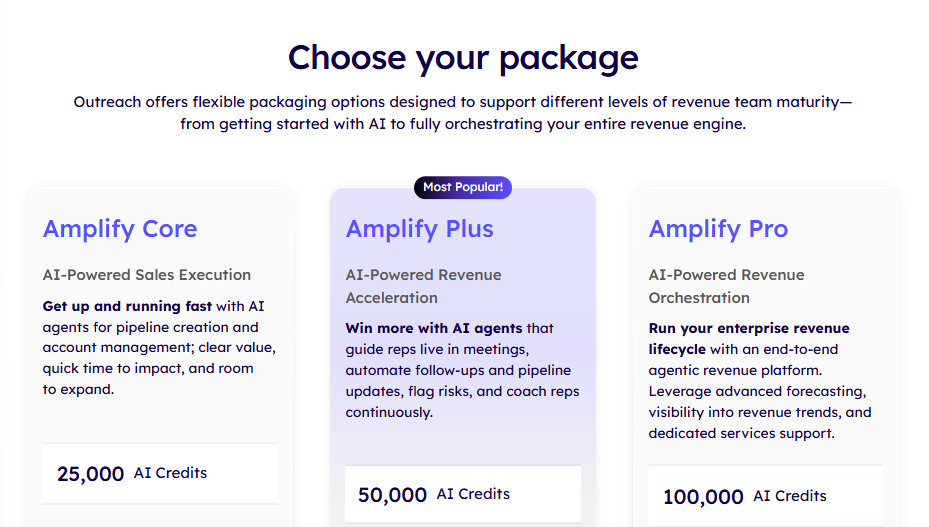
In 2026, Outreach restructured its packaging from the old Standard/Professional/Enterprise/Unlimited four-tier model into three new plans under the Amplify brand. Yet, it still uses the hidden cost approach.
- Amplify Core
AI credits included: 25,000
Best for: Smaller teams that need pipeline creation and account management - Amplify Plus
AI credits included: 50,000
Best for: Mid-market teams that need deal management and AI coaching - Amplify Pro
AI credits included: 100,000
Best for: Enterprise teams that need full forecasting and territory management. It also includes managed services.
Amplify Core — AI-Powered Sales Execution
Amplify Core is the entry-level Outreach plan, designed for teams getting started with AI-driven pipeline creation and account management. It includes 25,000 AI credits, the Research Agent, Revenue Agent and Personalization Agent, multi-channel engagement and sequences, account planning, relationship maps, call insights via the integrated dialer and Slack app integration.
Think of Core as what the old Standard plan aspired to be — but now augmented with AI agents that automate prospecting and personalization tasks. The 25,000 credit allocation is designed to cover a standard level of AI activity; heavier users of AI personalization and research can burn through this faster than expected.
Amplify Plus — AI-Powered Revenue Acceleration
Amplify Plus is the most popular tier, described by Outreach as the plan for teams that want AI agents guiding reps live in meetings, automating follow-ups, flagging deal risks and coaching continuously. It includes everything in Core plus: the Meeting Prep Agent, Deal Agent, real-time transcription and call analytics, sentiment analysis, deal health monitoring, deal and pipeline management and integrations with Zoom, Microsoft Teams, Google Meet and Cisco Webex.
The jump from Core to Plus is substantial in feature terms — this is where conversation intelligence, live coaching cards and AI deal summaries come in. It also doubles the AI credits to 50,000 and increases API calls to 500,000. Outreach claims Plus enables teams to predict deal outcomes with 81% accuracy and ramp new reps 3x faster.
Amplify Pro — AI-Powered Revenue Orchestration
Amplify Pro is the full enterprise tier, covering the complete revenue lifecycle including professional services like advanced AI forecasting, scenario planning, forecast rollups, territory management, multi-currency support and dedicated managed services. It includes 100,000 AI credits and 1,000,000 API calls.
The managed services component is a significant addition compared to previous enterprise tiers — Pro customers get tailored, ongoing support from Outreach’s team to help maintain the platform, scale workflows and drive adoption. For large organizations with complex revenue operations, this is the practical value driver.
Pricing for Pro is fully custom and negotiated on a case-by-case basis.
The AI Credit Layer: Why Outreach Cost Is Now Harder to Predict
The biggest change to outreach.ai pricing is the addition of consumption-based AI credits on top of seat costs. Credits are deducted per AI action — such as generating a personalized email, running a prospect research query or completing a meeting summary. Each action has a defined credit cost.
If your team uses AI-powered workflows heavily, you can run through the included credits faster than expected. Additional credit packs can be purchased at any time, but this creates a variable cost element that wasn’t present in the old per-seat model.
For finance and RevOps teams modeling Outreach cost, this is the critical new variable: seat costs are predictable, but AI usage costs are not — and they scale with adoption.
What Does Outreach Actually Cost? Real Numbers for 2026
Now we will show you three independent sources that tell us more about outreach.ai pricing, to check what you can expect regarding the platform costs.
- Based on user reports aggregated by Docket, the per-seat figures for the three Amplify plans break down as follows:
- Amplify Core at approximately $100/user/month,
- Amplify Plus at approximately $130/user/month,
- Amplify Pro at approximately $160/user/month.
Beyond seat costs, implementation fees run $5,000–$25,000+ depending on complexity and platform fees of $2,000–$5,000/year apply in addition to per-user charges.
Volume discounts become available at 20–25 users, with meaningful breaks at 50+, 100+ and 250+ seat thresholds.
- TechnologyInSales cross-referenced Vendr procurement data with MarketBetter’s 2026 analysis and arrived at a consistent range: core licenses at $100–$140/user/month for Amplify Core, scaling upward for Plus and Pro.
Their analysis adds important context on add-on costs:
- the Kaia conversation intelligence module runs an estimated $30–$50/user/month extra,
- the Deal module adds another $30–$50/user/month,
- Forecast adds $20–$40/user/month — each layered on top of the base plan.
For a 50-user deployment, Vendr data puts the pre-negotiation annual figure at roughly $72,000/year for Amplify Core, before implementation and add-ons. Teams typically extract 15–35% discounts through volume negotiation or at renewal.
- Prospeo‘s 2026 head-to-head analysis confirms the same seat-cost range and adds one useful data point on the dialer:
Outreach Voice add-ons run $10/user/month for 1,000 US/Canada minutes or $20/user/month for unlimited calling — relevant if your team uses Outreach as their primary dialer. The analysis also notes that Outreach charges no platform fee — which makes it cheaper at smaller team sizes even if per-user rates are similar.
What to expect: our conclusion
Three independent sources, all pointing to the same range. Here’s the honest bottom line on Amplify pricing:
- Amplify Core
Expected cost per user: Approximately $100–$120 per month
Annual cost for 20 users: Approximately $24,000–$28,800
Annual cost for 50 users: Approximately $60,000–$72,000 - Amplify Plus
Expected cost per user: Approximately $130–$160 per month
Annual cost for 20 users: Approximately $31,200–$38,400
Annual cost for 50 users: Approximately $78,000–$96,000 - Amplify Pro
Expected cost per user: $160 or more per month, based on a custom quote
Annual cost for 20 users: Custom quote
Annual cost for 50 users: Custom quote
Is Outreach Pricing the Only Issue with This Sales Engagement Platform?
Outreach cost is the most frequently cited concern, but it’s not the only one. Here’s the honest picture of where the platform struggles in 2026, based on G2, Capterra and TrustRadius reviews.
- No pricing transparency
You must attend a demo to receive a quote. This is the number-one complaint across review platforms. - Annual contract required
There is no monthly billing or short-term trial. Customers must commit to 12 months before they can fully evaluate the results. - Complex onboarding
New SDRs typically need two to four weeks to become productive. The platform has a steep learning curve, even for experienced sales operations teams. - Slow customer support
Multiple G2 reviewers report waiting several days for replies about broken integrations or workflow problems. - Unpredictable AI costs
The new credit-based usage model makes total monthly spending harder to predict. - Limited native enrichment
Outreach does not include prospect data. Users still need a separate data provider or enrichment tool. - CRM integration complexity
Non-standard Salesforce configurations may create integration difficulties. CRM options beyond Salesforce are limited.
Should You Purchase an Outreach.ai Subscription?
That depends on your situation. Here’s a clear framework:
Outreach makes sense if:
- You have a mid-market or enterprise sales team (typically 50+ reps)
- You need the full revenue stack: engagement + deal management + conversation intelligence + forecasting in one platform
- You have dedicated sales ops or a RevOps team to manage implementation and ongoing administration
- You’re already on Salesforce and want best-in-class integration depth
- Your deal values are high enough that even marginal improvements in rep productivity and forecast accuracy justify the outreach cost
Outreach is probably the wrong fit if:
- You’re a small team (under 15 reps) — the math rarely works at that scale
- You need to trial before committing — there’s no free trial, no monthly plan
- You need transparent, predictable pricing that your finance team can plan around
- You need integrations beyond the five major CRMs Outreach natively supports
- Your team doesn’t have the bandwidth for a 2–4 week onboarding curve
Woodpecker — The Outreach Alternative with Transparent Pricing
Sales engagement platforms don’t have to have opaque or enterprise-only pricing. Woodpecker is built for teams that want to run effective cold email outreach — personalized, sequenced, automated — without committing to a complex enterprise platform and a year-long contract before they’ve seen a single reply.
Here’s how the two compare on the factors that matter most to growing sales teams:
Starting price
Outreach: Approximately $100 per user per month
Woodpecker: From $35 per month
Pricing transparency
Outreach: Quote-based, with no public pricing
Woodpecker: Fully published pricing
- Free trial
Outreach: No
Woodpecker: Yes - Annual contract required
Outreach: Yes, mandatory
Woodpecker: No - Onboarding fee
Outreach: $1,000–$15,000 or more
Woodpecker: None - Email warm-up
Outreach: Available as an add-on
Woodpecker: Free and included - Email verification
Outreach: Sold separately
Woodpecker: Free and included - Inbox rotation
Outreach: Available
Woodpecker: Included - LinkedIn outreach
Outreach: Available
Woodpecker: Available as an add-on - Number of integrations
Outreach: Approximately five native CRM integrations, plus a marketplace
Woodpecker: Approximately 40 integrations - Agency multi-client panel
Outreach: Not built for agencies
Woodpecker: Dedicated Agency plan available - Best for
Outreach: Enterprise teams with more than 50 sales representatives
Woodpecker: Small and medium-sized businesses or agencies. It also suits growing teams.
Woodpecker lets you build personalized, multi-step cold email campaigns with automated follow-ups, A/B testing and condition-based sequences — all from a dashboard designed to be usable without a training period. The Agency plan lets lead generation agencies manage multiple clients from a single interface, which is a use case Outreach’s enterprise architecture isn’t designed for.
You can also pair Woodpecker campaigns with external tools — CRMs like Pipedrive and HubSpot, scheduling tools like Calendly, data tools like Clay and automation layers via Zapier and Google Sheets. The full list of Woodpecker integrations covers nearly 40 connections.
For a broader comparison of sales engagement tools available in 2026, see the complete cold email software buyer’s guide — it covers Outreach alongside every major alternative.
Start your free Woodpecker trial → No credit card required. No annual contract. Set up your first campaign today.
Frequently asked questions (FAQ)
What is the role of sales managers in the sales process?
Sales managers oversee reps and SDRs, set pipeline goals, run performance reviews and ensure the team hits targets. In Outreach’s Amplify platform, sales managers get dedicated tools including team performance dashboards, win/loss outcome tracking and rep coaching workflows built directly into the platform.
How can a sales outreach tool benefit sales reps?
A sales outreach tool automates the repetitive parts of prospecting — email sequencing, follow-up scheduling, CRM logging and call tracking — so reps can spend more time in actual sales conversations. In 2026, the best tools go further by using AI agents to handle research, personalization and meeting prep automatically. Outreach claims its AI agents give reps back 10 hours per week on Core and help ramp new reps 3x faster on Plus.
What are sales engagement tools and how do they improve sales?
Sales engagement tools are platforms that manage and optimize the interactions between sales reps and prospects across multiple channels — email, phone, LinkedIn and video. They provide email tracking, call recording, automated sequences and analytics that give managers visibility into what’s working. Outreach, Salesloft and Apollo are the most widely used enterprise-tier options in 2026, while tools like Woodpecker focus specifically on cold email outreach at a lower price point.
Why is pipeline management important for account executives?
Pipeline management gives AEs visibility into which deals are on track, which are at risk and where attention is most needed. Outreach’s Amplify Plus and Pro tiers both include AI-powered deal health monitoring, risk flagging and pipeline management dashboards — designed to help AEs prioritize the right opportunities at the right time rather than managing a list manually.
What features should you look for in an email outreach tool?
The most important features are: automated follow-up sequences, email personalization with custom fields, deliverability tools (warm-up, verification, inbox rotation), A/B testing, CRM integration and meaningful reply-rate analytics. For cold email specifically, deliverability infrastructure matters as much as the feature set — warm-up and email verification are critical and both should be included rather than sold as add-ons.
How can sales tools enhance the performance of sales teams?
Sales tools enhance performance by removing administrative friction, automating repetitive tasks and surfacing the data reps need to prioritize correctly. The 2026 shift is toward AI-driven automation — tools that don’t just record what happened but actively guide what to do next. Outreach’s AI agent model reflects this direction, though the cost of access to those agents varies significantly by plan.
What is the benefit of using an outreach platform on a per-user basis?
Per-user pricing scales with team size and ensures you’re paying for active users — which is straightforward. The complication in Outreach’s 2026 model is that per-user seat cost is now only part of the picture. The additional consumption-based AI credit layer means two teams of the same size can have meaningfully different monthly bills depending on how intensively they use AI features.
How do sales meetings contribute to the success of the sales pipeline?
Regular sales meetings — supported by the data your outreach and engagement platform captures — keep teams aligned on deal status, blockers and next steps. Outreach’s Amplify Plus and Pro plans include meeting intelligence features that record, transcribe and analyze calls, turning meeting content into coaching material and pipeline signals rather than just a log.