


In today’s crowded market for prospecting and sales intelligence tools, two names frequently surface: Apollo.io and Seamless AI.
Both promise to give sales and marketing teams rapid access to decision makers, verified emails and phone numbers, and even AI‑driven workflow assistance.
But how do they actually perform when you are trying to build a pipeline in 2026?
This article looks at Apollo.io and Seamless AI side by side, examining their data quality, feature sets, pricing structures and user feedback to see where each one shines and where they fall short.
We’ll explore questions that potential buyers often wrestle with:
How accurate is the contact data? Which product is easier for reps to adopt? Are the advanced features reserved for top‑tier plans? And most importantly, do these tools support your sales processes or bog you down with hidden costs and complexity?
Throughout the article, we draw on real customer reviews and official documentation to highlight both strengths and weaknesses.
At the end, we’ll share our perspective from the Woodpecker team and explain why many outbound teams choose our platform when Apollo or Seamless doesn’t meet their needs.
Data accuracy and data quality
For anyone running high‑volume outreach in 2026, the quality of the contact data they rely on has a huge impact on results.
Apollo.io markets itself as a sales intelligence platform that combines prospecting data with outreach functions, while Seamless AI positions itself as a lead generation tool built around a real‑time search engine and a global contact database.
In practice, both platforms make big promises about data accuracy and data quality, yet user feedback paints a mixed picture.
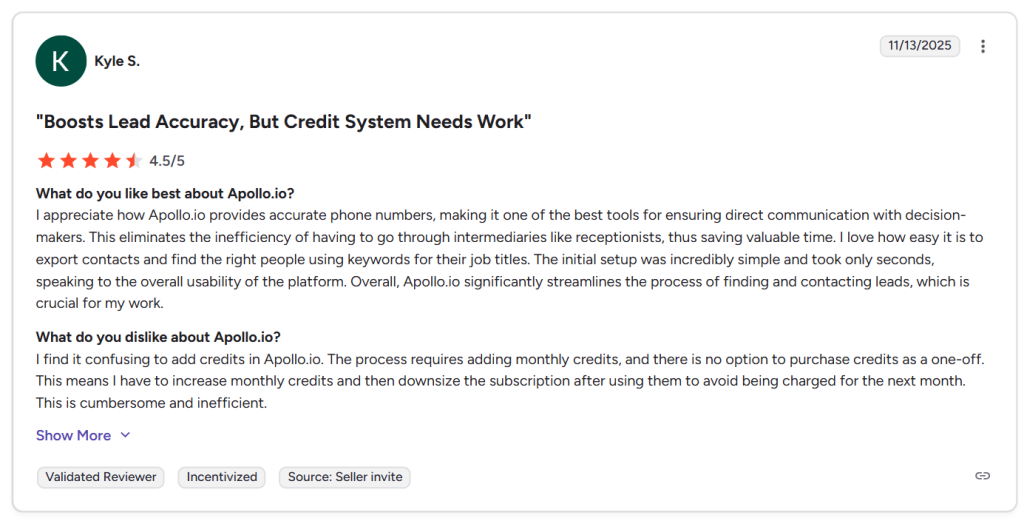
On the plus side, Apollo’s users appreciate having accurate phone numbers and emails at their fingertips.
One reviewer praised the platform for providing phone numbers that “make it one of the best tools for ensuring direct communication with decision‑makers,” adding that it saves valuable time by removing intermediaries like receptionists.
Seamless AI’s homepage highlights its access to over 1.3 billion business contacts and 121 million companies and stresses real‑time research and validation.
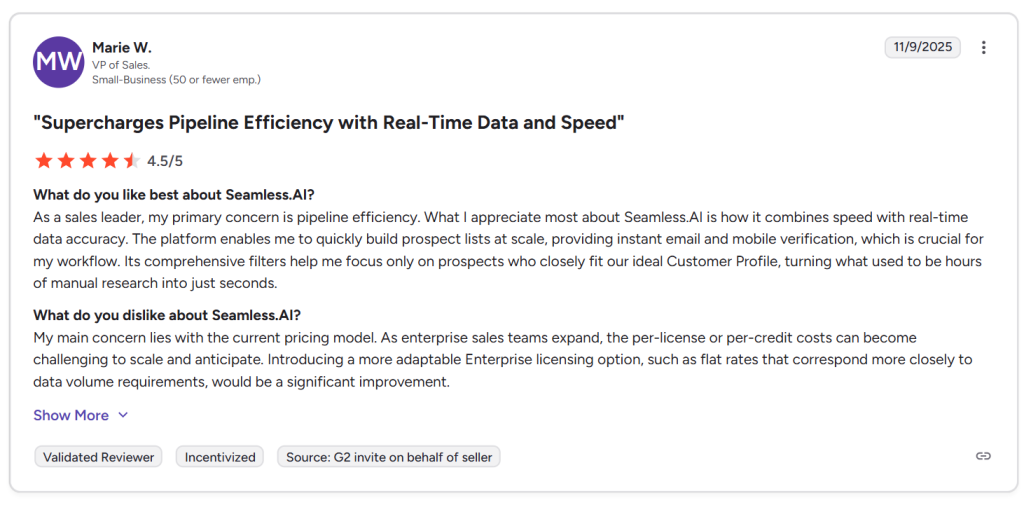
Some reviewers confirm this potential: one sales leader said the platform “combines speed with real‑time data accuracy,” letting their team build prospect lists at scale.
Yet quality issues are common.
Several Apollo users warn that up to date data isn’t a given. One reviewer noted that some data, especially phone numbers, can be inaccurate or outdated, which causes bounce rates to spike.
Another said they encountered many wrong or outdated numbers, forcing them to double‑check everything.
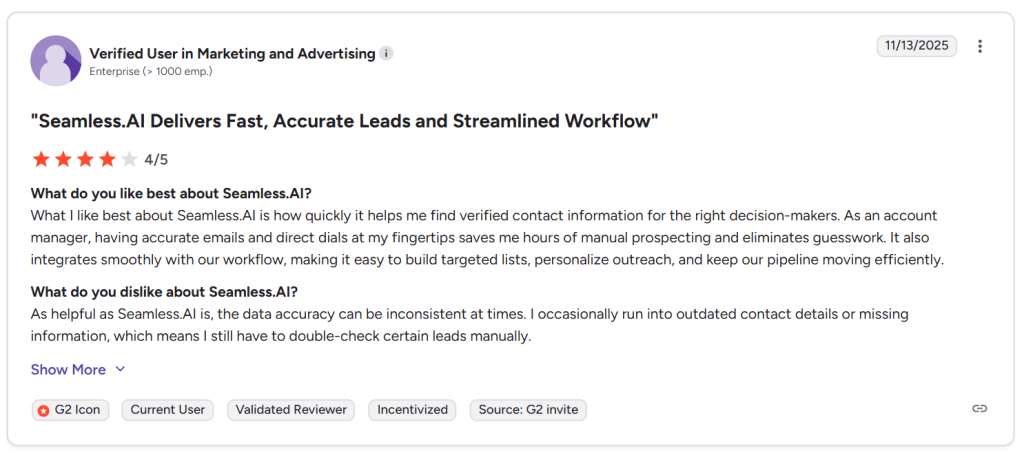
Seamless AI faces similar challenges: an account manager appreciated how quickly it finds verified contact information but admitted that data accuracy is inconsistent and sometimes outdated.
A marketing user said the platform’s “contacts are little outdated” and reported a 25% bounce rate when using a Seamless list.
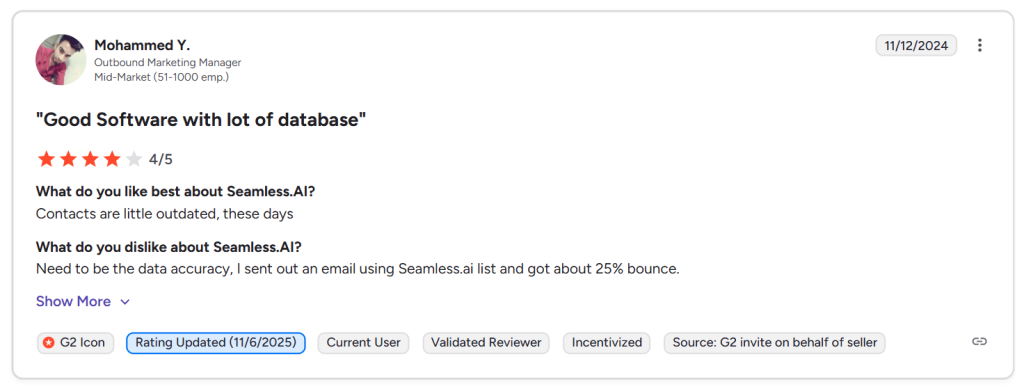
These mixed reports show that both tools supply a mix of fresh data and stale records, and teams still need to verify contact information before running campaigns.
Key differences in positioning
Lead generation and data enrichment capabilities
Apollo.io combines a large database with sales engagement tools. Its built‑in sequences, AI assistant and CRM integrations mean that sales and marketing teams can execute the entire lead generation process and follow up inside one environment.
Paid plans bundle AI research and AI lead scoring, advanced filters, data enrichment capabilities and buyer intent data (via intent topics and filters).
The platform also includes a deliverability suite and email warmup and features like domain & mailbox purchasing for building new sending infrastructure.
Advanced plans add a US dialer, parallel and power dialer, and call analytics. All of this makes Apollo.io more than a simple database – it’s a hybrid sales intelligence platform and sales engagement platform.
Seamless AI, by contrast, focuses on finding verified business contacts quickly. The company emphasises real‑time contact data and instant access to emails and phone numbers.
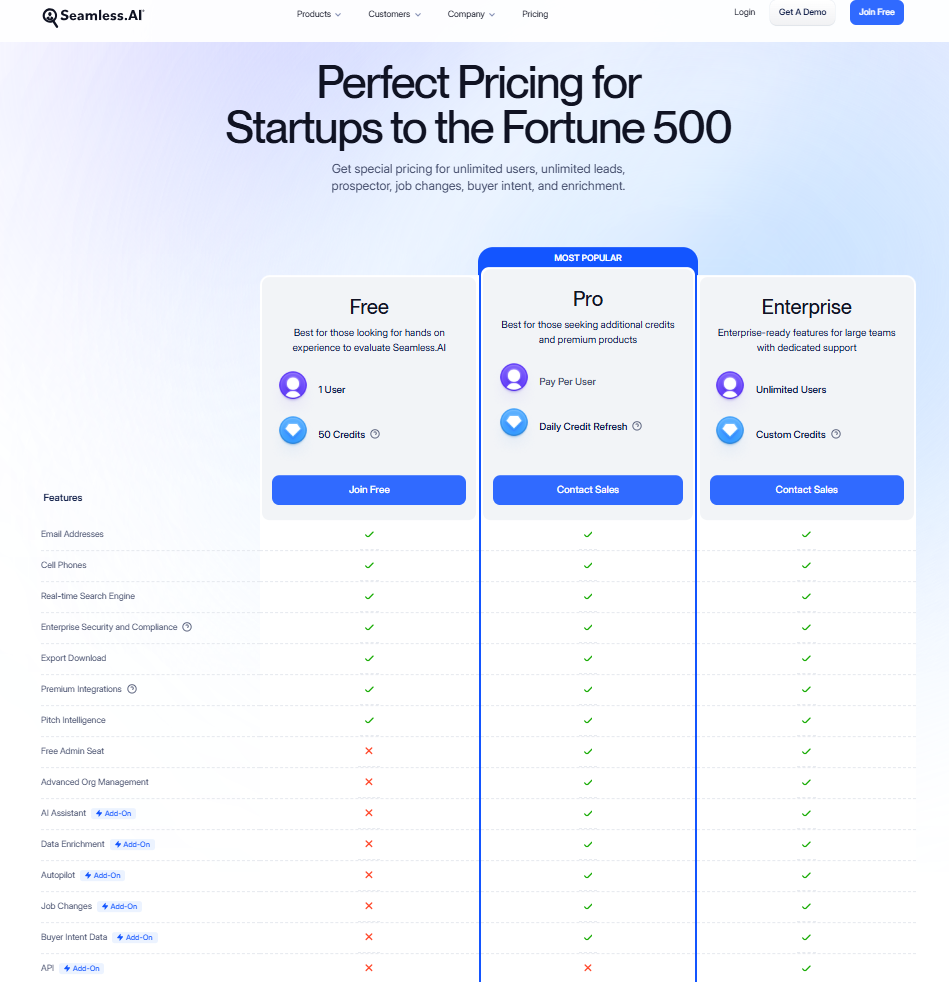
The free plan offers 50 credits per user and basic access to email addresses, cell phones and the search engine.
Pro and Enterprise tiers add or unlock premium features, but many advanced capabilities (AI assistant, data enrichment, autopilot sequences, job change alerts, intent data and API) are marked as add‑ons.
This makes Seamless more of a prospecting tool than a full engagement suite. Teams often combine it with another outreach tool to manage sequences and campaign management.
Phone numbers and contact reliability
Apollo.io’s reviewers often praise its phone data.
One user said Apollo “provides accurate phone numbers,” eliminating the inefficiency of going through receptionists. Others are less impressed: a mid‑market user warned that a lot of numbers are wrong or outdated, forcing double checks.
Seamless AI highlights direct dials and mobile verification on its homepage.
Users confirm that the platform makes it easy to find phone numbers quickly, but some complain about inconsistent accuracy.
For both tools, phone data quality varies by industry and region, and teams should plan to cross‑check numbers with third party data providers or other sources.
Key features: Apollo.io and Seamless.ai
Apollo’s paid tiers include a long list of key features.
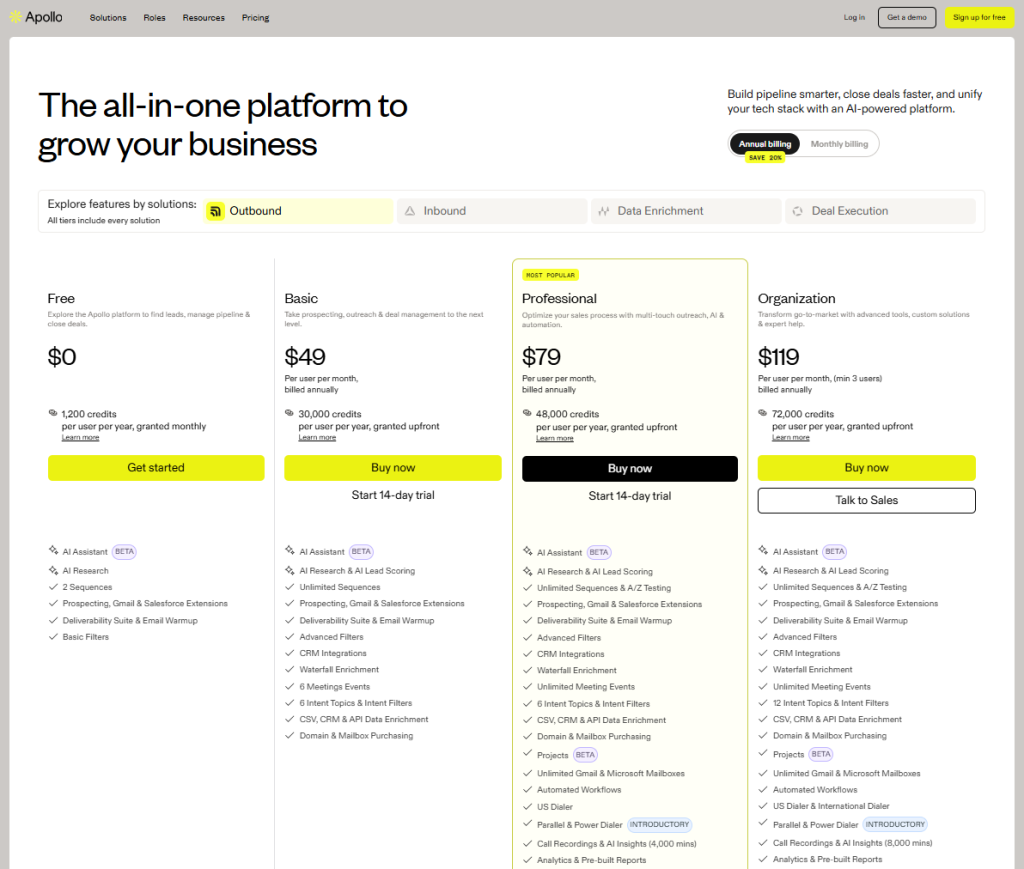
The Basic plan (US$49 per user per month, billed annually) offers AI assistant, AI research, unlimited sequences, advanced search filters, prospecting across Gmail and Salesforce extensions, deliverability suite & email warm‑up, CRM integrations, waterfall enrichment and access to intent topics and filters.
The Professional plan (US$79 per user) adds A/Z testing, unlimited meeting events, projects (beta), unlimited Gmail & Microsoft mailboxes, automated workflows, a US dialer, and parallel & power dialer, along with call recordings & AI insights.
The Organization plan (US$119 per user, minimum three seats) includes customizable dashboards, advanced security and single sign‑on (SSO).
Now, let’s move on to Seamless AI.
Seamless AI’s Free plan includes basic features: email addresses, cell phones, search engine and enterprise security, but limits users to 50 credits.
The Pro plan requires contacting sales and is described as pay‑per‑user with daily credit refresh.
The Enterprise plan offers unlimited users and custom credits, plus access to premium integrations, pitch intelligence, advanced org management and additional add‑ons such as AI assistant, data enrichment, autopilot, job changes, buyer intent and API.
Support tiers differ:
- Free offers self‑serve knowledge base and email support;
- Enterprise adds a priority support queue, onboarding specialist and live chat.
The heavy reliance on add‑ons means many desirable features are locked behind higher tiers.
Apollo.io vs Seamless.ai: Pricing plans and value
Apollo.io is transparent about its pricing. Besides the free plan with 1 200 credits per user per year, paid options scale from Basic to Organization, with increasing credit allowances and feature sets.
A recurring theme in user feedback is that the credit system can be confusing or restrictive. One reviewer said the process of adding credits “requires adding monthly credits” and there is no option to purchase credits as a one‑off, so they must increase monthly credits and then downsize.
Another lamented that daily email sending limits feel restrictive for high‑volume outreach.
The basic plan offers a lot for US$49, but certain advanced functions like intent data, domain purchasing and projects only appear in higher tiers.
Seamless AI takes a more opaque route.
The Pro and Enterprise options require contacting sales for custom pricing, making it hard to judge value.
Even for paying customers, important features like AI assistant, data enrichment and API are add‑ons, which can drive up costs quickly.
Reviewers note that the per‑credit or per‑license costs become challenging to anticipate as teams grow.
On the other hand, the credit‑based free plan is useful for testing the system before investing – many users appreciate having a free tier to evaluate contact quality.
However, “lower tier plans” offer little beyond basic data, and teams soon run into credit limits.
Lead generation tool & Chrome extension support
Apollo’s Chrome extension lets users pull contacts directly from LinkedIn and websites, but feedback is mixed.
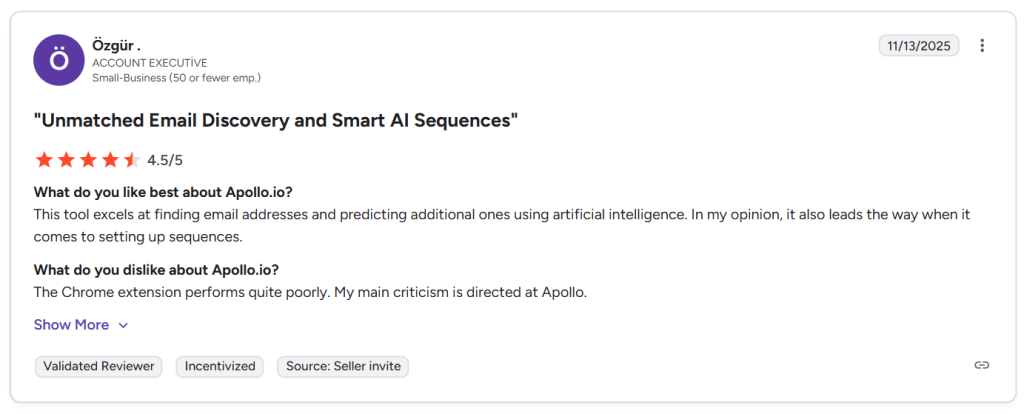
One account executive praised Apollo’s AI sequences but said the Chrome extension performs poorly.
Seamless AI also provides a Chrome extension (the “Real‑Time Search Engine”) that helps sales reps gather instant data about prospects, returning emails and direct dials with a click.
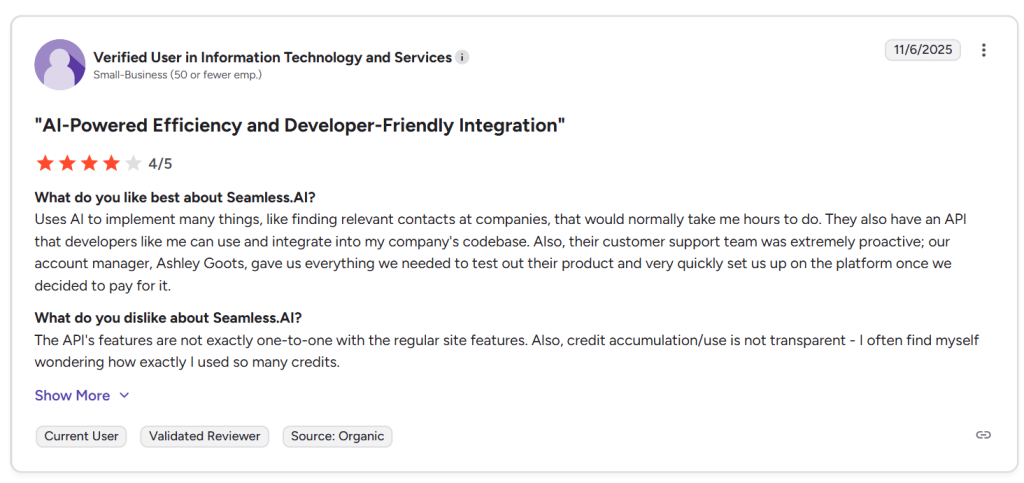
Reviewers like that the extension speeds up prospecting, but some note that the API and credit usage are not transparent.
The lead generation process and artificial intelligence
Both Apollo.io and Seamless AI advertise AI capabilities.
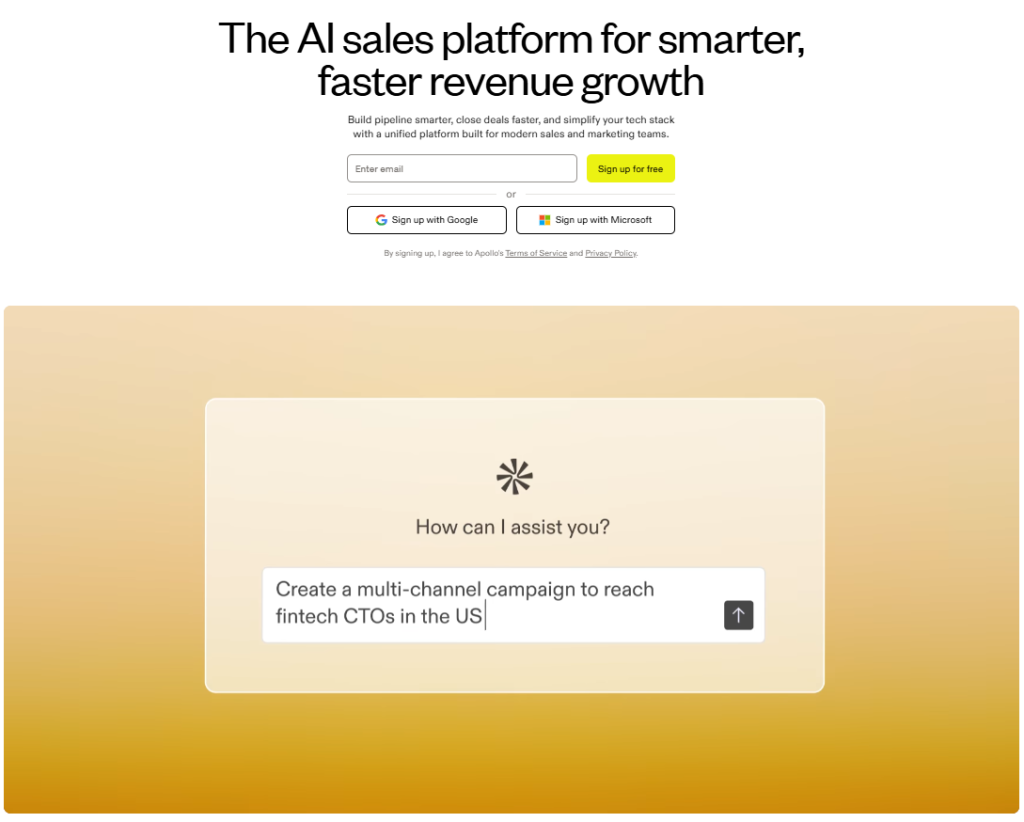
Apollo’s homepage shows a prompt asking its AI assistant to “create a multi‑channel campaign to reach fintech CTOs in the US”, which highlights how the tool can craft outreach sequences using machine learning.
Paid plans include AI research and AI lead scoring, which help users identify relevant contacts and refine targeting. Users often describe these features as helpful but note that there is a steep learning curve when navigating the many options.
Seamless AI uses artificial intelligence to find emails and predict additional contacts. Reviewers say the platform “excels at finding email addresses and predicting additional ones using AI”. Others appreciate the “user friendly interface” and easy navigation that AI enables.
However, the AI features (such as the AI assistant or AI driven data enrichment) are add‑ons and may cost extra.
Because of this, the base subscription may not include the real time data lookups that many sales teams expect.
User experience and interface
Apollo.io earns praise for a clean UI. A marketing specialist said the interface is “clean, fast, and intuitive,” and that the built‑in email sequences and LinkedIn automation save a lot of time.
At the same time, several reviewers mention that the CRM and email features are difficult to use and that getting used to all the options takes time.
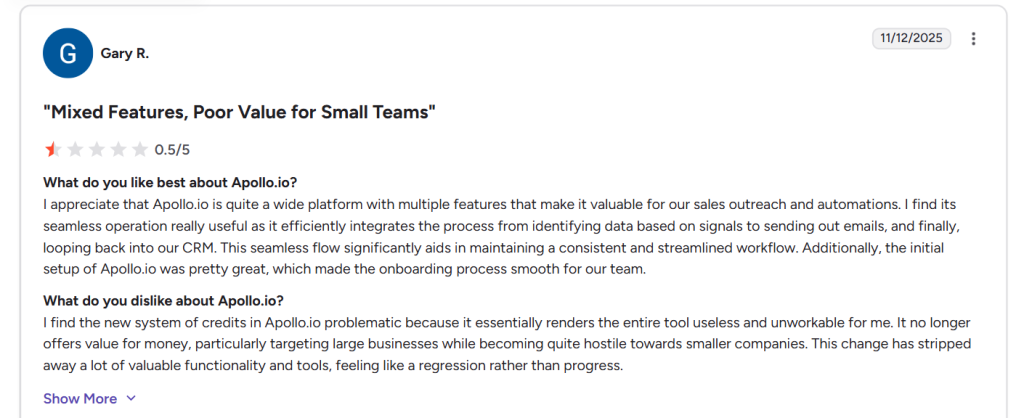
The credit system’s complexity adds friction for small teams, and some reviewers see the new credit model as a regression that removes value.
Seamless AI wins points for being easy to navigate. A business development rep said the platform “simplifies my workflow” and praised the ability to locate the right individual with minimal effort.
Another user highlighted the intuitive search feature that lets them type a company name and instantly view relevant contacts.
However, some users note that contact data can be inconsistent and that sales reps must manually double‑check details. Others point out that the credit model and the difference between API and site features are confusing.
Support, service and public data
Seamless AI offers a range of support options.
Enterprise customers get live training webinars, onboarding specialists and live chat, while free users are limited to a knowledge base and email support.
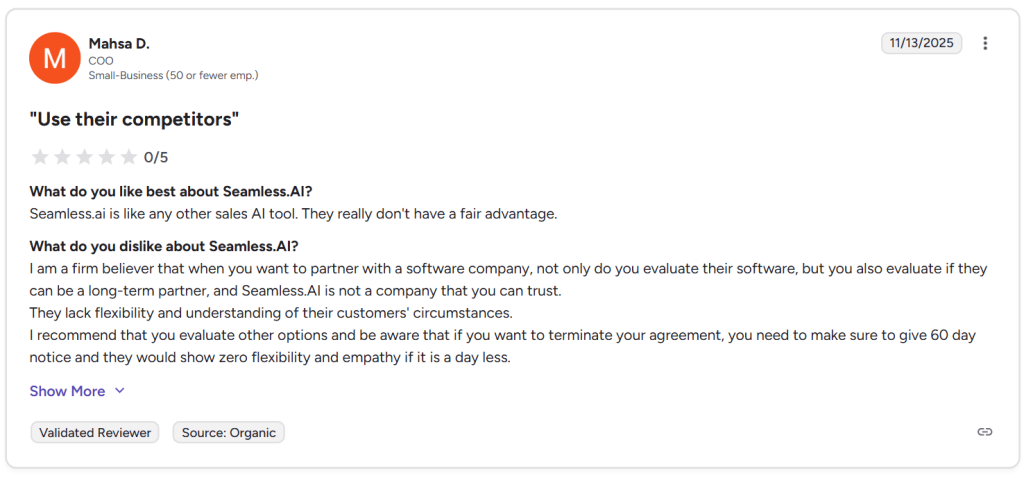
Some reviews praise the proactive support team and onboarding assistance. But there are negative stories: one COO warns that Seamless “lacks flexibility or empathy” and that terminating your agreement requires a 60‑day notice, with zero flexibility.
Apollo.io users generally view support as responsive, but complaints about the credit system and data accuracy often surface in reviews.
Because the platform sources data from a mix of public and third party data providers, coverage varies by region and industry.
Seamless AI also aggregates public data and vendor partnerships, which explains why some users find very rich contact details while others experience gaps in certain verticals.
Tech stack and integrations
Apollo.io integrates with Gmail, Outlook and CRMs such as Salesforce and HubSpot. It also supports CRM integrations via API and exports to CSV, making it possible to map leads into existing sales processes and sequences. The platform includes a sales tool dialer, outreach tools for LinkedIn and email, and advanced analytics for measuring replies and meetings.
Seamless AI concentrates on contact discovery, but its enterprise plans support API access and premium integrations, which let development teams embed contact search into their tech stack Customers note that Seamless’s API features are not always aligned with the regular site features and that credit usage is not transparent.
Limitations and steep learning curve
Both platforms come with caveats.
Apollo’s extensive feature set can overwhelm new users, leading to a steep learning curve. Reports of wrong phone numbers, inconsistent emails and the confusing credit system highlight the importance of verifying data and budgeting for extra credits.
Seamless AI’s biggest limitations are data inconsistency and the reliance on add‑ons. Several reviewers mention inconsistent contact details and missing information, while others worry that per‑credit costs become onerous for large sales teams.
The basic plan of both tools offers only a slice of functionality, requiring upgrades to access advanced features.
Woodpecker: a different approach
At Woodpecker we recognise that teams need accurate contact data and a robust outreach engine, but we believe that clarity, predictability and deliverability matter more than a long feature list.
We’ve built our platform to address the pain points that users voice about tools like Apollo.io and Seamless AI:
- Accurate contact information and deliverability
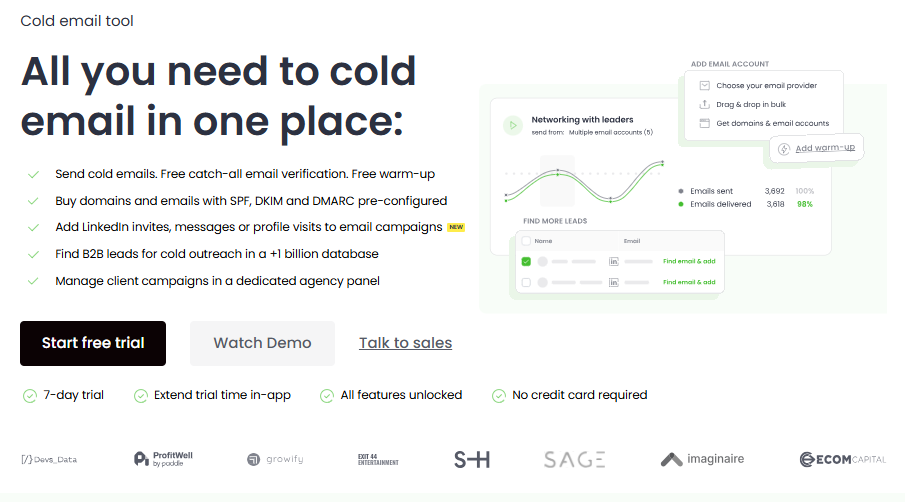
Woodpecker doesn’t sell a database. Instead, we integrate with trusted data sources and focus on verifying every email and warming every mailbox. Unlimited verification and warm‑up are built into every subscription, so your sales teams connect with prospects using real time contact data.
We even generate new domains and mailboxes with SPF, DKIM and DMARC configured for you, making sure your messages reach the business contacts you target.
- Transparent pricing plans
We price by the number of prospects contacted, not by user seats or credit packs. There are no hidden add‑ons and features like AI‑assisted writing, LinkedIn task automation, advanced filters, template A/B testing and reply detection come standard.
This affordable pricing model helps startups and sales professionals alike budget without surprises.
- Unified outreach and analytics
Our platform handles campaign management across email and LinkedIn with a single user friendly interface. You can schedule follow‑ups, insert conditional logic, and track opens, clicks and replies with detailed analytics.
A global contact database isn’t part of Woodpecker by design. Instead, we connect to whichever data source you prefer and help you nurture leads.
We also provide an agency panel for those managing multiple clients, enabling you to separate data, share templates and coordinate sequences across teams without extra seat fees.
- Predictable deliverability and warm‑up feature
Cold outreach fails when senders ignore deliverability. Woodpecker includes domain and mailbox warm‑up, bounce shield and reply classification on every tier. There is no per‑mailbox charge – you can connect unlimited mailboxes and run sequences concurrently, which is critical when your sales reps ramp up volume.
Thanks to avoiding credit systems and add‑on costs, Woodpecker aims to give sales and marketing teams a simple yet powerful stack that supports sales processes, sales strategies and growth without hidden fees.
If you’re evaluating sales intelligence tools like Apollo.io or prospecting tools like Seamless AI and need a partner that pairs outreach with deliverability and transparent pricing, Woodpecker might be the fit you’re looking for. Try it for free now.
Conclusion
Choosing between Apollo.io and Seamless AI depends on what you value most.
If you want a hybrid sales intelligence and engagement suite with multi‑channel sequences, AI scoring and email warm‑up, Apollo.io’s paid plans are comprehensive, though you’ll navigate credits and a heavy interface.
If you just need a real time search engine to pull accurate contact data fast, Seamless AI can accelerate prospecting, but be aware of data inconsistencies and add‑on costs.
Both platforms attempt to keep contacts fresh, yet reviews highlight inconsistent data accuracy, wrong phone numbers and extensive database gaps.
In the end, your choice should be guided by the balance of features you need, the pricing plans you can justify and the support you expect. For teams seeking predictable pricing, unlimited warm‑up and a unified outreach platform, Woodpecker stands out as a compelling alternative. Try it for free now.