


Demand generation and lead generation are often used as if they mean the same thing.
They do not.
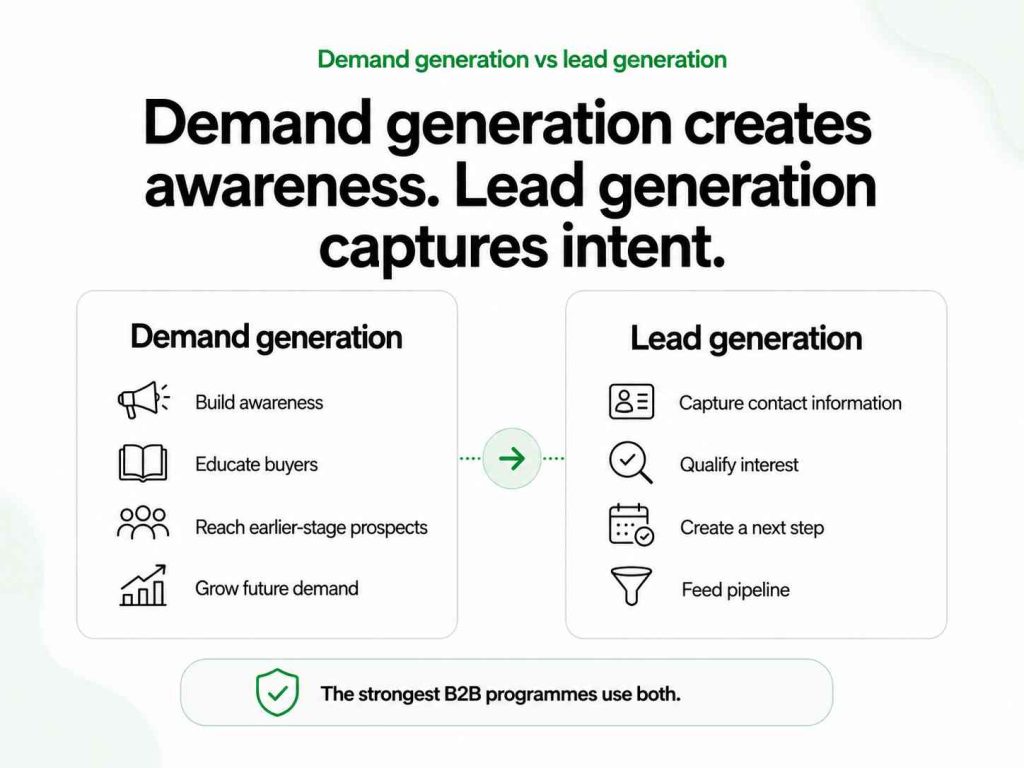
Demand generation creates awareness and interest in your product or service before someone is ready to share their contact information. Lead generation captures and qualifies that interest once a prospect is ready to take a more direct step.
For B2B teams, the distinction affects what you publish, what you gate, how you run marketing strategies, how you use outreach and how you judge pipeline quality.
Demand gen vs lead gen is not a choice between two opposing strategies. The strongest programmes use both. One helps more people understand why a problem deserves attention. The other gives your sales team a way to start useful conversations with the right prospects.
What is demand generation?
Demand generation is the work of creating awareness and interest in your brand, category or product before a buyer is actively looking for a solution.
A demand generation campaign may use educational content, thought leadership, webinars, LinkedIn posts, podcasts, events, community activity or useful industry research.
The immediate goal is not always to capture contact information.
Instead, demand generation builds awareness. It helps prospects recognise a problem, understand possible solutions and remember your brand when timing changes.
For example, a B2B company may publish an ungated guide on how to improve outbound reply quality. Someone may read it months before they have a budget, a team or a reason to buy an outreach platform.
That person is not necessarily a lead yet. But they may now know the company behind the content and associate it with a useful idea.
Demand generation creates awareness and interest over time. It does not need every interaction to turn into a form fill.
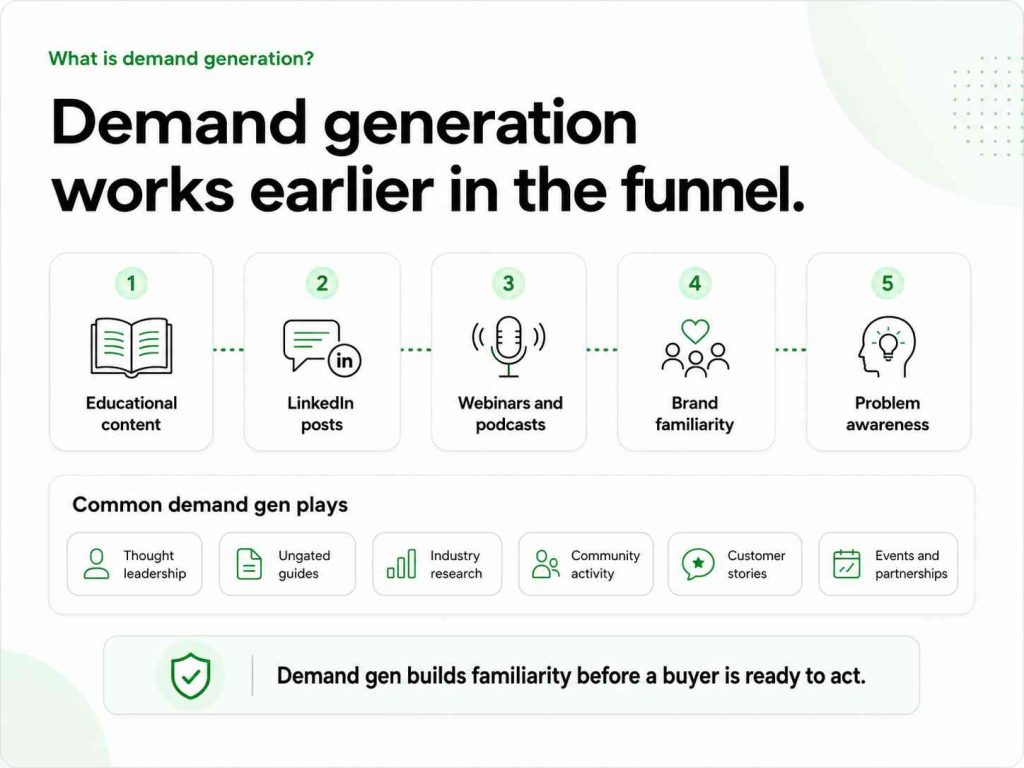
That is why ungated content often plays a central role. A useful article, video or LinkedIn post can reach more people when it does not ask for an email address before delivering value.
For content ideas that speak to early-stage B2B buyers, sales prospecting techniques and the ideal customer profile framework can help shape topics around real business problems rather than product features.
What is lead generation?
Lead generation is the process of identifying, capturing and qualifying potential buyers.
It usually begins when a prospect takes an action that gives you a way to follow up. They may complete a form, request a demo, start a free trial, register for a webinar or reply to a cold email.
Lead generation captures contact information and turns anonymous attention into a trackable sales or marketing opportunity.
A typical lead generation flow may look like this:
- A prospect finds a landing page through search, social media or a campaign.
- They download a guide, sign up for an event or request a demo.
- The business captures contact information.
- The lead is scored, routed or nurtured.
- A sales rep follows up when the prospect is ready.
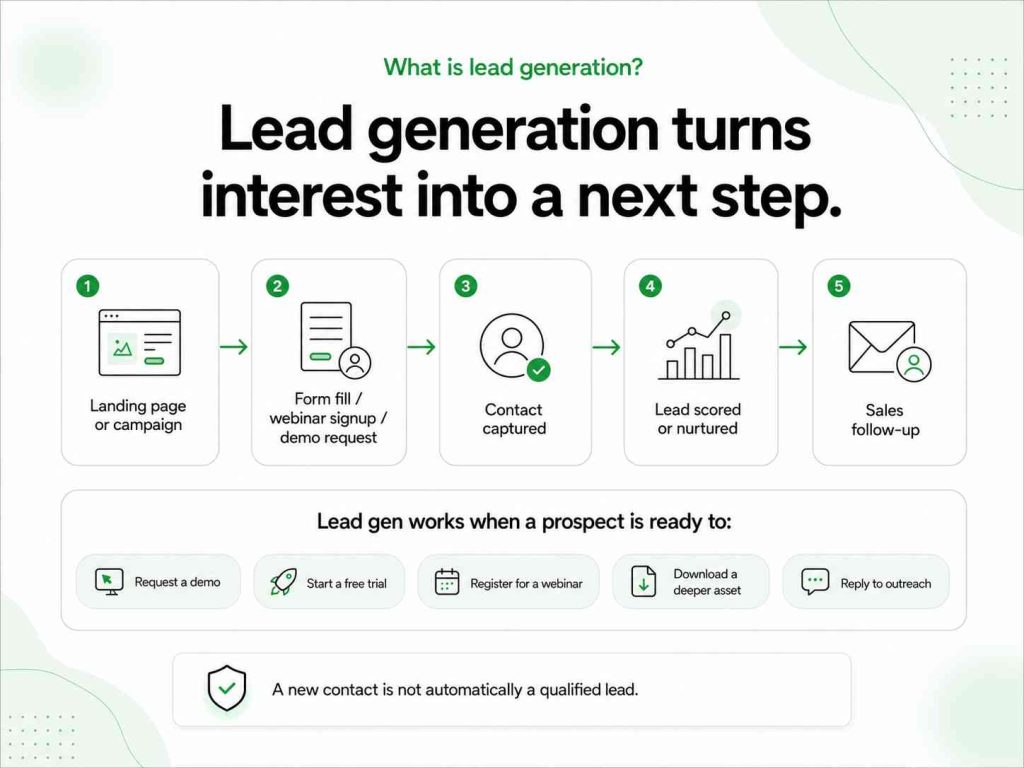
Lead generation focuses on creating a next step. It is usually closer to pipeline creation than demand generation.
That does not mean every new lead is ready to buy.
A person who downloads an ebook may only be researching. A webinar attendee may be curious about a topic but have no active project. A free trial user may never become a qualified lead.
The job of lead generation is to give sales and marketing teams a clear way to identify, qualify and nurture those contacts over time.
For a more practical look at that handoff, how to qualify new sales leads breaks down what teams should check before treating a contact as sales-ready.
Demand generation vs lead generation: the key differences
The difference between demand generation and lead generation is mostly about timing and intent.
Demand generation works earlier in the funnel. It creates familiarity before someone is actively comparing vendors or looking for a sales conversation.
Lead generation works when a prospect is ready to exchange some form of information or attention for a next step.
Demand generation asks:
How do we create demand for our product among the right future buyers?
Lead generation asks:
How do we capture and qualify the people who are showing enough interest to act?
Demand generation may focus on brand awareness, educational content and creating awareness around a category problem.
Lead generation may focus on a landing page, a lead magnet, a free trial, a webinar registration or a demo request.
Demand gen usually has a longer horizon. Lead gen often has a more immediate pipeline goal.
Neither is better by default.
A company can run highly efficient lead generation campaigns and still struggle because too few prospects know the brand or understand why the category is relevant. Another business may build strong demand but fail to convert that awareness because there is no clear path from content to a next step.
Demand generation vs lead generation only becomes useful when you connect both sides of the funnel.
Demand and lead generation work together
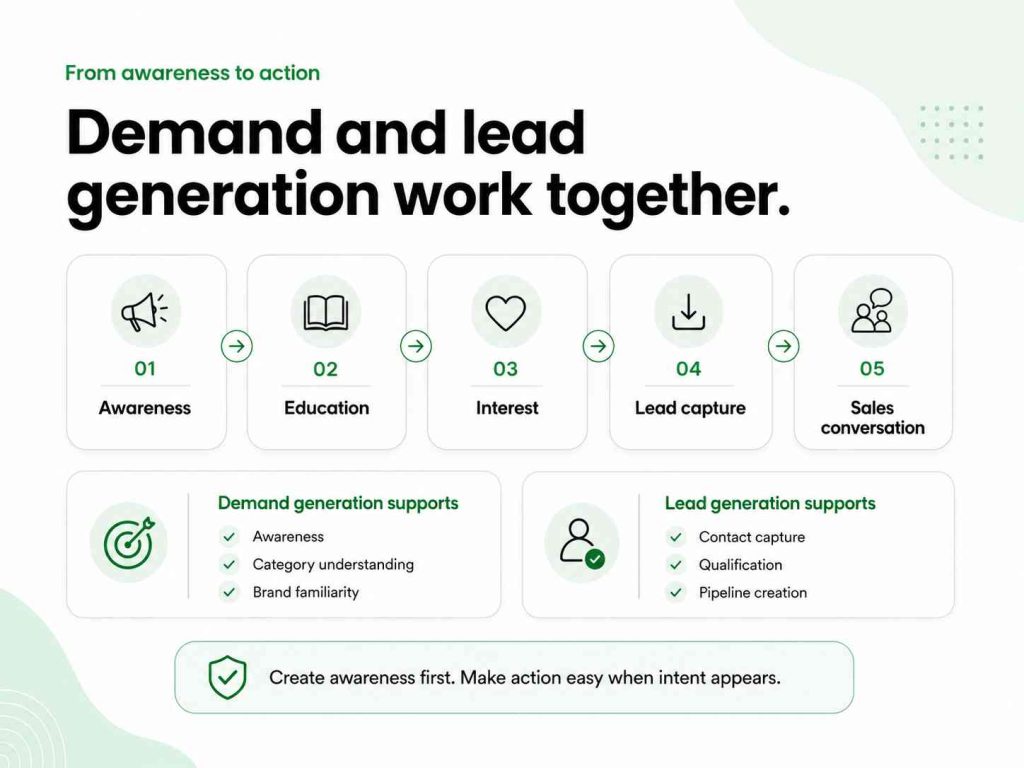
Demand generation and lead generation work together when the business gives buyers a path from awareness to action.
Demand generation builds the audience. Lead generation converts that awareness into identifiable contacts, conversations and potential pipeline.
A prospect may first encounter your company through an ungated article, a podcast appearance or a LinkedIn post. Weeks later, they may search for a more specific solution, visit a product page and request a demo.
The first interaction supported demand creation. The later action supported demand capture.
That is why demand and lead generation marketing should not be run as separate worlds.
The content team may create awareness and interest in your brand. The growth team may create lead generation assets. The sales team may use those assets in outreach or follow-up conversations.
For example, a sales rep may share an ungated piece of educational content after a cold email reply. That does not force the prospect into a funnel. It gives them a useful reason to keep engaging.
A well-timed sales follow-up email can use that content naturally, especially when a prospect is interested but not ready for a meeting.
Demand generation creates awareness before lead capture
Demand generation creates awareness before a prospect becomes identifiable.
That may feel less measurable than a form fill. But it can influence who shows up later, how familiar they are with your company and how much explanation a sales rep needs to do.
Demand generation efforts often include:
- thought leadership
- educational content
- category-level guides
- webinars
- podcasts
- LinkedIn content
- industry reports
- customer stories
- ungated resources
- partnerships and events
The focus is not always immediate conversion.
A useful demand generation campaign might explain why outbound teams need to separate data enrichment from outreach execution. It may help a future buyer understand the problem before they are ready to compare software.
That is different from a lead generation page that asks someone to request a demo or start a free trial.
Demand generation fills the top of the funnel with people who now recognise the problem and know your brand exists.
Strong demand makes lead capture easier later because the prospect is not meeting you for the first time in a high-pressure moment.
Lead generation captures contact information and intent
Lead generation captures contact information once someone is ready to take a step beyond passive consumption.
That step might be small.
A prospect may subscribe to a newsletter. They may sign up for a webinar. They may download gated content. They may reply to outreach. They may use a free trial or request a product demo.
The point is not to gate everything.
Gated content can be useful when the asset has clear value and the person receiving it is likely to want more help. An in-depth benchmark, template or specialist research report may justify a form.
But a basic article should not be locked away simply to generate more names for a spreadsheet.
Too much gating can damage demand generation because fewer people get to see the useful work in the first place.
A better split often looks like this:
- Use ungated content for awareness and education.
- Use gated content for deeper assets with real perceived value.
- Use landing pages for clear, high-intent actions.
- Use lead scoring to separate casual interest from qualified demand.
- Use nurture when timing is uncertain.
Lead generation captures contact information, but a contact is not automatically a qualified lead.
That distinction becomes especially important in B2B marketing, where several stakeholders may influence the buying decision and the sales cycle may take months.
Demand gen vs lead gen in a B2B sales funnel
Demand gen and lead gen play different roles in a B2B sales funnel.
At the top of the funnel, demand generation creates awareness around a challenge, category or new way of working.
In the middle of the funnel, lead generation gives interested people a more direct way to engage. That may include a webinar, a template, a guide, a newsletter subscription or a product walkthrough.
Further down the funnel, sales and marketing teams qualify the lead, nurture the relationship and decide whether a direct sales conversation makes sense.
The funnel is not always linear.
A prospect may read several articles, disappear for three months and then reply to a cold email. Another may request a demo immediately after discovering the brand. A third may become a customer after being influenced by content they never converted on.
That is why B2B demand should not be measured only through last-click attribution.
Demand generation builds the mental availability that makes later lead generation more effective.
Lead generation turns attention into a path the business can work with.
Lead generation tactics that support demand generation
Lead generation tactics work best when they do not interrupt the demand you have worked to create.
A lead magnet should connect naturally to the content that introduced the problem. A landing page should make the next step obvious. A nurture sequence should feel like an extension of the topic, not a sudden sales push.
For example, someone reading about outbound deliverability may be interested in:
- a deliverability checklist
- a domain setup guide
- a short audit
- a product walkthrough
- a workshop on improving cold email infrastructure
They may not be ready for a generic “Book a demo” button on every page.
Lead generation strategies should follow the level of intent already shown.
That is where lead nurturing becomes useful.
A prospect who is not ready to buy may still appreciate relevant educational content, a practical case study or an invitation to a webinar. The goal is to stay useful without treating every interaction as an immediate sales opportunity.
For outbound teams, how to create a cold email sales funnel shows how early messages can move from first contact to meaningful interest without rushing the prospect.
Where outbound and cold email fit
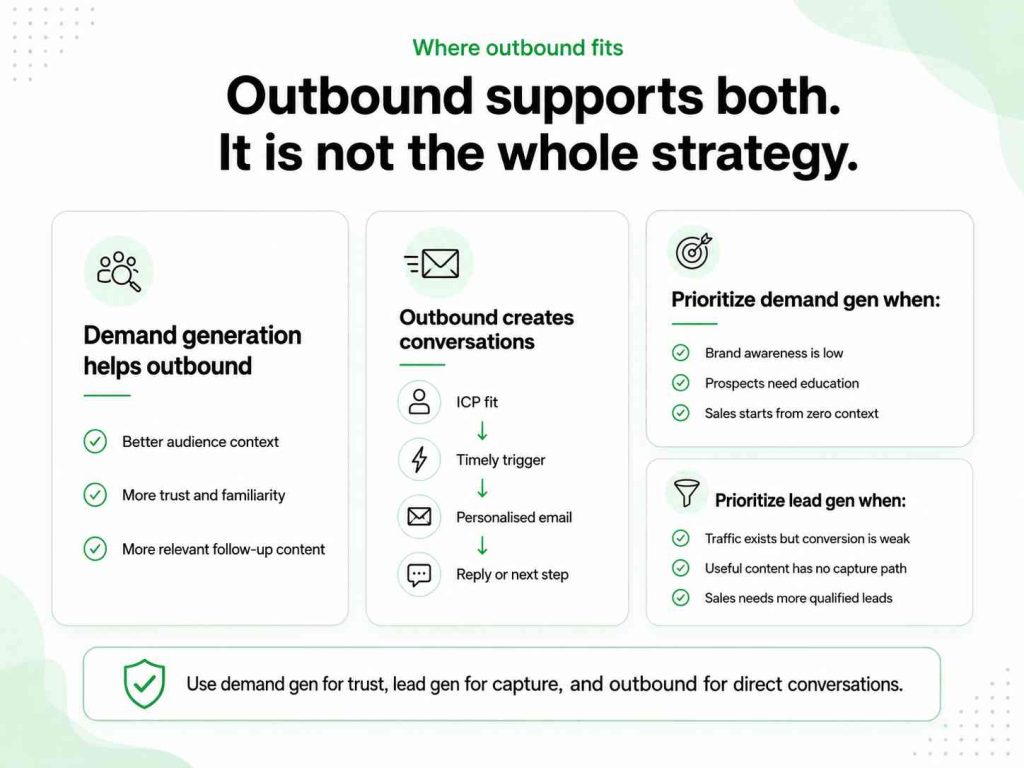
Outreach can support both demand generation and lead generation, but it should not be confused with either one.
Cold email is not demand generation in the same way as content, thought leadership or brand campaigns. It is a direct channel used to create conversations with specific prospects.
It can support lead generation when the team targets relevant accounts, uses a clear reason for writing and gives the prospect an easy next step.
For example, a sales rep may identify a company that fits the ideal customer profile, notice a timely business trigger and send a personalised cold email.
That email can create a new lead if the prospect replies, asks for more information or agrees to a meeting.
Cold outreach works best when it does not act like a mass distribution channel.
The prospect should understand why the email is relevant to them. A message based on a generic job title or a vague company compliment is unlikely to create useful demand or high-quality pipeline.
Personalised cold emails are more effective when they start from account context. For a larger strategy, account-based prospecting can help teams decide which accounts deserve that level of effort.
How demand generation and lead generation work with LinkedIn
LinkedIn can support both demand generation and lead generation.
For demand gen, LinkedIn works well for sharing useful opinions, practical advice, short educational posts and visible thought leadership. The aim is to build familiarity with the right audience before they are ready to engage directly.
For lead gen, LinkedIn can support more targeted activity. A business may use event signups, lead forms, direct conversations or targeted campaigns to capture contact information and create a more direct follow-up path.
The key is not to treat LinkedIn as a shortcut to cold pitching.
A person who has liked a post is not automatically a sales-ready prospect. A connection request is not a licence to send a long product pitch. The same standards apply as in email: relevance, timing and a clear reason to start the conversation.
Woodpecker’s LinkedIn outreach guide can help teams use LinkedIn alongside email without repeating the same message across channels.
How to prioritize demand generation vs lead generation
The question is not always whether to prioritize demand generation vs lead generation.
The better question is where the current bottleneck sits.
Prioritize demand generation when:
- your target market does not know the category well
- prospects need education before they recognise the problem
- brand awareness is low
- sales conversations start from zero context
- your content reaches too few of the right people
- lead generation campaigns have weak conversion rates because trust is low
Prioritize lead generation when:
- demand already exists but there is no clear conversion path
- your website receives relevant traffic but few prospects become identifiable
- marketing has useful content but no clear lead capture strategy
- sales teams do not receive enough qualified leads
- a free trial, demo or webinar has poor follow-up
- contact information is collected but not routed quickly
Most companies need both.
A business with strong demand but weak lead gen may have lots of attention and little pipeline. A business with aggressive lead gen but no demand may have a large contact database and low-quality conversations.
The right balance changes by company stage, sales cycle and buyer maturity.
Demand generation and lead generation by business stage
Early-stage B2B companies often need more demand generation than they expect.
The market may not understand the problem yet. The product may be new. The brand may have little trust. In that case, educational content and category positioning can create stronger future demand than forcing every visitor into a gated form.
A more established company may already have interest in its category. It may need better lead generation campaigns, improved lead scoring or stronger routing between marketing and sales.
A company with a mature outbound motion may need a third layer: using demand generation content to make cold outreach more credible.
For example, a sales rep can refer to a useful guide, customer example or industry insight when following up with a prospect. That does not replace direct outreach. It gives the conversation more substance.
The two strategies support each other.
Demand generation builds trust and familiarity. Lead gen captures intent. Outbound can turn a relevant signal into a direct conversation.
Understanding the difference between lead generation and demand generation
Understanding the difference between lead generation and demand generation helps teams avoid bad incentives.
Demand generation should not be judged only on form fills.
Lead generation should not be judged only on the number of contacts captured.
The better measures are closer to business outcomes.
For demand generation, look at:
- relevant audience growth
- branded search interest
- engaged returning visitors
- content distribution
- audience quality
- sales feedback on brand awareness
- influence on later pipeline
For lead generation, look at:
- qualified leads
- conversion rates
- speed to follow-up
- lead-to-opportunity rate
- pipeline created
- sales acceptance
- revenue contribution
Those measures reveal the key differences in how the two functions operate.
Demand generation builds awareness and interest. Lead generation turns that interest into trackable opportunities. Both can influence pipeline, but they should not be expected to do the same job.
Demand and lead generation marketing: common mistakes
The most common mistake is treating gated content as the only form of marketing.
That can lead to a site full of forms, low-value ebooks and weak audience reach.
Another mistake is treating demand generation as brand activity with no connection to sales. Demand creation should still focus on a relevant audience, useful business problems and a category position the company can own.
Other common issues include:
- using a lead magnet that does not match the landing page topic
- sending sales emails before a lead has shown enough interest
- measuring a demand generation campaign only through direct conversion
- ignoring nurture after someone shares contact information
- treating a cold email reply as a qualified opportunity
- asking sales reps to follow up on every lead in the same way
- building content around product features instead of buyer problems
Demand and lead generation work better when sales and marketing agree on what a qualified lead looks like and what happens after one appears.
Cross-channel lead generation can help bring those channels into one practical workflow instead of treating them as isolated campaigns.
Frequently asked questions
What’s the difference between demand generation and lead generation?
Demand generation creates awareness and interest in a brand, category or problem before a buyer is ready to act. Lead generation captures contact information and identifies people who show enough intent for a follow-up.
Is demand generation top of the funnel?
Demand generation often begins at the top of the funnel because it creates awareness and interest before a prospect becomes a lead. It can also support later stages through educational content, thought leadership and trust-building.
Can you do lead generation without demand generation?
You can, especially through outbound, paid campaigns or high-intent search. But lead generation without demand often creates colder conversations, lower conversion rates and more pressure on sales reps to explain the category from scratch.
Which has a shorter sales cycle: demand gen or lead gen?
Lead generation usually has a shorter route to a direct sales action because it captures an identifiable prospect. Demand generation often works over a longer period because it builds awareness before someone is ready to buy.
Demand generation vs lead generation: use both to build a healthier pipeline
Demand generation creates awareness before the buyer is ready to raise their hand.
Lead generation creates a route for that buyer to become known, qualified and followed up.
The strongest B2B marketing programmes do not force a choice between demand gen vs lead gen. They use demand creation to build trust, then use lead generation tactics to capture active intent when it appears.
For outbound teams, the same principle applies.
Use demand generation content to give prospects useful context. Use targeted outreach to start relevant conversations. Use clear lead qualification to protect the sales pipeline from low-intent activity.
Inbound sales can show how buyers move from interest to a sales conversation, while B2B lead generation tools can help teams build a more practical system for capturing and working the right leads.