


Every guide to email warmup tools looks the same. Eleven logos, three sentences each, a vague “our pick” at the top, and nothing that helps you actually decide. The rankings are usually affiliate-driven, the “tested” claims are rarely testable, and two different guides will give you completely different number-one picks.
Warmup tools do a real job, and the differences between them matter more than most rankings suggest. But the difference isn’t “tool A is 8/10 and tool B is 7/10.” The difference is whether a tool’s underlying warmup network is large enough to produce clean signals, whether the randomization is sophisticated enough to avoid detection, whether it integrates with the rest of your stack, and whether the ongoing cost makes sense for your actual send volumes.
This guide covers how to evaluate warmup tools instead of just listing them, the specific categories worth knowing about, honest notes on the major players, the network-size issue that matters more than almost any other feature, and how Woodpecker integrates warmup through partnerships with Warmy and Mailivery as part of a broader deliverability stack.
The short version: the “best” warmup tool depends on what you’re warming up, how many mailboxes, what your sending volume looks like, and whether warmup is a standalone purchase or part of a platform you already use. Generic rankings miss all of that.
Before the tools: what actually matters when evaluating warmup
Five things separate warmup tools that work from ones that burn budget. Most comparison posts don’t mention any of them.
1. Network size and diversity
Warmup tools operate networks of interconnected mailboxes that exchange warmup emails with yours. The size and quality of that network is the single biggest variable in how much real signal your warmup generates.
A warmup tool with 30,000 mailboxes in its network — which is typical for mid-tier tools — produces warmup traffic that comes from the same 30,000 IPs over and over. Inbox providers can detect this pattern. The warmup engagement is real, but it carries progressively less weight as inbox providers recognize the warmup network fingerprint.
The better-funded, larger warmup tools operate networks of 100,000+ mailboxes across diverse providers, geographies, and domain types. The signals they generate look closer to genuinely diverse legitimate correspondence.
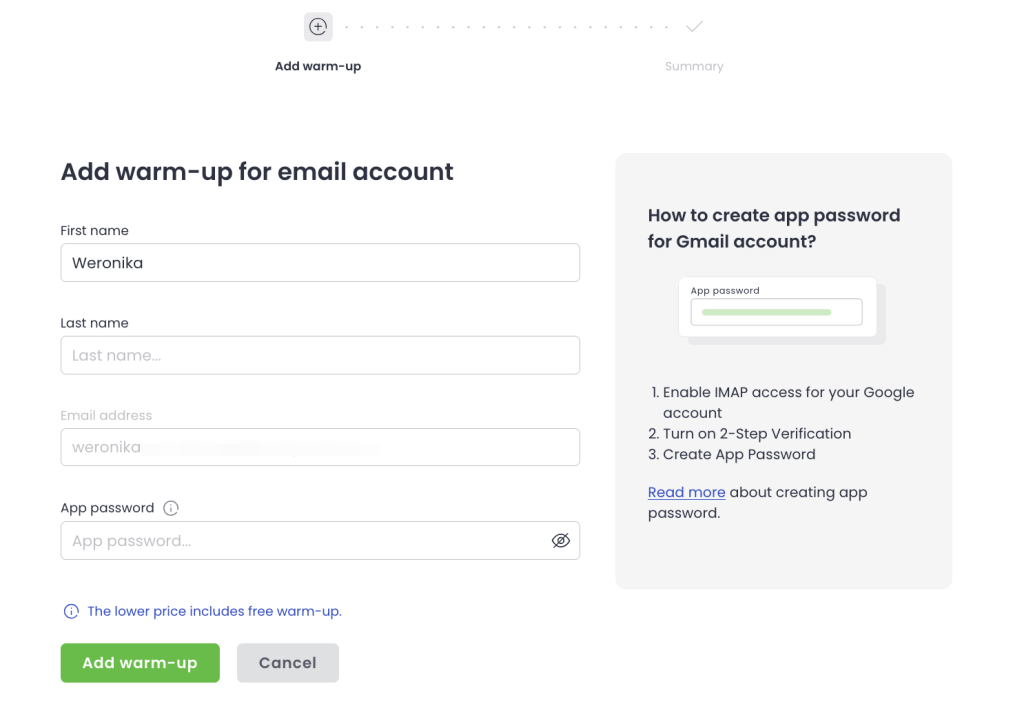
Most warmup tool listings don’t mention network size at all. It’s one of the first questions to ask any vendor. Check how warmups works in Woodpecker.
2. Randomization sophistication
A warmup tool that sends 20 emails on Monday, 20 on Tuesday, 20 on Wednesday — all at 10am, all to the same recipients — is producing obvious patterns that get discounted.
Good warmup tools randomize send times within realistic business-hour windows, vary the recipients significantly day to day, rotate subject line patterns, and adjust volume in non-linear ways. The goal is warmup traffic that’s indistinguishable from real correspondence at the pattern-analysis level.
Weak warmup tools are rigid and predictable. Strong warmup tools look like chaos that happens to have positive engagement attached.
3. Authentication and sending integrity
Warmup tools need to send from your actual mailbox using your actual authentication (SPF, DKIM, DMARC). A tool that sends “warmup-on-your-behalf” through some relay is building reputation for the relay, not for your domain.
Every legitimate warmup tool today connects directly to your mailbox via OAuth (for Gmail and Microsoft) or SMTP credentials. If a vendor’s setup looks different — especially if they offer to “send warmup for you without connecting your mailbox” — be skeptical.
4. Integration with your sending platform
Warmup runs in the background of whatever your actual sending workflow is. If warmup is on a separate tool with separate dashboards and separate settings, the cognitive overhead adds up. If warmup is integrated into the platform you actually use for real campaigns, it fades into the workflow.
This is where integrated cold email platforms (Woodpecker’s partnerships with Warmy and Mailivery being one example) have a structural advantage over standalone warmup services — the same mailbox is used for both, the configuration is in one place, and there’s no gap between warmup completion and real campaign start.
5. Ongoing cost at real sending volumes
Warmup tool pricing often looks reasonable at one or two mailboxes, then scales aggressively. A tool that costs $10/mailbox/month feels cheap until you have 15 mailboxes across three sending domains, at which point it’s $150/month for something that should be a baseline utility.
For teams running cold email at any real volume, the math on standalone warmup tools versus integrated platform warmup usually favors integrated platforms. This isn’t a marketing pitch — it’s arithmetic.
The categories of warmup tools
Not all warmup tools are the same product. Three distinct categories, each with different economics and use cases.
Category 1: Standalone dedicated warmup services
Tools that do only warmup. You connect your mailbox, they run warmup, you use a different tool for actual sending. Examples: Warmup Inbox, Warmy, Mailivery, Folderly, InboxAlly, MailToaster.
Strengths: Typically have larger warmup networks and more sophisticated randomization than platform-integrated warmup, because warmup is their only product. Good for teams who want best-in-class warmup and are willing to manage it separately.
Limitations: Separate subscription, separate configuration, no direct integration with the sending workflow. Costs add up fast at multiple mailboxes.
Best for: Teams whose sending platform doesn’t include warmup, or teams warming up mailboxes for purposes other than cold email (newsletter senders, transactional email senders).
Category 2: Sending platform-integrated warmup
Cold email and outbound platforms that include warmup as part of the product. The warmup runs on the same mailboxes used for real campaigns; configuration is inside the platform.
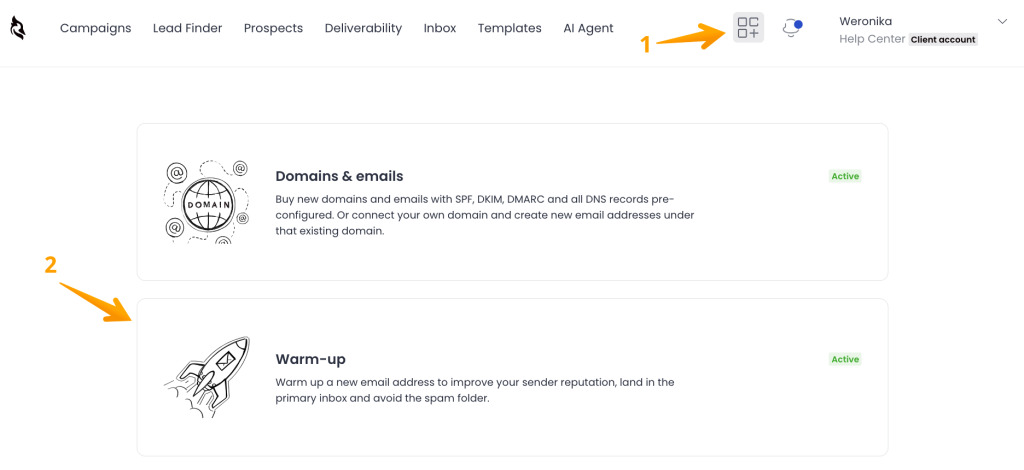
Woodpecker sits in this category through partnerships with Warmy and Mailivery — both white-labeled inside the Woodpecker interface, with users choosing which provider to activate. More on how this specifically works later in the guide.
Strengths: No separate subscription, unified workflow, warmup and sending on the same mailbox by default. Usually meaningfully cheaper than standalone warmup at real volumes.
Limitations: Warmup depth depends on the platform’s warmup partnership or build. Some integrated warmup is genuinely competitive with standalone tools; some is minimal.
Best for: Teams whose primary outbound channel is cold email, especially at multi-mailbox volumes where standalone warmup pricing becomes painful.
Category 3: Free or freemium warmup
Tools offering free tiers, usually with limited mailbox count or limited daily warmup volume. Examples: Warmup Inbox (freemium), emailwarmup.com (free), various others.
Strengths: Cost. Useful for testing, for hobbyists, or for very small-scale sending.
Limitations: Smaller networks (sometimes much smaller), less sophisticated randomization, and usually a clear upsell path to paid tiers. Free warmup is rarely “just as good” as paid warmup — it’s free for a reason.
Best for: Testing before committing to a paid solution, or very low-volume hobbyist sending where the signals can carry weaker warmup.
The major warmup tools: honest notes
Brief summaries of the tools that come up most frequently in 2026. This isn’t a ranking — use case fit matters more than an aggregated score.
Warmup Inbox
One of the most established standalone warmup services. Large network, straightforward interface, freemium tier available. Works with Gmail, Microsoft, and SMTP. Strong general-purpose option for teams that want standalone warmup without complexity.
Pricing: Starts around $19/mailbox/month at volume. Freemium tier has meaningful volume limits.
Warmy.io
One of the warmup providers Woodpecker users get free access to through the platform’s partnership. Standalone service for non-Woodpecker users. AI-driven approach to network engagement patterns. Works with major inbox providers and SMTP. Strong focus on monitoring and reporting alongside the warmup itself.
Pricing (standalone): Mid-tier; starts around $49/mailbox/month for paid plans.
Free for Woodpecker users through the built-in partnership integration.
Mailivery
The second warmup partner in Woodpecker’s integration. Standalone service with a focus on multi-mailbox and agency use cases. Uses peer-to-peer warmup networks. Detailed reputation reporting and recovery workflows.
Pricing (standalone): Similar tier to Warmy, typically $25-60/mailbox/month. Free for Woodpecker users through the built-in integration.
Folderly

Standalone service focused on deliverability more broadly than just warmup. Includes spam trigger analysis, placement monitoring, and ongoing optimization. More expensive than most warmup-only tools; fits teams that want a full deliverability consulting layer alongside the automated warmup.
Pricing: Higher than most — often $200+/mailbox/month depending on tier. Positioned more as enterprise deliverability than warmup alone.
InboxAlly
Positions itself specifically around engagement-based reputation recovery. Uses human-simulated engagement rather than purely automated warmup network traffic. Different approach from most warmup tools; produces distinct results.
Pricing: Mid-to-upper tier, typically $149+/mailbox/month.
MailToaster
Lower-cost standalone option. Smaller network than the premium tools, which shows up in signal weight. Fits teams with price sensitivity and lower sending volumes.
Pricing: Entry-level; typically $19-39/mailbox/month.
Mailwarm, Snov warmup, and similar
Several mid-tier standalone options in roughly the same price/feature range as Warmup Inbox. Differences come down to network size, interface preference, and specific integrations. Worth testing 2-3 in a short pilot before committing.
Warmup tools vs. integrated platform warmup: the real tradeoff
The actual question most teams face isn’t “which warmup tool is best?” — it’s “should I pay for standalone warmup, or should I use integrated warmup that comes with my sending platform?”
The math depends on two variables: your sending volume and how much warmup sophistication you actually need.
When standalone warmup makes sense
You’re warming up mailboxes for non-cold-email purposes. Newsletter sending, transactional email, customer service inboxes. A cold email platform’s integrated warmup usually isn’t relevant here.
You need deliverability consulting, not just warmup. Tools like Folderly or InboxAlly offer more than pure warmup — they’re closer to deliverability services. If you need that layer specifically, standalone providers are better equipped.
You’re running very specific warmup scenarios. Recovery from severe reputation damage, multi-domain setups with complex authentication, or sending from unusual infrastructure. Standalone tools often have more configuration flexibility.
Your sending platform doesn’t include competitive warmup. Some cold email platforms have minimal warmup integration. In that case, pay extra for standalone warmup rather than relying on weak integrated warmup.
When integrated platform warmup wins
You’re running cold email at any real volume. Multi-mailbox setups where standalone warmup pricing compounds badly. Running 10 mailboxes through a $49/mailbox standalone tool is $490/month; most platforms with integrated warmup cost less than that for the whole product.
You want one workflow. Same mailbox, same configuration, same dashboard. The friction of maintaining separate warmup and sending systems adds up — not in dollars, but in small operational mistakes that accumulate.
Your integrated warmup has real teeth. Not every platform’s warmup is equivalent. Integrated warmup through genuine partnerships with dedicated warmup providers (Woodpecker with Warmy and Mailivery, for example) is a different thing than a platform’s lightweight built-in feature that uses a small internal network.
Look at why warmup alone isn’t sufficient regardless of which tool you use. Email warmup: top tools shows how warmup sits in the broader deliverability workflow.
The network-size problem most guides ignore
Worth expanding on because it’s under-covered elsewhere and it affects every warmup tool on the market.
Every warmup tool operates a network of participating mailboxes. Your warmup emails go to other mailboxes in the network; mailboxes in the network send emails to yours. The network generates the engagement signals that build reputation.
The problem: inbox providers have massively more total mailboxes than any warmup network. Gmail alone has roughly 1.8 billion active accounts. A warmup network of 30,000 mailboxes is a rounding error by comparison.
What this means practically:
Inbox providers notice patterns at scale. If 30,000 mailboxes repeatedly exchange emails with each other in warmup-network patterns, those mailboxes get flagged as part of a warmup network over time. The engagement signals from those mailboxes get discounted or filtered out of reputation calculations.
Large warmup networks partially solve this by being too big to easily fingerprint. A network of 100,000+ mailboxes across diverse providers and geographies produces signals that are harder to isolate from general email traffic.
Small warmup networks don’t solve it at all. They produce technically correct warmup mechanics — mails go out, mails come back, positive engagement signals accumulate — but the inbox providers increasingly recognize the pattern and weight it accordingly.
The implication: network size is one of the most important selection criteria for warmup tools, and it’s one of the least discussed. Ask vendors specifically: how many active mailboxes are in your network right now? Answers under 50,000 are a caution flag. Answers under 20,000 are usually a problem.
What warmup tools can’t fix
Worth naming because a lot of teams reach for better warmup when the real problem is elsewhere.
Bad list quality. Sending warmup-enhanced emails to unverified lists with 15% bounce rates destroys reputation faster than warmup can build it. Verification first, warmup second.
Inadequate authentication. Warmup on a domain with broken SPF, DKIM, or DMARC produces weak signals because the baseline trust isn’t there. Fix authentication before worrying about warmup tool selection.
Content that reads as spam. No warmup tool compensates for subject lines and body copy that trigger spam filters. The content needs to be clean regardless of reputation.
Mixing opt-in marketing with cold outreach on the same domain. Warmup can’t resolve the conflicting signals this creates. Separate sending domains are mandatory.
Severe reputation damage. Once a domain has been flagged hard — spam trap hits, high complaint rates, blocklist additions — recovery requires pause and time, not more warmup volume. In extreme cases, starting fresh on a new domain is faster than rehabilitating a damaged one.
And why emails bounce? Read 10 most common issues!
How Woodpecker handles email warmup
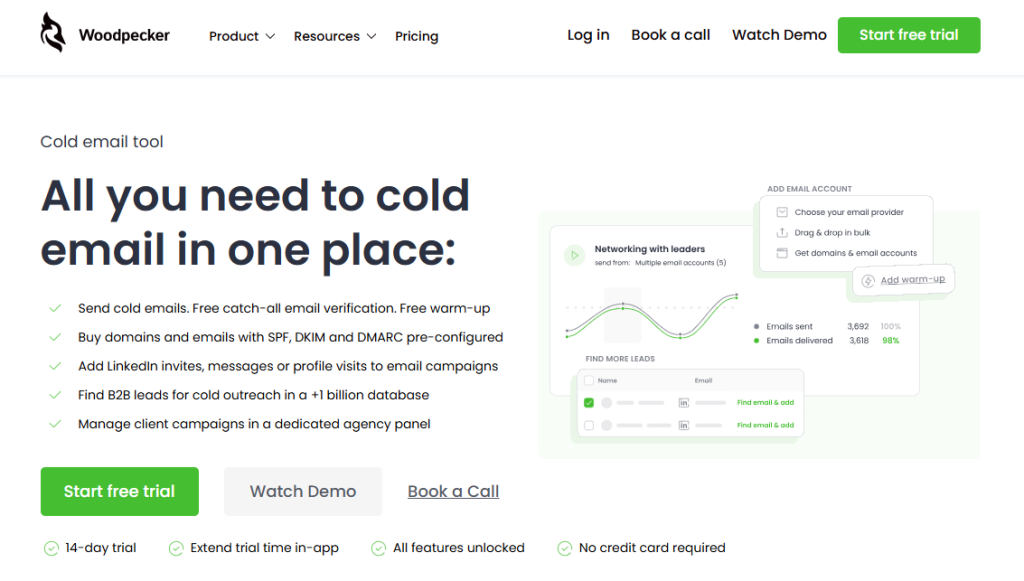
Woodpecker integrates warmup through partnerships with Warmy and Mailivery — both white-labeled inside the Woodpecker interface, with users picking which warmup provider they want to run on each mailbox.
What this actually means
Free warmup as part of the platform. Both Warmy and Mailivery warmup access is included in Woodpecker plans without separate subscription costs. For reference, standalone access to either tool typically costs $25-60/mailbox/month.
User choice between providers. Different warmup providers perform differently depending on mailbox setup, inbox provider, and sending patterns. Woodpecker lets users pick which partnership to activate rather than locking into one approach. Most teams test both on different mailboxes and stick with whichever produces better inbox placement for their specific configuration.
White-labeled integration. The warmup runs in the background of the Woodpecker workflow rather than requiring switching between tools. Connection, configuration, and monitoring happen inside the Woodpecker UI; the warmup itself operates continuously once enabled.
Same mailbox for warmup and sending. This sounds obvious but matters — warmup signals attach to the specific mailbox running warmup, and if that’s not the same mailbox doing real sending, the warmup effort is wasted on the wrong asset. Integrated warmup eliminates this risk by design.
Warmup as part of the full deliverability stack
Warmup alone doesn’t solve deliverability. Woodpecker provides warmup alongside the rest of the infrastructure that actually determines whether emails reach the primary inbox:
Inbox rotation. Across multiple mailboxes, randomized send intervals, automatic throttling. Works in parallel with warmup — warmup builds reputation, Adaptive Sending maintains it during real campaigns.
Deliverability. Continuous tracking of inbox placement across major providers. Surfaces reputation drift early.
Free unlimited catch-all email verification. Every address verified before sending. Prevents bad list quality from undoing warmup effort.
For teams running cold email at multi-mailbox scale, the integrated approach removes the subscription sprawl and configuration overhead of standalone warmup. For teams running warmup for non-cold-email purposes, standalone warmup tools in the category 1 list above are the right fit.
Sign up to Woodpecker to run warmup, verification, sequencing, & more.
FAQ
What is the best email warmup tool in 2026?
There’s no single “best” — it depends on use case. For standalone warmup of non-cold-email mailboxes, established tools like Warmup Inbox, Warmy, and Mailivery are solid choices. For deliverability consulting alongside warmup, Folderly or InboxAlly fit. For cold email at multi-mailbox volumes, integrated platform warmup (like Woodpecker’s free access to Warmy and Mailivery through platform partnerships) usually wins on cost and workflow simplicity. The “best” tool is the one that matches your specific sending context.
How do I choose an email warmup tool?
Evaluate on five criteria: network size (bigger and more diverse is better; under 50,000 mailboxes is a caution flag), randomization sophistication (varied send times, recipients, and patterns), authentication integration (direct connection to your mailbox via OAuth or SMTP), integration with your sending platform, and total cost at your actual mailbox count. Generic rankings that ignore these factors rarely produce decisions that hold up in production.
Are free email warmup tools worth using?
For testing or very low-volume sending, yes. For serious cold email operations, usually not — free warmup tools typically operate smaller networks, with less sophisticated randomization, and produce weaker signals than paid alternatives. If cost is a serious constraint, integrated platform warmup (like Woodpecker’s free access to Warmy and Mailivery) is usually a better value than free standalone tools.
Do I need a warmup tool if my sending platform already includes warmup?
Depends on how good the integrated warmup actually is. Not every platform’s built-in warmup is equivalent to a dedicated standalone tool. Integrated warmup through genuine partnerships with dedicated warmup providers (like Woodpecker with Warmy and Mailivery) is typically competitive with standalone options. Weaker platform-native warmup may not be. Test before deciding.
How does Woodpecker’s warmup compare to standalone warmup tools?
Woodpecker’s warmup is the same warmup as standalone Warmy and Mailivery — those are the underlying providers through platform partnerships. The difference is that it’s included free with Woodpecker plans (versus $25-60/mailbox/month standalone), runs on the same mailbox as real campaigns (eliminating the misconfiguration risk of separate warmup and sending systems), and integrates with the rest of Woodpecker’s deliverability infrastructure (Adaptive Sending, Deliverability, catch-all verification).