


TL;DR
- Wait 3–4 business days before sending the first follow-up after a cold email.
- Send 3–5 follow-ups in most cold outreach sequences, with longer gaps between later messages.
- Keep the follow-up shorter than the original email and introduce a new reason to reply.
- Continue the original email thread unless the topic or context has changed.
- Use a friendly or gentle tone early in the sequence. Reserve firm and breakup emails for later attempts.
- Stop the sequence immediately after the recipient replies or asks not to be contacted.
Sending a strong first email does not guarantee an immediate response.
Your recipient may be busy, overlook the message, postpone replying, or decide that the offer does not yet feel relevant. The email may also have landed in the spam folder or promotions tab.
A follow up email gives you another chance to start the conversation without repeating the original message word for word.
At Woodpecker, we have seen how much difference that additional touchpoint can make. Our earlier campaign research found that even one follow-up email can increase the reply rate by 22%.
The key is to remain pleasantly persistent. A useful follow-up adds context, reduces the effort required to answer, or introduces a different reason to consider the offer.
How long should you wait, and how many follow-ups should you send?
Wait 3–4 business days before sending the first follow-up to a cold email. Send 3–5 follow-ups in total, usually spaced 3–7 days apart. Increase the interval between later messages and stop as soon as the recipient replies or opts out.
The context may change the timing:
- After a meeting, send the promised recap or materials within 24 hours.
- After a proposal, follow up after the agreed review date or within 3–5 business days.
- After a job application or interview, follow the employer’s stated timeline.
- For a time-sensitive decision, refer to the real deadline rather than manufacturing urgency.
A recipient who has already spoken with you expects a faster follow-up than a cold prospect who has never interacted with you.
Follow up email templates after no response
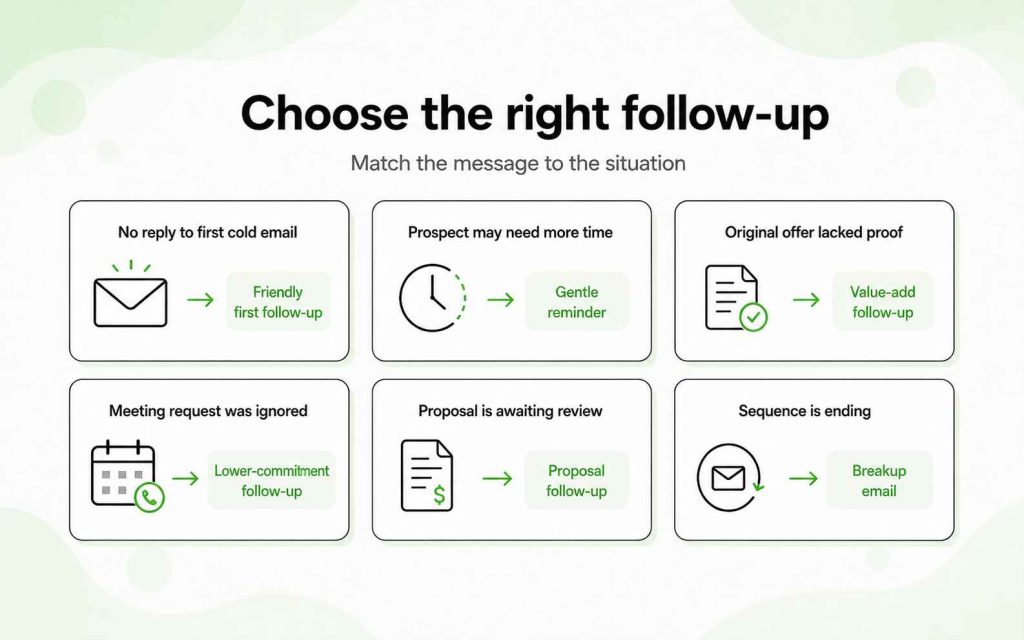
The right follow-up depends on where you are in the sequence and what happened before the silence.
An early follow-up should feel light and conversational. Later messages may become more direct, but they should remain respectful.
Use the table below to choose the right approach.
| Situation | Recommended approach | Best template |
|---|---|---|
| First cold email received no response | Friendly and brief | Friendly first follow-up |
| Recipient may need more time | Gentle and low-pressure | Gentle reminder |
| Original offer lacked proof | Introduce something useful | Value-add follow-up |
| Several messages received no response | Direct but professional | Firm follow-up |
| Meeting request was ignored | Reduce the commitment | Meeting-request follow-up |
| Meeting took place | Recap the agreed next step | After-meeting follow-up |
| Proposal is awaiting review | Ask about questions or timing | Proposal follow-up |
| Several follow-ups were ignored | Offer a simple choice | Nth no-response follow-up |
| Sequence is ending | Close the loop | Breakup email |
The examples below are starting points. Replace the placeholders and generic benefits with details specific to the recipient.
1. Friendly first follow-up email
Use this after the recipient has not replied to your initial cold email.
Subject: Keep the original subject line
Hi {{FIRST_NAME}},
I wanted to add one thought to the message below.
{{SHORT INSIGHT OR BENEFIT CONNECTED TO THE RECIPIENT’S SITUATION}}.
Would this be relevant to what {{COMPANY}} is working on right now?
Best,
{{YOUR_NAME}}
Why it works: It keeps the tone conversational and gives the prospect a specific question to answer.
2. Gentle follow-up email
Use this when the recipient may simply need more time.
Subject: Keep the original subject line
Hi {{FIRST_NAME}},
I know priorities can shift, so there is no rush on the message below.
Would it be better for me to come back to this later, or is {{TOPIC}} something your team is considering now?
Best,
{{YOUR_NAME}}
Why it works: The prospect may respond without agreeing to a call or making an immediate decision.
3. Value-add follow-up email
Use this when your original email may not have provided enough proof or practical value.
Subject: Keep the original subject line
Hi {{FIRST_NAME}},
One example that may add useful context:
{{SIMILAR COMPANY OR TEAM}} addressed {{RELEVANT PROBLEM}} by {{SHORT DESCRIPTION OF THE APPROACH}}, which resulted in {{SPECIFIC OUTCOME}}.
Would a short breakdown of the process be useful?
Best,
{{YOUR_NAME}}
Why it works: The follow-up gives the recipient new information instead of reminding them that they have not replied.
4. Friendly follow-up with a useful resource
Use this when you have a case study, guide, benchmark, or short video that relates directly to the recipient’s situation.
Subject: Keep the original subject line
Hi {{FIRST_NAME}},
I found this {{RESOURCE TYPE}} on {{TOPIC}} and thought it might be useful given {{SPECIFIC COMPANY SITUATION}}:
{{LINK}}
The section on {{RELEVANT DETAIL}} is particularly connected to what I mentioned below.
Worth discussing?
Best,
{{YOUR_NAME}}
Why it works: The resource creates a new reason to open the thread. Only share it when the connection is clear.
5. Firm follow-up email
Use this after several attempts when you need a clearer answer.
Subject: Keep the original subject line
Hi {{FIRST_NAME}},
I have reached out a couple of times about {{SPECIFIC TOPIC}} and do not want to keep filling your inbox.
Should I speak with someone else about this, revisit it later, or close the conversation?
Best,
{{YOUR_NAME}}
Why it works: It is direct without blaming the prospect for not responding.
6. Follow-up after an unanswered meeting request
Use this when your first message asked for a call but may have required too much commitment.
Subject: Keep the original subject line
Hi {{FIRST_NAME}},
A meeting may not be the easiest next step.
Would it be more useful if I sent a short summary of how {{SOLUTION OR APPROACH}} could apply to {{COMPANY}}?
Best,
{{YOUR_NAME}}
Why it works: The follow-up reduces the effort required from the recipient instead of repeating the meeting request.
7. Follow-up email after a meeting
Send this after a call, demo, or discovery meeting.
Subject: Next steps on {{TOPIC}}
Hi {{FIRST_NAME}},
Thank you for the conversation about {{TOPIC}}.
As agreed:
- {{YOU OR YOUR TEAM}} will {{ACTION}} by {{DATE}}.
- {{RECIPIENT OR THEIR TEAM}} will {{ACTION}}.
- We will reconnect on {{DATE OR CONDITION}}.
I have also attached {{PROMISED MATERIAL}}.
Let me know if I missed anything important.
Best,
{{YOUR_NAME}}
Why it works: It turns the conversation into clear actions and gives both parties a shared record of the next step.
8. Follow-up after a meeting when the prospect goes quiet
Use this when a promising conversation took place but the prospect has not completed the agreed action.
Subject: Re: {{ORIGINAL MEETING SUBJECT}}
Hi {{FIRST_NAME}},
During our conversation, you mentioned that {{PRIORITY OR PROBLEM}} was affecting {{BUSINESS AREA}}.
Has anything changed since we spoke, or would it still be useful to continue with {{AGREED NEXT STEP}}?
Best,
{{YOUR_NAME}}
Why it works: It refers to the recipient’s own priority rather than sending a generic reminder.
9. Follow-up email after sending a proposal
Use this after the recipient has had reasonable time to review your offer.
Subject: {{COMPANY}} proposal – questions?
Hi {{FIRST_NAME}},
I wanted to follow up on the proposal I sent on {{DATE}}.
Is there anything in the scope, timing, or pricing that you would like me to clarify before you decide on the next step?
Best,
{{YOUR_NAME}}
Why it works: The email identifies possible obstacles and gives the recipient several easy ways to respond.
10. Follow-up email after a quote or estimate
Use this when the recipient requested pricing but stopped responding.
Subject: Re: {{PROJECT OR SERVICE}} estimate
Hi {{FIRST_NAME}},
Have you had a chance to review the estimate for {{PROJECT OR SERVICE}}?
I can adjust the scope if {{BUDGET, TIMING, OR DELIVERABLE}} is the main concern.
Would you like to discuss an alternative version?
Best,
{{YOUR_NAME}}
Why it works: It opens a conversation about the likely objection without immediately offering an unnecessary discount.
11. Follow-up after sharing a demo or resource
Use this when the prospect requested material but did not respond after receiving it.
Subject: Re: {{RESOURCE OR DEMO}}
Hi {{FIRST_NAME}},
Did the {{DEMO, VIDEO, OR RESOURCE}} answer your question about {{SPECIFIC TOPIC}}?
The part most relevant to {{COMPANY}} is {{SHORT EXPLANATION}}.
Would you like me to expand on that section?
Best,
{{YOUR_NAME}}
Why it works: It asks about one specific part of the material rather than whether the recipient “had time to look.”
12. Follow-up after the second or third no-response
Use this when several messages have gone unanswered but you are not yet ready to close the sequence.
Subject: Keep the original subject line
Hi {{FIRST_NAME}},
I may have contacted you at the wrong time or reached the wrong person.
Which of these is closest?
- {{TOPIC}} is relevant, but not right now.
- Someone else handles it.
- It is not a priority.
A number is enough, and I will follow your lead.
Best,
{{YOUR_NAME}}
Why it works: The response requires almost no effort, while the options give you useful information.
13. Breakup follow-up email
Use this as the final message in the sequence.
Subject: Closing the loop
Hi {{FIRST_NAME}},
I have reached out a few times about {{SPECIFIC TOPIC}} and have not heard back, so I will assume the timing is not right.
I will close the loop here. If {{PROBLEM OR GOAL}} becomes relevant later, you know where to find me.
Best,
{{YOUR_NAME}}
Why it works: The message ends the sequence without guilt, fake urgency, or another disguised meeting request.
Why should you send a follow-up email?
A first email is only one opportunity to reach someone.
Even a well-targeted message may arrive while the prospect is traveling, handling a deadline, or concentrating on a more urgent problem.
Woodpecker’s earlier research found that adding one follow-up could increase the reply rate by 22%.
More recent cold email benchmarks reinforce the same principle. A significant share of campaign replies arrives after the first message, yet many senders still stop after one attempt.
Following up gives you an opportunity to:
- Reach a recipient who missed the first email
- Present the offer from a different angle
- Introduce proof or an additional benefit
- Reduce the effort required to respond
- Contact the recipient at a better time
- Confirm whether the topic is relevant
A prospect once replied to a follow-up from our team with a message along these lines:
Thanks for following up. This is a particularly busy period, but I would like to revisit the trial in the middle of next month.
The follow-up did not annoy the recipient. It made responding easier at a time when the original email was not a priority.
Will following up annoy the recipient?
It can – but usually because of the way the follow-up is written, not because a second message exists.
Follow-ups become annoying when they:
- Arrive every day
- Accuse the recipient of ignoring the sender
- Repeat the same request
- Manufacture urgency
- Add no new information
- Continue after an opt-out
- Demand a long meeting from a cold prospect
A respectful follow-up recognizes that the recipient does not owe you a response.
Your job is to provide another useful opportunity to engage, not pressure the person into answering.
Why do emails receive no response?
You rarely know exactly why a recipient did not answer.
The most common explanations fall into four groups.
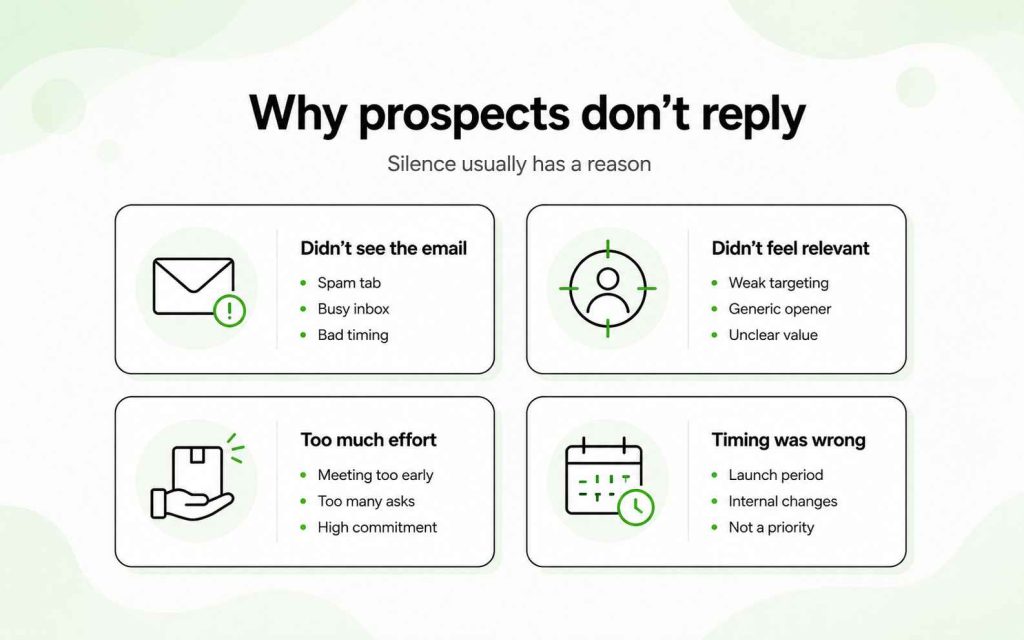
The recipient did not see the email
Your message may have:
- Landed in spam
- Been filtered into another tab
- Arrived during a busy period
- Been buried under newer emails
- Reached an inbox the prospect rarely checks
Before rewriting the campaign, confirm that your technical setup and list quality are not creating email deliverability problems.
The email did not feel relevant
The recipient may have read the message but decided that it did not address a current priority.
Possible causes include:
- The prospect does not match your ideal customer profile.
- The opening sentence is generic.
- The offer focuses on your product rather than the recipient’s problem.
- The benefit is too broad.
- The message does not explain why you contacted this person.
A follow-up cannot fix poor targeting on its own. Reconsider the segment if an entire campaign receives little engagement.
The request required too much effort
A cold prospect may ignore a request for a 30- or 45-minute meeting even when the subject is relevant.
Reduce the commitment in the follow-up:
- Ask one question.
- Offer to send a short explanation.
- Request permission to share an example.
- Ask whether you contacted the right person.
The easiest response should take only a few seconds.
The timing was wrong
A relevant offer may still arrive during a hiring freeze, product launch, annual planning cycle, or internal reorganization.
Give the recipient an option to postpone the conversation:
Is this something worth revisiting next quarter?
A “not now” reply is more useful than continued silence.
How to write a follow-up email after no response
A follow-up should not act as a notification that the previous email exists.
It should move the conversation forward.
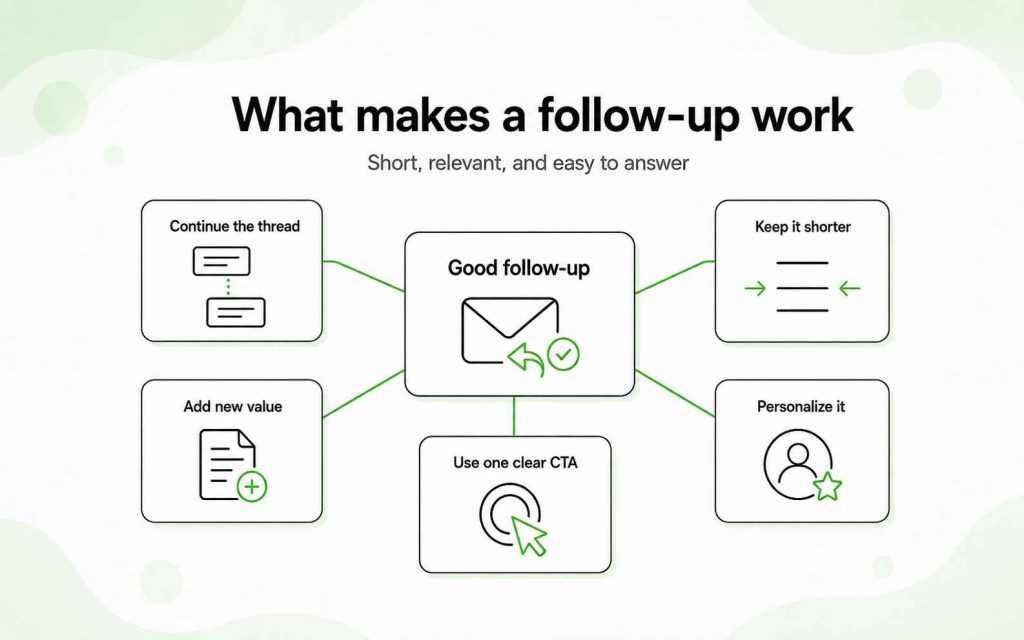
Continue the original thread
For cold outreach, keep most follow-ups in the same thread.
The original message remains visible below, so the recipient can recover the context without searching their inbox.
You also avoid creating multiple separate conversations about the same subject.
Leave the subject field empty when scheduling the follow-up in an outreach tool. The email will continue under the original subject line.
Start a new thread only when:
- The topic has materially changed.
- A long period has passed.
- A new event creates a different reason for contact.
- The original subject line no longer reflects the message.
Read the complete guide to follow-up email subject lines for examples across cold outreach, meetings, applications, and proposals.
Keep the follow-up shorter than the first email
The recipient can still see your original explanation.
Your follow-up does not need to restate:
- Who you are
- Every product feature
- The entire value proposition
- The complete case study
- All previous context
In most cases, two to five short sentences are enough.
Add a new reason to reply
Avoid opening with:
- Just following up
- Just checking in
- Did you see my previous email?
- I wanted to bump this to the top of your inbox
- I have not heard back from you
These phrases focus on the sender’s waiting rather than the recipient’s priorities.
Instead, introduce:
- A different benefit
- A customer example
- A relevant benchmark
- A useful resource
- A response to a likely objection
- A recent change at the prospect’s company
- A smaller next step
The follow-up should still make sense if the recipient reads it several days after the first email.
Keep one clear call to action
Do not give the prospect a list of tasks.
Choose one next step:
- Answer a question
- Confirm whether the topic is relevant
- Identify the correct contact
- Review a short resource
- Choose whether to continue
- Agree to a brief meeting
A follow-up with one clear question is easier to process than a paragraph ending in several requests.
Match the tone to the sequence stage
The first follow-up may be friendly and exploratory.
A later message may become more direct:
Should I revisit this next quarter, speak with someone else, or close the loop?
Direct does not mean aggressive. The message should never imply that the prospect has behaved badly by not answering.
Personalize the follow-up
Personalization should not disappear after the first message.
Use new information where relevant:
- A company announcement
- A job listing
- A recently published post
- A product update
- A change in the recipient’s responsibilities
- A point raised during a previous conversation
Do not introduce an unrelated detail merely to prove that you conducted research. Every personalized element should support the reason for contacting the recipient.
How long should you wait before sending a follow-up email?
For a cold email, wait approximately 3–4 business days before the first follow-up.
That period gives the recipient time to see and consider the message without letting the context become stale.
Use the schedule below as a starting point.
| Sequence step | Suggested timing | Purpose |
|---|---|---|
| Initial email | Day 1 | Introduce the relevant problem or opportunity |
| First follow-up | 3–4 business days later | Add context or reduce the CTA |
| Second follow-up | 5–7 days later | Introduce proof or another benefit |
| Third follow-up | 7–10 days later | Ask a more direct qualifying question |
| Fourth follow-up | 7–14 days later | Close the loop or send a breakup email |
Do not follow the schedule mechanically.
Timing depends on:
- The type of recipient
- The length of the sales cycle
- The urgency of the problem
- The commitment requested
- The prospect’s location
- Previous engagement
- A deadline discussed earlier
If the recipient promised a reply by Friday, follow up after Friday rather than following a generic campaign schedule.
How many follow-up emails should you send?
For most cold outreach, send 3–5 follow-ups after the initial email.
That creates a sequence of 4–6 total messages.
Later follow-ups tend to produce diminishing returns, while the risk of irritating recipients or receiving spam complaints rises. Quality matters more than extending the sequence indefinitely.
You may stop earlier when:
- The prospect is clearly not a fit.
- You have no new value to introduce.
- The business opportunity has expired.
- The recipient asks not to be contacted.
- Your messages receive negative engagement.
- The contact information is no longer valid.
You may use a longer sequence when:
- The sales cycle is naturally long.
- The offer is high-value and highly relevant.
- Each message introduces meaningful new information.
- The prospect has previously shown interest.
- The intervals become longer over time.
Do not continue merely because your outreach software supports additional steps.
How often should you send follow-up emails?
Do not send every follow-up at the same interval or time of day.
A message arriving at precisely 9:00 every three days looks automated. More importantly, it gives the recipient little breathing room.
Use shorter intervals early in the sequence and longer ones later.
For example:
- First follow-up – after 3–4 business days
- Second follow-up – after another 5–7 days
- Third follow-up – after another 7–10 days
- Final message – after another 7–14 days
For warm conversations, follow the timeline discussed with the recipient.
For example:
- Send meeting materials on the same day.
- Send a promised document by the agreed deadline.
- Follow up on a proposal after the review period.
- Send a reminder before a real event or expiration date.
The best schedule respects the recipient’s context instead of treating every silence in the same way.
How to send follow-up emails
You may send follow-ups manually or schedule them through a cold email platform.
Manual sending may work for a small number of high-value contacts. It becomes difficult when you need to remember different dates, monitor replies, and personalize messages for a larger list.
With Woodpecker, you can prepare an email sequence in advance and decide:
- How long to wait between messages
- Which days and times messages may be sent
- Which follow-up should appear next
- Which personalized fields to use
Follow-ups remain connected to the original message, giving the prospect the context of the whole conversation.
The sequence also stops when the recipient replies, so an automated reminder is not sent after the conversation has already started.
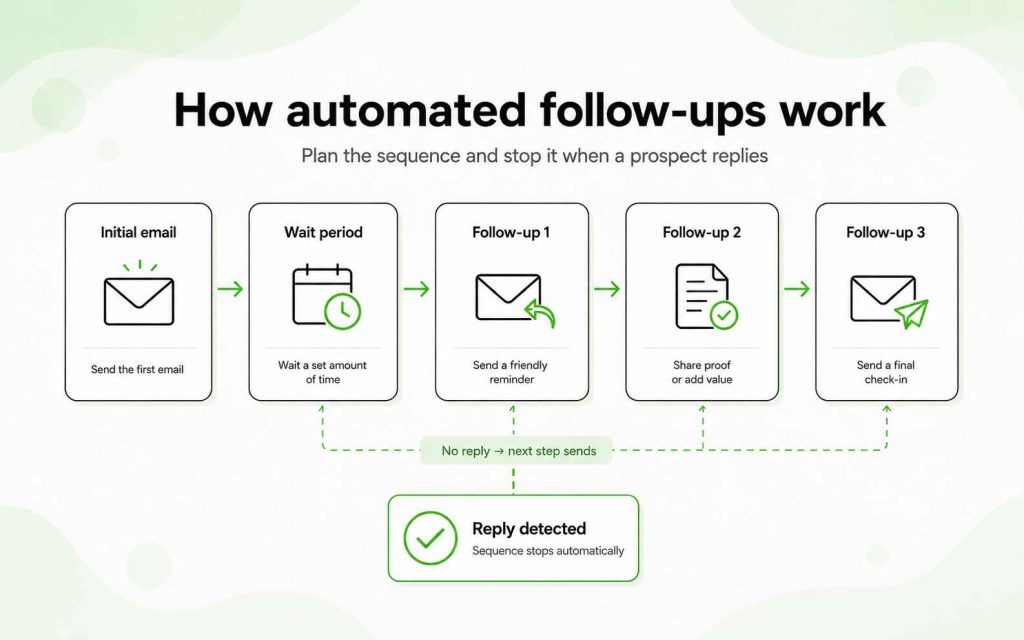
How to create a follow-up sequence in Woodpecker
- Create the initial email in your campaign.
- Add the first follow-up and choose the waiting period.
- Add further steps, giving each one a different purpose.
- Keep the subject field empty to continue the original thread.
- Review every personalization field.
- Send test messages before launching the campaign.
- Monitor replies and adjust the sequence based on performance.
Do not use automation to repeat the same message more efficiently.
Use it to deliver a carefully planned sequence while keeping the timing and reply management under control.
The breakup email: your final follow-up
A breakup email closes the sequence after several unanswered attempts.
Its purpose is not to pressure the recipient through scarcity or guilt. It simply communicates that you will stop following up.
A clear breakup email may generate a response because it:
- Removes the expectation of another message
- Gives the recipient an easy opportunity to decline
- Creates a natural decision point
- Demonstrates respect for the inbox
Use a message such as:
Hi {{FIRST_NAME}},
I have reached out a few times about {{TOPIC}} and have not heard back, so I will assume the timing is not right.
I will close the loop here. If {{PROBLEM OR GOAL}} becomes relevant later, you know where to find me.
Best,
{{YOUR_NAME}}
Avoid breakup emails that say:
- “I guess you are not interested in growing your business.”
- “This is your last chance.”
- “I am disappointed that you did not respond.”
- “I will remove you unless you answer.”
- “Should I assume you have given up on this project?”
These lines attempt to provoke a response by insulting or embarrassing the recipient.
A professional final message keeps the future relationship intact.
Common follow-up email mistakes
Repeating the original email
Sending the same explanation again does not create a new reason to respond.
Change the angle, add proof, or reduce the request.
Making the recipient feel guilty
The recipient does not owe a cold sender an answer.
Remove phrases that draw attention to how long you have been waiting.
Following up too quickly
Several messages in a short period may appear intrusive.
Give the prospect time to process the original email.
Waiting too long
A follow-up sent several weeks later may require the recipient to reconstruct the whole context.
Use longer gaps only later in the sequence or when the sales cycle justifies them.
Asking for too much
A long meeting may not be the right first step.
Try a simple question or ask permission to send more information.
Adding no value
“Checking in” describes what you are doing, not why the recipient should care.
Each follow-up should contain a useful point, question, or decision.
Ignoring replies and opt-outs
Stop automated follow-ups immediately after any reply.
Honor requests not to be contacted again and maintain an accurate suppression list.
Test and improve your follow-up sequence
There is no universal sequence that works for every market.
Use the recommendations in this guide as a starting point, then test:
- The number of follow-ups
- The interval between messages
- The value introduced at each step
- The CTA
- The sequence length
- The breakup-email wording
Evaluate more than the total reply rate.
Track:
- Positive replies
- Negative replies
- Meetings booked
- Qualified opportunities
- Opt-outs
- Spam complaints
- Conversions
A message that generates many replies but few relevant conversations may not be an improvement.
Look for patterns across campaigns. Your strongest sequence may vary according to the prospect’s role, industry, company size, or reason for outreach.
Start following up without repeating yourself
A good follow-up does not ask why someone failed to respond.
It gives the person a better reason and an easier way to answer.
Wait a few business days, continue the original thread, and keep the message brief. Introduce something new, use one clear CTA, and increase the spacing between later attempts.
After several no-replies, close the sequence respectfully.
That is the difference between persistence and inbox pressure.
Start a free Woodpecker trial and prepare a complete follow-up sequence that stops automatically when a prospect replies.
FAQ
How long should I wait before sending a follow-up email?
Wait approximately 3–4 business days before sending the first follow-up to a cold email. For later messages, wait another 5–7 days and gradually increase the interval.
After a meeting or an agreed deadline, use the timeline discussed with the recipient rather than a generic schedule.
How many follow-up emails should I send?
Send 3–5 follow-ups after the initial cold email in most campaigns.
Stop earlier if the recipient replies, opts out, is not a suitable prospect, or you have no meaningful new information to introduce.
What should I write in a follow-up email after no response?
Briefly reconnect the email to the original topic, introduce a new benefit or piece of information, and end with one easy question.
Do not simply tell the recipient that you are following up. Give them a new reason to respond.
How do I politely follow up on an unanswered email?
Use a neutral tone and acknowledge that the timing may not be right.
For example:
I know priorities can shift. Would it be better for me to revisit this later, or is {{TOPIC}} relevant to your team now?
This gives the recipient an easy way to answer without feeling pressured.
Should I use the same subject line for a follow-up email?
Yes. For most cold email follow-ups, continue the original thread and keep the same subject line.
Start a new thread only when the topic has changed, a long period has passed, or a new event creates a different reason to contact the person.
What is a good first follow-up email?
A good first follow-up is shorter than the original email and introduces one new point.
For example:
Hi {{FIRST_NAME}},
One detail that may add context to the message below: {{NEW INSIGHT OR BENEFIT}}.
Does this match what {{COMPANY}} is working on?
Best,
{{YOUR_NAME}}
How do I follow up after a meeting?
Send a short recap containing the decisions, responsibilities, and deadlines discussed during the meeting.
Include any promised materials and ask the recipient to correct anything you may have misunderstood.
How do I follow up after sending a proposal?
Wait until the recipient has had reasonable time to review it, then ask whether they have questions about the scope, timing, or pricing.
Avoid sending only “Have you reviewed the proposal?” Give the recipient a clearer way to explain what may be delaying the decision.
What is a breakup email?
A breakup email is the final message in an unanswered outreach sequence.
It tells the recipient that you will stop following up while leaving the conversation open if the topic becomes relevant later.
Can follow-up emails be automated?
Yes. A cold email platform may schedule follow-ups, maintain the original email thread, apply personalization, and stop the sequence after a recipient replies.
Review the copy and personalization before launching the campaign. Automation should manage the sequence rather than replace relevance.