


An email salutation is a small part of an email, but it does more work than most people give it credit for.
It sets the tone before the recipient reads the first real sentence. It tells them whether the message will feel formal, friendly, rushed or overly familiar. In a professional email, that first word can make the rest of the message easier to trust.
The right greeting does not need to be clever. It needs to fit the recipient, the reason you are writing and the level of formality the situation calls for.
That matters in every email, from a job application to a follow-up after a sales call. It matters even more in cold outreach, where you have no existing relationship to make a generic opening feel natural.
What you’ll learn
- The difference between an email greeting and an email salutation
- Formal and informal email greetings for common situations
- Professional email salutations that work without sounding stiff
- Cold email openers that beat “I hope this email finds you well”
- How to end an email professionally without repeating the same tone mistake twice
What is the difference between an email greeting and a salutation?
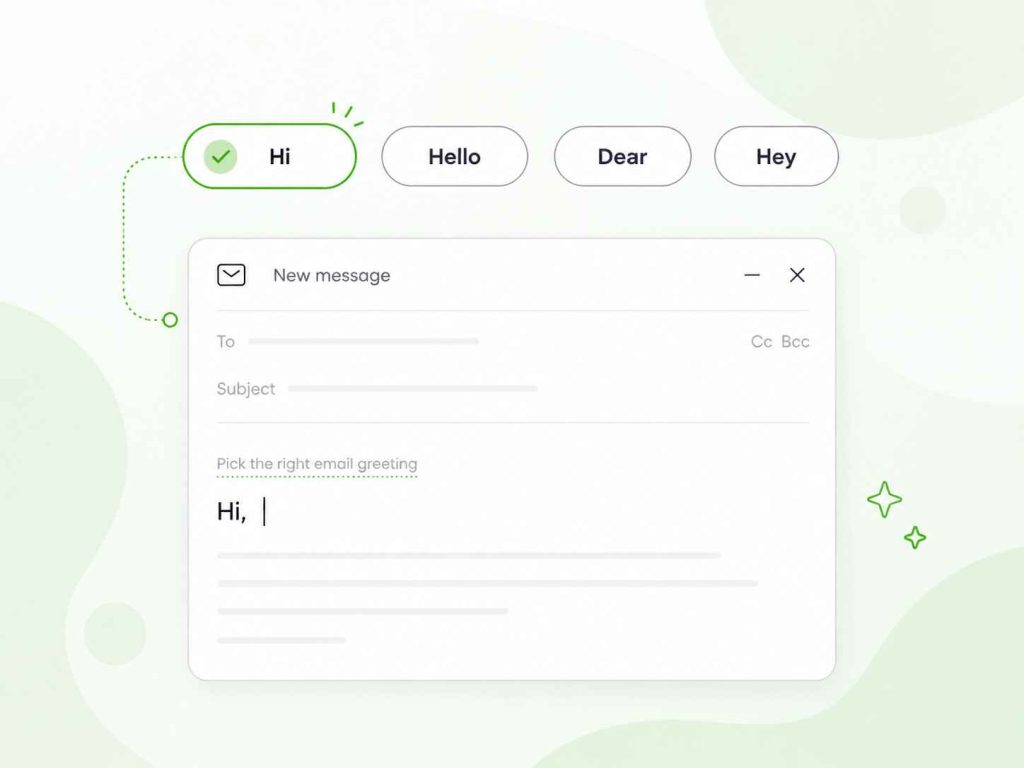
An email greeting is the opening line that addresses the recipient.
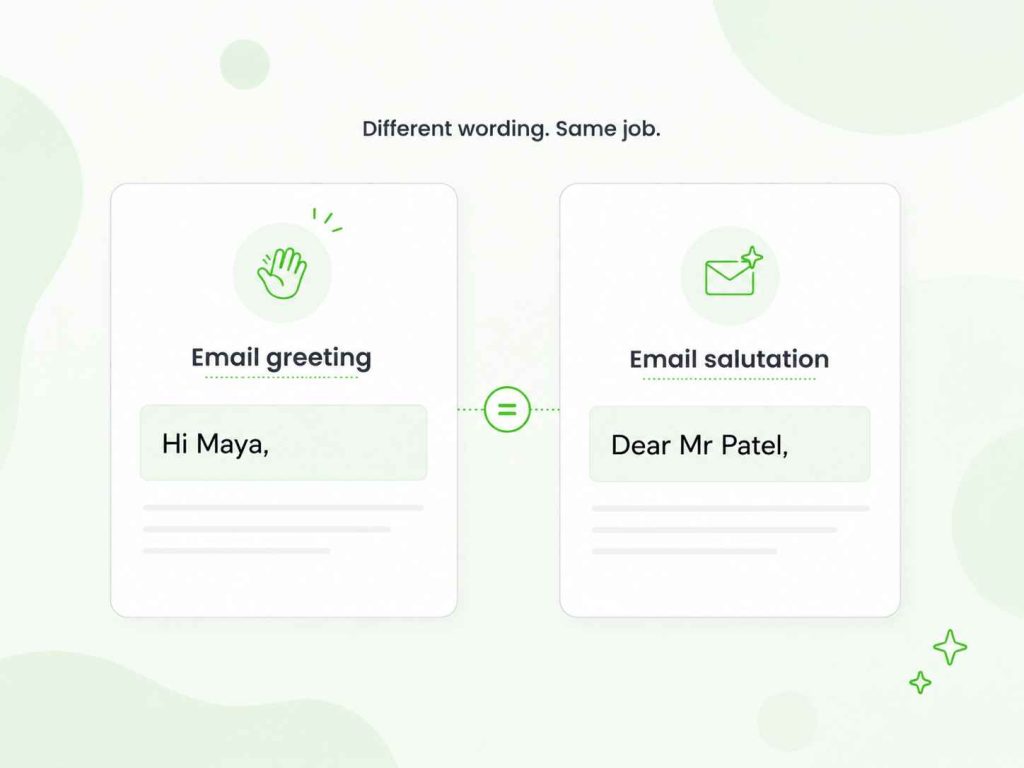
A salutation is the more formal term for that opening. In practice, people often use “greeting” and “email salutation” interchangeably.
For example:
Hi Maya,
Dear Mr Patel,
Hello everyone,
All three are email greetings. They are also salutations for emails.
The difference is mostly about language, not function. “Salutation” tends to appear in formal writing advice. “Greeting” feels more conversational.
What matters is that the email salutation sets the right tone for the rest of the message.
A formal salutation followed by a very casual body can feel inconsistent. The same goes for a relaxed “Hey” followed by an overly formal paragraph full of corporate phrasing.
Before you write an email, decide what relationship you have with the recipient and what kind of reply you want.
Professional email salutations for formal situations
A formal email usually needs a more careful greeting.
That does not mean every professional email should start with “Dear Sir or Madam.” In fact, that phrase is often too impersonal. A name, job title or team name is usually better.
Use a formal salutation when you are applying for a job, contacting a senior stakeholder for the first time, writing to a legal or financial contact or sending a message where precision matters.
Examples:
Dear Ms Patel,
Dear Dr Evans,
Dear Professor Morgan,
Dear Hiring Manager,
Dear Customer Support Team,
Dear [Company Name] Team,
When you know the name of the person, use it. A recipient’s name makes the email feel considered. It also shows that you took the time to identify the right contact person.
When you do not know the person’s name, use their role where possible.
For example, “Dear Hiring Manager” is stronger than “To Whom It May Concern” because it still tells the reader who the message is for.
A formal business email does not need to sound cold. You can still write with clarity, brevity and a positive impression in mind.
For a job application, your email may begin:
Dear Hiring Manager,
I’m writing to apply for the sales manager position advertised on your careers page.
That gives the recipient context immediately and makes the next line easy to follow.
Professional email greetings for everyday business communication
Most business communication sits somewhere between highly formal and casual.
That is where professional email greetings are useful. They are polite, clear and not overly formal.
A safe default is:
Hi [First Name],
or:
Hello [First Name],
Both work in most professional contexts.
You can also use:
Good morning, [First Name],
Good afternoon, [First Name],
Hi [First Name] —
Hello [First Name] —
The punctuation matters less than the overall tone. A comma is standard. A dash can make the opening feel slightly more direct. An exclamation mark can feel warm, but it can also look too enthusiastic when you are writing to someone you do not know.
Use a greeting that matches the relationship.
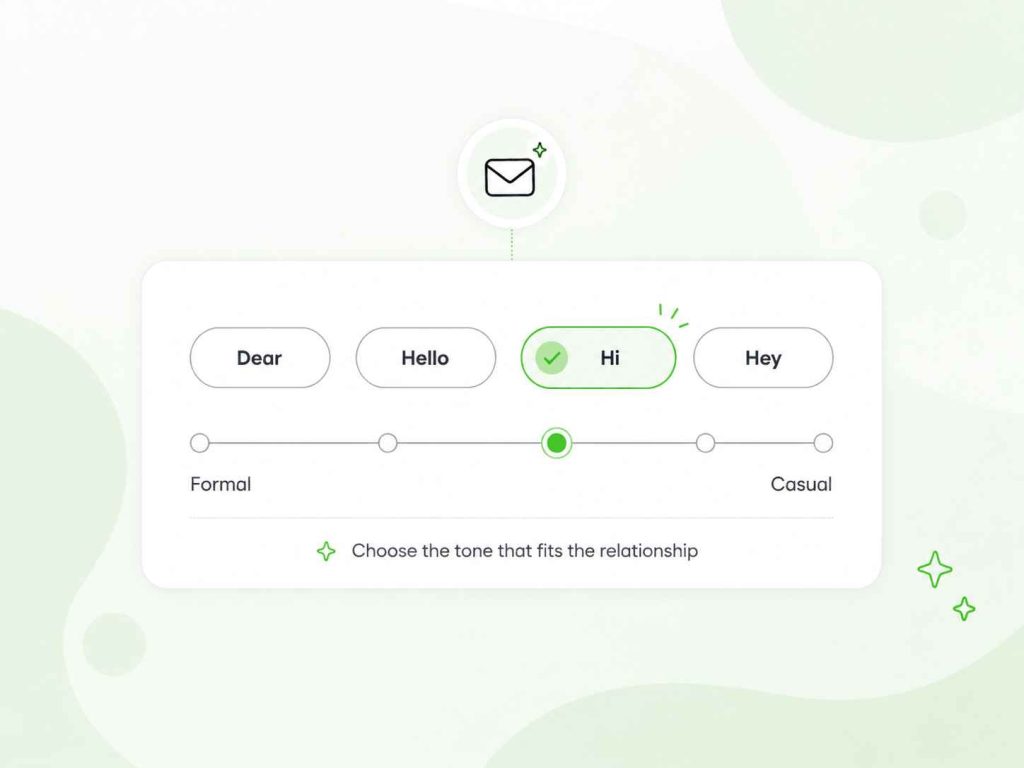
“Hi” is usually the best email default. “Hello” feels slightly more neutral. “Dear” carries more formality. “Hey” is fine when you know the person or the company culture is casual.
If you received an email from someone who used “Hi Alex,” it is usually safe to reply in the same register. Matching the tone of the received email is one of the simplest ways to email professionally.
Email greetings by relationship and context
The greeting should reflect why you are writing, not only who you are writing to.
Email greetings when you know the person
When you know the person, a simple greeting is usually enough.
Hi Jordan,
Hello Priya,
Hey Sam,
You can make the opening more contextual when you have just spoken:
Great speaking earlier, Jordan —
Thanks again for the time today, Priya —
Good to connect this morning, Sam —
These are not traditional greetings in a strict grammatical sense. But they work because they give the recipient an immediate reason for the email.
Email greetings when writing to follow up
A follow-up email does not need to restart the relationship from zero.
Instead of writing “I hope this email finds you well” after a call, use context:
Following up on our conversation about the onboarding timeline —
Circling back on the proposal you were reviewing —
Wanted to check in on the next steps we discussed —
When you are writing to follow up after no reply, keep the opener brief. The email should make it easy for the recipient to understand what you are following up on.
Woodpecker’s guidance on following up after no response is useful here because it focuses on adding a reason to reply rather than repeating the first message.
Email greetings for a group
A group email needs a greeting that includes everyone without sounding clumsy.
Good options include:
Hi everyone,
Hello all,
Hi team,
Dear team,
Good morning, everyone,
If you are writing to two people, use both names:
Hi Maya and Jordan,
That small detail feels more considered than a generic group greeting.
Avoid “Hi guys” in a professional context. It can be informal in a way that does not work for every recipient. “Dear all” is more formal, but may sound stiff unless the setting calls for it.
Formal and informal email greetings
Formal and informal email greetings both have a place.
A formal email may begin with “Dear Dr Singh,” because the relationship, role or context requires more distance.
An informal email may begin with “Hey Chris,” because you work together regularly and a formal salutation would feel unnatural.
The important thing is not to choose the most formal option. It is to choose the right greeting.
A good rule:
- Use “Dear” for formal first contact, applications and high-stakes communication.
- Use “Hi” for most business email.
- Use “Hello” when you want a neutral tone.
- Use “Hey” only when you know the person or the context is genuinely casual.
Cold email greetings that do not sound generic
Cold email is different from regular professional communication.
You are reaching out to someone who did not expect your message. That means the greeting cannot carry the entire email, but it can still make the first impression worse.
A plain:
Hi Maya,
is usually better than forcing warmth.
The phrase “Hope this email finds you well” is not grammatically wrong. But in cold outreach, it has become a signal that the sender may have copied the same opening into hundreds of emails.
The problem is not the words themselves. The problem is that they do not give the recipient a reason to keep reading.
Instead of:
Hi Maya,
Hope this email finds you well.
Try a context-led opening line:
Hi Maya,
I noticed your team is hiring SDRs across two new markets.
Or:
Hi Maya,
Your recent post about improving rep ramp time caught my attention.
Or:
Maya,
Quick question about how your team handles prospecting consistency as it grows.
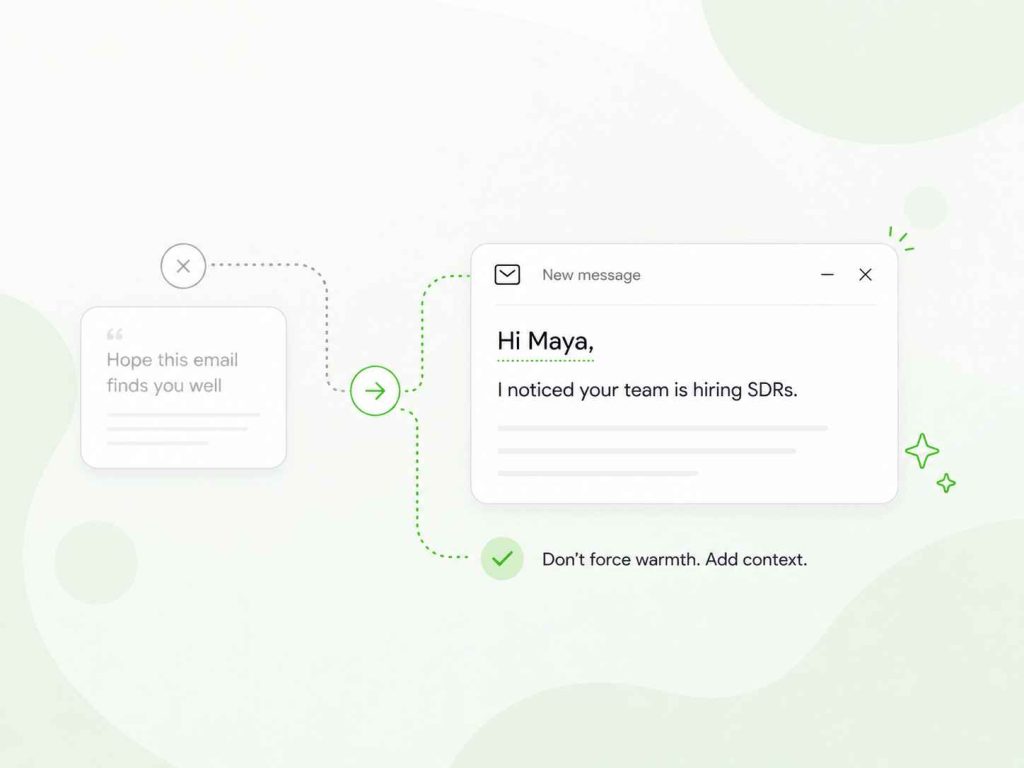
The first word of the email can still be “Hi.” The real difference is what comes next.
A cold email opener should show that you know why you are writing. It should not pretend you know the recipient personally.
This is especially important when you are reaching out to a prospect for the first time. A thoughtful personalised cold email will do more for reply rates than any clever greeting.
Email salutations to avoid
Some greetings are technically correct, but they make the email feel impersonal, overly formal or out of place.
“To Whom It May Concern”
Use this only when you genuinely cannot find a name, role or team.
In most cases, “Dear Hiring Manager” or “Hello Customer Support Team” is more specific.
“Dear Sir or Madam”
This is grammatically fine, but it feels outdated and gendered. A gender-neutral role or full name instead is usually a better choice.
“I hope this email finds you well”
This phrase can work in a real relationship where you mean it. In cold outreach, it is usually filler.
If you want to open warmly, use a relevant context line instead.
“Hi [First Name]!”
A first-name greeting with an exclamation mark can feel too salesy when you do not know the recipient.
“Hi Maya,” is usually enough.
“Greetings”
“Greetings” can work in a funny or intentionally old-fashioned note. In most professional email, it can feel awkward unless the rest of the message has the same conversational tone.
The goal is not to steer clear of every phrase that sounds formal. It is to avoid a greeting that distracts from the actual message.
How to start an email after the greeting
The greeting is only the first line.
The opening line tells the recipient why you are writing.
A strong opening line gives one of three things:
- context,
- a clear purpose,
- a useful reason to pay attention.
For example:
Hi Maya,
I’m reaching out because your team recently expanded into the DACH market.
Hello Jordan,
I’m writing to follow up on the timeline we discussed last week.
Dear Hiring Manager,
I’m applying for the sales manager position and have attached my resume for your review.
The best email opener does not need a long introduction. It just needs to make the recipient’s next thought obvious.
A clear email introduction can help when you need to explain who you are without burying the point.
Formal greetings, casual tone and professional email sign-offs
The right greeting depends on the person, the purpose and how formal the email needs to be.
If you know the name of the person, use it. “Hi Maya,” is usually a safe choice for everyday business communication. A simple “Hi” can work well when you already know the recipient or are writing a note after a recent call.
“Hey” can fit a casual tone, but only when the relationship supports it. It may feel too relaxed in a formal business email, job application or first message to a senior contact.
Formal greetings are better when the professional context calls for more distance:
Dear Ms Patel,
Dear Hiring Manager,
Dear Customer Support Team,
A professional salutation should set the tone for the rest of the message. If you are writing a professional email about an application, you could write:
Dear Hiring Manager,
I’m writing to apply for the role. I’ve attached my resume for your review.
That is clearer than opening with a vague line and hoping the recipient will read the email closely enough to understand the purpose.
Time-based greetings can work too, but they have limits. “Good morning” may feel odd if the recipient reads the email at a different time or in another time zone. The same goes for “Good afternoon” when the email lands after 5 p.m. A simple greeting usually avoids that issue.
The opener matters, but the ending needs to match it. Professional email sign-offs should reflect the same level of formality as the greeting.
For a formal email, use:
Best regards,
Kind regards,
Sincerely,
For an everyday business email, use:
Best,
Thanks,
Speak soon,
The goal is to end your email professionally without making the sign-off feel more formal than the rest of the message.
Do not use a greeting only because it sounds polished. Use one that helps the recipient understand the tone quickly, reinforces the reason for writing and makes a positive impression before they reach the first real sentence.
How to end an email professionally
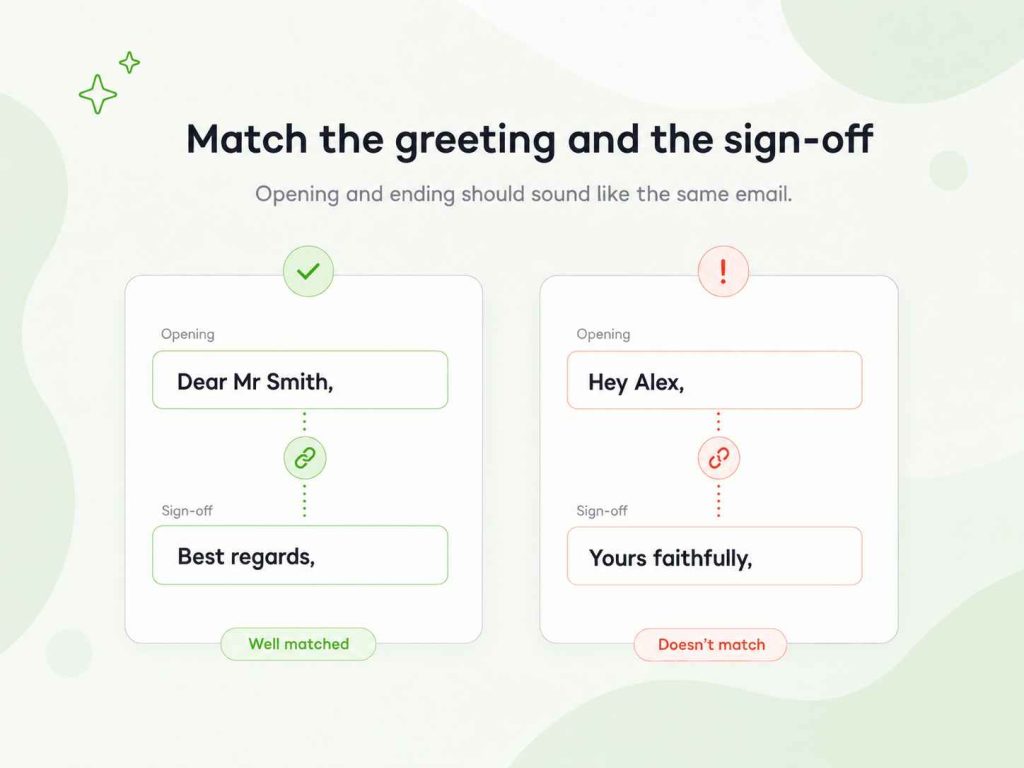
A greeting and a sign-off should match.
If you start with “Dear Mr Smith,” then ending with “Cheers!” may feel inconsistent. If you start with “Hey Alex,” then “Yours faithfully” will feel equally strange.
Professional email sign-offs include:
Best regards,
Kind regards,
Sincerely,
Best,
Thank you,
The right sign-off depends on formality and relationship.
“Best regards” works well in many formal business messages. “Kind regards” is polite and slightly warmer. “Sincerely” is common in formal correspondence. “Best” works in everyday professional communication.
You can also use a sign-off that points naturally to the next step:
I look forward to hearing from you.
Please let me know your thoughts.
Thank you for your time.
Do not overdo it. A sign-off should not repeat the whole email.
For a fuller breakdown of how to end an email professionally, see how to end a business email and email closing lines that fit different contexts.
Email signature, punctuation and the final impression
Your email signature is part of professional communication too.
It should make it easy for the recipient to understand who you are and how to reply. A simple signature may include your full name, job title, company name and a link to your website.
Do not overload it with multiple quotes, badges, large images or several calls to action.
The same rule applies to punctuation.
A comma after a greeting is standard:
Hi Maya,
A colon can work in a more formal email:
Dear Ms Patel:
But a comma is usually the safest choice for modern business email.
The recipient reads the greeting, the first sentence and your signature as one experience. Small choices affect the message feel.
A clear email signature and a concise opening can make your email look more professional than adding extra formality ever will.
Woodpecker’s email signature generator can help you create a simple signature that does not overwhelm the email.
Frequently asked questions about email greetings and salutations
What is a good salutation for a professional email?
“Hi [First Name],” is the safest option for most professional emails. For a more formal context, use “Dear [Name],” or “Dear [Job Title],” when you do not know the person’s name.
Is “Dear” still appropriate in an email?
Yes. “Dear” is still appropriate for formal email, job applications, legal matters and first contact with senior stakeholders. It can sound overly formal in casual team communication, so match it to the context.
How do you greet multiple recipients in an email?
Use “Hi everyone,” “Hello all,” or “Dear team,” for a group. If you are writing to two people, use both names: “Hi Maya and Jordan,”.
Should you use “I hope this email finds you well”?
It is not wrong, but it can feel generic in a cold email. Use it when it genuinely fits the relationship. In outreach, a context-led opening line is usually stronger.
What is the best email greeting for a reply?
Match the greeting used in the email you received. If the sender wrote “Hi Alex,” replying with “Hi Maya,” keeps the tone natural and professional.
Choose the greeting that earns the next sentence
A good email greeting is not a performance.
It is a quick signal that tells the recipient: this email is meant for you, the tone fits the situation and the sender knows why they are writing.
Use formal salutations when the stakes call for them. Use “Hi” when you want a safe professional default. Use context-led openers when you are writing a cold email and need to get to the point quickly.
Then make the rest of the message worth reading.
Woodpecker helps outbound teams keep those conversations organised after the first email. When someone replies, teams can manage the thread in a centralised inbox instead of losing context across multiple mailboxes. For the first message itself, the cold email guide is a useful place to start, especially when you need a greeting that leads naturally into a real reason to write.