
AI is often discussed in sales as if it were a single tool. It is not. The more useful way to think about AI in B2B sales is to look at the sales funnel and ask where AI can improve each stage. The problems at the top of the funnel are different from the problems near the bottom. Prospecting requires relevance and scale. Qualification requires judgment. Opportunity management requires context. Closing requires timing, stakeholder alignment, and a clear understanding of risk. That means the strongest AI use cases are usually not broad ideas such as “use AI for sales.” They are specific applications tied to a specific funnel problem. For example, AI can help a sales team identify which accounts are showing signs of buying intent, write more relevant outreach, summarize discovery calls, compare deals with previous opportunities, identify missing stakeholders, and find patterns in lost deals. The goal is not to automate the entire funnel. The goal is to improve the decisions being made at each stage.
TL;DR
AI can support almost every stage of a B2B sales funnel, but the use case should match the problem. At the top of the funnel, AI can help identify better accounts, research prospects, and improve personalization. When teams test multiple AI-assisted outreach variants, Woodpecker’s cold email A/B test calculator can help check whether the difference is meaningful rather than random. In the middle of the funnel, it can summarize conversations, qualify opportunities, identify stakeholder gaps, and recommend relevant content. Near the bottom, it can detect deal risk, prepare negotiation context, and improve forecasting. After the deal is closed or lost, AI can analyze outcomes and feed those insights back into marketing, sales training, and future prospecting. The most useful AI sales funnel use cases usually fall into these areas:
- Account prioritization
- Buying signal detection
- Research and personalization
- Lead qualification
- Discovery analysis
- Stakeholder mapping
- Opportunity scoring
- Deal-risk detection
- Next-best-action recommendations
- Objection analysis
- Forecast support
- Win-loss analysis
The important principle is simple: Use AI to improve movement through the funnel, not simply to increase activity inside it.
1. Identify Better Accounts Before Prospecting Starts
Many sales funnels become inefficient before the first email is sent. A sales team may have thousands of accounts inside its CRM, but only a fraction of them are likely to be good prospects at a particular moment. Traditional prospecting often begins with broad filters such as industry, employee count, revenue, geography, or job title. These are useful, but they mainly tell you whether an account fits your ideal customer profile. They do not necessarily tell you whether the company has a reason to buy now.
Use AI to Combine Fit With Timing
AI can help combine firmographic data with signals that may suggest a changing business need. For example, a company might match your ideal customer profile and also be hiring a new sales team, expanding into another country, changing technology platforms, launching a new service, or opening several roles related to the problem your product solves. One of these signals alone may not mean much. Together, they can make the account more interesting. Imagine a company that sells sales coaching software. Two companies both have 200 sales representatives, but one has maintained roughly the same team size for three years while the other is hiring 40 new representatives and several sales managers. The second account may have a much stronger immediate reason to improve onboarding and coaching. AI can help surface those differences before representatives spend time researching every account manually.
2. Turn Buying Signals Into Sales Plays
Finding a signal is only useful if the sales team knows what to do with it. This is an area where many sales intelligence systems stop too early. They tell a representative that something happened but leave the person to figure out why it matters. AI can help convert signals into possible sales angles. Suppose a target account has recently opened a new office in Germany. A weak alert might say:
“Company X expanded into Germany.”
That is information. A more useful AI-assisted sales play could explain:
“International expansion may create additional reporting, compliance, localization, and operational requirements. For this account, consider messaging around managing reporting across multiple markets.”
The system is no longer simply identifying the event. It is helping the representative connect the event to a potential business problem.
Keep the Reasoning Relevant
This only works when the connection between the signal and the sales problem is believable. AI should not turn every company announcement into an excuse for outreach. A new office may be relevant to a payroll provider but completely irrelevant to another product. The sales team still needs clear rules around which signals actually matter.
3. Create Different Outreach for Different Funnel Entry Points
Not every prospect enters the funnel in the same way. Some people receive a cold email. Others download a guide, attend a webinar, visit a pricing page, request a demo, or return to the website after several months. These people should not receive the same message. AI can help sales teams adapt outreach based on how the prospect entered the funnel.
Cold Prospect
A cold prospect may need more context and a strong reason for the conversation. The outreach might focus on a business trigger, common problem, or relevant observation.
Content Lead
Someone who downloaded a guide already knows something about the topic. Instead of pretending the relationship is completely cold, the follow-up could connect the content to a deeper question. For example:
“You downloaded our guide on sales forecasting. One issue we often see after that is that the forecast problem actually starts with inconsistent CRM data. Curious whether that is something your team is dealing with as well.”
Demo Request
A demo request should not receive five automated nurture emails explaining what the company does. This person has already shown stronger intent. AI can help summarize the information already available and prepare a faster, more specific sales response. The use case here is not simply email generation. It is funnel-aware communication.

If AI is helping draft outreach at this stage, Woodpecker’s email preview tool gives the rep a quick way to check how the final message will look before it goes out.
4. Score Leads Using More Than Form Fields
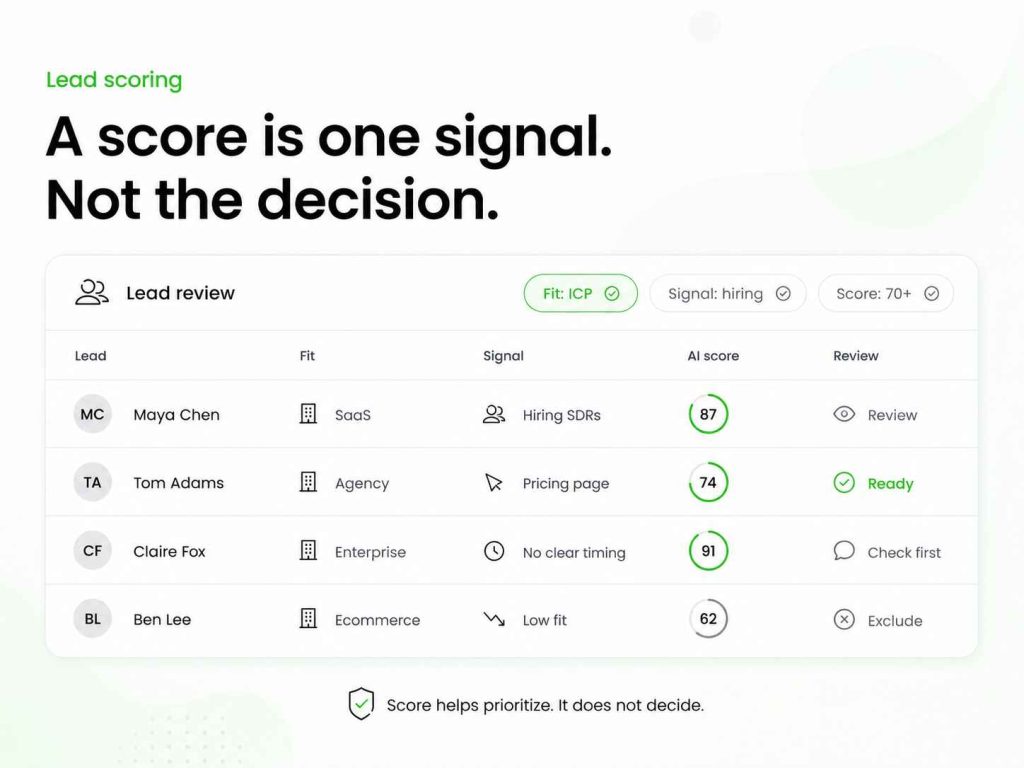
Lead qualification is another stage where AI can add useful context. Traditional scoring systems often rely on simple rules. A VP receives more points than a manager. A company with 1,000 employees receives more than one with 20. A pricing-page visit receives more points than a blog-page visit. These systems can work, but they often miss intent hidden inside less structured data.
Analyze What the Prospect Actually Says
Suppose two people submit the same demo form. The first writes:
“Looking around at available solutions.”
The second writes:
“Our contract with the current provider ends in November. We need to choose a replacement before September so we can complete implementation.”
The second lead clearly contains stronger purchase signals. AI can extract factors such as urgency, existing solution, implementation timing, specific business problems, and competitive evaluation. These signals can support the lead score. The important difference is that qualification moves beyond asking who the person is and begins considering what is happening around the purchase.
5. Improve Discovery Call Analysis
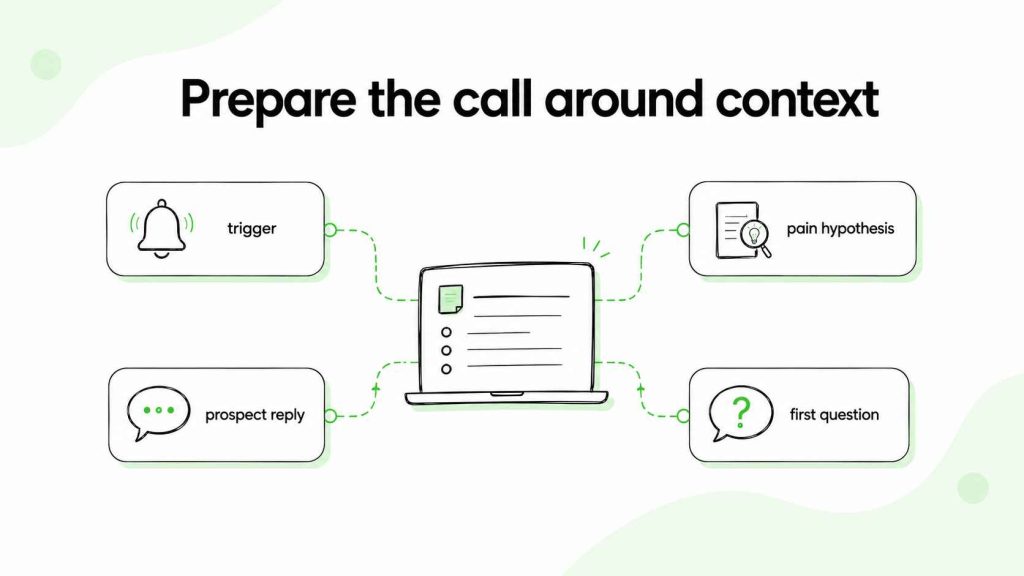
Discovery is one of the most important stages in a B2B funnel because this is where the seller begins understanding whether there is a real opportunity. AI can help by analyzing the conversation after the call and turning it into structured information. For example, it can identify the prospect’s main problem, business impact, existing process, timeline, stakeholders, objections, competitors, and agreed next steps. This creates a much richer opportunity record than a salesperson writing:
“Good meeting, interested, follow up next week.”
Find What Was Not Discussed
A more interesting use case is not summarizing what happened, but identifying what is missing. Suppose a discovery call contains detailed discussion of the problem and technical requirements, but no discussion of timeline, buying process, or who approves the budget. AI can flag those gaps. A post-call summary might say:
Strong problem fit identified. Implementation requirements were discussed, but there is no confirmed decision timeline, economic buyer, or purchasing process.
This helps the salesperson understand what needs to happen in the next conversation. That is more useful than a basic transcript summary.
6. Build an AI-Assisted Stakeholder Map
Complex B2B sales rarely depend on one person. There may be a champion, end users, technical reviewers, procurement, finance, legal, senior executives, and other people influencing the decision. One reason deals stall is that the sales team believes it has enough support when it is actually speaking with only one interested contact. AI can help analyze communication history and CRM activity to build a simple stakeholder map.
Identify Missing Roles
For example, the system may recognize that a $150,000 enterprise opportunity has had six meetings, but every meeting has involved people from the same operational team. No financial decision-maker has appeared. No executive sponsor has been identified. No procurement contact exists in the CRM. That does not mean the deal is bad. It does mean the opportunity may have stakeholder risk. An AI-generated recommendation might say:
The opportunity has strong user engagement but limited senior-level involvement. Consider confirming who approves the budget before moving into the proposal stage.
This gives the account executive a practical next action.
7. Detect Opportunities That Look Healthy but Are Not
Sales pipelines often contain deals that appear healthy because they have a high value, a late stage, and a close date this month. But those fields do not always reflect what is actually happening. AI can analyze activity patterns to identify contradictions. Suppose an opportunity is marked as “Negotiation,” but the prospect has not replied in 18 days, the last two meetings were cancelled, and no next step is scheduled. The CRM stage says one thing. The behavior says another.
Create Deal-Risk Signals
Useful risk indicators might include:
- Long gaps between conversations
- Repeatedly delayed meetings
- No agreed next step
- Only one stakeholder involved
- No executive engagement
- Close date repeatedly moved
- Pricing sent before sufficient discovery
- Competitor mentioned late in the process
- Prospect engagement declining over time
AI can combine these signals and highlight opportunities that deserve attention during pipeline review. The purpose is not to automatically close deals as lost. It is to help managers focus on the opportunities where intervention may matter.
8. Recommend the Next Best Action
One of the more interesting AI use cases in sales funnels is moving from reporting to recommendations. Instead of simply saying what happened, the system suggests what should happen next. For example, after analyzing an opportunity, AI might recommend:
Confirm the implementation timeline.
Introduce the technical lead to the prospect’s IT team.
Send a case study from the same industry.
Identify the economic buyer before sending the proposal.
Re-engage the champion because there has been no activity for ten days.
These recommendations can be based on the current deal, the company’s sales methodology, and patterns from similar successful opportunities.
Recommendations Should Be Explainable
A recommendation becomes much more useful when the salesperson understands why it exists. Compare:
“Schedule another meeting.”
with:
“The prospect has confirmed the business problem and technical fit, but no implementation timeline has been discussed. Use the next meeting to confirm timing and purchasing steps.”
The second recommendation contains context. That makes it easier for the representative to judge whether the suggestion makes sense.
9. Match Sales Content to Funnel Stage
Sales teams often have dozens or hundreds of assets available. Case studies, comparison pages, ROI calculators, product videos, technical documentation, implementation guides, security documents, and customer stories may all exist somewhere. The problem is finding the right asset for the right opportunity. AI can use the context of the deal to recommend relevant content.
Example
Suppose the prospect is a financial services company concerned about security and implementation complexity. Instead of sending a generic product brochure, the system could suggest:
- A financial services case study
- Security documentation
- An implementation timeline
- A technical integration guide
For another prospect concerned mainly about ROI, the recommended content could be completely different. This makes sales enablement more contextual. The value comes from connecting deal stage + buyer concern + relevant content. The same principle can apply to content distribution outside direct sales conversations. For example, a sales or marketing team can use a social media management platform such as RecurPost to plan, schedule, and repurpose educational content across social channels. This can help keep useful content in circulation while sales teams focus on using the right asset in one-to-one conversations.
10. Analyze Objections Across Funnel Stages
Objections do not only happen during negotiation. They appear throughout the funnel. Early-stage prospects may say they do not see the need for the product. Mid-funnel buyers may be concerned about integration. Late-stage buyers may question pricing, risk, implementation time, or internal resources. AI can analyze these objections across large numbers of conversations.
Find Where Deals Begin to Break
Suppose the analysis shows that small companies most often disappear after discussing pricing, while enterprise companies frequently stall after technical evaluation. That suggests two different problems. The SMB segment may have a pricing or positioning issue. The enterprise segment may need stronger implementation support, technical content, or earlier involvement from solution engineers. Looking only at the final lost reason would hide this difference. Looking at objections by funnel stage gives the sales team a clearer picture of where deals are slowing down.
11. Use AI to Improve Proposal Preparation
Creating a strong proposal often requires information from multiple places. The seller needs to understand the prospect’s goals, current process, agreed requirements, implementation needs, pricing, and decision criteria. AI can help organize this information before the proposal is created. For example, it can review meeting notes and identify the specific business outcomes the prospect mentioned. Instead of a generic proposal opening such as:
“Our platform helps companies improve operational efficiency.”
the document could focus on the prospect’s actual objectives:
“The project is intended to reduce weekly reporting time, create consistent performance data across three regions, and replace the current spreadsheet-based process.”
The proposal feels more relevant because it reflects the discovery process. The salesperson should still verify the final content, especially pricing, commitments, and technical details.
12. Improve Forecasting With Funnel Behavior
Forecasting often depends heavily on CRM stages. A company may assign a 20% probability to discovery, 50% to proposal, and 80% to negotiation. The problem is that two deals in the same stage can behave very differently. AI can add behavioral information. A negotiation-stage deal with frequent executive engagement, confirmed purchasing steps, and a scheduled legal review may be very different from another negotiation-stage opportunity that has had no response for three weeks.
Compare Deals With Similar Historical Opportunities
An AI model can analyze how similar past deals progressed. It might look at deal size, industry, funnel stage, number of stakeholders, time in stage, meeting activity, email engagement, close-date changes, and other signals. This can help create a more realistic forecast. However, the result should still support human judgment rather than replace it. A probability score cannot know everything happening inside the prospect’s company.
13. Learn From Won Deals
The end of the funnel creates useful data for the beginning of the next one. When a company wins a deal, AI can analyze what happened during the sales process. Which problem created urgency? Which stakeholders were involved? Which content was used? How long did each stage take? Which competitor appeared? What objections had to be resolved? Over time, patterns may emerge.
Feed Winning Patterns Back Into Prospecting
Suppose the company discovers that its strongest enterprise customers often share three characteristics: They have recently expanded internationally, use a specific CRM, and have a revenue operations team larger than five people. Those signals can influence future account selection. The sales funnel becomes a feedback loop. Closed deals improve the company’s understanding of which accounts to target next.
14. Learn Even More From Lost Deals
Lost deals can be just as useful as wins. Many organizations record lost reasons poorly. Representatives select broad categories such as “price,” “competitor,” or “no decision” because the CRM requires something before the opportunity can be closed. AI can analyze the actual conversations and produce more detailed patterns. For example, deals marked “price” might actually fall into several groups: Some buyers could not justify the expected ROI. Others liked the product but had insufficient budget. Some compared the solution with a cheaper competitor. Others did not see enough difference between available options. These are not the same problem. Each one requires a different response from sales, marketing, product, or pricing teams.
15. Create a Sales Funnel Feedback Loop
The most interesting AI use case may not exist inside a single stage at all. It is connecting information across the whole funnel. Imagine a system that identifies which accounts convert best, which messages create conversations, which discovery problems lead to real opportunities, which stakeholders appear in successful deals, and which objections cause deals to fail. Those insights can flow back into the top of the funnel. Marketing can change campaigns. Sales development can change targeting. Account executives can improve discovery. Sales enablement can create better content. Managers can update qualification rules. The organization begins learning from its own funnel rather than treating every stage as a separate process.
What AI Should Not Do in the Sales Funnel
AI creates the most value when it reduces unnecessary work or improves access to information. Problems begin when automation replaces judgment in areas where context matters. For example, AI should not automatically decide that an important enterprise account is worthless because the model gives it a low score. It should not send sensitive negotiation emails without review. It should not invent personalization or create research that representatives never verify. The sales team also needs to understand where AI-generated information comes from and how reliable it is. A useful system supports decisions. A dangerous one quietly makes them without anyone understanding why.
How to Choose the Right AI Sales Funnel Use Case
Companies do not need to implement every possible AI workflow. A better approach is to find the biggest sources of friction inside the existing funnel.
Ask Where Time Is Being Lost
Are SDRs spending hours researching accounts? If the constraint is outreach capacity rather than research alone, the cold email infrastructure calculator can help estimate the sending setup needed for a target volume. Are account executives writing CRM notes late at night? Are managers manually reviewing hundreds of opportunities? Does the sales team struggle to find the right content? These are potential automation opportunities.
Ask Where Deals Are Being Lost
Maybe too many leads are poorly qualified. Perhaps discovery calls fail to identify real buying processes. Maybe proposals are sent without an economic buyer. Perhaps late-stage deals regularly stall because technical requirements appear too late. These are potential intelligence opportunities. The best AI project is usually connected to a clear funnel problem and a measurable business outcome. For outbound campaigns, Woodpecker’s cold email benchmarks can provide a useful external reference point for interpreting results.
Final Thoughts
AI becomes much more useful in sales when you stop treating it as one large category and start applying it to specific stages of the funnel. At the top, it can improve account selection, buying-signal analysis, research, and personalization. In the middle, it can strengthen qualification, discovery, stakeholder mapping, and sales enablement. Near the bottom, it can help identify deal risk, prepare proposals, support negotiations, and improve forecasting. After the deal is finished, AI can analyze why the company won or lost and feed those insights back into the next sales cycle. That creates something more valuable than automation. It creates a sales funnel that learns. The best question is therefore not: “Where can we add AI to sales?” It is: “Where in our funnel are we losing time, information, or good opportunities — and can AI help us fix that?”