
A list of 2,000 leads is not one audience just because every contact fits the same broad ICP. The CFO at a 70-person SaaS company, the VP Sales at a 900-person software business and the founder who just hired their first SDR may all be potential buyers. They still have different priorities, buying processes and reasons to reply. Lead segmentation turns one large prospect list into smaller groups that can support a more relevant message, offer, CTA or outreach cadence. Done well, it gives personalization some structure. Done badly, it creates dozens of tiny lists without changing what you actually send.
This guide explains which B2B lead segmentation criteria matter for outbound, how to decide when a segment deserves its own campaign and how to build a practical segmentation model without turning prospecting into a data project.
What is lead segmentation?
Lead segmentation is the process of grouping leads or prospects according to characteristics that matter to your sales motion. Those characteristics may include company size, industry, role, geography, buying signal, technology stack, account value or stage in the relationship.
The point is not to create more categories. The point is to make a useful decision differently for each group.
| Segment difference | What may change |
| Company size | Problem framing, proof, sales cycle and CTA |
| Job function | Pain point, language and value proposition |
| Seniority | Level of detail and type of outcome discussed |
| Geography | Market context, language, timing or compliance considerations |
| Buying signal | Reason for contacting the account now |
| Account value | Research depth, personalization and channel mix |
If dividing a list does not change targeting, copy, offer, timing or prioritization, the split probably does not need to exist.
Lead segmentation vs ICP vs lead scoring
These ideas are related, but they solve different problems.
Your ideal customer profile defines the type of company most likely to benefit from what you sell. Segmentation divides that broader target market into groups that need different treatment. Lead scoring or prioritization then helps decide which accounts or people deserve attention first.
| Concept | Question it answers | Example |
| ICP | Who should we sell to? | B2B SaaS companies with 50–500 employees |
| Segmentation | Which groups inside that ICP need different outreach? | 50–150 employees vs 151–500 employees |
| Prioritization | Who should we contact first? | Companies currently hiring SDRs move to the front of the queue |
A strong outbound process often uses all three. The ICP prevents obvious poor-fit accounts from entering the list. Segmentation keeps the message relevant. Prioritization helps the sales team spend more time where the potential return is higher.
The best segmentation criteria are the ones that change the message
It is easy to segment a database because a field exists. That does not mean the field matters.
Suppose your database contains employee count, founding year, city, industry and revenue. You could create a separate campaign for companies founded between 2016 and 2019. Unless company age changes the problem you discuss, that segment has little practical value.
A useful test is simple:
| Ask | If the answer is yes… |
| Would I use a different problem or use case? | Consider a separate segment. |
| Would I select different proof? | A segment may improve relevance. |
| Would the CTA change? | The buyer may belong in a different campaign. |
| Would I contact them at a different moment? | Trigger-based segmentation may help. |
| Would I still send exactly the same email? | Do not create another segment just for reporting. |
Seven useful ways to segment B2B leads for outreach
1. Segment by company size
Employee count is useful when the problem changes as the organization grows. A founder at a 20-person business may personally manage outbound. A 500-person company may have SDR leadership, RevOps and procurement involved in the same decision.
The product can be identical while the sales story changes considerably. Smaller companies may care about getting a process running without adding headcount. Larger companies may care about consistency, governance, reporting or coordination across teams.
Avoid arbitrary size bands simply because a database offers them. Use ranges that correspond to a meaningful change in how customers buy or use your product.
2. Segment by role and department
Two people at the same account can care about the same problem for different reasons.
A Head of Sales may care about pipeline. RevOps may care about process consistency and data. An SDR manager may care about execution and rep productivity. Sending all three the same pitch wastes information you already have.
| Persona | Possible angle |
| VP Sales | Pipeline output, team capacity and predictability |
| RevOps | Workflow, integrations, governance and reporting |
| SDR Manager | Rep workflow, sequencing and campaign execution |
| Founder | Getting outbound working with limited people and tools |
This does not mean writing a completely different sequence for every job title. Group roles when they share the same business concern and split them when the value proposition meaningfully changes.
3. Segment by industry
Industry segmentation helps when customers face different workflows, regulations, buying cycles or terminology. A logistics company and a SaaS company may both need lead generation, but examples and business triggers that make sense in one industry can sound irrelevant in the other.
Industry labels alone are often too broad. “Technology” can include cybersecurity vendors, developer tools, HR software and fintech businesses with very different sales models. Use industry alongside another variable when the category covers several distinct use cases.
4. Segment by geography
Geography matters for more than time zones. Different markets can have different levels of category awareness, local terminology, legal requirements and expectations around formality.
Do not create one campaign per country automatically. Split markets when localization changes the message or process. Germany, the UK and the US may need different proof or phrasing for some products, while several similar markets may work perfectly well inside one segment.
If your segmentation uses personal data for European outreach, review the GDPR email compliance checklist as part of list preparation rather than treating compliance as a footer added after the campaign is built.
5. Segment by buying signal or business trigger
Trigger-based segments can be especially powerful because they explain why the account may deserve attention now.
Examples include a new senior hire, team expansion, entry into another market, recent funding, a product launch or a technology change. The useful part is not mentioning the event. It is connecting the event to a business problem your offer can plausibly solve.
Woodpecker’s guide to B2B buying signals goes deeper into which signals are strong enough to affect account prioritization and which ones should remain internal context.
| Signal | Weak use | Stronger use |
| Hiring SDRs | “Congrats on hiring!” | Segment companies building outbound teams and discuss onboarding or workflow consistency. |
| Funding | Mention the announcement and immediately pitch. | Use funding only when planned growth creates a problem related to your offer. |
| New executive | Send the same generic welcome message to every new leader. | Look for the mandate or change that person may have been hired to lead. |
6. Segment by technology or current setup
Technographic data is useful when the tools a company already uses change your pitch. A CRM integration, competing platform or manual workflow can affect product fit and the type of friction you need to address.
Avoid the creepy version of technographic personalization. The prospect does not need to hear every tool you detected on their website. Use the information to choose a relevant angle, then explain the business consequence rather than proving how much data you collected.
7. Segment by account value and sales complexity
Not every prospect deserves the same research cost.
A strategic account that could become a large customer may justify manual research, several stakeholders and a multichannel cadence. A broad SMB segment may need a lighter workflow with reusable research fields and simpler personalization.
| Segment | Research depth | Personalization | Possible channel mix |
| Tier 1 strategic accounts | High | Account-specific | Email + LinkedIn + selective calls |
| Tier 2 core ICP | Medium | Segment + trigger | Email + LinkedIn when useful |
| Tier 3 broad-fit prospects | Light | Segment-level | Mostly email |
Build segments around message differences, not spreadsheet columns
A practical segmentation exercise starts with copy, not data.
Take your current campaign and ask what would have to be different for a second group of prospects. Maybe enterprise accounts need different proof. Maybe founders and RevOps teams care about different outcomes. Maybe recently funded companies deserve a timely opening while the remaining accounts do not.
Only then translate those differences into database filters.
Example: segmenting one SaaS outbound list
Imagine you sell software that helps B2B companies manage outbound prospecting.
Your original list contains 1,200 companies with 30–500 employees. Sending the same campaign to all of them would be easy, but it ignores several useful differences.
| Segment | Criteria | Core angle |
| Founders starting outbound | 30–80 employees + founder/CEO + no clear SDR leadership | Build a repeatable process without a large sales stack. |
| Growing SDR teams | Hiring SDRs or sales development leadership | Keep sending and follow-up workflows consistent as headcount grows. |
| RevOps-led teams | 150+ employees + RevOps title | Improve process visibility, integrations and campaign governance. |
| International expansion | New market hiring or regional sales expansion | Coordinate outbound across markets without fragmenting the workflow. |
Those four groups can still buy the same product. The segmentation matters because the reason to care is different.
How granular should lead segmentation be?
The smallest possible segment is one person. That does not mean every contact needs a unique campaign.
Granularity should stop where additional splitting no longer changes the sales decision. If German and Austrian SaaS founders receive the same offer, proof and CTA, they may belong together. If enterprise companies require security review and procurement while SMB buyers can start independently, those groups probably should not.
A useful rule is to create the fewest segments necessary to preserve meaningful differences.
| Too broad | Useful | Too granular |
| All SaaS companies | SaaS companies building their first SDR team | Separate campaigns for every employee-count interval and city without a copy difference |
| Marketing leaders | Demand gen leaders at companies expanding paid acquisition | Separate segment for every exact job-title variation |
Use personalization inside a segment, not instead of segmentation
Segmentation and personalization solve different layers of the same problem.
The segment determines the shared business story. Personalization adds the detail that explains why an individual account belongs in that story.
For example, every prospect in a “new SDR team” segment may receive messaging about outbound consistency. One company may be hiring in the US and another across DACH. Those account-specific facts can shape the opener while the central problem remains consistent.
Woodpecker’s guide to personalizing outreach at scale explains how to use shared segment logic without making every message feel mass-produced.
How to build segmented prospect lists in Woodpecker
Woodpecker Lead Finder can support the list-building part of segmentation when you do not already have the prospect data.
Current search filters include fields such as job title, country, industry, department, seniority and company criteria. You can begin from individual leads or use the Companies view to narrow the types of organizations you want before finding contacts inside them.
The useful workflow is to define the segment outside the tool first, then reproduce those criteria as filters. Starting with random filters and deciding what the segment means afterward usually creates a list rather than a strategy.
| Before Lead Finder | Inside Lead Finder | Before campaign launch |
| Define ICP and segment logic | Apply company and lead filters | Review whether returned prospects genuinely fit |
| Decide the message angle | Find the relevant people | Check data and personalization fields |
| Define exclusions | Exclude irrelevant criteria where needed | Add selected prospects to the right campaign |
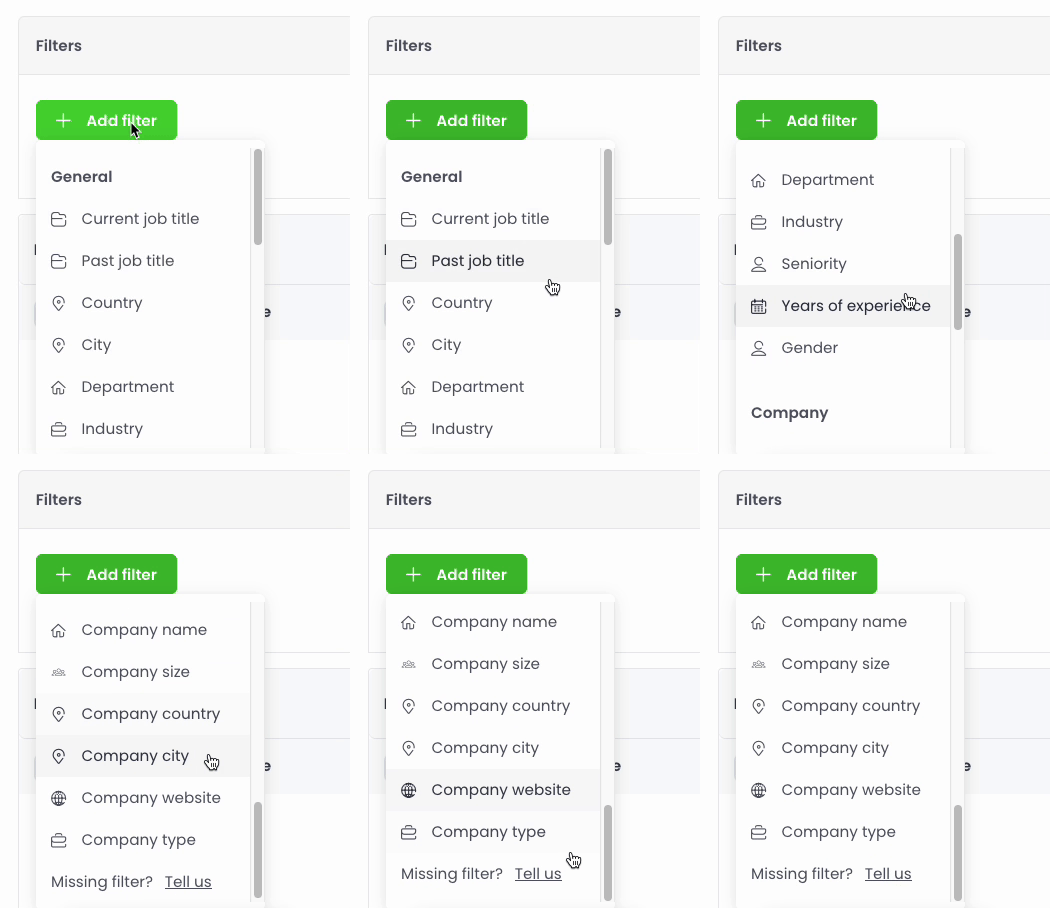
The screenshot above is useful for exactly one reason: it shows the filtering layer that turns your segmentation criteria into an actual prospect search.
For a broader comparison of prospect data sources, see Woodpecker’s guide to B2B contact database providers.
Check the segment before you write the sequence
A filter can return technically correct records that still make a poor audience.
Review a small sample before investing time in the campaign. Twenty to thirty records are often enough to expose obvious problems with the segmentation rule.
- Company fit: Do these accounts actually resemble the customers you intended to target?
- Role fit: Can the selected person influence or understand the problem?
- Shared problem: Is the same core business issue plausible across most records?
- Message fit: Could one useful sequence address this group without becoming generic?
- Exclusions: Are obvious poor-fit subgroups still slipping through?
- Data quality: Are job titles, employers and contact details current enough to use?
If several records make you think “technically yes, but I would never send them this email,” the segment probably needs another filter.
Check email quality before adding the segment to outreach
Correct segmentation does not help if the underlying contact data is unreliable. Review questionable records before launch rather than treating every address returned from a data source as equally safe to use.
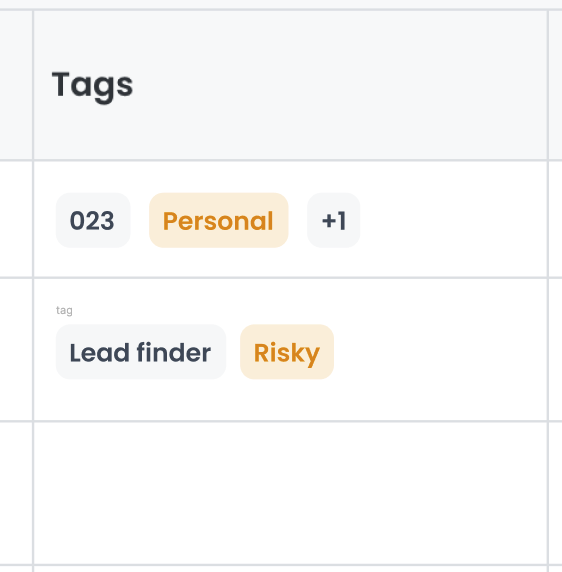
Woodpecker can label found addresses with indicators such as Risky or Personal. Those labels give you another review point before a prospect enters a campaign, which is especially useful when a large segment was built from several filters at once.
Let each segment have one clear message hypothesis
Once the list makes sense, write down the campaign hypothesis in one sentence before drafting copy.
For example:
We believe sales leaders at SaaS companies currently hiring several SDRs will care about standardizing outbound workflows because team expansion makes inconsistent processes more expensive.
That sentence is useful because it can be wrong. If the campaign receives no meaningful replies, you can examine the target, trigger and problem instead of endlessly rewriting synonyms in the email.
The sales outreach plan template can help connect segment logic with channel choice, cadence and campaign goals.
Do not test two segments as though they were two copy variants
Suppose Campaign A targets founders and Campaign B targets RevOps leaders. Campaign B gets more replies.
That does not automatically mean its subject line or CTA was better. You changed the audience at the same time as the message.
First compare performance between segments to understand where the offer resonates. Then test copy variants inside the same segment when you want to learn about subject lines, openings or CTAs.
For a true message experiment with enough observations, the cold email A/B test calculator can help determine whether the difference between two variants is likely to be meaningful rather than random variation.
Measure performance at the segment level
A campaign-wide average can hide an important targeting problem.
Imagine one sequence reaches 600 prospects and generates a 6% reply rate. That looks respectable until you split the results: one segment replies at 11%, another at 2% and a third produces plenty of replies but almost no qualified conversations.
| Metric | What it can reveal |
| Bounce rate | Possible data-quality differences between segments |
| Reply rate | How often the audience engages with the message |
| Positive reply rate | Which segment sees genuine relevance |
| Qualified meeting rate | Which groups create useful sales conversations |
| Opportunity rate | Whether the segment produces pipeline rather than curiosity |
| Opt-outs or negative replies | Where targeting or positioning may be too broad |
Use Woodpecker’s cold email benchmarks for external context, but prioritize comparisons between your own segments over time. Your audience, offer and market rarely match an industry-wide benchmark perfectly.
Segmentation does not fix bad infrastructure
Smaller, more relevant segments improve targeting. They do not change the technical limits of your sending setup.
If segmentation creates six campaigns instead of one, calculate the total email volume across all sequences, including follow-ups. The cold email infrastructure calculator can help estimate how many domains and email accounts the planned outbound volume may require.
Before activating a new segment, use the email preview tool with real values from several prospects. That is especially useful when different segments populate different personalization fields and one missing field could make an otherwise good email look automated.
Common lead segmentation mistakes
Creating segments because the field exists. Data should earn its place in the model. If company founding year does not change anything about outreach, leave it out.
Using only one dimension. “Healthcare companies” may still be too broad. Combining industry with company size, role or a business trigger often creates a more useful audience.
Building dozens of tiny campaigns. Hyper-segmentation can create more operational work than relevance. Split a group only when something meaningful changes.
Confusing signals with qualification. Funding, hiring or website activity can make an account more interesting. They do not make a poor-fit company part of your ICP.
Writing the sequence before validating the list. Review actual records first. A segmentation rule can look excellent on paper and produce strange results in the database.
Comparing campaign averages only. Segment-level results often reveal that one part of the audience is carrying the entire campaign.
Lead segmentation FAQ
What is lead segmentation?
Lead segmentation means dividing prospects into groups based on characteristics that matter to the sales process, such as industry, company size, role, location, buying signals or account value. The goal is to make targeting and outreach more relevant.
What is B2B lead segmentation?
B2B lead segmentation groups potential business buyers according to company and professional characteristics. Unlike consumer segmentation, B2B segmentation often relies heavily on firmographics, buying roles, account context, technology and business events.
How is lead segmentation different from lead scoring?
Segmentation determines which group a lead belongs to. Lead scoring or prioritization estimates which leads deserve attention first. A prospect can belong to the “mid-market RevOps” segment while receiving a higher priority because their company is actively hiring SDRs.
How many lead segments should I create?
There is no ideal number. Create enough segments to capture meaningful differences in message, offer, timing or sales process, but avoid splitting groups when the outreach would remain almost identical.
What are the most useful B2B segmentation criteria?
Common criteria include industry, employee count, geography, department, seniority, job role, technology, buying signals and account value. The best criteria are the ones that change what your sales team actually does.
Can AI segment sales leads?
AI can classify records, summarize account information and identify patterns that help build segments. A salesperson should still decide which differences matter commercially. Automating a weak segmentation model only creates poor targeting faster.
Should every lead segment have a different email sequence?
No. Separate sequences make sense when the problem, proof, CTA, timing or buying context changes. Several similar segments can share a sequence when those elements remain consistent.
Make every segment explain why the prospect belongs there
Good segmentation sits between broad targeting and one-to-one personalization. It gives enough structure to run outbound efficiently without pretending that every person inside the ICP has the same reason to care.
Start with the business difference, then find the data field that represents it. Validate real prospects before writing the sequence and compare results at segment level after launch. If a segment does not change the way you communicate or prioritize, simplify it.
A smaller number of well-defined groups will usually teach you more than a huge database treated as one audience.