


A buying signal is any action, change or pattern that suggests a prospect may be moving closer to a purchase.
For B2B sales teams, the useful part is not spotting every signal. It is knowing which ones suggest real buyer intent, which ones are too weak to act on and how to turn a trigger into relevant outreach.
A company raising funding is a buying signal. So is a new VP of Sales, a burst of hiring, repeated visits to a pricing page or a prospect replying to a cold email. None of those signals automatically means the company is ready to buy.
B2B buying signals help marketing and sales teams prioritise accounts with a plausible reason to engage now. They should inform outreach, not replace judgement.
This guide explains how buying signals in sales work, where to find them and how to act without sending the usual “I saw you raised funding” email.
What are B2B buying signals?
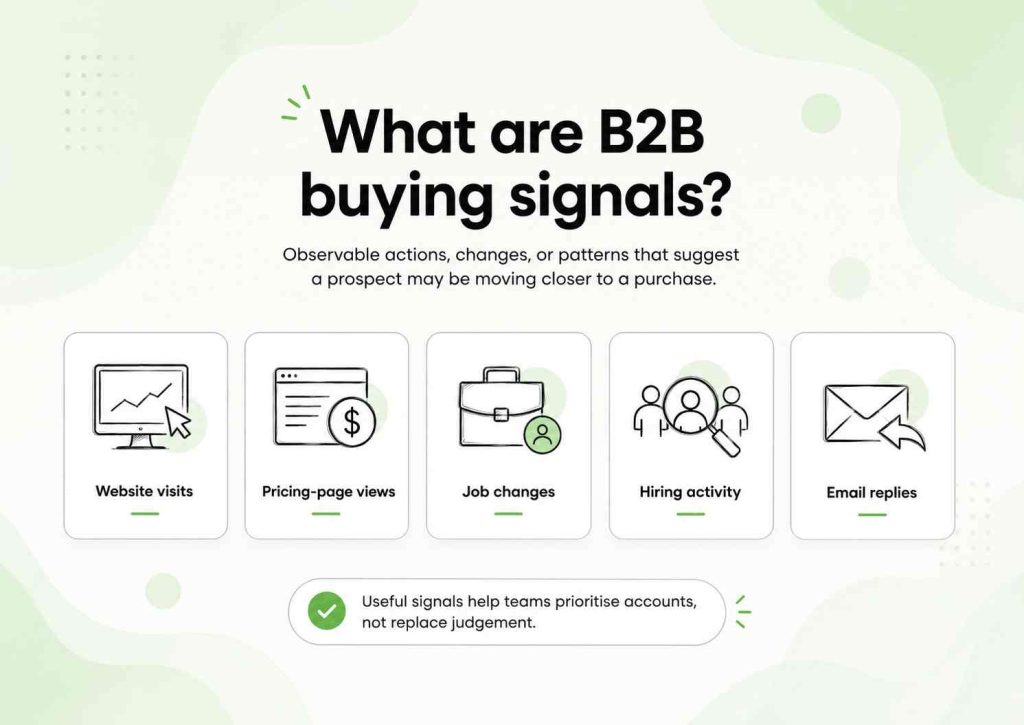
B2B buying signals are observable signs that a company, buying group or individual may have interest in solving a problem.
A signal can come from public activity, first-party data, CRM history, website behaviour or changes inside the business.
For example, B2B buyers may:
- visit a product or pricing page several times
- download a comparison guide
- start a free trial
- change jobs into a relevant role
- post about a problem your product addresses
- hire people connected to the workflow you support
- reply to outreach
- ask a colleague for a recommendation
Some signals suggest awareness. Some suggest research. Some point to stronger buying intent.
The key is context.
A prospect reading one blog post may be curious. A buying committee returning to your website, comparing features and asking about security may be closer to a decision.
B2B buying is rarely a single-person action. Several stakeholders may influence the buying process, often at different stages and with different priorities. That is why an account-level view is more useful than a random list of job titles. Account-based prospecting gives teams a practical way to build that view.
Buying signal vs intent signal vs intent data
The terms buying signal, intent signal and intent data are often used interchangeably. They overlap, but they are not exactly the same.
A buying signal is a specific action or event that may indicate interest. It could be a job change, a product-page visit or a reply to an email.
An intent signal is similar, but it often refers to behaviour that suggests research or purchase intent before a person has contacted you directly.
Intent data is the information collected around those signals. It can come from your own website, CRM or product data. It can also come from third-party intent data providers that track topic research or activity across external sites.
First-party intent data is usually easier to trust because you know where it came from.
A prospect visiting your pricing page, starting a free trial or replying to a campaign gives you direct evidence of interest in your product or service.
Third-party intent data can help identify accounts researching a category. But it is broader and often less precise. A company may be reading content about your category without actively evaluating vendors.
The useful question is:
What did this signal actually tell us about the buyer’s current situation?
Types of B2B buying signals
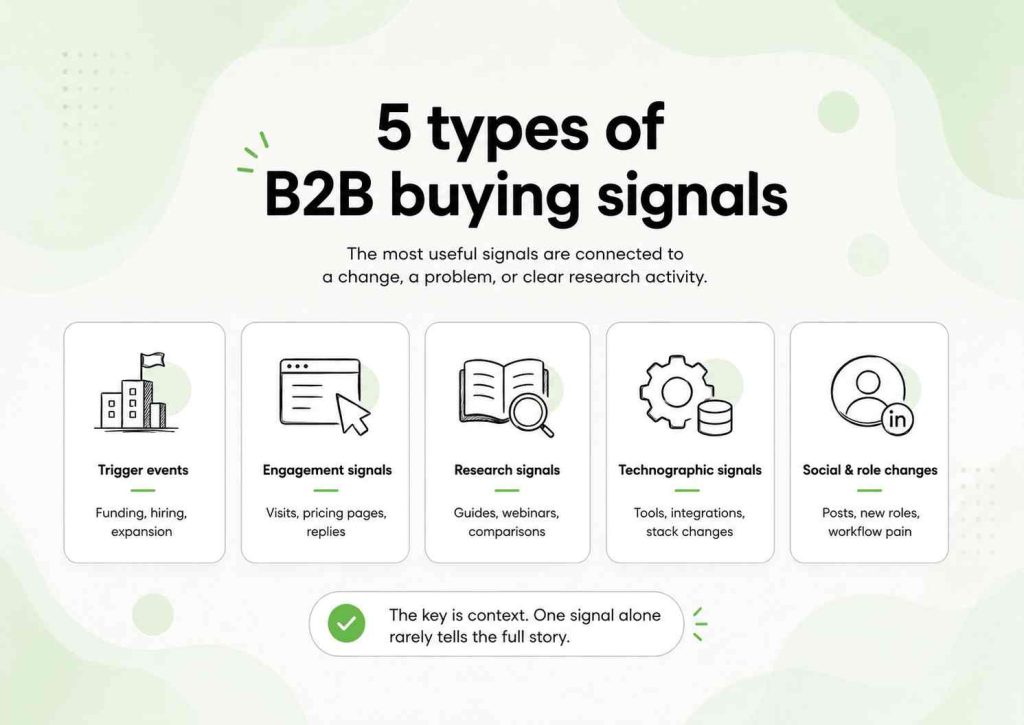
The most useful types of B2B buying signals are connected to a change, a problem or a clear sign of research.
Trigger events: buying signals in sales before the buyer raises their hand
Trigger events are external changes that can create a reason for a company to revisit a process, tool or supplier.
Common buying signals include:
- funding announcements
- leadership changes
- rapid hiring
- new market expansion
- mergers or acquisitions
- product launches
- new partnerships
- changes in the tech stack
- major customer wins
- regulatory changes
For example, a company hiring six SDRs may have a future need for more structured prospecting and outreach. But the signal alone is weak.
The stronger version is a pattern:
The company is hiring SDRs, opening a new market and bringing in a new sales leader.
That combination may point to a workflow change, a new sales process or pressure to create pipeline faster.
The more signals across multiple sources you can connect, the more useful the hypothesis becomes. A targeted prospecting workflow can help you collect that context before anyone starts outreach.
Engagement signals and first-party intent data
Engagement signals come from direct interaction with your brand.
They may include:
- repeated website visits
- viewing high-intent pages
- returning to pricing or integration pages
- downloading a guide
- attending a webinar
- using a calculator or free tool
- opening product emails
- replying to outreach
- starting a free trial
- inviting teammates into a product
These signals are often more useful than generic company news because they connect directly to your product.
A visitor who reads one article may be browsing. A company account that returns to your pricing, security and integration pages within a week may show stronger buying readiness.
Tools for identifying anonymous website visitors can help connect website activity to target accounts. The next message still needs a credible reason to exist.
Do not write:
I saw you visited our pricing page.
Use the activity as internal context. Then write a message that speaks to the likely problem.
Content and research signals
Research signals appear when B2B buyers consume content related to a category problem.
They may read a guide, listen to a webinar, search for alternatives, compare vendors or engage with educational content on LinkedIn.
These interest signals can be useful for marketing and sales because they suggest that the account may be trying to understand a problem.
But they do not always indicate immediate purchase intent.
A person reading “how to improve cold email deliverability” may be researching for a future project, a blog post or general professional development.
The signal becomes more useful when it appears alongside other behaviour.
For example:
A target account downloads a deliverability checklist, visits your pricing page and a sales leader follows your LinkedIn page.
That does not guarantee a deal. It gives the revenue team a reason to watch the account more closely.
Technographic and workflow signals
Technographic signals show which tools, systems or platforms a company uses.
They can help B2B organizations understand whether an account is likely to face a relevant operational problem.
For example, a company using a CRM that connects with your product may be easier to target than one using an incompatible setup. A business that has adopted a new sales engagement platform may be in the middle of changing its workflow.
Technographic B2B data should not become a gimmick.
The prospect does not care that you know which tool they use. They care whether you understand a problem connected to that setup.
Use technographic signals to inform account research, not to make the email sound invasive. That research can later feed a more relevant personalised cold email.
Social, role-change and hidden buying signals
Some of the strongest buying signals are not visible in a database.
A new leader may publish a post about the challenge they were hired to solve. A team member may comment on a discussion about a process gap. A job post may reveal a new priority. A customer review may hint at frustration with an existing workflow.
These hidden buying signals take more effort to find, but they can create better outreach than a generic company-level trigger.
For example, a new Head of Sales posting about standardising prospecting across regions gives you a more credible opening than simply mentioning that they changed jobs.
A thoughtful LinkedIn outreach strategy uses this kind of context carefully. The goal is not to prove that you have watched every move. It is to show you understand the business challenge behind the signal.
Common buying signals: which ones are actually strong?
Not all buying signals deserve the same response.
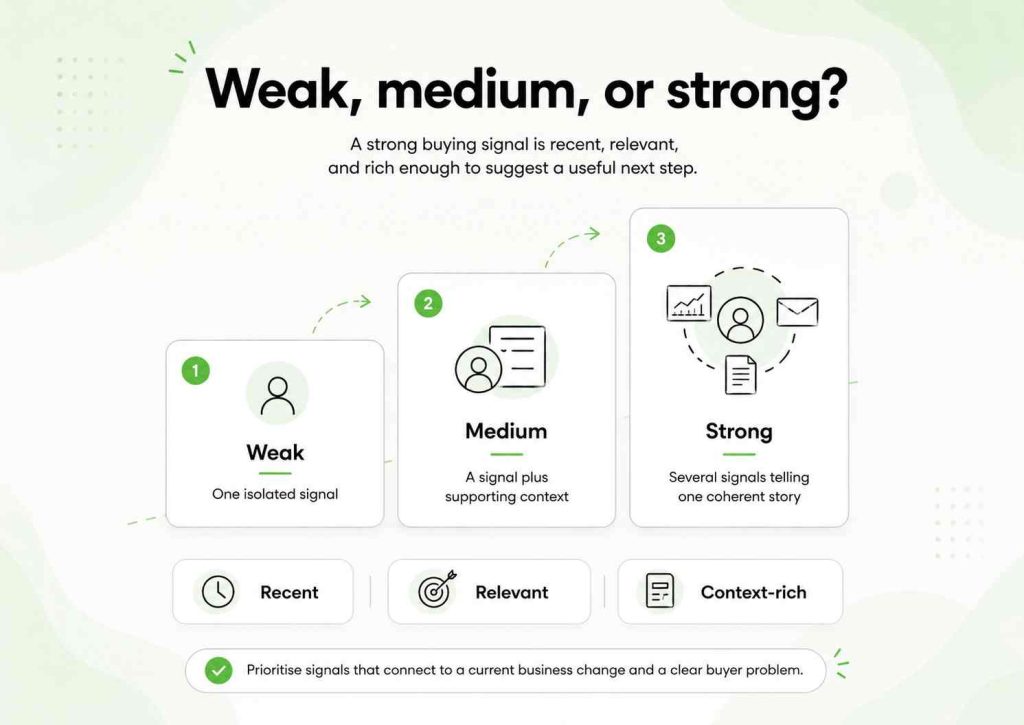
A strong buying signal usually has three qualities:
- It is recent.
- It connects to a problem you can help solve.
- It gives you enough context to create a relevant next step.
Here is a practical way to classify them.
A weak signal might be a company that raised funding six months ago.
A medium signal might be a company that raised funding recently and began hiring for roles connected to your product category.
A strong buying signal might be a company that raised funding, hired a new sales leader, opened several SDR roles and showed direct engagement with your content.
The difference is not the number of signals alone. It is whether they tell one coherent story.
Accounts showing early buying signals should not always be pushed into immediate outreach. Some may need monitoring, more research or an educational touch before a direct sales message.
Signals to prioritize for your revenue team
A revenue team should prioritise signals that connect to a current business change and a clear buyer problem.
Start with these categories.
Direct product interest
This includes pricing-page visits, repeat product-page activity, trial starts, demo requests and replies to campaigns.
These are usually high-priority because the account has already interacted with your product or service.
A new role with a relevant mandate
A new VP of Sales, RevOps leader or demand generation manager may be reviewing systems, processes or suppliers.
But do not assume every job change creates immediate buying intent.
Check what the person was hired to do. Their LinkedIn profile, company announcements and job description can help contextualise these signals.
Hiring linked to a workflow problem
Hiring SDRs, growth marketers, customer success managers or RevOps staff may indicate a company is scaling a function.
The signal gets stronger when job descriptions mention the process your product helps improve.
Research across several relevant topics
Third-party intent data may show that an account is researching a category. First-party signals may show they have interacted with your content too.
When several research signals appear together, the account may be worth prioritising.
Known internal champions returning to the conversation
A past prospect who starts engaging again is often a better opportunity than a new name on a cold list.
Look at previous CRM data, earlier objections and the timing of the last conversation before restarting outreach. This is also where a consistent sales follow-up process can stop good conversations from quietly disappearing.
Buying signals with AI: useful support, not automatic decisions
Buying signals with AI can help teams process more information without manually checking every account.
AI can summarise company news, group signals by account, flag buying patterns and help sales reps prepare research briefs.
For example, an AI agent may detect:
- a leadership change
- a hiring spike
- a new market launch
- a topic relevant to your product
- recent engagement with your website
It can then suggest that the account is worth a closer look.
AI should not decide that the account is ready to buy.
AI can predict buying intent from patterns in data, but prediction is not the same as actual buying behavior.
The sales team should inspect the evidence before taking action. This protects the brand from messages that feel automated, premature or based on a misunderstanding.
AI for sales prospecting can make account research faster. AI lead generation shows how those signals can sit inside a broader lead generation workflow.
B2B sales: how to act on signals without jumping to conclusions
B2B sales teams should use buying signals to decide where to spend research time, not as permission to send an email immediately.
The most useful signals often appear in combination. A single pricing-page visit may be weak. A cluster of behavioral signals, interest signals and product activity from several people at one account may point to a different buying stage.
For example, a B2B company may show several key buying signals at once:
- a new sales leader joins
- the company hires SDRs
- two people from the same account visit commercial pages
- one person starts a free trial
- another contact engages with category content
Those are not separate facts. Together, they may indicate that the buying cycle has started or that the buying group is exploring a change.
This is where B2B data becomes useful. Sales and marketing teams can aggregate signals from CRM activity, website behaviour, job posts, public company updates and buyer conversations. The goal is not to create a perfect score. It is to understand which accounts deserve a closer look.
Some buyer intent signals come directly from your own systems. Others come from B2B publishers, public sources or intent data providers. First-party and third-party intent signals should not be treated in the same way. A reply to an email or a trial start is stronger evidence than a broad topic-research signal gathered elsewhere.
Intent data signals: what they can and cannot tell you
Intent data signals can show that an account may be researching a topic, comparing tools or consuming relevant content.
They cannot confirm the reason for that research.
A company may be reading about your category because it is evaluating a product, preparing an internal project or simply training a new team member. That is why intent data should help you prioritise accounts, not make assumptions about their budget or purchase timeline.
Use intent data signals to form a hypothesis. Then look for additional context: the contact’s role, recent company changes, known CRM history and the likely problem behind the activity.
Act on signals with the right next step
To act on signals well, match the response to the strength of the evidence.
For a direct trial start or a demo request, a sales rep can follow up quickly and offer help.
For a cluster of research signals, start with a useful observation or relevant piece of content instead of pushing for a meeting.
For early account changes, such as new hiring or leadership moves, monitor the account and research the likely business priority before creating outreach.
The goal is to act on signals in a way that reflects the buyer’s likely context. That improves timing without turning every data point into an automated sales pitch.
How to use buying signals in B2B outreach
The point of a buying signal is not to name it in the first line of an email.
The point is to use it to build a better message hypothesis.
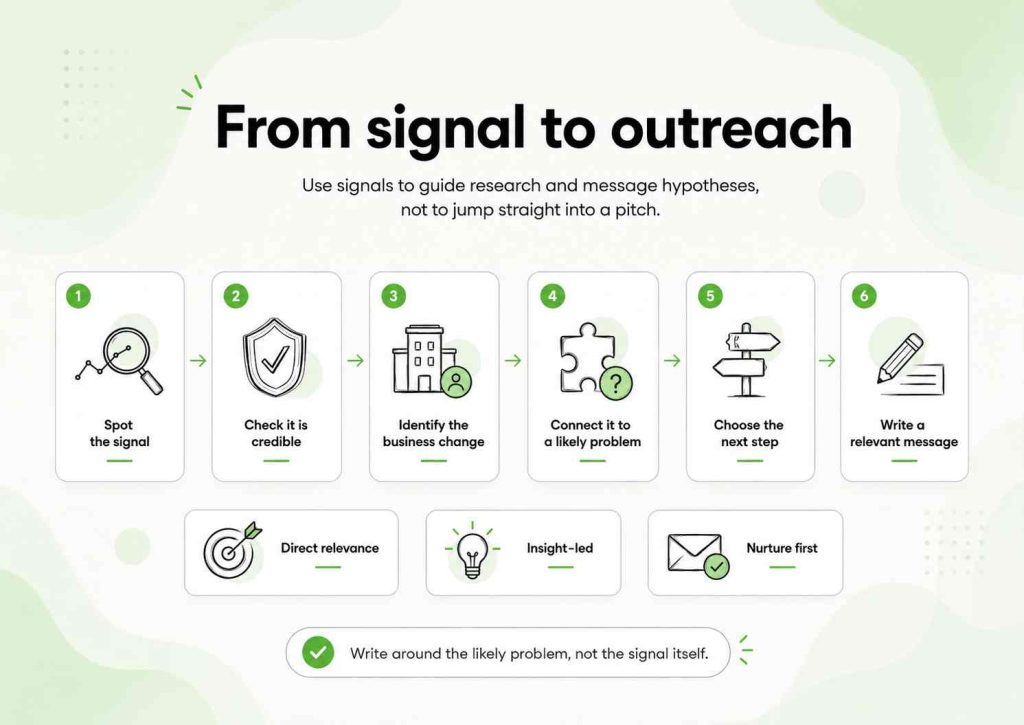
A practical signal-based outreach process looks like this:
- Spot the signal.
- Check whether it is recent and credible.
- Identify the possible business change behind it.
- Connect that change to a problem you can help solve.
- Decide whether the account needs an email, a lighter touch or no action.
- Write a message around the likely problem, not the signal itself.
- Track the response and update the account context.
For example:
Signal: The company is hiring SDRs in two regions.
Weak outreach:
“I saw you are hiring SDRs and wanted to introduce our platform.”
Better outreach:
“Noticed you are building SDR teams across two regions. When teams scale that quickly, outreach processes often split into different habits before there is time to standardise them. Is that a project you are already working on?”
The second message does not pretend to know their exact situation. It gives the prospect a clear reason to engage or correct the assumption.
That is how to act on signals without turning every trigger into a generic opener.
The research stage is covered in how to personalise cold emails through research. The next step is turning that insight into a concise message, which is where the copywriting side of personalisation becomes useful.
Responding to buying signals: three outreach plays
A buying signal should shape the type of response, not only the wording.
Play 1: Direct relevance
Use this when the signal is strong and connected to a clear problem.
For example, a prospect requests a demo, starts a trial or repeatedly returns to a commercial page.
The next step can be direct:
Hi Maya,
I noticed your team has been reviewing our campaign and deliverability pages. If you are comparing ways to standardise outreach without risking sender reputation, I can show how teams usually set that up.
Would a short walkthrough be useful?
Play 2: Insight-led outreach
Use this when the signal is suggestive but not conclusive.
For example, a company is hiring a new sales team or entering a new market.
Start with the likely operational change, then ask a question.
Hi Maya,
Opening a new market while hiring SDRs often creates pressure to make prospecting repeatable before new reps start building their own approach.
Is that a priority for your team this quarter?
Play 3: Nurture before the ask
Use this when the account shows research signals but little direct buying intent.
Instead of forcing a meeting request, share useful content or a relevant observation.
That approach can help build trust while the account moves through the buying journey.
A cold email sales funnel can give those touches a structure, especially when the prospect is interested but not ready to talk.
Use intent signals without overreacting
Intent signals are useful because they help sales reps focus attention.
They become risky when teams treat every data point as proof of a buying decision.
Do not assume that:
- one website visit means readiness
- one job post means budget
- one LinkedIn like means interest
- one funding announcement means a new project
- one content download means a qualified lead
Use intent signals to prioritize research, not to skip it.
A good test is to ask:
Could I explain why this account received this outreach without mentioning the signal itself?
If the answer is no, the message may be too dependent on a weak piece of data.
The prospect should see relevance. They do not need to see your entire research trail.
How B2B marketing and sales should share buyer intent data
B2B marketing and sales teams often see different parts of buyer intent.
Marketing may see website engagement, content consumption, webinar attendance and email activity.
Sales may see outreach replies, discovery calls, objections and account-level context.
The strongest process combines both.
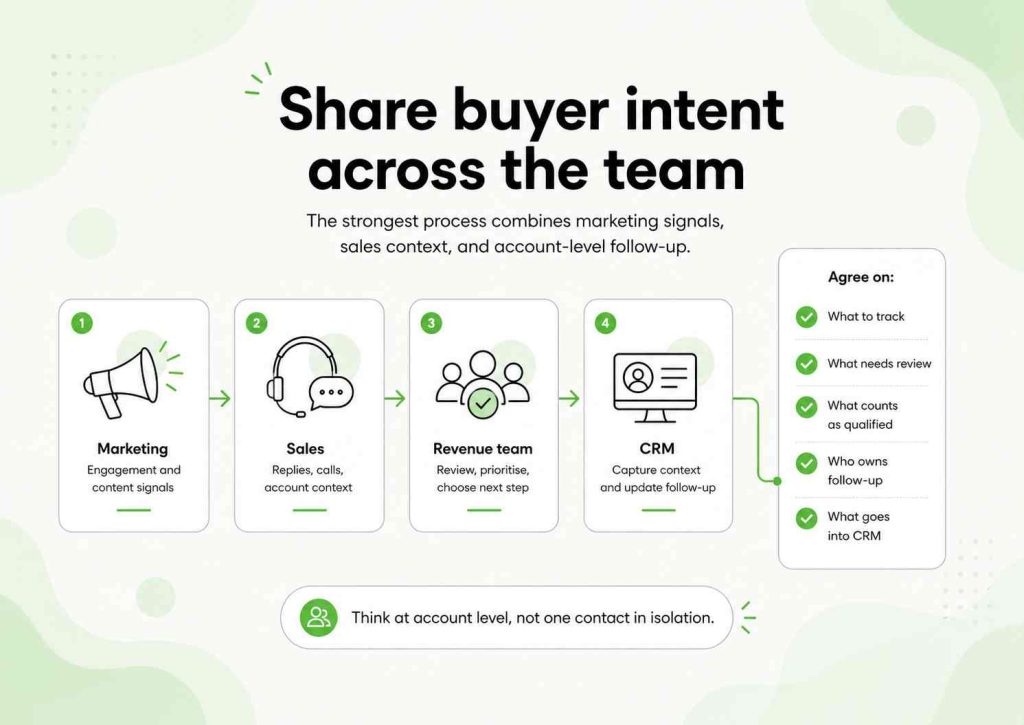
Marketing and sales should agree on:
- which signals are worth tracking
- which signals require manual review
- what counts as a qualified lead
- when a signal should create a task
- who owns follow-up
- what information should be added to the CRM
- when an account should be removed from outreach
This helps B2B organizations avoid the usual problem where marketing passes over a “hot” lead and sales sees no real context behind it.
A simple shared process may look like this:
Marketing flags high-intent engagement.
Sales checks account fit and existing CRM history.
The revenue team chooses the right next step.
Outreach starts only when there is a credible reason to contact the account.
This works better when qualification criteria are written down. Discovery call questions can help teams move from vague interest to evidence that the opportunity belongs in the pipeline.
Buyer intent data and the buying committee
Buyer intent data can become misleading when you look at only one person.
In B2B buying, the person reading content may not be the person who signs the contract. A user may research the category while a manager owns the budget. A security team may join late. Procurement may slow the process even when the buying group agrees.
That is why buying committee awareness is useful.
When an account shows strong buying intent, ask:
- Who is researching the problem?
- Who would use the product?
- Who owns the budget?
- Who can block the decision?
- Who needs to be involved before the deal moves forward?
A single intent signal may show awareness. Multiple contacts engaging from the same account may show stronger buying intent.
That is one reason account-level outreach often works better than contact-level automation for complex B2B sales. A multichannel sales cadence can help teams coordinate those touches without repeating the same pitch everywhere.
Buying signals in B2B: common mistakes
Teams often lose the value of buying signals by reacting too quickly or too broadly.
Common mistakes include:
- using stale company news as a reason to write
- copying the same “I saw you…” opener into every email
- treating third-party intent data as confirmed purchase intent
- messaging every person at an account with the same pitch
- failing to check existing CRM history
- ignoring whether the buyer is actually in your target segment
- pushing for a meeting before there is enough context
- tracking signals but never changing the sales process around them
Buying signals help when they improve decisions.
They do not help when they become another spreadsheet column that nobody trusts.
A stronger way to manage that process is to pair signals with a defined sales cadence and a rule for when reps should stop, pause or personalise further.
Frequently asked questions
What are B2B buying signals?
B2B buying signals are actions, events or patterns that may suggest a company or buyer is researching a problem, changing a relevant process or moving closer to a purchase. Examples include hiring, leadership changes, website engagement, trial activity and outreach replies.
What is the difference between buying signals and intent data?
A buying signal is a specific sign of possible interest, such as a job change or a pricing-page visit. Intent data is the information collected around research and behaviour, often from first-party or third-party sources. Intent data can contain several buying signals.
What are the strongest B2B buying signals?
The strongest signals are recent, relevant and connected to a likely business change. Direct product interest, multiple stakeholders engaging from one account, a trial start and a clear trigger event paired with account research are usually stronger than one isolated activity.
How do you use buying signals in sales?
Use buying signals to prioritise accounts, build a message hypothesis and choose the right next step. Check the signal first, connect it to a plausible problem and write outreach around that problem rather than simply naming the trigger.
Use buying signals to improve timing, not to automate assumptions
B2B buying signals can help sales reps find a better reason to reach out.
They can show where research may be happening, where a team is changing and where a buyer may need help. They can also help marketing and sales focus on the accounts most likely to deserve attention.
But the signal is only the start.
Check the context. Understand the buying process. Decide whether the account needs direct outreach, nurture or no action at all.
Then write a message that treats the prospect like a person, not a row in an intent-data platform.
Lead generation tools can help create a cleaner prospecting process. From there, personalised campaigns and deliverability checks help turn research into a safer outbound motion.