


A sales forecast is not a promise that your team will hit a number.
It is a working estimate of future sales, based on what is already happening in your pipeline, what your sales team can realistically create and how long deals usually take to close.
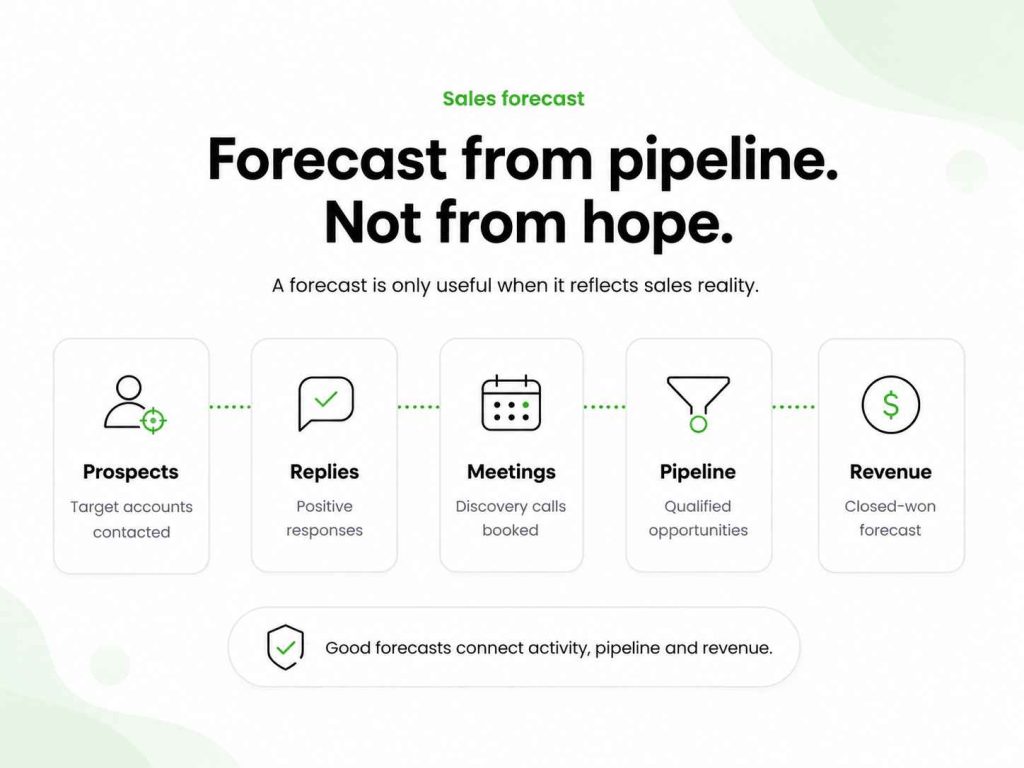
For an outbound-led business, that means looking beyond closed deals. You need to understand how many prospects enter the funnel, how many reply, how many book meetings and how many opportunities become customers.
A forecast is only useful when it reflects that reality.
This guide to sales forecasting explains the main sales forecasting methods, how to create an accurate forecast with limited data and how small sales teams can work backwards from outbound activity to a revenue target they can actually use.
What is a sales forecast?
A sales forecast is an estimate of the sales revenue your business expects to generate over a defined period.
That period may be a month, quarter or year. Most sales leaders use a forecast to plan hiring, set sales targets, decide where to invest and spot gaps before the end of the quarter arrives.
Sales forecasting is the process of using sales data, pipeline information and conversion assumptions to predict future sales.
A useful forecast does not need to be complicated.
It needs to answer practical questions:
- How much revenue is likely to close this quarter?
- How much pipeline do we need to create?
- Which deals are at risk?
- Are current sales targets realistic?
- How many qualified meetings does the team need next month?
The answer changes depending on your sales cycle, company size and how much historical sales data you have.
A business with recurring inbound demand may lean heavily on past sales data. A newer outbound team may need to build a forecast from activity, meetings and conversion rates.
That is why forecasting starts with a clear view of the sales pipeline, not a number someone picked for the board deck.
Why an accurate sales forecast helps a sales team
An accurate sales forecast gives the sales team a shared version of reality.
It helps sales reps understand the activity and pipeline coverage needed to reach quota. It gives sales managers a way to spot deals that have slipped. It gives leadership a clearer picture of expected sales before revenue is already lost.
Without a forecast, teams often react too late.
They discover in the final weeks of a quarter that the pipeline is too thin, too many opportunities are stalled or the sales cycle is longer than expected.
A forecast does not remove uncertainty. It gives the team a way to work with it.
It can help sales leaders:
- set more realistic sales quotas
- plan hiring and territory coverage
- compare current sales performance with expected outcomes
- identify pipeline gaps earlier
- improve sales strategy with real conversion data
- decide where sales and marketing need to work together
For example, when outbound replies fall below expectation, you may need to revisit list quality, positioning or campaign volume. When meetings are healthy but close rates drop, the issue may sit later in the sales process.
That is why sales metrics should sit next to your forecast rather than in a separate report nobody uses.
The sales forecasting process: start with the sales process you actually have
The sales forecasting process should reflect the way prospects move through your business.
A well-defined sales process gives you stages you can track. For an outbound-led team, those stages may include:
- Target account identified
- Prospect contacted
- Positive reply
- Discovery meeting booked
- Qualified opportunity
- Proposal or commercial discussion
- Closed won or closed lost
You do not need to forecast every stage with the same confidence.
The early stages are useful for planning future pipeline. The later stages are more useful for predicting near-term revenue.
A clean process also makes sales reps and managers more consistent. Two people should not label the same opportunity differently because one person is optimistic and the other is cautious.
That is where qualification helps. A reply is not a qualified opportunity. A booked call is not automatically a deal. The questions asked during discovery should help the team decide whether a prospect has a real problem, a workable timeline and the right people involved.
For complex B2B sales, using a structured qualification method such as MEDDPICC can make forecast conversations less subjective.
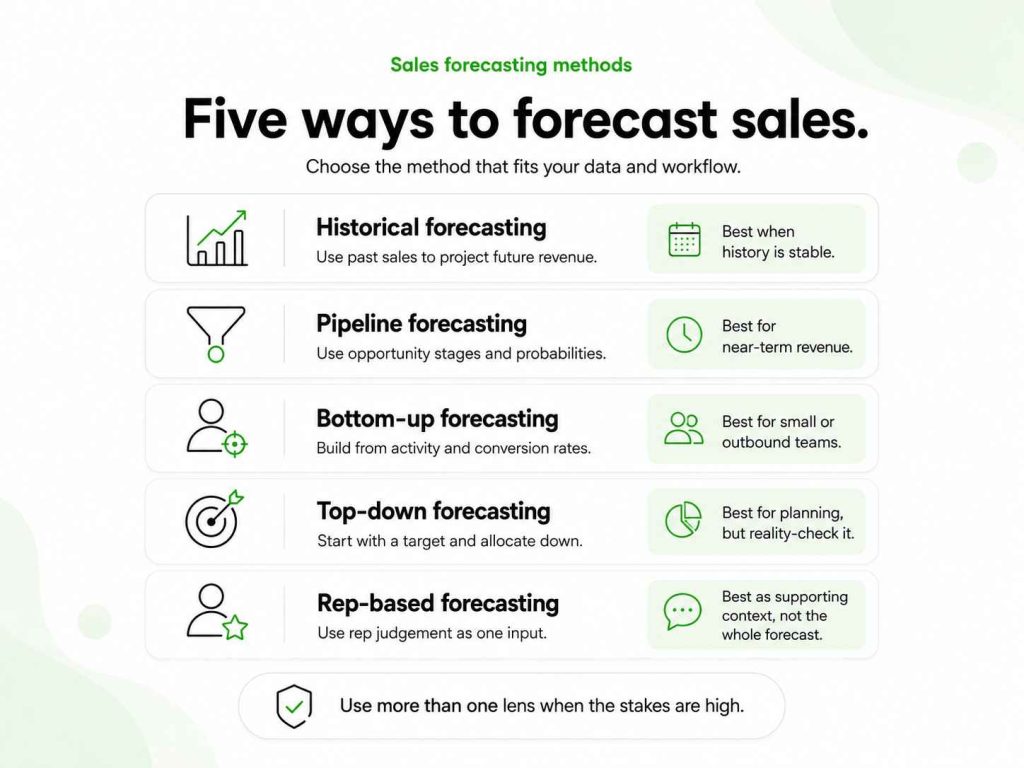
Sales forecasting methods: five ways to forecast sales
There is no universal forecasting method that works for every business.
The right forecasting method depends on how much sales data you have, how predictable your sales cycle is and how consistently your CRM is updated.
Historical sales forecasting method
Historical forecasting uses past sales to estimate future sales.
For example, if you closed £100,000 in the same quarter last year and the business has grown steadily, you may use that number as a starting point for this year’s forecast.
This method is simple. It works best when:
- sales cycles are stable
- seasonality is predictable
- past sales are reliable
- the product and pricing have not changed much
- the market is relatively consistent
Its weakness is obvious: past sales do not always predict future sales.
A new pricing model, a new sales team, a changed target market or a longer buying cycle can make historical data less useful than it looks.
Pipeline forecasting method
Pipeline forecasting estimates revenue based on opportunities already in the pipeline.
A common version uses opportunity stage forecasting. Each stage gets a probability, then the forecast multiplies the deal value by that probability.
For example:
| Opportunity stage | Deal value | Probability | Forecast value |
|---|---|---|---|
| Discovery completed | £20,000 | 25% | £5,000 |
| Proposal sent | £20,000 | 50% | £10,000 |
| Procurement | £20,000 | 80% | £16,000 |
Add the forecast values together and you get a weighted sales forecast.
This is one of the most common sales forecasting models because it connects directly to the pipeline.
But it only works when stages mean something. If every sales rep moves deals forward too early, the forecast will look healthier than it is.
The stages used to manage an outbound sales pipeline should reflect real buyer progress, not a seller’s hope that the deal will close.
Bottom-up forecasting
Bottom-up forecasting starts with activity and conversion rates.
It is especially useful for small teams, new outbound motions or businesses with little historical data.
Instead of starting with a company-wide revenue target, you calculate what each sales rep can realistically produce.
For example:
- one rep can book 20 qualified meetings per month
- 50% of meetings become qualified opportunities
- 25% of qualified opportunities close
- the average deal size is £8,000
That produces:
20 meetings × 50% × 25% × £8,000 = £20,000 forecast revenue per month
Bottom-up forecasting can be more realistic than a top-down target because it starts from the work the team can actually do.
It also reveals where the problem sits. If the sales forecast is too low, you can see whether you need more meetings, better qualification, stronger close rates or a larger average deal size.
Top-down forecasting
Top-down forecasting starts with a broader business target.
Leadership may decide that the company needs £1 million in new annual revenue. That target is then divided across territories, teams or sales reps.
This can be useful for planning. It can also become disconnected from reality when the target is not tested against pipeline, sales cycle length or current sales capacity.
A top-down forecast should always be checked against a bottom-up model.
If leadership expects £1 million but the current team can only create £600,000 with existing conversion rates, the gap needs a plan. It cannot be solved by optimism.
Rep-based or intuitive forecasting
Rep-based forecasting asks each sales rep what they expect to close.
Experienced reps may have useful insight into deal momentum, buyer sentiment and internal blockers that are not visible in a dashboard.
But intuitive forecasting is vulnerable to sandbagging and overconfidence.
Some reps understate likely deals to make quota feel easier. Others count every positive conversation as expected sales.
Use rep judgement as an input, not the full forecast.
A reliable sales forecast combines the rep’s view with pipeline data, stage criteria and past conversion patterns.
How to forecast sales from outbound activity
Outbound teams often struggle with sales forecasting because the first part of the funnel is not always tracked carefully.
The team may know how many emails were sent, but not how many conversations became qualified opportunities. Or they may know how many meetings were booked, but not how many became revenue.
A simple outbound model can fix that.
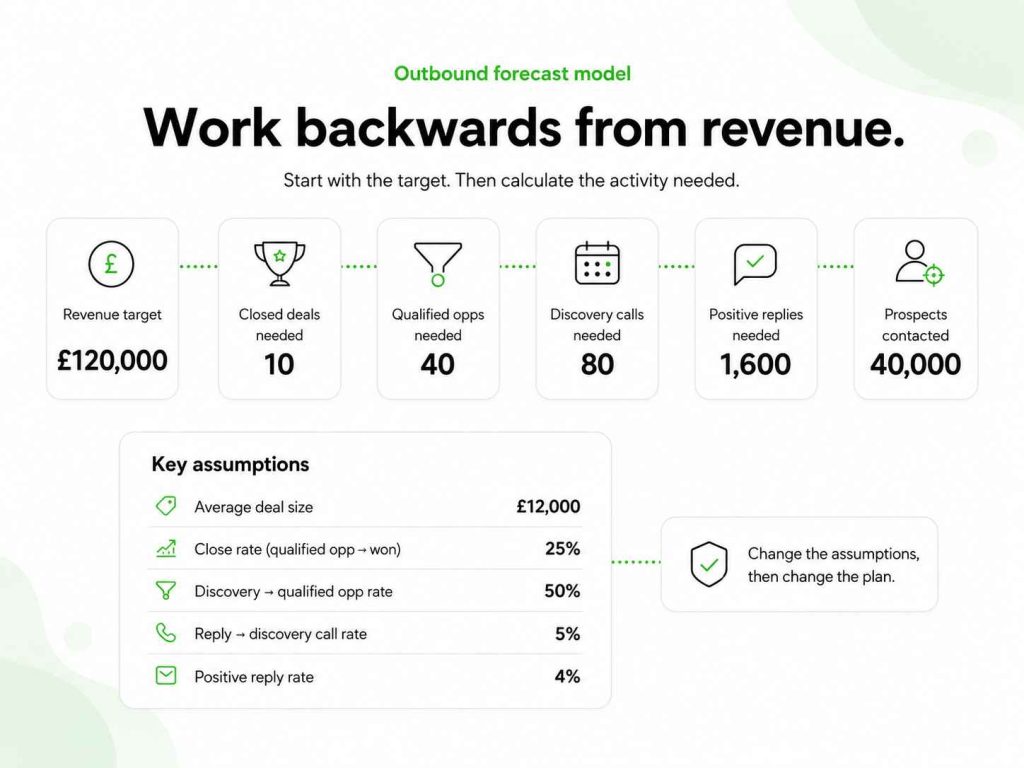
Start with the revenue target.
Let’s say your target is £120,000 in new sales revenue next quarter.
Your average deal size is £12,000.
That means you need:
£120,000 ÷ £12,000 = 10 closed deals
Now use your actual conversion rates.
Assume:
- 25% of qualified opportunities close
- 50% of discovery calls become qualified opportunities
- 5% of positive replies become booked discovery calls
- 4% of prospects reply positively
You would need:
10 closed deals
40 qualified opportunities
80 discovery calls
1,600 positive replies
40,000 prospects contacted
That number may feel high. That is the point.
A forecast should show the reality of your current conversion rates before the team commits to a target.
From there, you can ask better questions:
- Can we improve reply quality through tighter targeting?
- Should we adjust the offer or the call to action?
- Do we need more sales reps?
- Are we asking for meetings too early?
- Is the average deal size realistic?
- Is the sales cycle longer than the quarter we are forecasting?
A sales cadence can help you structure early outreach, but it should not be treated as a guaranteed meeting machine. The forecast needs your own numbers, not generic benchmarks.
How to create an accurate sales forecast with limited data
A new sales organisation may not have enough historical sales data to build a sophisticated forecast.
That is normal.
You can still create an accurate forecast by using conservative assumptions and updating it often.
Start with the data you do have:
- current sales pipeline
- average deal size
- open opportunity stage
- sales cycle length
- number of meetings booked
- number of qualified opportunities
- closed-won and closed-lost reasons
- outbound activity and reply quality
Then make assumptions visible.
For example:
| Metric | Current assumption |
|---|---|
| Average deal size | £10,000 |
| Close rate from qualified opportunity | 20% |
| Discovery-to-qualified-opportunity rate | 40% |
| Positive reply-to-meeting rate | 10% |
| Sales cycle | 60 days |
You may not know whether those assumptions are perfect. You do know where they came from.
That is better than presenting one precise number with no explanation.
An accurate sales forecast is rarely about predicting every deal perfectly. It is about being clear about the likely range, the assumptions behind it and the risks that could change the outcome.
Forecasting models for SMB and outbound-led teams
Many sales forecasting models are designed for large enterprise sales organisations with complex territories, long procurement cycles and dedicated sales operations teams.
A small team does not need to copy that setup.
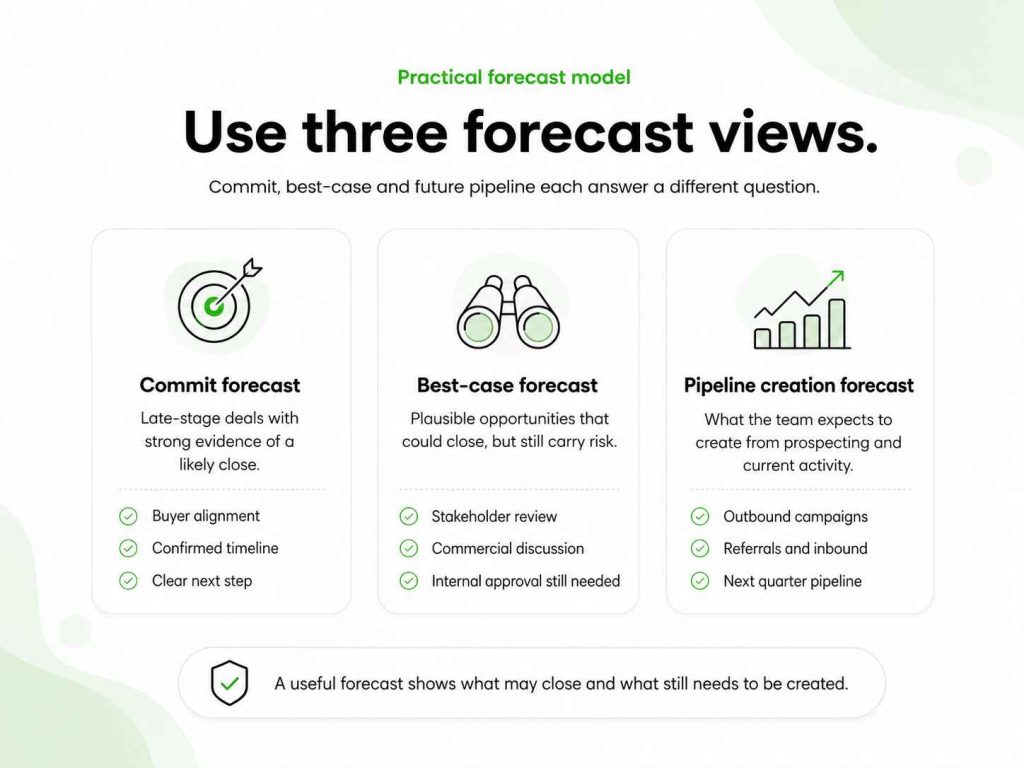
A practical model can combine three views:
1. Commit forecast
This includes late-stage opportunities with strong evidence of a likely close.
The sales rep should be able to explain why the deal belongs here: buyer alignment, confirmed timeline, clear next step and low deal risk.
2. Best-case forecast
This includes plausible opportunities that could close, but still have uncertainty.
They may need a stakeholder meeting, a commercial review or internal approval.
3. Pipeline creation forecast
This estimates the opportunities your team expects to create from current prospecting, referrals, inbound leads and outbound campaigns.
This third view is especially useful for sales teams that rely on cold email or targeted outbound.
It tells you whether next quarter’s pipeline is being created now.
The outbound sales team structure should support that model. Reps need ownership over the right part of the funnel, clear definitions and reporting that does not reward empty activity.
Benefits of sales forecasting beyond the revenue number
The benefits of sales forecasting go beyond predicting revenue.
A healthy forecasting process can improve sales performance because it forces the team to look closely at what is happening in the funnel.
It can expose weak qualification, inconsistent CRM updates, unrealistic sales quotas and deals that have been stuck for too long.
It can also improve the relationship between sales and marketing.
When the forecast shows that pipeline creation is too low, the conversation becomes more useful. Instead of saying “we need more leads”, the team can identify how many qualified opportunities are needed, how many meetings are required and where the current funnel is underperforming.
A sales forecast can help sales and marketing teams agree on:
- lead volume
- lead quality
- handoff rules
- pipeline coverage
- conversion expectations
- campaign timing
That is more useful than comparing who generated more activity.
The lead qualification process should connect directly to the forecast. A pipeline full of low-fit contacts does not make future sales more predictable.
Challenges of sales forecasting
The biggest challenges of sales forecasting are usually not mathematical.
They are operational.
Inconsistent CRM data
A sales forecast is only as good as the CRM data behind it.
If deals are missing values, stages are outdated or next steps are unclear, no forecasting software can fix the problem automatically.
Keeping the CRM in sync with outreach conversations helps. A connected CRM and cold email workflow gives reps a better chance of recording activity before details disappear into inboxes.
Optimistic opportunity stages
A prospect attending a discovery call does not mean the deal is halfway closed.
Opportunity stage forecasting breaks down when stages are based on seller enthusiasm rather than buyer evidence.
Set clear exit criteria for every stage.
Ignoring sales cycle length
A forecast may look strong if it includes many new opportunities. But if your sales cycle is 90 days, deals created at the end of the quarter are unlikely to become current-quarter revenue.
Forecasting and pipeline creation need to be reviewed separately.
Treating activity as pipeline
Sending more cold email does not automatically create more pipeline.
The sales team needs targeted prospects, relevant messaging and a process for handling replies. Otherwise, you get more activity without better forecasting.
The sales engagement process should make it easier to turn meaningful interactions into qualified opportunities, not just track open rates.
Sandbagging
Sandbagging happens when sales reps deliberately understate what they expect to close.
It can make forecasts look safer. It also makes planning harder.
Compare individual forecasts against historical performance, stage data and deal evidence. The goal is not to punish caution. It is to create a forecast that leadership can use.
Forecasting tools and when you need them
Forecasting tools can help when your pipeline grows beyond a spreadsheet.
A CRM such as Salesforce can give you core opportunity data, stage reporting and dashboard visibility. Sales forecasting software can add weighted models, rep forecasts, scenario planning and pipeline risk analysis.
But tools do not replace a clean sales process.
Before buying advanced forecasting software, make sure you have:
- clear opportunity stages
- reliable CRM ownership
- defined sales cycle expectations
- consistent deal values
- realistic conversion data
- a regular forecast review process
For a small team, a CRM export and a simple spreadsheet may be enough at first.
For a larger team, sales forecasting tools can make it easier to compare forecast calls, spot changes in pipeline coverage and track sales results across territories.
A sales engagement platform can also support the earlier part of the funnel by giving reps visibility into campaign responses, follow-ups and contact activity before opportunities reach the CRM.
Sales forecasting tools, CRM data and outreach activity
Sales forecasting tools are most useful when they connect sales data across the full funnel.
A forecast should not begin only when a deal reaches proposal stage. It should also reflect whether the team is creating enough future pipeline.
For outbound-led teams, that means reviewing:
- prospecting volume
- positive reply rate
- meeting rate
- qualification rate
- opportunity conversion
- close rate
- average deal size
- sales cycle length
You do not need every metric in the forecast meeting.
But you need enough context to see whether a revenue gap started with poor outreach, weak qualification or late-stage deal risk.
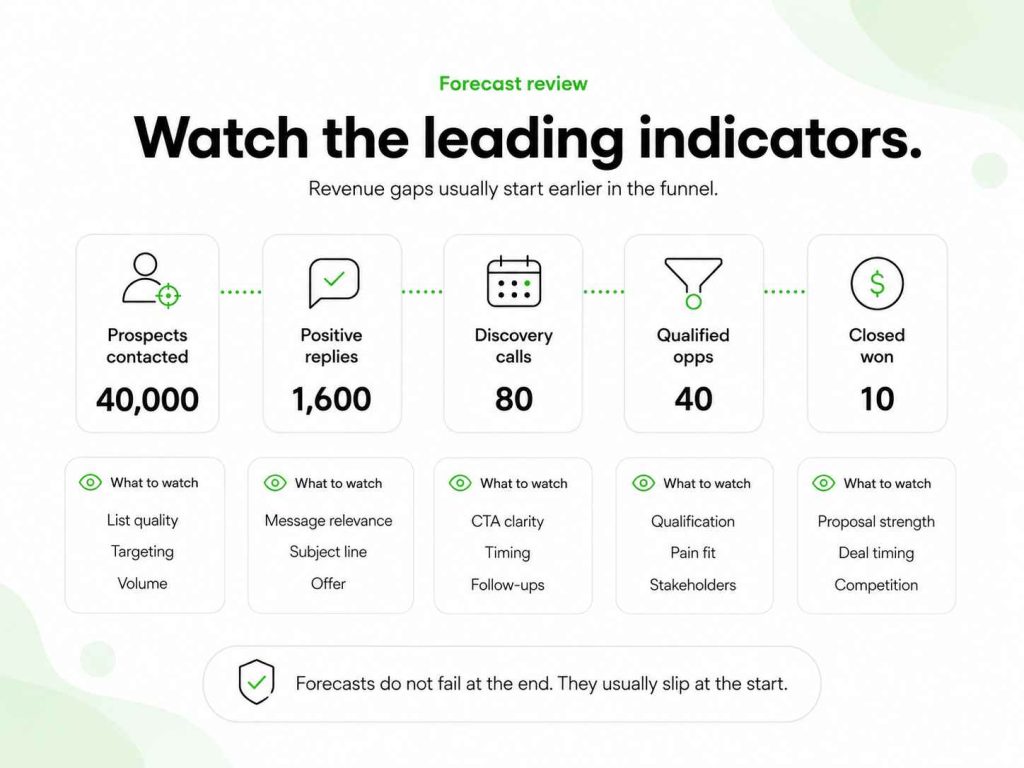
The sales engagement metrics and outbound sales automation workflow can help you track the earlier activity that feeds the sales pipeline.
A simple sales forecasting template
Use this simple model as a starting point.
| Input | Example |
|---|---|
| Revenue target | £120,000 |
| Average deal size | £12,000 |
| Closed deals needed | 10 |
| Qualified opportunity close rate | 25% |
| Qualified opportunities needed | 40 |
| Discovery-to-qualified rate | 50% |
| Discovery calls needed | 80 |
| Positive reply-to-meeting rate | 5% |
| Positive replies needed | 1,600 |
| Positive reply rate | 4% |
| Prospects needed | 40,000 |
Then add a second table for current pipeline:
| Pipeline stage | Number of deals | Total value | Forecast value |
|---|---|---|---|
| Late-stage | 8 | £96,000 | £72,000 |
| Proposal sent | 12 | £144,000 | £72,000 |
| Discovery complete | 20 | £240,000 | £60,000 |
The first table tells you what needs to happen.
The second tells you what is already in motion.
Together, they create a more reliable sales forecast than either one alone.
Frequently asked questions
What is the easiest sales forecasting method?
For a small sales team, a bottom-up forecasting method is often the easiest. Start with average deal size, close rate and the number of qualified opportunities or meetings you can realistically create. Then work backwards to the activity needed.
How do you forecast sales with little data?
Use the sales data you do have, such as current pipeline, early conversion rates, average deal value and sales cycle length. Use conservative assumptions and update the forecast often as new data appears.
What is the difference between pipeline forecasting and sales forecasting?
Pipeline forecasting estimates the likely value of open opportunities. Sales forecasting is broader. It may include current pipeline, expected sales from new activity, historical performance and rep judgement.
How accurate should a sales forecast be?
A forecast should be accurate enough to support decisions about hiring, budget and sales targets. It will never be perfect. The aim is to make assumptions visible, improve them over time and avoid surprises late in the quarter.
Build a forecast that gives the sales team something to act on
A sales forecast should not exist only for leadership meetings.
It should help sales reps decide where to focus. It should help managers see where deals are slipping. It should show whether the team is creating enough future pipeline before the quarter becomes difficult to save.
Start simple.
Use current pipeline, sales cycle length, average deal size and real conversion data. Build a bottom-up model for outbound activity. Review it every week. Improve the assumptions as the team learns.
When your forecast shows a pipeline gap, the fix often starts upstream: stronger prospecting, cleaner qualification and better follow-up.
A more focused prospecting workflow can help build the right top-of-funnel activity, while achievable outbound sales targets give that activity a number the team can work towards.