


This guide is about Clay.com, the GTM data enrichment and workflow platform, not modelling clay.
Clay has become popular with GTM teams that want to enrich contact data, connect multiple data sources, run AI research and automate parts of their workflow. But it is not the right fit for every sales team.
Some teams need simpler enrichment. Some want stronger sales intelligence. Others only need waterfall enrichment for email addresses and phone numbers. A small team may want a lower-cost Clay alternative. Larger B2B teams may need deeper CRM controls, intent data or enterprise-grade data governance.
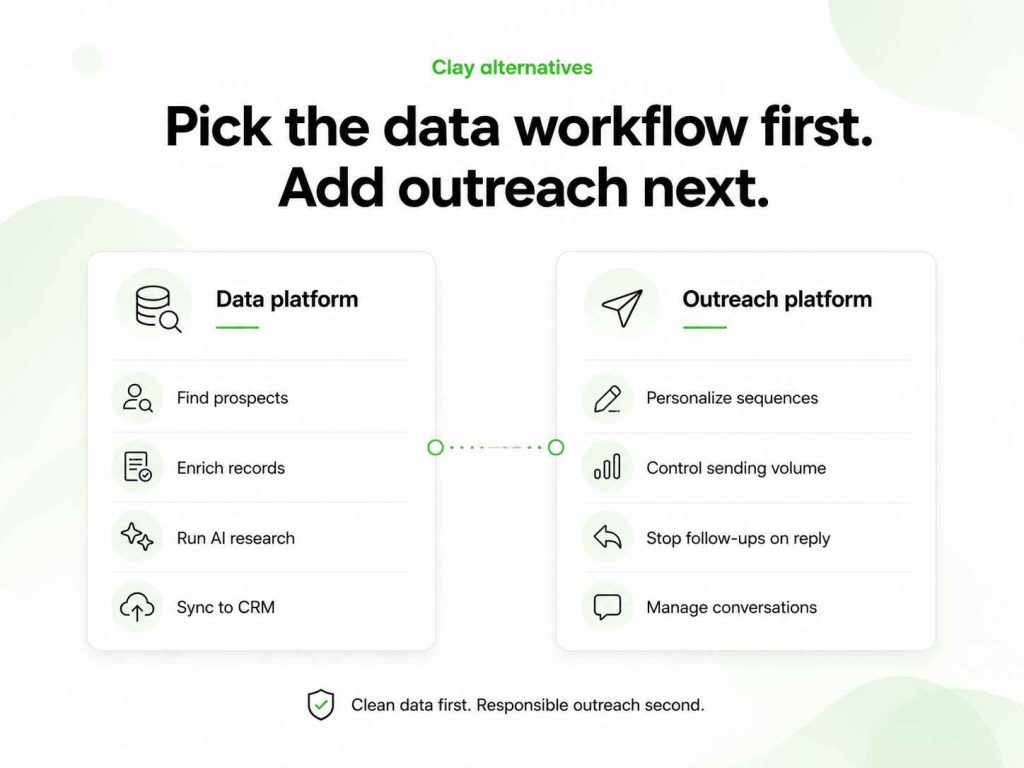
The key is to choose a data tool for the job before you think about outreach.
A data platform can find and enrich prospects. An outreach platform helps you contact them responsibly once you have a verified, relevant list.
What Clay does for GTM teams in 2026
Clay is a GTM workflow platform built around data enrichment, AI research and automation.
Teams can use Clay to pull data from several sources, enrich a lead list, run research prompts, score accounts and send structured data into a CRM or another GTM tool.
Its strength is flexibility.
A GTM engineer can build detailed workflows that combine company data, LinkedIn information, buying signals, AI research and custom logic. Clay can also support waterfall enrichment, where a workflow checks several data sources until it finds usable contact data.
That flexibility can create a learning curve.
Clay pricing is also based on actions and data credits, which can feel less predictable for a team that is still learning how often it will enrich records, run AI tasks or export data. The free plan can be useful for testing, but a production workflow often needs more planning around usage and spend.
Clay is a strong choice when you need custom GTM automation. But teams looking for a more focused enrichment tool, a lighter workflow or a more direct sales intelligence platform may prefer an alternative to Clay.
For the outreach side, start with clean targeting. Woodpecker’s guide to where to find prospects can help you define where your list should come from before you enrich it.
What to look for in a Clay alternative
The best Clay alternative depends on what you are trying to replace.
Some teams want more accurate contact data. Others want an easier workflow, a lower pricing commitment or a better CRM sync. Others want a tool that can enrich an existing database without forcing them to build a full GTM workflow.
Before you compare Clay alternatives in 2026, decide which of these jobs you need done:
- finding B2B contact data
- enriching a CRM
- running waterfall enrichment
- identifying buying signals
- building prospect lists
- adding email and phone data
- automating a repeatable GTM workflow
- researching accounts with AI
- passing verified records into outreach
A tool can be excellent at one job and weak at another.
For example, a sales intelligence platform may be better for account research and intent data. A waterfall enrichment tool may be better for finding missing email addresses. A CRM-native product may be better for automatic enrichment across incoming leads.
The best alternatives for GTM are not always the platforms with the biggest feature lists. They are the ones that fit your data quality problem without adding unnecessary complexity.
10 best Clay alternatives in 2026
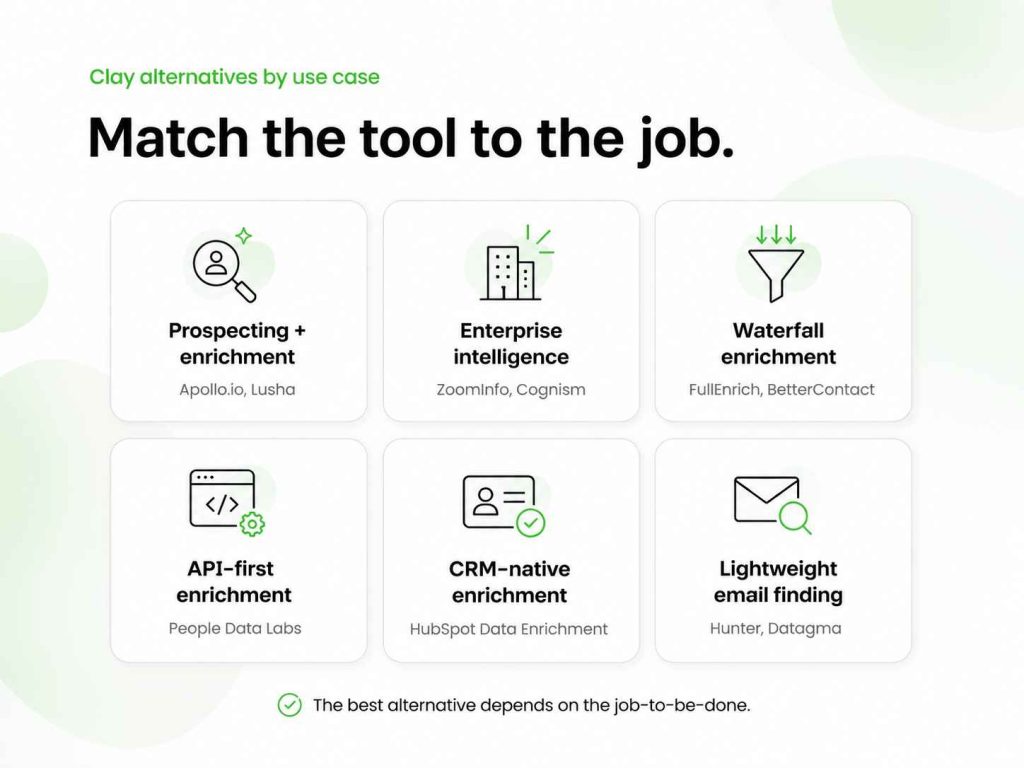
The 10 Clay alternatives below are grouped by job-to-be-done rather than ranked as one universal list.
That is more useful than claiming there is a single best tool for every GTM team.
| Tool | Best for | What it replaces |
|---|---|---|
| Apollo.io | Prospecting plus enrichment | A lighter all-in-one data workflow |
| ZoomInfo | Enterprise sales intelligence | Large-scale account and contact data |
| Cognism | EMEA-focused sales intelligence | Compliant B2B data and enrichment |
| FullEnrich | Waterfall enrichment | Email and phone finding |
| BetterContact | Flexible waterfall enrichment | Multi-provider contact enrichment |
| People Data Labs | API-first enrichment | Developer-led data workflows |
| HubSpot Data Enrichment | CRM-native enrichment | HubSpot record enrichment and routing |
| Lusha | Contact data and buying signals | Sales intelligence for prospecting |
| Hunter | Email finding and verification | Lightweight email data workflows |
| Datagma | CRM enrichment and job changes | Contact enrichment for smaller teams |
These are not direct like-for-like Clay replacements. Clay combines enrichment, AI, workflow logic and integrations in one platform. Most alternatives specialise.
That is often a benefit.
Apollo.io: a Clay alternative for prospecting, enrichment and workflow simplicity
Apollo.io is a practical Clay alternative for teams that want contact data, prospecting and sales workflow support in one platform.
Apollo combines a B2B database, enrichment, sales intelligence, CRM integrations and prospecting features. It can be useful for a sales team that does not want to build a custom enrichment workflow from several separate tools.
Compared with Clay, Apollo.io is usually easier to adopt for straightforward prospecting.
You search for companies and contacts, add prospects to a list, enrich records and sync them into a CRM. That can work well for a small team that needs a more guided workflow.
The trade-off is flexibility.
Clay gives GTM teams more freedom to combine data providers, custom prompts and automation logic. Apollo is more opinionated. That can be helpful when your team wants to move quickly without building a complex system.
Apollo may be a good fit when you need:
- B2B contact data
- CRM sync
- prospecting workflows
- a free plan for testing
- one platform for list building and enrichment
If you use Apollo for data, treat outreach as a separate decision. A verified contact does not automatically justify a cold email. Woodpecker’s guide to personalised cold emails can help turn a contact record into a relevant reason to write.
ZoomInfo – best Clay alternative for enterprise sales intelligence
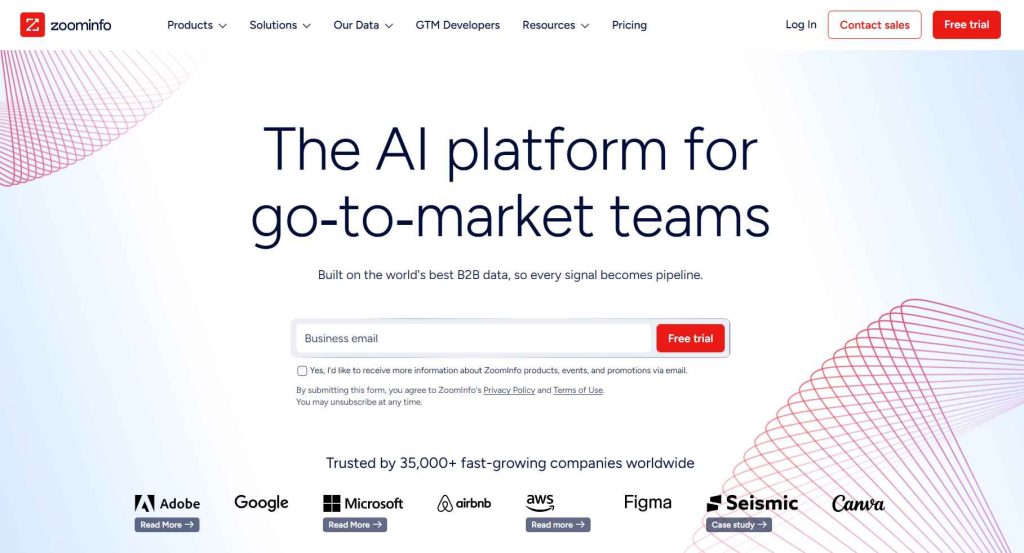
ZoomInfo is often considered by larger B2B teams that need an enterprise sales intelligence platform rather than a flexible enrichment workflow.
It is designed around company and contact data, sales intelligence, intent data, account research and CRM enrichment. Sales reps can use it to identify companies, find buying committees, review account information and build pipeline.
Clay and ZoomInfo solve different problems.
Clay is stronger for GTM engineering, enrichment across multiple data sources and custom workflow automation. ZoomInfo is more focused on giving teams a large sales intelligence database and account-level information in one platform.
ZoomInfo may suit teams that need:
- broad B2B company and contact data
- account intelligence
- intent data
- CRM enrichment
- enterprise sales workflows
- sales reps working on larger account lists
The main question is pricing.
Enterprise sales intelligence usually comes with a larger budget and longer buying process than a lightweight enrichment tool. Small teams should check whether they need that level of platform before committing.
Clay and ZoomInfo can also work together. Clay may handle enrichment logic while ZoomInfo acts as one data provider in a wider workflow.
Cognism: a Clay alternative for compliant B2B contact data
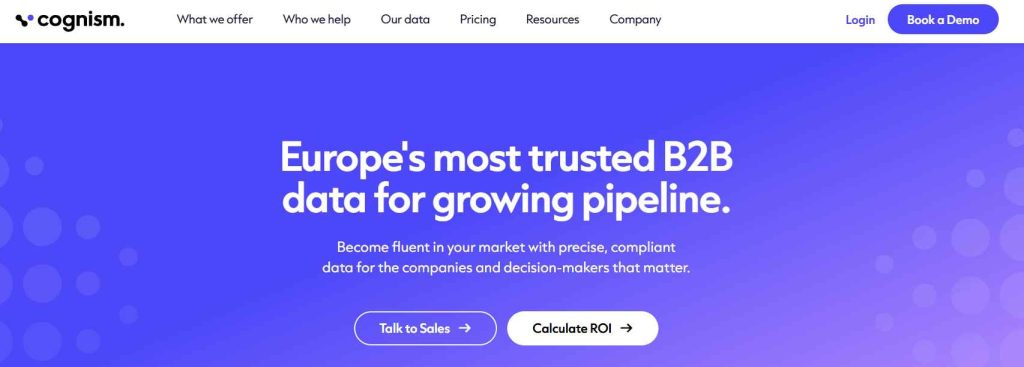
Cognism is a strong option for GTM teams that care about B2B contact data, sales intelligence and compliance, especially across the UK, EMEA and DACH.
It focuses on data quality, verified business information, CRM enrichment and account signals. Its positioning is less about custom GTM engineering and more about giving sales and marketing teams usable contact and company data.
Cognism may be a better Clay alternative when your team wants:
- B2B data for EMEA markets
- compliant contact data
- sales intelligence
- CRM enrichment
- account-level buying signals
- less custom workflow building
For many teams, the choice between Clay and Cognism comes down to workflow complexity.
Choose Clay when you want to enrich across several providers and build custom automations. Choose Cognism when you want a more direct data provider and sales intelligence platform.
Data quality should come before campaign volume. Before you upload a large list into any outreach workflow, review Woodpecker’s guidance on email verification and how to reduce spam score.
FullEnrich: best Clay alternative for waterfall enrichment
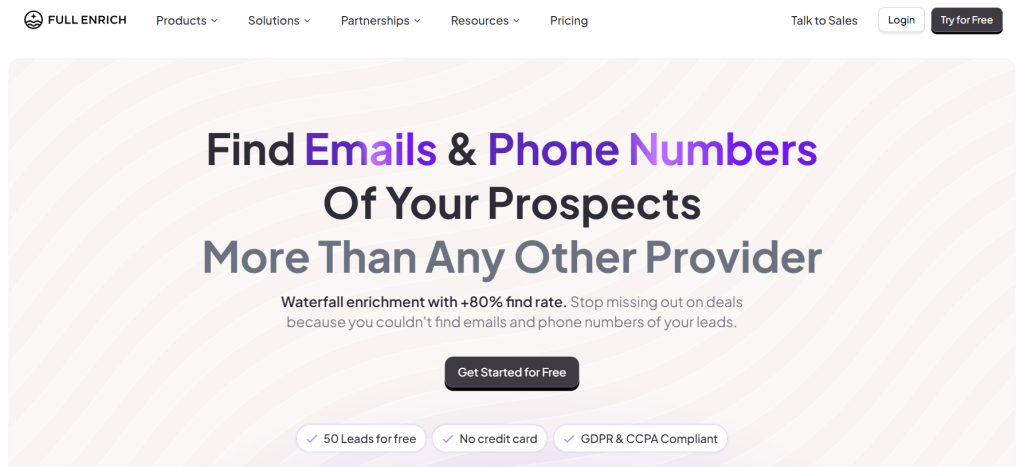
FullEnrich is built around waterfall enrichment for email and phone data.
Waterfall enrichment checks multiple data providers one after another until it finds a valid match. That can be useful when one provider has weak coverage for a specific geography, seniority level or industry.
This makes FullEnrich a good Clay alternative for teams that do not need a full GTM workflow.
You may already have a lead list. You may already use a CRM. You may simply need better coverage for email addresses and phone numbers before your sales reps start outreach.
FullEnrich can be useful for:
- waterfall enrichment
- verified email and phone data
- list enrichment
- CRM-connected enrichment
- data workflows that need fewer manual checks
- teams with an existing prospecting process
It is not a full Clay replacement for AI research or complex workflow orchestration. It is a focused enrichment tool.
That focus can be valuable when the main problem is missing contact data, not building a custom data pipeline.
BetterContact: a Clay alternative for flexible email and phone enrichment
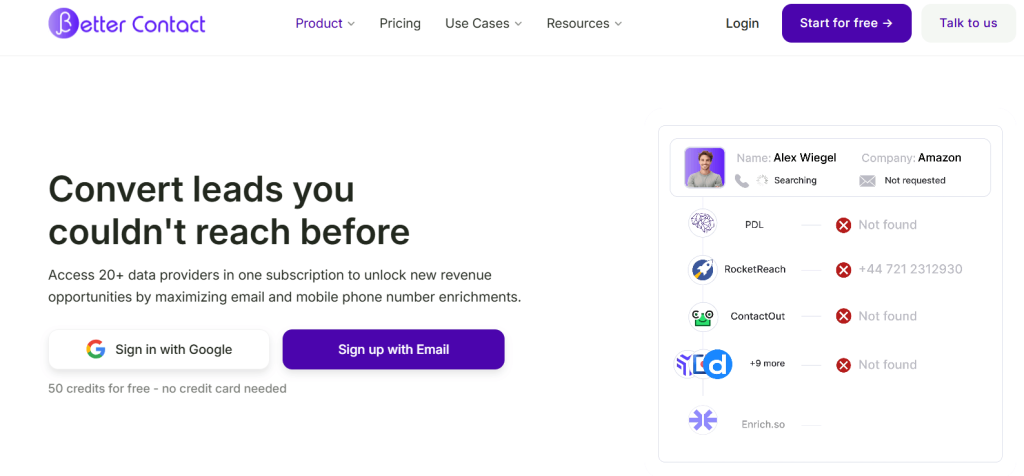
BetterContact is another waterfall enrichment option.
It focuses on finding B2B email addresses and phone numbers through multiple providers, then verifying the results before they move into a workflow.
For a small team, BetterContact can be easier to understand than a broad GTM platform. The use case is direct: enrich a list, find usable contact data and reduce the number of invalid records that reach outbound campaigns.
BetterContact may be useful when you need:
- waterfall enrichment
- email and phone data
- a clear pricing model
- CRM or spreadsheet sync
- contact enrichment without a full GTM engineering setup
- a lightweight alternative to Clay
It is less suitable for teams that want broad AI research, custom web scraping or complex signal-based GTM logic.
The right question is not “Can BetterContact replace Clay?” It is “Do we need Clay’s full workflow, or do we mainly need better contact data?”
People Data Labs: an API-first Clay alternative for data teams
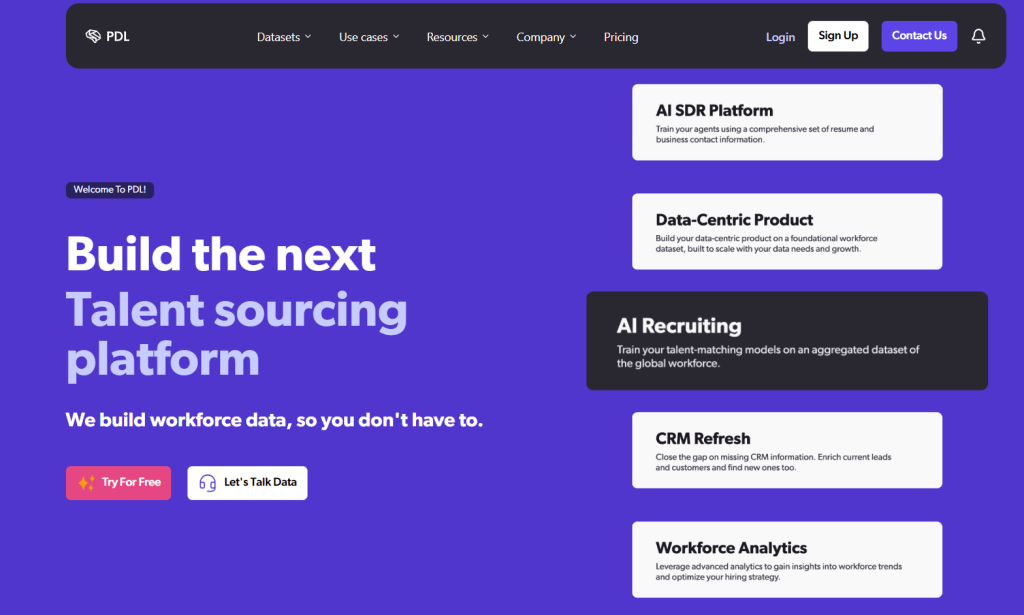
People Data Labs is a better fit for teams that want enrichment through APIs rather than a no-code interface.
It provides person and company enrichment APIs that can be used inside custom applications, internal systems or product workflows. That makes it useful for technical GTM teams, RevOps teams and developers who need more control over how data enters the CRM or warehouse.
People Data Labs may work well when you need:
- API-based enrichment
- company and person data
- custom data models
- bulk enrichment
- enrichment inside your own product
- flexible workflow integration
It is not designed as a ready-made prospecting workspace for sales reps.
If your use case is “give SDRs a list they can work today”, a sales intelligence platform may be easier. If your use case is “enrich thousands of records inside our own workflow”, an API-first tool may be a better Clay alternative.
HubSpot Data Enrichment: best for HubSpot CRM workflows
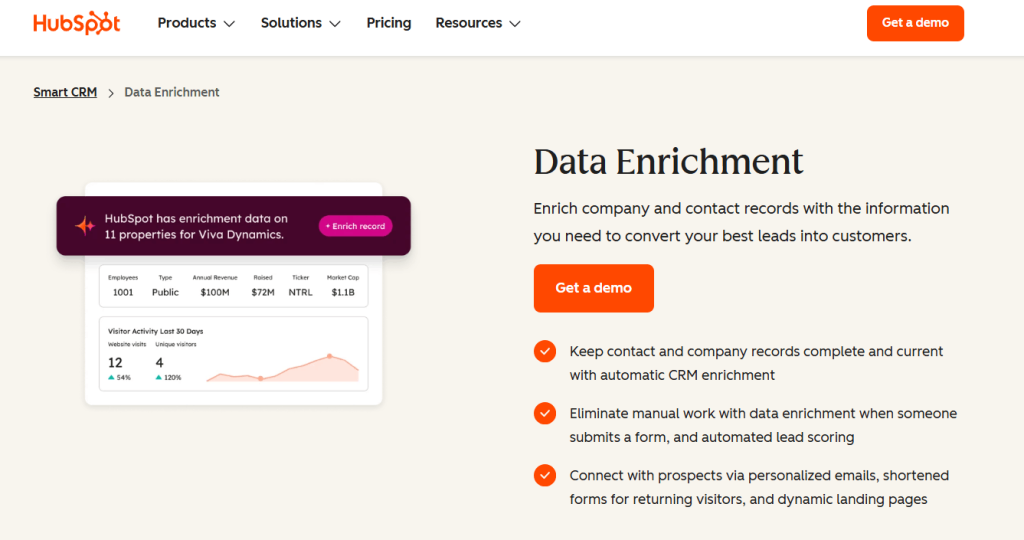
HubSpot Data Enrichment is a natural option for teams that already run their CRM inside HubSpot.
It can enrich contact and company records, update CRM data and support lead routing and segmentation inside the same environment. That reduces the need to export records, enrich them elsewhere and sync them back manually.
HubSpot may be the best Clay alternative for teams that need:
- CRM-native enrichment
- HubSpot workflows
- lead routing
- enrichment for inbound forms
- automatic contact and company updates
- a simpler one-platform experience
It is not a full replacement for Clay if you need waterfall enrichment across many data providers or custom AI research.
But for a HubSpot-heavy sales team, keeping data enrichment inside the CRM may offer more ease of use than a separate GTM workflow.
You can connect that cleaner CRM data to outreach later. Woodpecker’s HubSpot integration can help teams move approved contacts into personalised sequences without losing context.
Lusha: a sales intelligence platform for contact data and signals
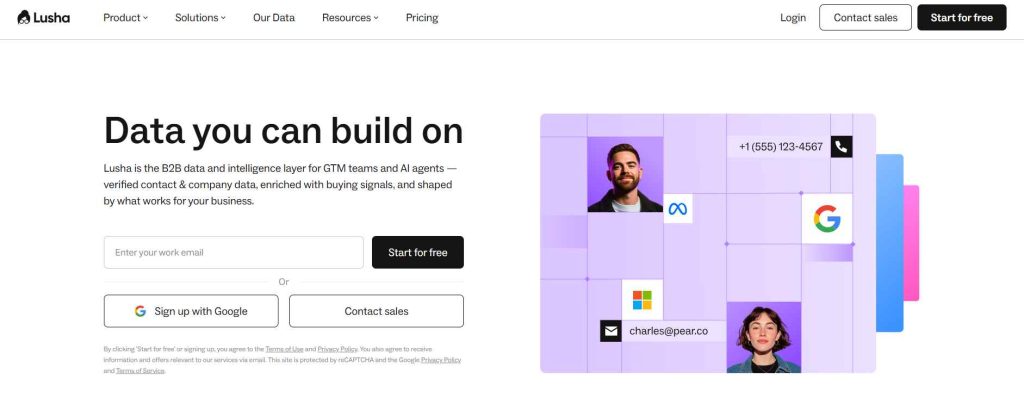
Lusha is a sales intelligence platform that combines B2B contact data, company data and buying signals.
It can be useful for sales reps who want to identify decision-makers, find contact data and monitor account-level signals without building a custom Clay table.
Lusha may be a useful Clay alternative for:
- sales intelligence
- buying signals
- contact data
- prospecting lists
- LinkedIn-led research
- CRM enrichment
- small team workflows
Clay is often more flexible for enrichment and workflow design. Lusha is often more direct for sales reps who want a searchable intelligence platform with data and signals already connected.
This can be useful for signal-based GTM. But a signal should not become a generic opening line.
Avoid sending:
I saw you raised funding, so I wanted to reach out.
Instead, connect the signal to a plausible change in the prospect’s day-to-day work. Woodpecker’s guide to account-based prospecting shows how to turn account research into a more focused outreach plan.
Hunter: a lightweight Clay alternative for email addresses
Hunter is a lighter option for teams that mainly need professional email addresses, domain search and email verification.
It is not designed to replace Clay’s enrichment workflow. It is more useful when you know who you want to contact and need to find or verify an email address before outreach.
Hunter may suit teams that need:
- email finder workflows
- email verification
- a Chrome extension
- a free tier
- bulk email checks
- simple contact lookup
- a lightweight enrichment tool
For a small team, that simplicity can be enough.
You may not need waterfall enrichment, AI research or a complex GTM workflow if your main challenge is finding the right email addresses for a targeted list.
Still, treat verification as a separate step before sending. Woodpecker’s guide to mailboxes for outbound explains why clean data and dedicated sending infrastructure should work together.
Datagma: CRM enrichment and job-change data
Datagma is a data enrichment option for teams that want to update CRM records, find contact data and identify changes such as job moves.
It can be useful for a sales team that wants a more direct enrichment workflow than Clay, especially where job changes or refreshed contact data are part of the prospecting process.
Datagma may be worth considering for:
- CRM enrichment
- contact data
- job-change detection
- LinkedIn-related prospecting
- small team workflows
- lead scoring support
- basic sales intelligence
It is less of a GTM engineering platform and more of an enrichment layer.
That can make it easier to adopt when the workflow is straightforward.
Persana AI: not a recommended option in 2026
Persana AI appears in some lists of Clay alternatives and competitors because it previously offered AI enrichment, data workflows and GTM automation.
However, Persana announced that its platform would sunset in May 2026.
For that reason, it should not be treated as an active Clay replacement for new GTM teams in 2026.
If you see Persana AI in older “10 Clay alternatives” articles, check the publishing date before treating the recommendation as current.
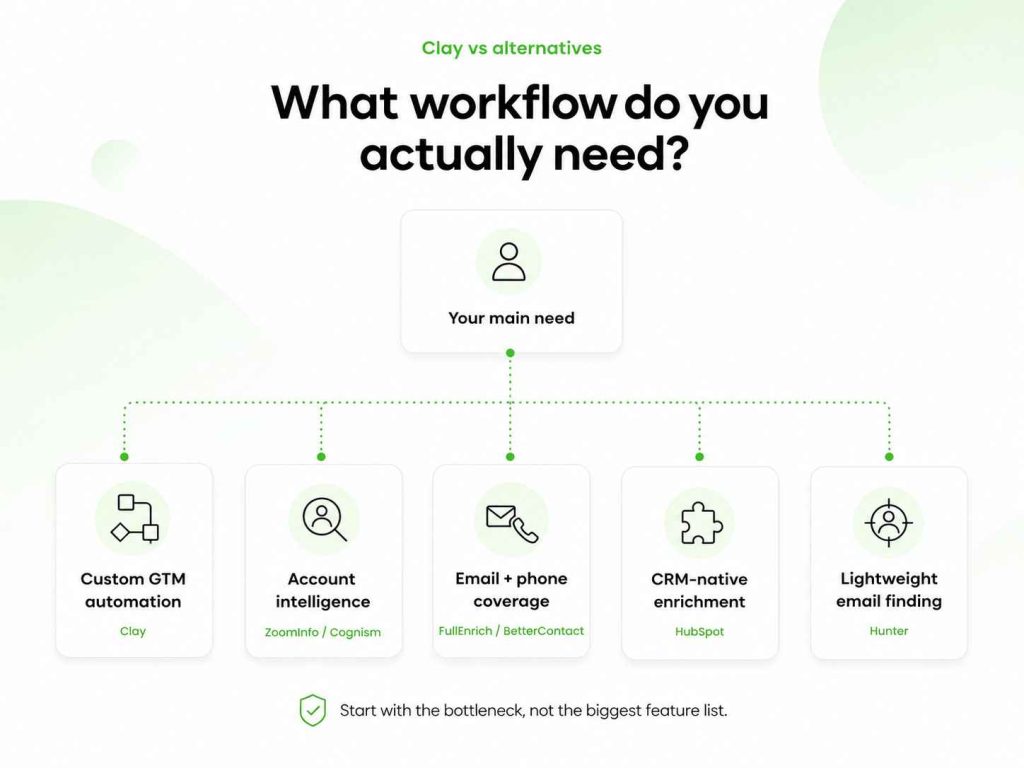
Clay vs alternatives: which workflow do you actually need?
Clay vs another platform is rarely a simple feature comparison.
The better decision starts with the workflow.
Choose Clay when you need:
- custom enrichment across several data sources
- AI research inside a GTM workflow
- flexible tables and custom logic
- GTM engineering support
- workflow automation across tools
- a system that can connect enrichment with many downstream actions
Choose a sales intelligence platform when you need:
- accurate contact data
- account information
- buying signals
- CRM enrichment
- a simple workspace for sales reps
- less technical setup
Choose a waterfall enrichment tool when you need:
- email and phone coverage
- more than one data provider
- contact verification
- a direct workflow for enriching existing lists
- lower complexity than a full GTM automation platform
Choose a CRM-native tool when you need:
- one platform for data and CRM workflow
- automatic record updates
- lead routing
- easier reporting
- less syncing between systems
The best tool should reduce the work your GTM teams already struggle with.
Where outreach fits after data enrichment
Data enrichment is not outreach.
A data provider can find a prospect. A workflow can enrich a CRM record. An AI agent can summarise company news. None of that tells you whether the contact should receive a cold email today.
Outreach begins after you have answered three questions:
- Is this account a real fit?
- Is the contact relevant to the problem we solve?
- Do we have a credible reason to contact them now?
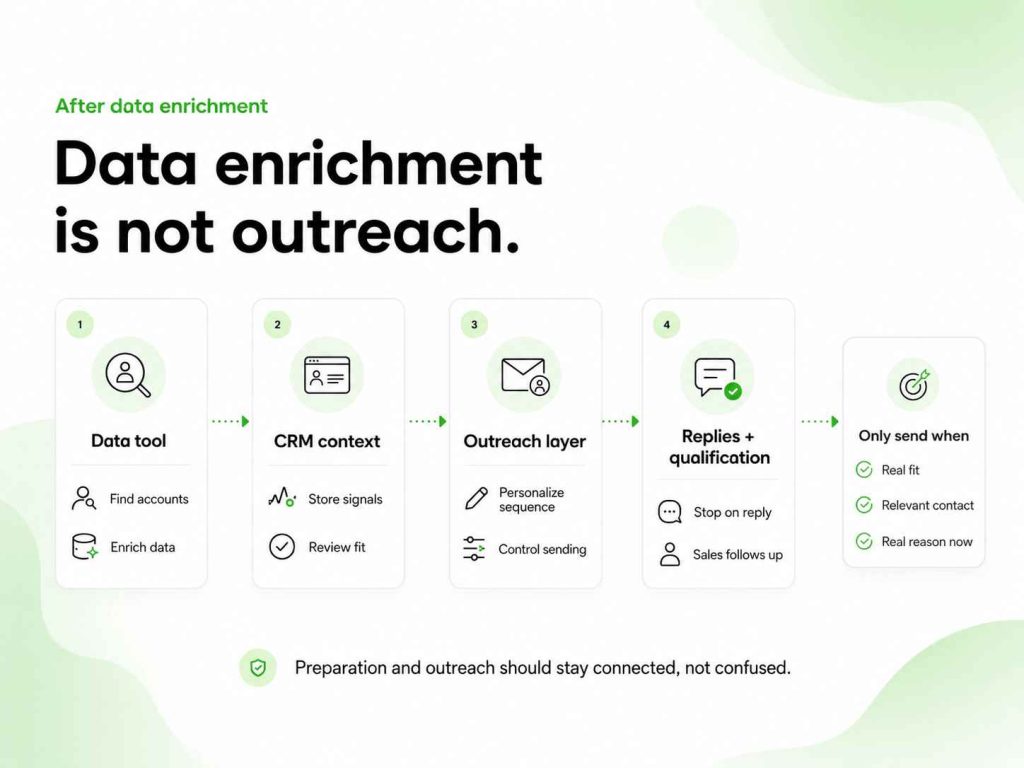
Once you have clean data, Woodpecker becomes the outreach layer.
You can move a verified lead list into a campaign, personalise the sequence, control sending volume and stop follow-ups when a prospect replies. That lets your data workflow and outreach workflow stay connected without treating them as the same job.
For example:
Data tool finds and enriches accounts
CRM stores account context
Woodpecker sends a relevant sequence
Sales reps handle replies and qualification
That is often a cleaner setup than asking one platform to handle end-to-end GTM without strong controls at each stage.
Woodpecker’s cold email sequence guide explains how the sequence should change as a prospect replies or shows interest. Its sales follow-up guide can help once the first email has created a real conversation.
Clay alternatives and competitors by use case
Here is a quick way to narrow the list.
| Your use case | Better starting point |
|---|---|
| Need broad data plus prospecting | Apollo.io or Lusha |
| Need enterprise account intelligence | ZoomInfo or Cognism |
| Need EMEA-focused data | Cognism |
| Need email and phone waterfall enrichment | FullEnrich or BetterContact |
| Need API-first enrichment | People Data Labs |
| Need CRM-native enrichment | HubSpot Data Enrichment |
| Need lightweight email finding | Hunter |
| Need CRM refresh and job-change information | Datagma |
| Need custom GTM engineering workflows | Clay |
There are several alternatives for GTM, but no single Clay replacement will cover every use case.
A platform similar to Clay may still be a poor fit if you only need verified email addresses. A lightweight tool may be too limited if your GTM leaders need custom enrichment across many sources.
Choose the workflow first. Then choose the platform.
Pricing, free plans and how to compare cost
Pricing can be difficult to compare because enrichment tools charge in different ways.
Some use credits. Some charge by user. Some charge for contact data, phone data or AI actions separately. Some offer a free plan or free trial. Others require a sales conversation before showing paid plans.
When comparing pricing, look beyond the monthly number.
Ask:
- How many records can we enrich each month?
- Does a phone lookup cost more than an email lookup?
- Are invalid records charged?
- Does the tool charge for workflow actions?
- Can unused credits roll over?
- Does the free plan support real testing?
- Will we need another tool for verification?
- Will we need another tool for outreach?
- Can the platform sync data into our CRM without manual exports?
The cheapest option is not always the best Clay alternative.
A low-cost tool can become expensive if the data quality is poor and your sales reps spend hours fixing records. A higher-priced tool may save money if it reduces manual enrichment, failed sends and duplicate work.
How to choose the best Clay alternative for your sales team
A small team should avoid buying an enterprise platform just because it has more features.
Start with the bottleneck.
If your sales team spends too much time finding email addresses, choose a contact data or waterfall enrichment tool.
If your CRM data is incomplete, choose a CRM enrichment platform.
If your GTM teams need complex AI workflows and many data sources, Clay may still be the best tool.
If the issue is not data but outreach execution, do not buy another enrichment platform. Improve the campaign workflow instead.
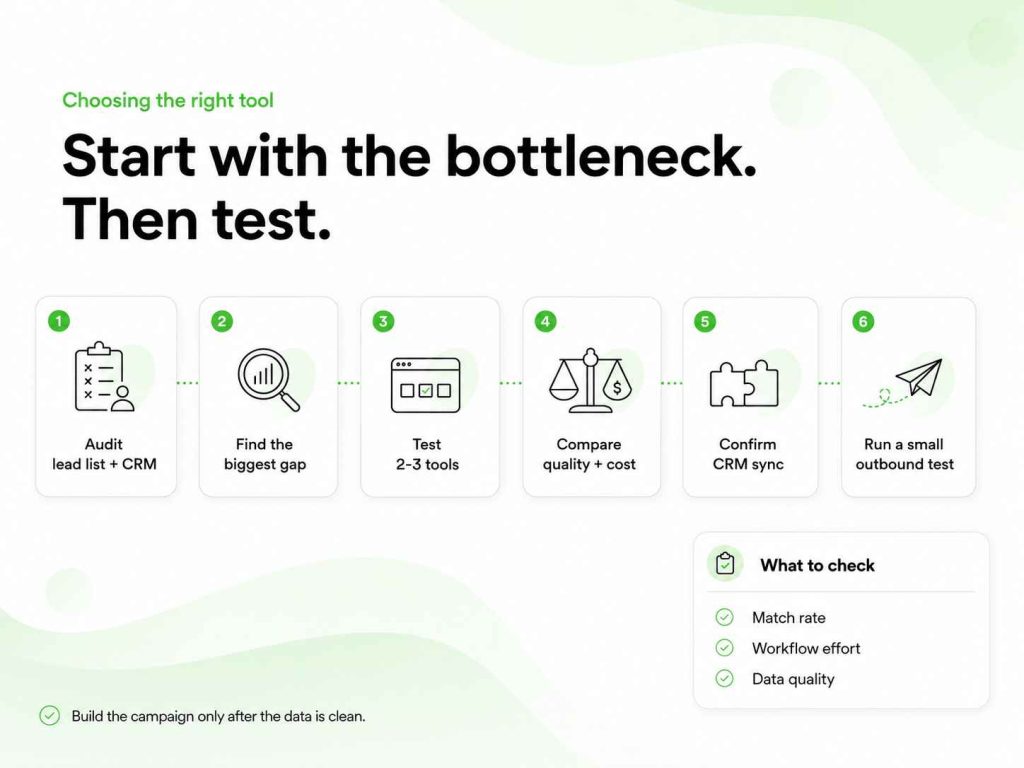
Use this decision process:
- Audit your current lead list and CRM data.
- Identify the biggest gap: contact data, enrichment, workflow, signals or outreach.
- Test a small sample of records in two or three tools.
- Compare match rate, data quality, workflow effort and cost.
- Check whether the tool supports your geography and target segment.
- Confirm how data syncs into your CRM.
- Build a small outbound test only after the data is clean.
For the last step, Woodpecker’s guide to how to safely scale cold email outreach can help you protect sender reputation while you test new lists.
FAQ
What is the best Clay alternative?
The best Clay alternative depends on the workflow. Apollo.io can suit teams that want prospecting and enrichment in one platform. FullEnrich and BetterContact are better for waterfall enrichment. HubSpot Data Enrichment can suit HubSpot-first teams. ZoomInfo and Cognism are stronger for enterprise sales intelligence.
Is there a free Clay alternative?
Several alternatives offer a free plan, free tier or free trial. The best option depends on whether you need contact data, email verification, enrichment or a full workflow. Test a small lead list first rather than choosing based only on free credits.
Is Clay worth it for GTM teams in 2026?
Clay can be worth it for GTM teams that need flexible enrichment, AI research and custom automation. It may be too complex or expensive for a small team that only needs email addresses, simple CRM enrichment or a lightweight prospecting workflow.
Is Apollo a Clay alternative for cold email?
Apollo can be an alternative to Clay for teams that want B2B contact data, prospecting, enrichment and CRM workflows in a more guided platform. Clay offers more flexibility for custom GTM engineering and multi-source enrichment.
Can Clay replace an outreach platform?
No. Clay can support data enrichment and GTM workflows, but it is not the same as an outreach platform. A data tool helps you find and enrich prospects. An outreach platform helps you send, manage and improve the sales sequence after you have a relevant list.
Pick the data workflow first, then build the outreach around it
Clay alternatives are not all trying to solve the same problem.
Some help you enrich contact data. Some help you build a prospect list. Some give sales reps account intelligence. Some offer waterfall enrichment. Some keep CRM data current.
Clay is strongest when you need a flexible GTM workflow across data sources, AI and automation. But a specialised tool may be a better choice when your team only needs one part of that system.
Once your data is verified and your target accounts are clear, Woodpecker helps you turn that preparation into thoughtful outreach.
Use Lead Finder to support prospecting, Bouncer verification to check email addresses, then use cold email personalisation and deliverability checks before your campaign goes live.