


An AI SDR is software designed to support sales development work that once sat entirely with a sales development representative.
Depending on the platform, AI SDRs can research accounts, identify possible buying signals, draft outreach, suggest follow-ups, qualify leads and help sales teams keep campaigns moving.
That does not automatically make an AI SDR a full replacement for a human sales rep.
The strongest setup uses AI for repetitive tasks, research preparation and workflow support. Human SDRs still bring judgement, context and the ability to turn a vague response into a useful conversation.
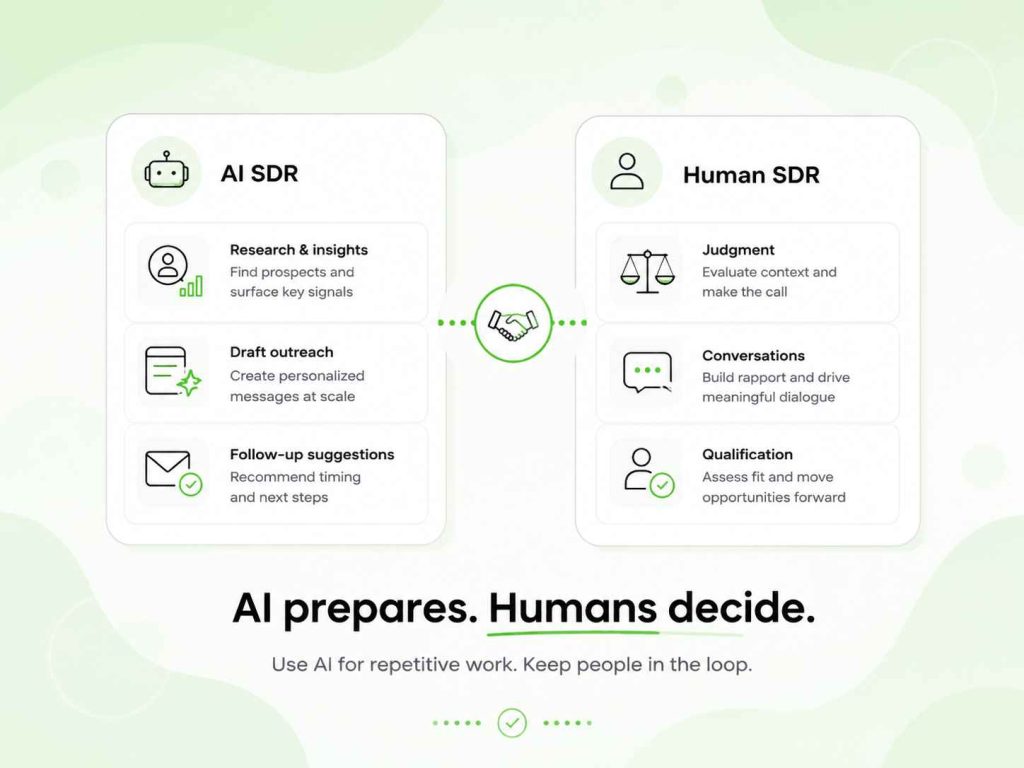
That distinction is important in outbound sales. A tool can generate dozens of messages in minutes. It cannot tell you whether the company is actually a fit, whether the timing is right or whether your message gives the recipient a real reason to reply.
What you’ll learn
- What an AI SDR is and how AI SDRs work
- Which outreach tasks AI can support
- Where human SDRs still outperform automation
- How to personalize outreach without producing generic messages
- What to look for when evaluating AI SDR platforms
- Why better outbound does not mean more automated cold outreach
AI SDR: what does the term actually mean?
An AI SDR is an AI-powered system that supports sales development and outreach.
A traditional SDR researches prospects, writes first messages, follows up, qualifies leads and tries to book meetings for account executives. An AI SDR agent can take over parts of that work through automation.
Some AI SDR tools focus on prospect research. Others focus on writing or automating outreach. Some are sold as AI sales agent tools that can manage most of the early outbound sales process with limited human input.
The label covers very different products.
One AI SDR tool may help a sales rep prepare a more relevant cold email. Another may find companies that fit an ideal customer profile. A third may send multi-step sequences, classify replies and move contacts through a sales funnel.
That is why “AI SDR” should not be treated as one fixed product category.
The better question is:
Which part of our sales development workflow needs help, and where should a human still make the final call?
Woodpecker’s guide to outbound sales automation takes a useful position here: automation should reduce admin and repetitive tasks, not turn the whole process into impersonal sending.
How AI SDRs work across outreach and outbound
AI SDRs work by combining prospect data, AI technologies and workflow automation.
They may use information from company websites, job posts, CRM records, LinkedIn activity, company news or public account data. The system then suggests a message angle, a possible pain point or a next action.
For example, an AI SDR may detect that a company is hiring several SDRs, expanding into a new region or changing sales leadership. It might suggest outreach around onboarding, prospecting consistency or pipeline coverage.
That can save time.
It does not prove that the company has the problem you are describing.
AI SDRs use public information to form a hypothesis. A human should still decide whether the signal is current, relevant and useful enough to mention in a first email.
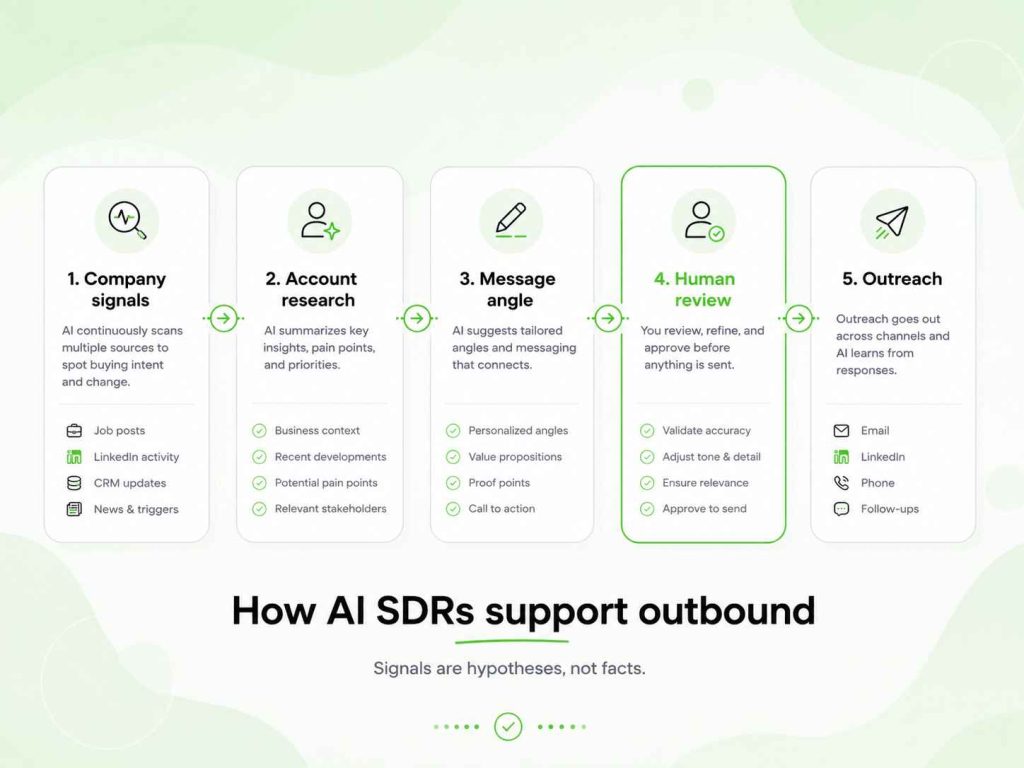
The best results usually come from combining AI preparation with focused account research. Start with a clear ideal customer profile, then use AI to speed up the work around that target list.
A weak prospect list does not become stronger because an AI agent writes the opening line.
AI SDR agent and SDR agents: what automation can do
An AI SDR agent can support several jobs that normally take up a large part of an SDR workflow.
AI SDRs are designed to help with work such as:
- account research
- prospect prioritisation
- first-draft outreach
- follow-up suggestions
- reply classification
- CRM enrichment
- meeting preparation
Some SDR agents can also monitor activity and suggest when a prospect may be worth contacting again.
This is useful when a sales team has a large number of accounts but limited time to review every signal manually.
For example, AI can flag companies with recent hiring activity, a new funding round or a change in leadership. It can then summarise the account and draft a starting point for the sales rep.
The rep still needs to ask a basic question:
Would this person recognise the issue I am raising?
That question protects the campaign from generic cold outreach.
Woodpecker’s sales prospecting tools guide is useful when building this workflow because it separates list building, account research and sending instead of pretending one tool should solve every sales task.
AI sales, AI sales agent and AI SDR tool: where the categories overlap
AI sales is a broad term.
It can describe anything from an AI tool that scores leads to a full AI sales agent that drafts messages, triggers follow-ups and updates CRM fields.
An AI SDR tool is more specific. It is built around the work that happens before a deal reaches an account executive.
That includes finding accounts, researching decision-makers, preparing outreach and helping qualify leads.
An AI sales agent may overlap with that role, but it can also work later in the sales process. Some tools focus on call summaries, pipeline forecasting or deal coaching. Others focus on lead generation and outbound.
That is why a sales team should not buy an AI SDR just because it appears on a “best AI” list.
First, decide whether you need help with:
- finding better prospects
- writing clearer emails
- automating outreach
- organising reply handling
- preparing calls
- updating the sales pipeline
A platform that is strong at lead generation may not be the right choice for follow-up management. A tool that writes good first drafts may not support the sending infrastructure needed for safe outbound.
Lead generation and prospect prioritisation with AI SDRs
Lead generation is one of the clearest uses for AI SDRs.
An AI SDR can scan a broader set of companies, compare account attributes and flag prospects that look closer to your ideal customer profile.
It can also help the SDR team sort accounts by signals such as company size, hiring plans, funding, role changes or website activity.
That can make prospecting faster.
It does not remove the need for qualification.
A company that raised funding may be a good fit. It may also be spending the money on something completely unrelated to your product or service. A prospect who downloaded content may be curious, not ready to buy.
Good lead generation still needs a clear definition of fit.
Woodpecker’s B2B sales lead generation guide is helpful here because it starts with who you should contact, not only how many contacts you can find.
Human SDRs and human SDR judgement
AI SDRs and human SDRs are not interchangeable.
AI can process information quickly. It can review many accounts, prepare message variations and keep track of repetitive steps. A human SDR can read nuance, ask better questions and recognise when an answer is polite rather than genuinely interested.
That difference appears quickly in a real reply.
A prospect may write:
We are looking at this, but it is not a priority right now.
An AI SDR may label that reply as “follow up later”.
A strong human SDR may ask whether the issue is timing, budget, internal ownership or a missing stakeholder. They may see an opening for a short follow-up question instead of sending a generic reminder three months later.
Human SDRs are particularly useful when:
- several stakeholders influence the purchase
- the buyer has a complex problem
- the account needs a tailored value proposition
- the prospect raises an objection
- a sales call needs real discovery
- the sales cycle is long or political
AI and human SDRs work best together when AI handles the repetitive groundwork and people handle the judgement-heavy work.
Human SDR vs AI SDR: where each one is stronger
An AI SDR is usually stronger at speed, consistency and scale.
A human SDR is usually stronger at judgement, relationship-building and handling uncertainty.
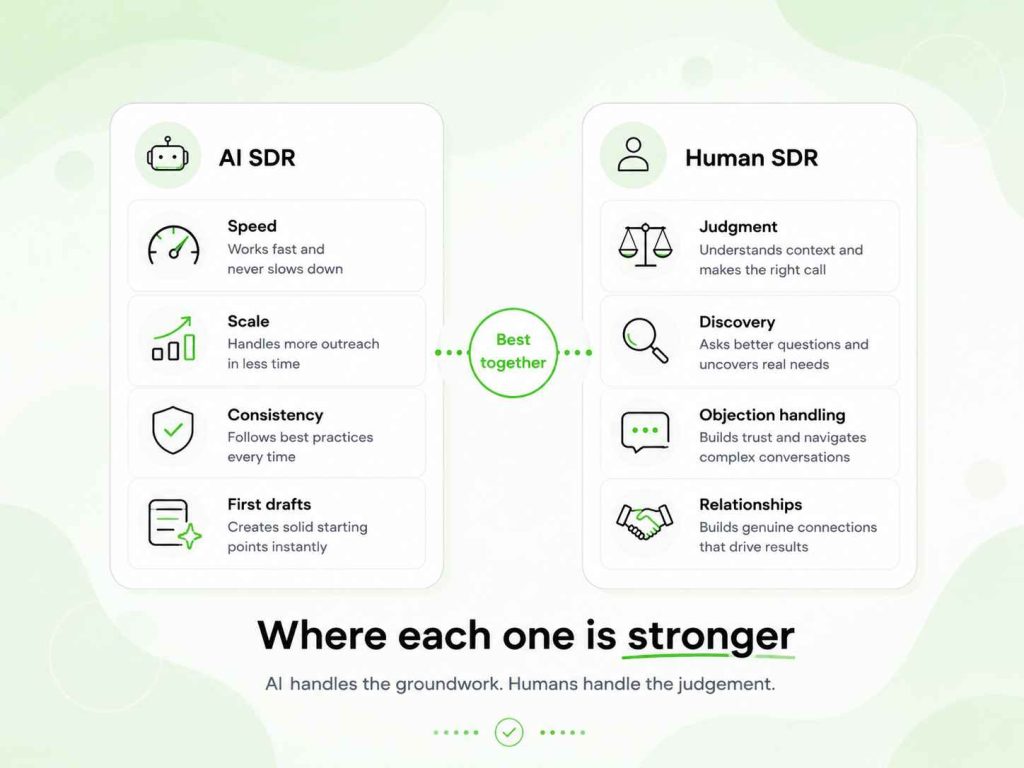
Here is a practical comparison:
| Area | AI SDR | Human SDR |
|---|---|---|
| Reviewing large account lists | Fast | Slower but more selective |
| Summarising company news | Fast | Can judge relevance better |
| Drafting outreach | Fast first draft | Stronger final message |
| Handling ambiguous replies | Limited | Better contextual judgement |
| Cold calling | Can prepare notes | Better live conversation |
| Discovery questions | Can suggest them | Can adapt in real time |
| Objections | Can classify patterns | Can explore the real concern |
| Relationship-building | Limited | Stronger |
An AI SDR vs human SDR comparison should not turn into a competition over which one is “better”.
The practical question is where each one adds the most value.
AI can help a rep arrive at a conversation better prepared. It should not convince teams that a full AI replacement will work for every B2B sales motion.
How AI SDRs help personalize outreach
AI can help personalize outreach faster, but it can also make personalisation look fake.
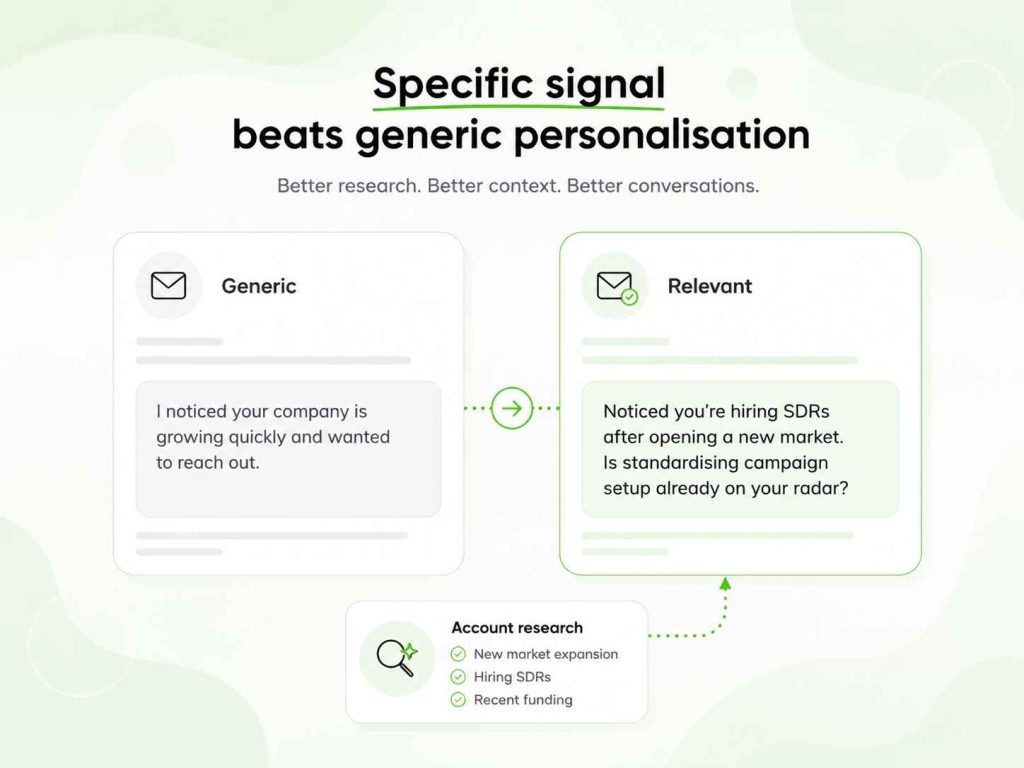
A weak AI-generated first line often sounds like this:
I noticed your company is growing quickly and wanted to reach out.
That is technically personalised. It is also vague enough to send to almost anyone.
A better message uses one specific observation and a possible implication:
Noticed you are hiring SDRs after opening a new market. Teams at that stage often struggle to standardise campaign setup across new hires. Is that already on your radar?
The difference is not the tool. It is the quality of the input and the human review behind it.
AI SDRs handle first drafts well when the rep provides a useful account signal and a clear reason for contacting the prospect.
They perform badly when asked to write “a personalised cold email” with no account context.
Woodpecker’s guide to personalized cold emails shows why one researched detail should shape the message itself, not simply sit in the opening sentence.
For deeper research work, see how to personalise cold emails through research and how to turn that research into better copy.
AI sales and automation for the sales team
Automation is useful when it removes work that does not need a person’s full attention.
For an SDR team, that can mean:
- compiling account notes
- cleaning prospect lists
- suggesting subject lines
- preparing message variants
- scheduling follow-ups
- routing replies
- updating CRM fields
A good automation tool should give the sales team more time for research, qualification and conversations.
It should not create a situation where AI SDRs to manage become another layer of work. If a manager has to spend hours fixing poor drafts, sorting bad leads and apologising for irrelevant campaigns, the system has not saved time.
The best AI SDR experience feels like a useful co-pilot. It gives the rep a strong starting point, while leaving them control over the final outreach.
Woodpecker’s AI-generated emails guide is helpful for this reason: AI output should be a draft to improve, not a message to copy without review.
AI SDRs, outbound sales and the sales pipeline
AI can improve parts of the outbound sales process, but it cannot fix a weak sales pipeline on its own.
If the target account list is poor, outreach will stay weak. If the offer is unclear, message automation will not make it stronger. If follow-ups are repetitive, AI can simply send more of them.
The best use of outbound AI is to support an existing process with clear steps:
- Define the target account.
- Gather useful account signals.
- Build a relevant message hypothesis.
- Send a short, human-reviewed first email.
- Adjust the follow-up based on what the prospect does or says.
- Qualify replies before pushing for a meeting.
This protects the sales funnel from becoming a volume exercise.
Woodpecker’s cold email sequence guide is useful here because every email in the sequence has a different role. The follow-up should not repeat the first message with different wording.
AI SDRs and cold outreach: where teams go wrong
AI cold outreach becomes risky when teams optimise only for output.
The temptation is obvious. AI can generate lists, draft messages and automate outreach far faster than one person can.
But AI SDRs don’t automatically create relevance.
They do not know whether a public post reflects a current business priority. They do not understand internal politics. They cannot always tell whether a short reply means real interest or polite dismissal.
A sales rep still needs to review the account, the message and the sending plan.
That is especially true for AI cold calling. AI may help prepare call notes, identify possible objections or suggest questions. It cannot replace a real discovery conversation when the buyer has a complex problem.
For better cold email structure, see Woodpecker’s cold email format guide and cold email templates. Both are most useful when you adapt them to the account instead of copying them word for word.
Best AI SDR tools: what to evaluate before you buy
The best AI SDR tool depends on the job you need done.
Do not start by looking for the most autonomous platform or the tool with the biggest claims around outbound AI.
Start with your workflow.
When evaluating AI, ask:
- Does it improve research, writing, sending or reply handling?
- Can the team review messages before they go out?
- Does it work with your CRM and current sales engagement platform?
- Does it support verified data and safe outreach practices?
- Can it personalise outreach with real account context?
- Does it help the team qualify leads, rather than only generate more of them?
- Does it fit the company size, sales cycle and available team capacity?
AI SDR tools focus on different stages of the workflow. Some help you find prospects. Some are designed for message generation. Some try to cover the full AI sales process from list building to booking meetings.
No single category is automatically the best AI choice for every team.
10 best AI SDR tools, top AI and top 5 AI SDRs: why listicles are only a starting point
Searches for “10 best AI SDR” or “top 5 AI SDRs” are understandable.
Teams want a shortlist. They want to know which top AI option can reduce manual work without creating a mess in the inbox.
But a ranking cannot tell you whether a tool fits your actual sales process.
A small agency may need a simple AI SDR tool for campaign research and follow-ups. A larger B2B sales team may need deeper CRM workflows, permissions and reporting. A company with complex deals may need an AI sales agent that prepares account briefs, not one that tries to send autonomous messages.
The best AI SDR is rarely the platform with the most features.
It is the platform that supports your existing outbound motion without forcing the team into a new, rigid process.
A useful shortlist should compare:
- research support
- data quality
- message controls
- email and LinkedIn workflow options
- CRM integration
- reply handling
- deliverability support
- reporting
- human review requirements
- pricing that fits the team
That is more useful than choosing a tool because it appears first in a “top AI” article.
Artisan AI, AI BDR and the rise of autonomous AI agents
Terms such as Artisan AI, AI BDR, autonomous AI sales and custom AI agents are often used to describe tools that promise a more hands-off version of sales development.
The pitch is usually simple: let AI agents find prospects, write messages, follow up and book meetings.
Some teams will find value in that model, especially when the sales motion is simple, the target audience is clear and the message is easy to standardise.
But fully autonomous AI creates a trade-off.
The more independent the AI agent becomes, the more carefully you need to control data, message quality and outbound volume.
A platform may offer impressive AI capabilities, but that does not mean it should run without review.
In complex B2B sales, the best use of AI is often not a full AI replacement. It is an AI assistant that helps reps prepare faster and make stronger decisions.
Benefits of AI SDRs for B2B sales
The benefits of AI are most obvious when a team has repeatable processes and too much low-value admin.
AI SDRs can help a sales team:
- spend less time on repetitive account research
- prioritise accounts using clearer signals
- prepare message drafts faster
- keep follow-ups organised
- sort replies and route them to the right person
- reduce manual CRM updates
- spot patterns across a larger volume of outreach
Those benefits do not remove the need for best practices.
The team still needs good data, sensible sending limits and a clear definition of a qualified lead.
AI can speed up a poor process. It can also speed up a good one.
That is why the first step is not “How can we automate more?”
It is “Which work does the team repeat without adding much value?”
How to choose the right AI SDR for your team
The right AI SDR depends on the kind of outbound you run.
A lean startup may need help turning prospect notes into better first drafts. A sales agency may need clearer campaign workflows across several clients. A larger company may need governance, reporting and reliable CRM integration.
Think about three areas.
First, data. Does the platform have enough context to support relevant outreach, or will your team need to build the research process elsewhere?
Second, control. Can a human approve, edit or stop messages before they go out?
Third, delivery. Does the platform help you maintain a safe sending setup, or does it only focus on producing more messages?
The best AI SDR tools support the full workflow around outreach, not only the first draft.
Woodpecker supports that broader process through campaign creation, follow-ups, reply detection and deliverability-focused controls. Its email outreach tool guide shows how the sending layer should stay connected to the research and copy work that happens before it.
Can AI SDRs book meetings?
AI SDRs can help book meetings by identifying relevant prospects, preparing outreach, sending follow-ups and routing interested replies.
But booking a meeting is not the same as creating a qualified opportunity.
An AI SDR can fill a calendar with conversations that go nowhere if the targeting is weak or the messages overpromise.
The goal is to book meetings that make sense for both the sales team and the buyer.
That requires good qualification and a sales rep who can run an effective discovery call.
Woodpecker’s discovery call questions guide can help turn an interested reply into a useful conversation instead of a rushed product pitch.
AI SDRs, reply quality and follow-up decisions
A reply is not always a positive signal.
A prospect may ask to be removed. They may say they are not responsible. They may be interested but unable to act for six months. They may be curious without having a real buying problem.
AI can classify those replies. It can suggest a next step. It can help summarise the conversation for a sales rep.
But the human should decide what belongs in the pipeline.
That is where an SDR workflow needs clear rules. The team should know when to create an opportunity, when to nurture a contact and when to stop following up.
For more complex qualification, a framework such as MEDDPICC can help the team separate polite interest from a real opportunity.
Woodpecker’s cold email reply rate guide is also useful because it focuses on meaningful response management, not only sending volume.
AI SDRs and deliverability still need human attention
AI handles copy and workflow support. It does not replace deliverability work.
A well-written email can still land in spam if the domain is poorly configured, the list is low quality or the sending pattern is too aggressive.
Before you scale outreach, make sure the basics are in place:
- use verified email addresses
- authenticate your sending domain
- warm up new mailboxes gradually
- keep sends measured
- monitor replies, bounces and spam signals
- stop sequences when someone replies
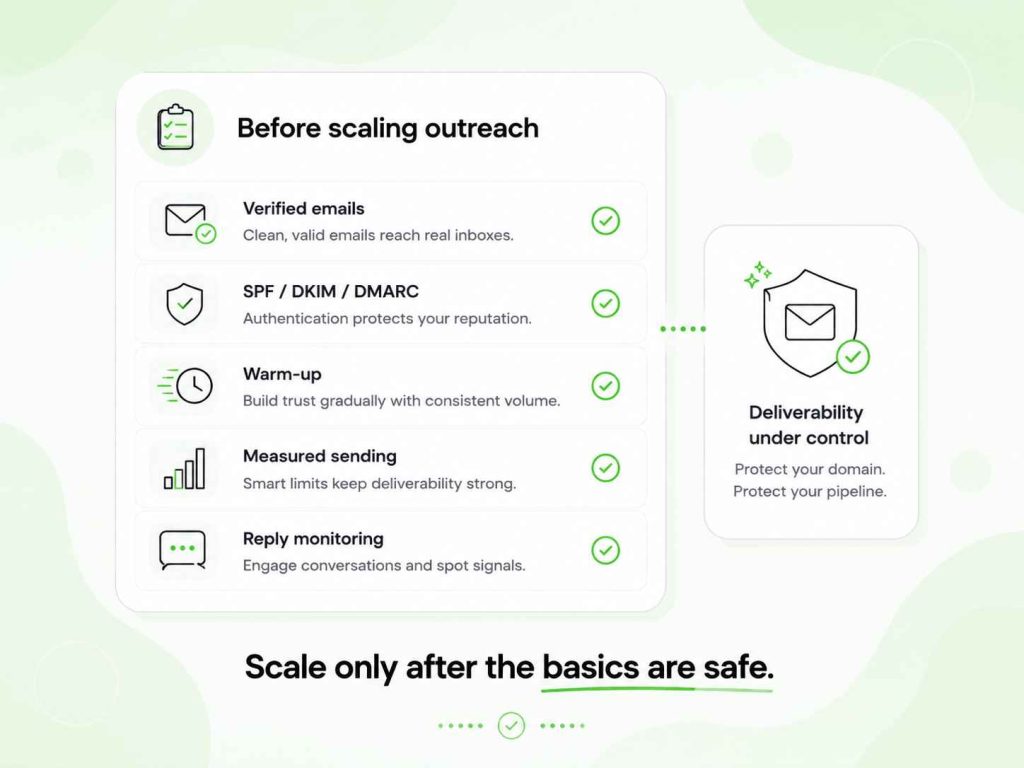
Woodpecker’s cold email infrastructure guide explains the sending setup behind safe campaigns. You can also review SPF, DKIM and DMARC, domain reputation and how to set up a domain and mailbox for cold outreach.
Before launching, verify your contact data too. Email verification in Woodpecker can help reduce avoidable bounces.
FAQ
What is an AI SDR?
An AI SDR is software that supports sales development work such as account research, lead generation, message drafting, follow-up preparation, reply routing and outreach automation.
Can AI SDRs replace human SDRs?
AI SDRs can reduce repetitive work and help reps work faster. They are less reliable for complex discovery, objection handling, relationship-building and ambiguous buyer conversations.
What does an AI SDR agent do?
An AI SDR agent may research accounts, identify potential buying signals, prepare outreach drafts, suggest follow-ups, classify replies and help route leads to the right sales rep.
Is an AI SDR the same as an AI BDR?
The terms overlap. Both refer to AI tools that support early-stage sales work. “AI BDR” may focus more on business development and new account creation, while “AI SDR” is often used for prospecting and qualification workflows.
Are AI SDR platforms safe for outbound sales?
They can be, when the team reviews AI output, uses verified contact data, limits sending volume and protects sender reputation. AI does not remove the need for good outreach practices.
Use AI SDRs to improve outreach, not multiply generic messages
AI SDRs can help sales teams prepare campaigns faster, organise research and keep follow-ups moving.
They cannot replace thoughtful targeting, a relevant message or real sales judgement.
Use AI for the repetitive work. Keep people involved where context, trust and decision-making are needed.
That is how AI can support outbound sales without turning the process into high-volume spam.
Woodpecker gives teams a practical way to combine AI-assisted campaign work with deliverability protection, personalised email outreach and reply management. Start with AI for sales prospecting or read about how to humanise an automated sales process.