


There’s a moment at the end of writing any email – after you’ve said the thing you needed to say – where you have one last decision. What sentence do you leave the reader with?
Most people treat it as a formality.
“Thanks!”
“Best!”
“Let me know!”
Whatever comes to mind.
And most of the time, it’s fine. But the last line of an email is working harder than most senders realize. It’s the thing the reader sees while deciding whether to reply, how to reply, and how they feel about you when they close the message.
A good closing line makes the next step obvious. A bad one adds friction, or worse, feels needy. Across thousands of emails that get sent by sales teams, recruiters, job applicants, and business development pros, the closing is where more replies are won or lost than people think.
This guide isn’t a list of 50 sentences to pick from at random. It’s 50+ closings grouped by the job each one does – where they work, where they don’t, and why. You’ll find closings for asking for a reply, applying pressure without being rude, recovering from a mistake, ending a cold email, and closing a message to someone senior. Read the section that matches your situation.
Why the closing line does more work than you think
The opening of an email establishes context. The body delivers the substance. The closing does three things that neither of the other two can do:
- It sets the expectation for what happens next. The reader finishes your email with a clear (or unclear) sense of what you want them to do.
- It signals your confidence in the interaction. “Let me know if you have any questions” reads differently than “I’ll wait to hear your thoughts by Friday.” Both are polite. One is passive, the other is calm and specific.
- It leaves a last impression. If someone else forwards your email, the closing line is often the thing that sticks – especially in sales contexts where the decision-maker might read only the last few sentences.
The closing is also where most emails leak credibility. Filler phrases like “hope this helps,” “thanks in advance,” and “looking forward to your response” have become so common they’ve stopped registering as anything at all. They read as auto-text. If you want your email to stand out – even a little – the closing is one of the easiest places to do it.
For more on the broader mechanics of ending emails, read How to End Email: Sales-Driven Sign-Off Hacks.
The 4 jobs a closing line does
Before the examples, a quick map of what closings actually do. Every closing falls into one of these buckets.
- Prompt action. Tells the reader exactly what you want them to do. “Could you confirm by Thursday?” “Let me know if 2pm works.” Action closings work when there’s a specific next step you’re asking for.
- Leave the door open. Used when there’s no specific action, but you want the conversation to continue. “Happy to discuss whenever works for you.” “Let me know if there’s more context I can share.” Less urgent than action closings, but more personal than a flat sign-off.
- Close gracefully. Used when the exchange is ending – for now, or permanently. “Thanks again for your time.” “Appreciated the conversation.” No follow-up expected, but the door is polite and open.
- Reset expectations. Used when the thread has gone stale, the request has changed, or you need to reframe something. “I want to be realistic about the timeline.” “If this isn’t the right moment, I’ll check back in Q3.” Harder to get right, but often the highest-value closing in B2B contexts.
Most closings people write are attempts at #2 (leave the door open) that accidentally land as weak versions of #1 (prompt action). If you find yourself writing “let me know” for the tenth time this week, you’re probably defaulting to a closing that doesn’t actually do the job you need it to do.
Closings for sales and business development emails
Sales emails live or die by their closing. A generic “looking forward to your thoughts” kills a perfectly good email. The closings below are grouped by sales situation.
Cold outreach (first email)
The first cold email needs a closing that asks for one thing – a reply, a conversation, or a small commitment. Over-asking here is the most common mistake. Under-asking is the second most common.
- “Would you be open to a 15-minute conversation next week?” – Clean, specific, time-bound. Works because 15 minutes feels low-cost to say yes to.
- “Does any of this resonate, or am I off base?” – Disarming. Invites a reply that doesn’t require commitment. Good when you’ve taken a specific angle and want feedback.
- “If this isn’t the right time, I can check back in a few months – just let me know.” – Removes pressure. Paradoxically tends to get more replies than a harder ask because it signals you’re not desperate.
- “Is this something worth exploring, or not really a fit?” – Binary choice closing. Respects the reader’s time. Gets faster yes/no responses.
- “Happy to share more context if it’s useful. Otherwise, I’ll leave you to your morning.” – Polite acknowledgment that they’re busy. Feels human. Works especially well for outreach to senior people.
Avoid in cold outreach: “Let me know if you have any questions” (they don’t, they don’t know enough to have questions yet), “I look forward to your response” (presumes interest you haven’t earned), “Awaiting your reply” (reads as pushy).
Check our tips for making your cold emails more persuasive – they cover essential tips and practices.
Follow-up emails
Follow-ups need closings that apply gentle pressure without being annoying. The challenge: saying “following up” without sounding like the fifteenth person to follow up with this prospect this week.
- “Did this get buried? Happy to resend.” – Acknowledges the real world. Assumes competence on their part (they’re busy, not ignoring you). Very hard to take badly.
- “Should I take the silence as a no for now?” – Direct. Asks for a response by offering an exit. Controversial with some sales teams but consistently pulls replies.
- “If you’ve moved on from this, no problem – just reply with a quick ‘pass’ and I’ll stop the thread.” – Explicit, respectful. Gives the reader a one-word out. Most people will actually reply with “pass” rather than ignore, and some will explain why (which is useful intel).
- “Bumping this up in case it got lost – no pressure either way.” – Soft acknowledgment. Good for early-stage follow-ups when you don’t want to come across as aggressive.
- “Happy to close the loop on this – is there someone else on your team I should be talking to?” – Shifts the ask from decision to direction. Gets forwarded internally and often produces the right contact.
Wondering how to send a follow-up email after no response? Or what to do when you see negative replies? Check out our ideas.
Proposal and deal-close emails
Closings when there’s a proposal on the table change in tone. The reader knows what you want. Your job is to make the yes easy.
- “Ready to move forward whenever you are – just let me know the best next step on your end.” – Puts the action with them but signals readiness. Confident.
- “Let me know what needs to happen to get to a yes.” – Collaborative. Invites them to name the blockers without you having to guess.
- “Happy to walk through this on a call, or answer anything in writing if that’s easier.” – Gives them control over the format. Removes a small friction point.
- “I’ll assume we’re good to proceed unless I hear otherwise by Friday.” – Assumptive close. Use carefully and only when there’s prior agreement on the deal. When it fits, it moves faster than any other closing.
- “Should we get this on paper this week, or does next week work better?” – Two-option close that moves the timeline conversation forward.
Breakup emails
The “I’m going to stop emailing you now” message. Oddly, one of the highest-converting emails in any sequence. A good breakup closing makes it easy for the prospect to either re-engage or formally close the loop.
- “I won’t keep bothering you – if the timing changes, my contact info is below.” – Clean exit. Leaves the door open without pressure.
- “Closing the loop on my end. If there’s a better person to talk to, I’d appreciate the pointer.” – Asks for one small favor on the way out. Often gets a useful answer.
- “Circling back one last time – if now’s not right, happy to check in later in the year.” – Sets up the future conversation explicitly. Works well for longer sales cycles.
Closings for job applications and career emails
Job-related emails have a specific register: confident but not presumptuous, eager but not desperate, appreciative without groveling. The closing does a lot of the work in landing that register.
Job application closings
- “Thank you for your consideration – I’d welcome the chance to discuss how I could contribute.” – Classic. Works because it’s polite, direct, and names the next step (a discussion) without assuming it.
- “I’ve attached my resume and portfolio. Happy to answer any questions or send additional samples.” – Practical. Signals preparation and openness.
- “Looking forward to the opportunity to discuss this further.” – Slightly more assertive. Works when you have a genuine reason to expect a response (strong qualification match, mutual connection, referral).
- “If you need any additional information to support my application, please let me know.” – Active offer. Better than the passive “please let me know if you need anything.”
Post-interview follow-up closings
- “Thank you again for the conversation – it reinforced my interest in the role.” – Reinforces interest without overstating it. Appropriate in most interview follow-ups.
- “I appreciated the chance to learn more about the team’s priorities. I’d be glad to share additional thoughts on the [specific topic] if useful.” – Offers something concrete. Demonstrates listening (you remember a specific topic) and readiness to add value.
- “Let me know what the next steps look like, or if there’s anything I can clarify from our conversation.” – Active close. Better than the passive “looking forward to hearing back.”
Networking and informational outreach closings
- “I’d love your perspective whenever you have time – no rush.” – Low-pressure ask. Respectful of senior contacts who get lots of these.
- “Thanks for even considering it – happy to work around your schedule.” – Humble, but not groveling. Works when asking for time from someone significantly more senior.
- “I’ll be in [city] on the 12th if a coffee works – otherwise a phone call is perfect.” – Specific and flexible. Demonstrates you’ve thought about their convenience.
Closings for internal business emails
Internal email closings are where most defaults show up – “Thanks!” “Best!” “Let me know!” – and most of the time they’re fine. But the situations where you’d benefit from a sharper closing are more common than people assume.
Closings that prompt clear action
- “Could you confirm by EOD Thursday?” – Specific. Named deadline. No ambiguity.
- “Two things I need from you: [X] and [Y]. Both by Friday if possible.” – Names the asks. Makes them easy to find in the inbox.
- “Let me know if you’re good with this, or if you want to discuss.” – Binary option. Forces a response.
- “Approving on your end will unblock the engineering team – they’re waiting on this to ship.” – Names the downstream impact. Adds urgency without panic.
Closings for status updates
- “I’ll send the next update on [date]. Let me know if you need anything sooner.” – Sets expectation for the next message. Removes the need for you to be chased.
- “No action needed from you right now – this is just for visibility.” – Explicit “don’t worry about this.” Huge kindness to busy readers. Underused.
- “Happy to jump on a call if this raises questions – otherwise, this is the latest.” – Offers a conversation without requiring one.
Closings for escalations or sensitive issues
- “Flagging this at your level because of [specific reason] – I’ll send a follow-up by [time].” – Names the why and the when. Reduces anxiety rather than creating it.
- “Want to make sure this lands on your radar. Happy to discuss how to handle.” – Calm. Opens the conversation without presuming direction.
Closings for apologies and sensitive situations
When you’ve made a mistake, missed a deadline, or need to deliver uncomfortable news, the closing matters more than in almost any other email. A bad closing makes an apology feel half-hearted. A good one resets the relationship.
- “Thank you for your patience while we resolve this.” – Simple. Acknowledges their grace. Doesn’t over-apologize.
- “I’ve put [specific preventive measure] in place so this doesn’t repeat.” – Names the fix. Essential – apologies without corrective action read as performative.
- “Happy to discuss further if this has caused real friction on your end.” – Opens the door to a conversation without forcing one. Respects that they may want to move on.
- “I recognize this is frustrating. Thank you for flagging it so we could address it.” – Names their emotion without overclaiming to understand it. Appreciates the heads-up.
- “Sending this now so it doesn’t surprise you later in the week.” – Used for preemptive apologies or tough news. Shows you’re trying to help them manage their time.
Closings that signal confidence without arrogance
A small category but worth having in your kit. These closings work when you need to project readiness or conviction – not common, but occasionally exactly the right move.
- “Ready when you are.” – Three words. Confident. Works when there’s clear agreement on what’s next.
- “Confident this will work – let’s get it moving.” – Named confidence. Use when you genuinely believe it. Don’t use as decoration.
- “Happy to own this end-to-end. Just let me know you’re good with the approach.” – Offers accountability. Strong closing when you want to take something off someone’s plate.
- “I’ll take it from here.” – Four words. Useful when you’re closing out an exchange where you’ve gathered what you need.
Closings for thank-you emails
Thank-yous are a specific format. The closing should land the gratitude cleanly without adding pressure for more interaction.
- “Thanks again – genuinely appreciated.” – Minor variation on “thanks again” that reads more sincere. The word “genuinely” is weirdly effective here because it’s rarely used.
- “Your time on this made a real difference.” – Specific to time/effort. Avoids vague gratitude.
- “Hoping to return the favor at some point.” – Opens the possibility of reciprocity without demanding it.
- “No reply needed – just wanted to say thanks.” – Useful because it removes obligation. The recipient may reply anyway, but you haven’t demanded it.
Bonus: closings to stop using
Worth naming the closings that have stopped working because they’ve been overused. If you find yourself using these on autopilot, swap in something from the sections above.
- “Just following up.” – Makes the reader feel like an item on your checklist. Try “did this get buried?” or “bumping this up.”
- “I look forward to your response.” – Presumptive when you haven’t earned the response. Try “let me know what you think, whenever you have time.”
- “Thanks in advance.” – Transactional. Feels like you’re banking the thanks before earning it. Just write “thanks” at the start or name the specific thing you’re thanking them for.
- “Let me know if you have any questions.” – Passive. Assumes they’re going to generate their own momentum. Try “happy to answer anything that comes up, or jump on a quick call if easier.”
- “Hope this helps!” – Default filler. Skip it entirely or replace with something specific: “happy to clarify any of this.”
- “Best!” with an exclamation point – reads as trying too hard. Just “Best,” or “Thanks,” without the exclamation.
Match your closing to the situation: quick reference
A compressed guide to picking the right closing based on what the email is actually trying to do.
- Cold outreach, first message → ask for a small specific thing (15 min, one question), or offer them an easy out
- Cold outreach, follow-up → acknowledge the real world (they’re busy) + offer them a no-cost reply option
- Proposal delivery → be specific about the next step and who owns it
- Deal close → assumptive close if appropriate, or name the specific commitment needed
- Job application → confident, next-step-aware, not presumptuous
- Post-interview follow-up → reference something specific from the conversation + offer something useful
- Internal status update → state what happens next and when, remove the need to be chased
- Escalation → name the reason you’re flagging + commit to a follow-up time
- Apology → acknowledge + name the fix + open the door for conversation if needed
- Thank-you → specific, sincere, no obligation for reply
- Breakup email → clean exit + one easy ask (point me to the right person) or a specific future window
Closings and volume: why this gets harder at scale
The analysis above works fine when you’re writing a single important email. It works badly when you’re sending 30, 50, or 100 emails a week and defaulting to “Let me know!” out of pure fatigue.
This is the core problem most professionals run into: the closings that matter most are the ones written when you’re tired, rushed, or on the tenth email of the hour. The first email of the day gets a thoughtful closing. By 4pm, everything ends with “Thanks!” and a hope that was just habit.
For sales, business development, and outreach roles specifically, this is where automation helps – not by replacing the thinking, but by removing the mechanical parts.
Woodpecker handles the sequencing, the timing of follow-ups, the auto-stop when someone replies. That frees your attention for the parts of the email that actually matter: the opening observation, the specific ask, and – yes – the closing that matches what the situation actually needs.
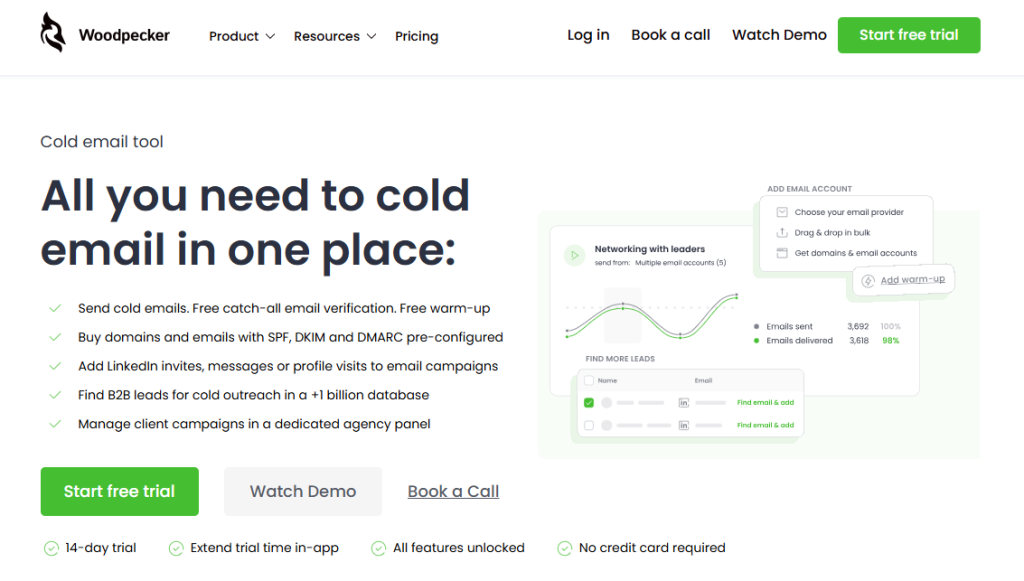
If you’re doing volume outreach and your closings have started to feel auto-generated, sign up for Woodpecker and let the platform handle the repetition so your writing can stay sharp where it counts.
FAQ
What is a good closing line for an email?
A good closing line matches the purpose of the email. For action-driven emails, it names the specific next step (“Could you confirm by Thursday?”). For open-ended emails, it invites continued conversation (“Happy to discuss whenever works for you”). The closings that land badly are the generic ones: “Just checking in,” “Let me know if you have any questions,” “Looking forward to your response” – they’ve been used so often they’ve stopped registering.
How do you end a professional email?
A professional email ends with three things: a sentence that prompts or acknowledges the next step, a sign-off that matches the formality of the relationship (“Best regards,” “Sincerely,” “Thanks”), and your full name plus relevant context (title, company, contact). The closing line is the sentence; the sign-off is the word or phrase before your name.
What’s the difference between an email closing line and an email sign-off?
The closing line is the last sentence of the body – the thing that prompts a reply or wraps up the conversation (“Let me know what Thursday looks like,” “Thanks again for the introduction”). The sign-off is the short phrase that comes after (“Best regards,” “Cheers,” “Sincerely”) followed by your name. Both matter; they’re doing different jobs.
How does Gen Z end emails?
Gen Z has moved toward shorter, more casual sign-offs – “Thanks!” “Cheers!” “TTYL!” – and some have popularized omitting a closing entirely, signing off with just their first name. There’s also been a shift toward emoji sign-offs in casual contexts. Professional contexts still call for traditional closings; register matters across generations.
What are the 5 C’s of email?
The 5 C’s of email communication are typically: Clear (the message is easy to understand), Concise (no unnecessary words), Complete (has all needed information), Courteous (respectful tone), and Correct (no errors). Some frameworks replace Correct with Consistent or Compelling. The underlying principle is the same: readable, respectful, and useful to the reader.
Is “Best” a good email sign-off?
Yes – “Best” or “Best regards” is one of the most widely accepted professional sign-offs. It works in most B2B contexts. It can feel slightly impersonal if overused, so mixing in “Thanks,” “Kind regards,” or “With thanks” depending on the email helps avoid defaulting to the same sign-off on everything.
What’s the best closing for a cold email?
The best cold email closings make a small, specific ask or offer the reader an easy out. Examples: “Would you be open to a 15-minute conversation next week?” or “If this isn’t the right time, happy to check back in a few months.” Avoid presumptuous closings like “I look forward to your response” – they haven’t earned it yet.
How do you end a follow-up email without being annoying?
Acknowledge the real world (they’re busy, not ignoring you), and offer a low-cost reply option. “Did this get buried? Happy to resend,” or “If you’ve moved on from this, just reply with a quick ‘pass’ and I’ll stop the thread.” These closings tend to convert better than “just following up” because they make a reply easier, not harder.