


If you’ve ever tried to send the same cold email to 500 people without it landing in spam, you’ve run into the spintax question. Most outbound teams get to it eventually – sometimes from a deliverability consultant, sometimes from a colleague who swears by it, sometimes from an email service provider that surfaces the feature with no real explanation of what it does.
The short version: spintax is a way to send variations of the same message so that Google, Microsoft, and every other inbox provider see slightly different emails instead of identical ones. It’s older than cold email as we know it today – the technique came out of SEO content spinning in the late 2000s – but it found a second life in outbound sales when email providers started getting more aggressive about flagging mass-sent messages.
Spintax done well can meaningfully improve how many of your emails reach the inbox. Spintax done badly produces emails that sound like a mad-libs version of themselves – which a prospect notices immediately and a spam filter doesn’t forgive. The line between the two is mostly craft, and that’s what this guide covers.
You’ll find: what spintax actually is and how the syntax works, how it affects deliverability (with evidence, not just claims), where it helps and where it hurts, a library of real spintax variations you can use for every part of a cold email, the common mistakes that break spintax, and how Woodpecker handles it natively.
What is spintax?
Spintax is a simple syntax for representing multiple versions of a piece of text at the same time. You write one message with branching options in curly braces, and the email tool picks one option per braces each time it sends.
The basic form looks like this:
{Hi|Hello|Hey} {{firstname}},
Every time this email goes out, the sender picks one greeting – “Hi,” “Hello,” or “Hey” – and merges the recipient’s first name. Send to 300 people, and you’ve sent roughly 100 “Hi” emails, 100 “Hello” emails, and 100 “Hey” emails instead of 300 identical ones.
The term “spintax” comes from “spinning syntax” – the idea of spinning a single text into multiple variations. The curly-brace notation became the de facto standard across most outbound tools, though the exact syntax varies slightly between platforms.
💡 Woodpecker uses {option1|option2|option3}. Most tools follow the same convention.
You can nest spintax. You can stack multiple spin tags in one sentence. You can mix spintax with standard merge fields like {{firstname}} or {{company}}. The underlying idea stays simple: one email template, many possible actual emails.
Example
Here’s a full cold email with spintax:
Subject: {Quick question about|Curious about} {{company}}’s {approach to|strategy for} {outbound|cold email}
{Hi|Hello} {{firstname}},
{I noticed|I came across the fact that|I saw} {{company}} {recently launched|has been scaling} {its European operations|into EU markets}. Based on the work we’ve done with {similar companies|teams in your space}, I had a {thought|hypothesis} I wanted to run by you.
{Would you be open to|Could we set up} a {15-minute|short} {call|conversation} {this week|next week}?
{Thanks|Best|Cheers},
Michael
Every braces section gets one option picked at send time. A single recipient sees one clean, normal-looking email. But across a list of 500 recipients, the aggregated pattern of text looks meaningfully different to an inbox provider – because it is.
How spintax affects cold email deliverability
The deliverability argument for spintax goes like this: inbox providers flag messages that look identical across many recipients as spam. By varying the text, you reduce the “same message repeated N times” signal. Your sender reputation stays healthier. More of your emails reach the primary inbox.
That argument is broadly correct but often overstated. Spintax is one of several signals inbox providers look at, not the single determining factor. A few things worth understanding.
What actually gets flagged. Modern spam filters use dozens of signals: sender reputation, authentication (SPF, DKIM, DMARC), link patterns, sending volume ramp, engagement metrics, domain age, and content similarity across messages. Content similarity matters, but it’s not the top signal – authentication and reputation dominate. If your domain isn’t authenticated and warmed up, no amount of spintax will save you.
Our guide to cold email deliverability covers the full picture.
Where spintax actually helps. At the margin, when everything else is set up correctly, varying content reduces the probability that your messages are fingerprinted as mass-sent. This matters most when you’re sending higher volumes from the same domain – say, 100+ emails a day per mailbox – and the small reduction in sameness adds up across thousands of messages.
Where it doesn’t help. If you’re sending 10 emails a day from a warmed domain to people who actually want to hear from you, spintax won’t measurably improve deliverability. Your content is already unique enough. If your emails are already personalized (real sentences written for the specific prospect), you’ve already achieved what spintax tries to do – through better means.
What the data says. Independent tests done by cold email tools consistently show a small but real lift in inbox placement when spintax is used correctly – typically in the 3–8% range across campaigns that weren’t already heavily personalized. That’s not huge, but across 1,000 sends it’s 30–80 additional inbox placements, which for a sales team is meaningful over time.
What the data doesn’t say. There’s no solid evidence that more spintax always means better deliverability. Past a certain point – roughly, when every other word has alternatives – the emails start to read as forced, response rates drop, and some inbox providers actually pattern-match this kind of heavy-spun text as spammy. More on this below.
When to use spintax – and when to skip it
A useful frame: spintax is a tool for making moderate-volume, lightly-templated outbound cleaner at scale. Outside that window, it’s either unnecessary or counterproductive.
Use spintax when:
You’re running sequences of 50+ emails a day per mailbox. The volume starts to matter here. Small content variations compound across sends.
Your emails are templated by design. Most sales outreach uses a template – that’s not a failure, it’s efficient. Spintax adds the variation that pure templates can’t.
Your deliverability is already optimized but could be slightly better. If you’re getting 75% inbox placement and want to push toward 85%, spintax is one of the levers. If you’re at 40% and hoping spintax fixes it, the problem is somewhere else – probably authentication or warmup.
Skip spintax when:
Every email is truly individually written. A rep sending 20 highly personalized emails a day doesn’t need spintax – the variation is already real. Adding spintax just adds complexity without payoff.
You’re sending to a small, high-touch list. Spintax on a 30-person outreach campaign is wasted effort. The scale isn’t there.
Your variations don’t add meaningful difference. Changing “Hi” to “Hello” three times in an email doesn’t materially vary the message. If your spintax options are essentially synonyms-of-synonyms, you’re solving nothing.
You’re new to cold email. Spintax is a second-order optimization. Get the fundamentals right – targeting, subject line, value proposition, follow-up cadence – before reaching for it.
The spintax library: real variations for every part of a cold email
What most guides give you at this point: “here are some example spintax lines.” What you actually need: a working library you can adapt to your own campaigns. Here’s that.
The library is organized by email part – subject line, greeting, opener, middle, CTA, sign-off. Each section has variations that actually sound like different sentences, not just the same sentence with different words. That distinction matters. Real variation produces real diversity; synonym-swapping produces the same fingerprint the inbox providers are already matching on.
Subject line spintax
Subject lines are where spintax is most valuable and most dangerous. Valuable because subject line patterns are one of the things inbox providers actively fingerprint. Dangerous because a bad spintaxed subject line lands as obvious automation.
{Quick question about|Curious about|Question regarding} {{company}}’s {approach to|strategy for|thinking on} {outbound|cold email|outreach}
{Worth a look?|Worth 15 minutes?|Worth exploring?}
{{firstname}}, {a thought on|a question about|an idea for} {{company}}
{Saw your|Noticed your|Reading your} {post|piece|article} on {{topic}}
Check out also AI tools for email subject lines go deeper.
Greeting spintax
The greeting is the safest place to apply spintax – options here are genuinely interchangeable without changing meaning.
{Hi|Hello|Hey} {{firstname}},
{Hi|Hello} {{firstname}} –
{Morning|Hi} {{firstname}},
For cold email specifically, keep greeting spintax light. The best opener is often no greeting at all – jumping straight to a specific observation.
Opener spintax (the first real sentence)
This is where spintax earns its keep if it’s going to. The opener is the most scanned part of a cold email, and also the one where templated language is most obvious.
{I noticed|I saw|I came across the fact} that {{company}} {recently|just} {launched|announced|started rolling out} {{specific_thing}}.
{Reaching out because|Writing because|Sending this because} {your recent work on {{topic}}|{{company}}’s approach to {{topic}}|the piece you published on {{topic}}} {caught my attention|resonated with something I’ve been working on}.
{Quick context|Brief intro}: {we’ve worked with|I lead outbound at} {{your_company}}, {a tool that helps|a platform built for} {{your_positioning}}.
Note the pattern: options that produce materially different sentence shapes, not just word substitutions. “I noticed” vs. “I saw” is a weak spin. “Reaching out because” vs. “I saw” changes the sentence structure – that’s a real spin.
Middle spintax (the value proposition)
The middle of the email is where you connect the opener to the ask. Spintax here needs to preserve the specific value claim while varying the framing.
{Based on the work we’ve done with|From what we’ve seen at} {similar companies|teams in your space|clients in your vertical}, {there’s usually an angle worth exploring|there are a few patterns that tend to hold}.
{Specifically|In particular}, {{specific_result_1}}, or {{specific_result_2}}.
Be careful here. Value proposition language is the part of your email a reader actually evaluates. If you spin it into three versions and one is noticeably weaker, you’re sending that weaker version to a third of your list. Test your options individually.
Call-to-action spintax
CTAs are where spintax can meaningfully shift response rates. Some CTAs convert better than others, and varying them can surface which style works for your audience.
{Would you be open to|Could we set up|Any interest in} a {15-minute|short|quick} {call|conversation|chat} {this week|next week}?
{Is this worth|Is there anything here worth} a {brief conversation|15-minute call|short intro}?
{If the timing isn’t right|If this isn’t a priority right now}, {no problem – happy to check back|just let me know and I’ll circle back} {later in the quarter|in a few months}.
The third option is a soft-CTA that lowers pressure. Including it in the spin gives some percentage of your audience an easier path to reply – which can actually raise total reply rates.
Sign-off spintax
The smallest spin option. Usually just three to four interchangeable closers.
{Thanks|Best|Cheers},
{Thanks,|Best,|All the best,}
Don’t overthink this. The sign-off is the least important spin in terms of deliverability and the easiest to get wrong by overspinning.
Common spintax mistakes
These show up constantly in real campaigns. Worth knowing because each one undermines the reason you’re using spintax in the first place.
Spinning into awkward sentences
The most common mistake. You spin a word in a sentence without thinking about whether every option fits the surrounding grammar. Result: some recipients get “I’m write reaching out” or “based at our work” because the spin option didn’t agree with the rest of the sentence.
Fix: spin at phrase level, not word level. Instead of {I’m|I am|Been} reaching out…, spin the whole clause: {I’m reaching out|Writing today|Following up}….
Each option is a complete, grammatical unit.
Synonyms that aren’t actually synonyms
{Hi|Greetings|Salutations} is technically three greetings. In practice, “Salutations” is comically formal and will land wrong for 95% of recipients. The variation exists but the experience across recipients is inconsistent.
Fix: every option should be appropriate for every recipient. If one option reads as weird or wrong, remove it.
Over-spinning the value proposition
{We help teams save time|Our platform reduces workload|Our solution streamlines processes}. All three sound like generic SaaS marketing. None of them actually say anything.
Fix: your value proposition should be specific and real. Spinning through multiple versions of vague marketing language doesn’t help – it just produces three versions of a weak claim. Better to have one clear, specific claim than three fuzzy ones.
Spin options of very different quality
If you spin {Would you be open to a call|Got time to talk|Chat?}, you’re sending your worst option to a third of your list. “Chat?” is too curt for most first outreach; “Got time to talk” is too casual for senior contacts.
Fix: every option in your spin should be one you’d be comfortable sending on its own. If you wouldn’t ship it as a standalone, don’t include it as a spin option.
Spinning merge fields incorrectly
{Hi|Hello} {{firstname|Friend}} – some tools will interpret this as a spin within the merge field and send “Hi Friend” to everyone whose first name didn’t merge. Others will throw an error. The behavior is inconsistent.
Fix: keep spins and merge fields separate. Use a fallback inside the merge field syntax your tool supports, not spintax.
Relying on spintax instead of personalization
The biggest strategic mistake. Spintax is a way to vary the same message. Personalization is the practice of actually writing for the specific person. If your outreach is failing, it’s almost always because of weak personalization, not insufficient spintax.
Fix: invest in personalization first. Then use spintax to handle the parts of the email that genuinely are templated across recipients.
Spintax vs. AI-generated variations
A question that comes up more in 2026: should I use spintax or just let an AI generate unique versions of each email?
Short answer: both have a place. Different jobs.
AI-generated variations produce genuinely unique emails – each recipient gets a truly different message, not just a permutation of a template. That’s closer to real personalization than spintax. But AI variations are harder to quality-control at scale, more expensive to run, and can produce weird artifacts if the prompt isn’t tight.
Spintax is cheaper, faster, and more predictable. Every variation you ship is one you’ve approved. The trade-off is that you’re working within the options you wrote, rather than generating new ones on the fly.
For most sales outreach, spintax is still the right tool. It’s deterministic, auditable, and fast. AI has its place in personalization at the opener or research level – writing a specific observation about each prospect that no template can produce. Combining the two – AI-generated openers plus spintax through the rest of the email – is a pattern some teams have started running.
How Woodpecker handles spintax
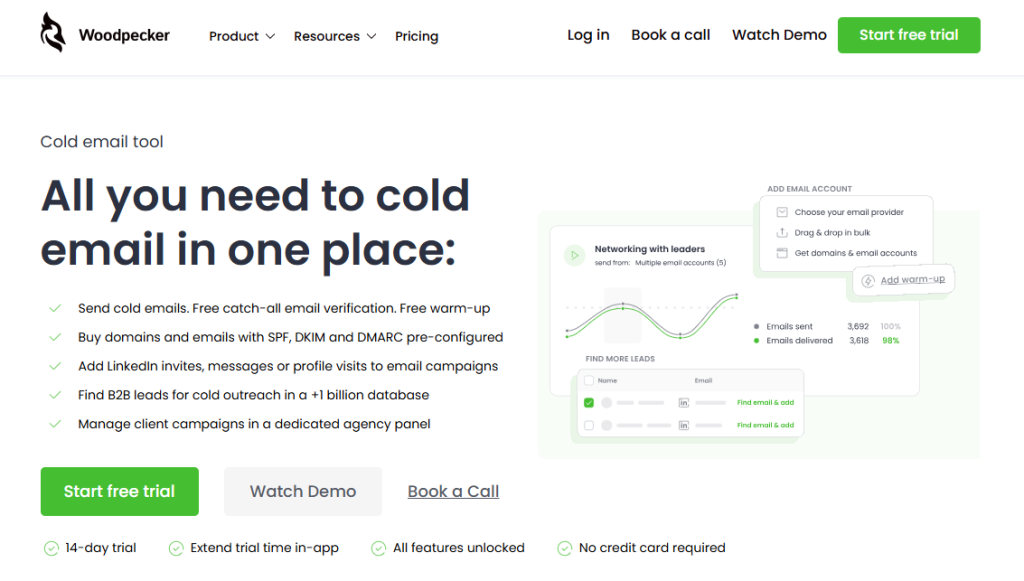
Most email tools support some version of spintax. The difference is in how it’s implemented and how much control you get.
Woodpecker handles spintax natively using the standard {option1|option2|option3} syntax. You write the spintax directly in your email template – no separate editor, no awkward UI for managing variations. When you send, Woodpecker picks one option per braces group per recipient, and you can preview a specific recipient’s actual rendered email before sending to check that the spin didn’t produce anything awkward.
A few things that matter specifically for deliverability-focused outbound:
Nesting is supported. You can spin within a spin, which allows more complex variations when you need them. Most teams don’t need this, but having it available means you’re not constrained when you do.
Spintax works alongside real personalization. Merge fields, conditional logic, and spin tags coexist in the same template. This matters because the best cold email combines genuine personalization (specific observations about the prospect) with template-level spintax (for the parts that are genuinely shared across recipients). Moreover, you can also personalize outreach at scale.
Preview before you send. You can preview the rendered email for specific prospects, which catches spin errors – grammatical agreement issues, wrong tone options, bad merge – before they go out. This sounds basic. A lot of teams don’t do it, and it’s where most embarrassing spintax mistakes come from.
Auto-stop on reply. If a spintaxed email gets a response, the sequence stops – the rest of the sequence doesn’t send. Obvious. Still surprisingly frequently missed by teams running manual campaigns in other tools.
If you’re running outbound at any real volume, the email platform layer is doing a lot of work that’s invisible when it works right – and costly when it doesn’t.
Sign up to Woodpecker and run your first sequence with spintax properly handled alongside deliverability, sequencing, and reply management.
FAQ
What is spintax in simple terms?
Spintax is a way to write one email template that produces multiple actual emails when sent. You use curly braces with options separated by pipes – {Hi|Hello|Hey} – and the email tool picks one option per braces for each recipient. The point is to make your emails look less identical across a list, which helps with spam filters and overall deliverability.
Does spintax actually improve cold email deliverability?
Modestly, when used correctly. Spintax reduces the content similarity across mass-sent emails, which is one signal inbox providers use to identify mass campaigns. The improvement is typically in the 3–8% range for inbox placement on campaigns that weren’t already heavily personalized. It’s not a miracle fix – authentication, warmup, and sender reputation matter more – but at the margin, spintax helps.
What’s the difference between spintax and personalization?
Spintax varies the same template across recipients using pre-written options. Personalization means writing specific content for the specific recipient – referencing their actual company, role, or recent work. Spintax is automation-friendly but shallow; personalization is labor-intensive but deep. The best outbound combines both: personalized openers plus spintax through the templated sections.
Can spintax hurt my cold email?
Yes, in two ways. First, badly constructed spintax produces awkward sentences that prospects notice and respond to negatively. Second, heavy-handed spintax – spinning every other word – can actually be pattern-matched by modern spam filters as a signal of mass-generated content. The fix is to spin at phrase level, keep options short and appropriate, and always preview before sending.
Is spintax the same as email spinning?
Basically yes – “spintax” is short for “spinning syntax,” and the technique comes from SEO content spinning in the 2000s. In the cold email context, spintax typically refers specifically to the {option1|option2|option3} syntax used in outbound tools.
What tools support spintax?
Most established cold email platforms support spintax, typically using the standard {option1|option2} syntax. The implementation varies – some tools handle nesting, merge-field integration, and preview better than others. If you’re evaluating a platform, test that spintax works alongside your merge fields, that you can preview rendered emails before sending, and that sequences auto-stop on reply.
How many spintax variations should I include per section?
Two to four per braces group is usually the right range. Fewer than two defeats the point; more than four rarely adds meaningful variation and increases the chance of shipping one weak option. Focus on quality – every option should be one you’d ship on its own – rather than maximizing count.
Is spintax detectable by spam filters?
Not directly – spam filters don’t look for curly braces in the final email, because by the time the email is sent, the spintax has been resolved into one specific option. What they can detect is the pattern that heavy spintax produces: emails with unusual word frequency distributions, stilted phrasing, or structural similarity that indicates templating. Well-written spintax avoids these patterns; poorly-written spintax falls into them.
Should I use spintax for every cold email campaign?
No. Spintax is most useful for mid-to-high-volume outreach where emails are necessarily templated at some level. For low-volume, high-touch campaigns where each email is individually crafted, spintax adds complexity without real payoff. Match the tool to the job.
Can I combine spintax with AI-generated personalization?
Yes, and this is a common pattern in 2026. Use AI to generate genuinely unique openers – specific to each prospect – and use spintax through the rest of the email to handle the templated sections. The combination produces emails that are both deeply personalized at the top and safely varied through the body, without the cost of full AI generation for every message.