


With so many sales tools in the market, it’s natural to get choice paralysis and feel stuck choosing the perfect sales tech stack. Apollo promises to lift the weight off your shoulders, giving you access to everything a sales team may need to go from cold leads to closed won deals.
But this can make you wonder if Apollo is a jack of all trades, and a master of none, rightfully so. Today we take a look at Apollo: what it does well and where it could perform better.
What is Apollo.io and who is it for?
Apollo.io is a sales engagement and data platform that helps B2B teams find contacts, build prospect lists, and reach out through email and calls. It combines a large database of companies and decision makers with tools for outreach, enrichment, and reporting.

It is used by sales reps, marketing teams, and revenue operations teams that need reliable contact data and a single workspace to manage outbound activity. It also fits small and mid sized B2B companies that want a more organized approach to prospecting and lead generation.
Top features include:
- Large contact database: access to a broad set of B2B profiles with verified emails and phone numbers.
- Advanced search filters: segment contacts by industry, role, seniority, company size, and other firmographic details.
- Email and call sequences: create outreach steps that run automatically with scheduled follow ups.
- Data enrichment: update or complete missing fields in your CRM to keep lead information accurate.
- Integrations with major CRMs: sync contact data, sequence activity, and task updates directly into tools like HubSpot or Salesforce.
- Engagement and performance analytics: track opens, replies, connected calls, and meeting conversions to understand what is working.
Apollo.io reviews: the good sides
Apollo can be a capable choice for your sales outreach efforts, and there are plenty of customers who are happy with this sales intelligence platform. Here are some of the high points of Apollo.
The support team is pretty good
As we’ll discuss in a minute, this sales platform is really powerful and comes with multiple tools and features. You might get stuck figuring them out, which is when the customer support comes in. According to user reviews, this is one of the highlights of Apollo.
“I have contacted Apollo’s customer support two or three times, and each time my questions have been answered within an hour. This level of efficiency has made it much easier to incorporate Apollo into my daily workflow.” – Source
The search filtering capabilities are solid
On top of the basic search filters, Apollo lets you refine your prospecting efforts by company size, location, technology usage, and other criteria. This helps you get intent signals and capture leads that are ready to purchase.
“The search filters and enrichment are strong, which saves a lot of time when targeting specific industries or roles. Sequences are straightforward to set up, and the analytics give good visibility into what’s working. It’s also relatively easy to implement, and the feature set is deeper than most competitors at a similar price point. Frequent updates and a wide range of integrations make it flexible to fit into existing workflows.” – Source
The feature set is excellent
Apollo’s features are a blessing and a curse. For sales and revenue teams, there is little you cannot do in terms of engagement strategies or deal management. All the features in one place make for a comprehensive suite that you would usually have to pay for in multiple tools.
“Considering the breadth involved, Apollo’s data is very impressive. The data oriented processes are easy to use, and covers SMB and mid-market much better than its peers. The overall suite has broad capability, implementation is easy, and it integrates with many lead point solutions. Apollo’s dev team aggressively pushes new features; if you have heard of a functionality and Apollo doesn’t have it, it probably will soon.” – Source
Apollo.io reviews: the bad sides
There aren’t many downsides to Apollo, but the negative feedback that comes in revolves around the same handful of issues. Here is what you should be aware of.
The data accuracy isn’t the best
Your entire sales process is based on good data quality. Apollo comes with its own lead database where sales reps can pull emails, phone numbers, intent data and relevant company information for outreach efforts. This is one of Apollo’s key features and apparently, it’s not that good.
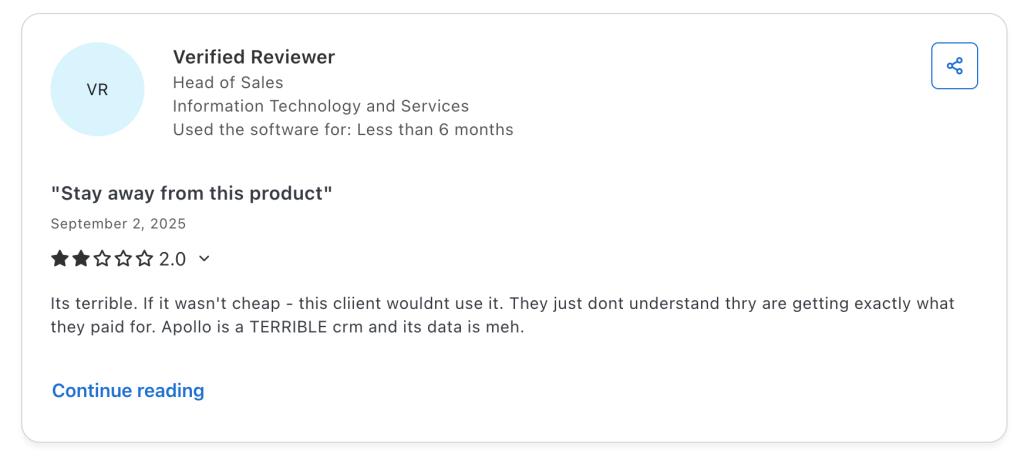
Many users state that they would appreciate having more accurate contact data.
“The data accuracy can sometimes vary depending on the industry or geographic region. There are instances where email or phone numbers need to be manually verified. It’s not a major drawback, but it does require periodic double-checking.” – Source
It seems that the situation is worse the smaller you go with the companies you reach out to:
“While Apollo.io is an excellent all-in-one prospecting and engagement platform, one drawback is that the interface can feel slightly cluttered due to the numerous features it incorporates. It sometimes takes a bit of time to find specific tools or filters. Additionally, some contact data, especially for smaller companies, can be outdated or incomplete.” – Source
“Some data—especially phone numbers—can be inaccurate or outdated, depending on the industry or region. Email deliverability is generally good, but occasionally bounce rates spike.” – Source
If you don’t want to use the database, you’ll be forced to use your own lead generation methods, which kind of defeats the purpose of using Apollo’s sales tools. However, if your own data is fairly accurate, you’ll bump into another issue.
And it gets worse:
“2. The information is incorrect. It’s wrong more often than not. When we look up our own company, it’s missing most of our senior leadership. This isn’t worth the money to get such bad information.” – Source
The user interface can be cluttered and hard to navigate
Having poor UI/UX definitely won’t hold back your sales efforts. However, the issue is not the design. Apollo is a powerful sales automation tool that comes packed with valuable features. The more features there are, the more complex the onboarding. Apollo can have a steep learning curve, especially if your sales team is inexperienced.
As users state:
“There’s also a learning curve because there are so many features. Reporting is fine but could offer more customization. Daily email-sending limits on certain plans feel restrictive for high-volume outreach.” – Source
“Some more advanced functions require a bit of a learning curve, and the interface could be more intuitive in certain automation modules. Other than that, the support is excellent and the system is constantly updated.” – Source
You may be interested in our Lemlist vs. Apollo comparison too.
The pricing isn’t the best
When it comes to sales engagement, Apollo is one of the more reasonably priced tools, but it can still be too expensive for your team. It’s not the Apollo pricing itself, but the credit system that is the issue. Here is what the pricing looks like:
- Free plan: 1,200 credits
- Basic plan: $49 per user per month for 30,000 credits per year
- Professional plan: $79 per user per month for 48,000 credits per year
- Organization plan: $119 per user per month for 72,000 credits per year
This seems affordable until you look at how the credit system works:
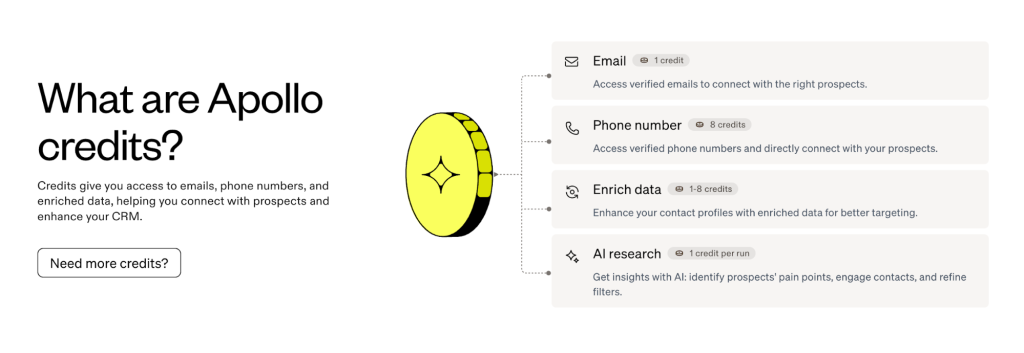
One email address is one credit, and a phone number is eight credits. To get the basic information on a lead, you’ll need nine credits. All of a sudden, the generous free plan doesn’t seem all that generous.
So, you get the Basic plan with 30,000 credits, which translates to about 3,333 leads per year or 277 per month. For most sales teams, this is not going to be enough. The numbers above are provided that you don’t use credits for anything else, such as data enrichment or AI research.
If you want to get more leads for sales outreach, you have to purchase additional credits:
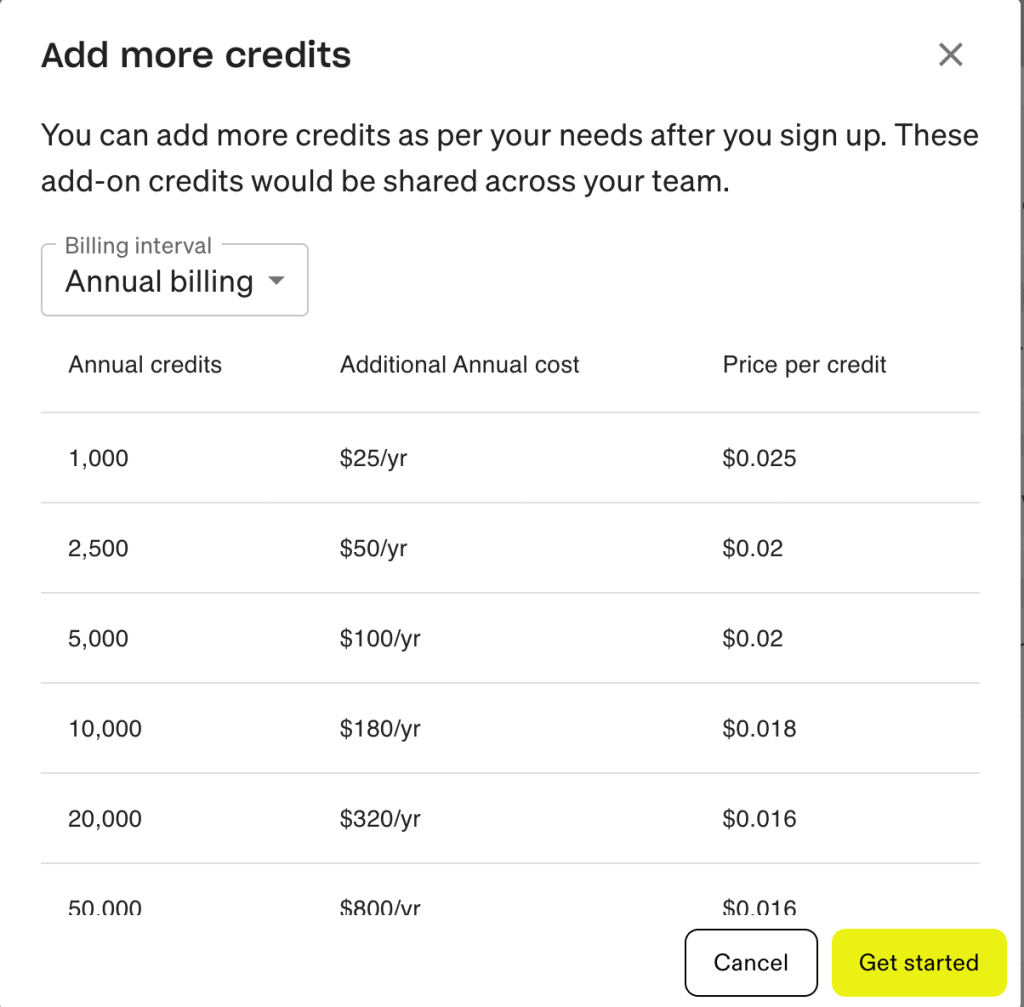
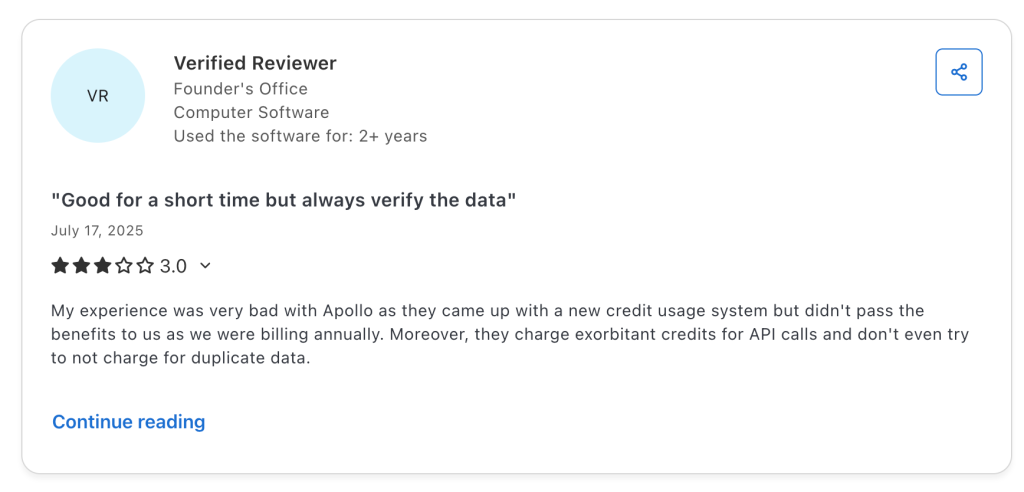
In other words, it can get very expensive, very fast, if you don’t have your own lead data and rely on Apollo to get you those sales leads. And the worst part is that the leads you’re paying for may not have accurate or up to date data, which affects your sales performance.
Should you get Apollo for your sales team?
Apollo has a lot of good things going for it. The customer support is great, it comes with advanced search filters and many features that make it easy to go from no leads to closed deals in one tool. However, there are plenty of concerns too. Apollo’s data quality is far from stellar, the credit system can have you spending a fortune and the features can be overwhelming for beginners.
But what if you just need a cold email tool instead?
When Apollo fails, you can count on Woodpecker. We’re built for hyper-personalized outreach campaigns that deliver real results.
Woodpecker combines email sequences, smart triggers, verification, deliverability features and more to give your sales operations a boost with emails that reach the primary inbox.