


Working on the Woodpecker team gives me a front‑row seat to the evolution of outbound tools.
In this piece I’ll discuss Manyreach, a cold emailing platform that uses a credit based pricing model rather than traditional monthly subscriptions.
I’ll walk through the various packs, including a free trial, and share my impressions as someone who helps design a competing tool.
Finally, I’ll explain why I think Woodpecker still delivers better value for most teams.
Pay as you go
Manyreach’s main promise is “pay once, use forever.” Instead of monthly subscriptions you buy a bundle of credits.
Each credit equates to one campaign email, and ten warm‑up emails count as one credit. Credits never expire, and there is no hidden fee.
This pay as you go model has two benefits: you know exactly how many messages you can send, and you avoid paying for months when you don’t run campaigns.
A starter pack of 250 credits is completely free. From there prices step up: 10,000 credits cost $99, 100,000 credits cost $199 (around $0.0019 per credit. A promotional pack of 300,000 credits is $299 instead of $399, making it roughly $0.0009 per credit. Larger packs of 600,000 and 1,000,000 credits are priced at $599 and $999 respectively.
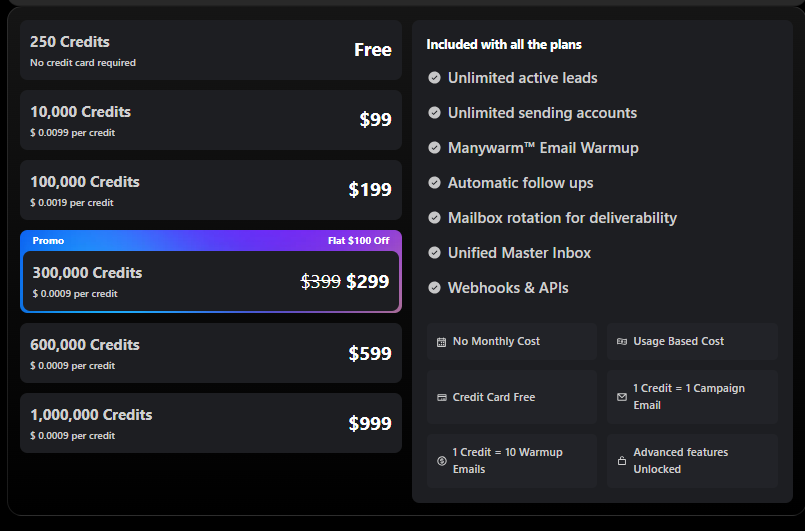
Each purchase unlocks the same feature set, so you don’t have to compare tiers. I like the transparency here as there are no complicated upsells, and you can scale your usage gradually.
For small businesses sending a few thousand messages, the $99 or $199 packs may last several months.
In addition to one‑time packs, Manyreach occasionally runs limited promotions.
At the time of writing they advertised a Black Friday deal starting at $249 for a one‑time payment with sending credits every month.

Another promotion called “Birthday” includes one‑time deals: Birthday 10K (10,000 emails per month) for $249, Birthday 100K (100,000 emails per month) for $399, and Birthday 300K (300,000 emails per month) for $949.
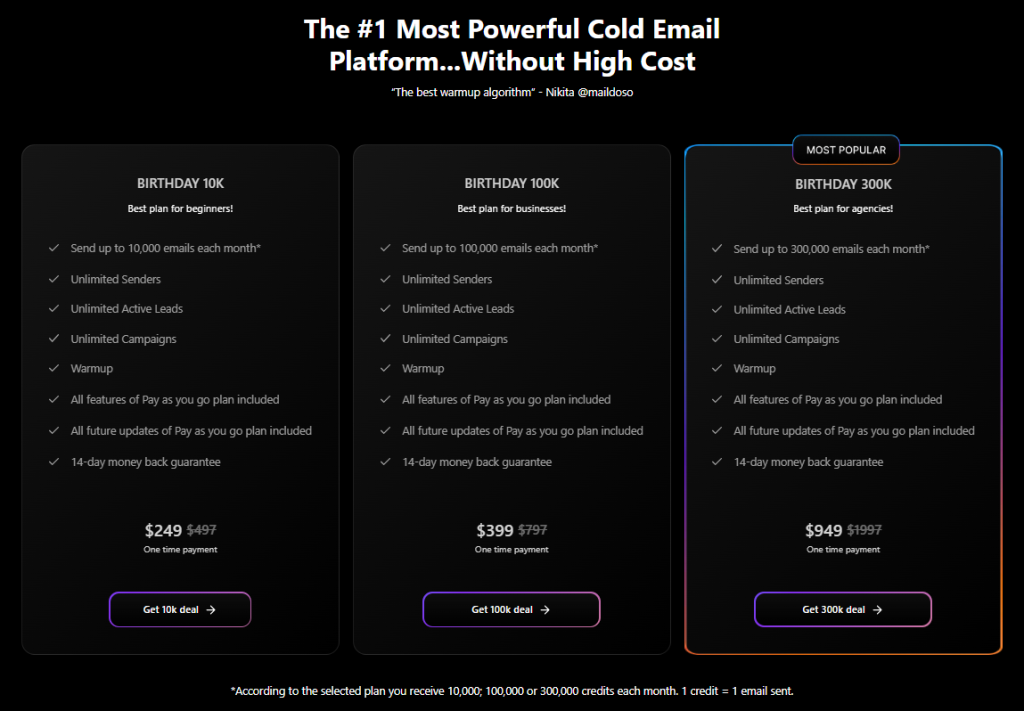
These bundles grant unlimited senders, unlimited active leads, unlimited campaigns, warm‑up and future updates of the pay‑as‑you‑go plan.
All offers include a 14‑day money‑back guarantee. The deals remind me of a growth plan disguised as a party: you pay once and get a big bank of credits plus continued updates.
Pricing plans
Every Manyreach package, whether free or paid, comes with a consistent set of features included.
These include:
- unlimited active leads,
- unlimited sending accounts,
- Manywarm email warm‑up,
- automatic follow‑ups,
- mailbox rotation,
- a unified inbox,
- APIs,
- CRM & conditional sequences,
- reply detection,
- AZ testing,
- global block list,
- advanced workflows for conditional workflows,
- open and link tracking,
- bounce shield,
- and detailed campaign analytics.
Time‑zone scheduling and reply rescheduling are built in, helping you time messages for when prospects are likely to read them.
On the sending side, you can set daily limits, build signatures, connect any SMTP or IMAP, and control sending intervals.
There are also custom tracking domains and webhooks for developers. The fact that you get advanced features even at the lowest credit tier is a selling point; you don’t have to upgrade to access deeper functions.
Because Manyreach doesn’t have monthly plans, you’ll need to decide how many credits to buy. They help with this by providing a pricing calculator.
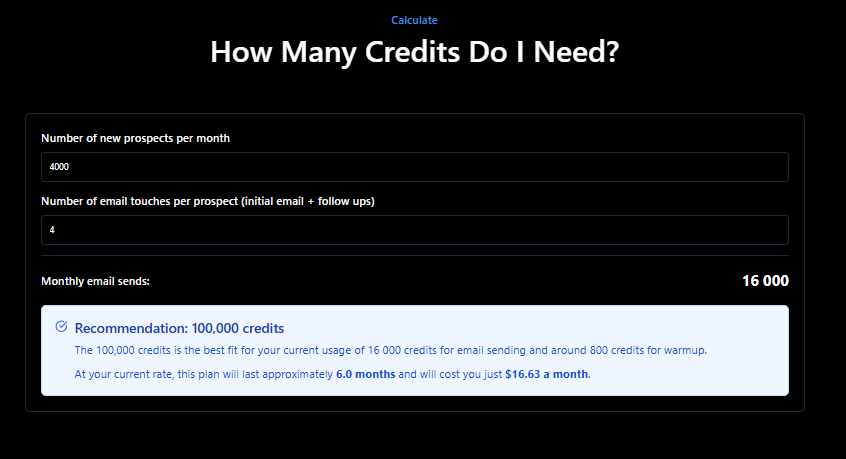
For example, if you plan to contact 4,000 new prospects per month and send four touches each (one initial plus three follow‑ups), you will send 16,000 emails monthly.
The calculator then recommends the 100,000 credit pack, which would last about six months and average $16.63 per month.
This tool gives key insights into your predicted spending. You can adjust the number of touches or prospects to see how different volumes affect credit usage.
I appreciate this transparent estimate, as it helps potential buyers decide which pack is the most cost effective solution for their volume.
Free trial
For those not ready to invest, Manyreach has a free trial that grants 250 credits.
You can explore all features and send test campaigns without entering a credit card.
This free plan behaves like an extended trial since you get full access to the tool and can run small campaigns.
The company emphasises that you also get unlimited warm‑up if you activate Power Mode (likely a paid add‑on).
If you need more than 250 credits, you have to buy a pack.
The free plan is handy for exploring the dashboard, seeing how the warm‑up works and testing personalized email templates before investing.
For someone new to outbound, the ability to send a couple of hundred emails and monitor deliverability provides a safe experiment.
Cold emailing platform
The Manyreach dashboard is positioned as an all‑in‑one tool for cold email campaigns. Under the hood it functions like email marketing software built specifically for outbound.
You can run multi‑sequence outreach, manage a unified inbox, warm up new accounts, and track performance. The credits you buy let you send to unlimited prospects and unlimited leads – you are never charged based on contacts.
Manyreach states that you can upload as many leads as you want and that the system becomes your master database.
This is appealing for sales teams that handle large lists. There is also no limit on senders: you can connect unlimited email accounts and rotate between them to maximize deliverability.
This feature is helpful for cold outreach campaigns because it keeps your sending volume spread across addresses, which in turn helps protect your sender reputation.
Another strength is that you can connect unlimited mailboxes across multiple domains and still use the same set of credits.
The platform describes this as unlimited mailbox connections, and it is part of the value Manyreach presents to customers who have many brands or clients.
You can also create unlimited workspaces for different teams or projects. During initial setup, you link your Google or Microsoft accounts and then you’re ready to send.
If you need to integrate with external services, Manyreach supports pabbly connect, Zapier, Make and other tools. These connectors help you sync leads, update CRM records and trigger notifications.
Natural email warmup process
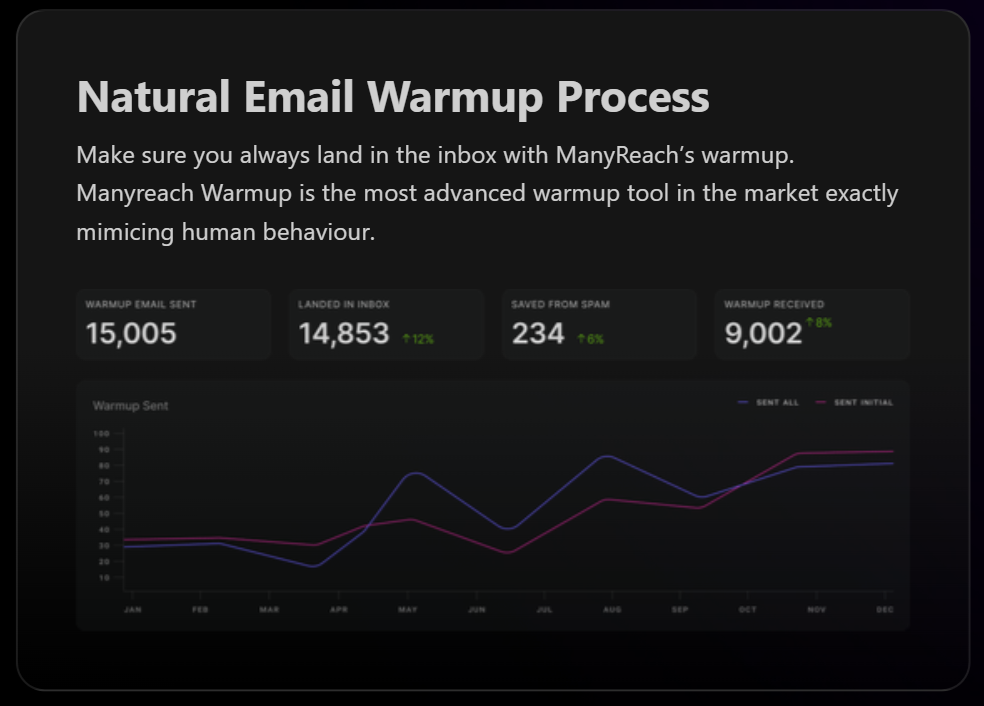
Deliverability is a big concern in outbound. Manyreach includes a warmup system called Manywarm.
It runs a natural email warmup process by sending and receiving small volumes of messages between participating accounts.
According to the FAQ on their website, you need credits on a pay‑as‑you‑go plan to run warm‑ups (10 warm‑up messages equal one credit).
There is an optional Power Mode add‑on that gives you unlimited warm‑ups.
The platform emphasises that its warm‑up algorithm mimics human behavior with random delays, rotating IPs, mailbox rotation, spintax, time‑zone matching and auto‑volume adjustments.
These techniques aim to make emails land in the primary inbox instead of spam.
Manyreach claims this advanced warmup tool is part of every plan and helps maintain premium deliverability for your domain.
In my view, it’s good that the warm‑up is integrated rather than an expensive add‑on, though you still spend credits or pay extra for unlimited use.
Lead generation
Manyreach includes features to support lead generation and manage leads once they are in your system.
You can upload unlimited contacts and use the platform as a central database.
The CRM functionality is basic but supports CRM integrations and conditional logic. You can label leads, set statuses and automatically move them through stages based on responses.
There is also an unified inbox that gathers replies across all accounts, with an activity feed, templated replies and AI reply categorization. This makes it easier to track conversations with prospects.
Manyreach’s API and webhooks can sync data with external systems, which helps keep your sales stack up to date.
Overall, while the CRM component may not replace a dedicated customer database, it does enables users to manage their pipeline within the same platform.
Powerful features
Manyreach lists a long set of powerful features across the basics, campaign, and sending categories.
- Campaign sender rotation and email content rotation help keep each message fresh.
- Detailed analytics track opens, clicks, replies and bounces. You can perform A‑Z testing (similar to A/B but with more variants) and use a global block list to prevent sending to suppressed domains.
- Auto‑reply detection and rescheduling adjust follow‑ups based on out‑of‑office replies.
- The platform also has a bounce shield, time‑zone scheduling and liquid syntax for dynamic templates. These advanced analytics features would normally be reserved for enterprise tiers, but here they come with every pack.
- I find the inclusion of a powerful API and webhooks particularly important for tech‑savvy teams who want to build custom reporting or triggers.
- There are also workflow automations through Zapier and Make, enabling integration with other tools like HubSpot or Salesforce.
Additional standout features include the ability to set adjustable daily sending limits and customizable sending intervals. You can connect any SMTP or IMAP service, create a signature builder, and access detailed sender analytics for each mailbox.
These features support campaign performance tracking at a granular level. For teams using multiple domains, you can set custom tracking domains to maintain brand consistency.
The platform also includes conditional follow ups and conditional sequences, which send different emails based on replies or engagement.
All of this adds up to a comprehensive set of functions that help you run cold outreach campaigns from start to finish.
Manyreach offers
At the time of writing Manyreach is pushing a hypergrowth plan via its Birthday and Black Friday promotions.
These bundles make sense if you plan to send tens of thousands of emails each month and want to lock in a discount.
For example, the Birthday 10K deal, priced at $249, lets you send up to 10,000 emails each month with unlimited senders, unlimited campaigns and unlimited active leads.
The Birthday 100K and Birthday 300K deals scale this volume to 100,000 and 300,000 emails per month for $399 and $949 respectively.
They include free updates to the pay‑as‑you‑go plan and a money‑back guarantee. These limited‑time offers might be appealing to agencies or teams planning a large campaign run.
However, if you don’t plan to send at such high volumes, you might be better off with the standard credit packs. It’s easy to get tempted by a discount, but it only makes sense if you will use the credits.
The Manyreach FAQ clarifies some details that are often overlooked. All unused credits are swapped for a new set at the end of each month depending on your plan. This means you cannot hoard credits forever, but you also never lose them – they just reset.
The FAQ also answers whether there is a free trial. Yes, there is, and there is also a credit limit. The warm‑up system uses random delays, rotating IPs, and auto‑volume increasers to maintain sender reputation. If you have more questions, their support team can be reached via chat.
Woodpecker as a better choice
While Manyreach’s platform offers a flexible pricing model and robust feature set, it may not suit every use case.
The credit system is interesting but could be confusing for someone new to outbound.
From my perspective at Woodpecker, we focus on simplicity and predictability. We charge by the number of prospects contacted rather than credits.
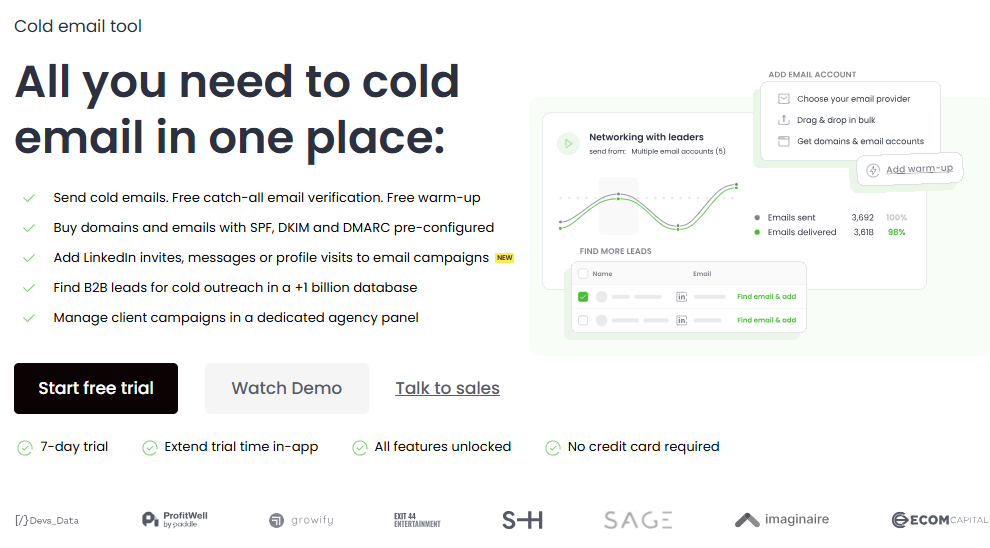
Our plans include unlimited email verification and warm‑up at no extra cost.
We also connect unlimited mailboxes without charging per address, and we do not charge per user. Every feature, from AI email crafting to advanced workflows and conditional sequences, is included in every tier.
There is a single price per prospect count, making budgeting straightforward. Our system includes domain registration with SPF, DKIM and DMARC set up, so you can start sending without a technical hassle.
For teams that need unlimited users or manage multiple clients, Woodpecker includes an agency panel with separate databases and shared templates.
We also integrate LinkedIn actions for a small fee.
In short, we aim to be a cost effective solution that scales with your business.
Manyreach has many strong points. Its warm‑up tool, manyreach’s warmup, and credit model give you fine control over spending.
But if you value a predictable bill, integrated LinkedIn outreach, and built‑in email verification, Woodpecker might be the better fit.
Our tool helps sales teams manage the entire outreach process, from sourcing leads to scheduling campaigns and measuring response rates.
We also support CRM integrations, advanced reporting and dedicated support without add‑on costs. If you plan to send a few thousand emails per month, Manyreach’s packs could work.
If you plan to grow or need unlimited team members, the all‑inclusive approach of Woodpecker will likely save you time and money.
Final thoughts
Manyreach is a clever entry into the cold email space. Its credit based pricing is refreshing in a world dominated by monthly fees. The platform’s advanced email warm up and Manyreach’s warmup features mimic human sending patterns, which helps your personalized cold emails reach the inbox.
I appreciate that the same feature set is available regardless of pack size, so you don’t need to upgrade to access deeper tools.
The ability to connect unlimited email accounts, create unlimited workspaces, and maintain a unified inbox offers flexibility for teams of various sizes. Integration with pabbly connect and a powerful API add to its versatility.
However, there are trade‑offs.
Credits reset monthly, so unused credits are swapped rather than banked. Unlimited warm‑up may require an add‑on.
Without a pre‑existing estimate, it can be hard to know how many credits you need. In my experience, first‑time users sometimes under‑ or over‑estimate their volume.
This is where a tool like Woodpecker, with monthly plans based on prospect count and advanced analytics, may feel more predictable.
Woodpecker also includes a unified inbox, unlimited leads, automatic warm‑up, and domain setup. Our focus on workflow automations, email deliverability, and integrated LinkedIn outreach helps businesses scale their outreach without juggling multiple subscriptions.
As always, the best fit depends on your preferences.
If you enjoy the flexibility of credits and have variable sending volumes, Manyreach is worth a look. If you prefer a stable bill with all features unlocked and a strong deliverability backbone, try Woodpecker for free now.