


There’s a specific feeling a prospect gets when they see the fifth “Just following up” subject line of the week. It’s not annoyance exactly – it’s more like a low-grade dismissal. The email gets ignored before it’s even opened, not because the content is bad but because the subject line signals “this is a template” before the message has a chance to say anything.
Follow-up subject lines are a specific subcategory of email copy that gets treated carelessly even by people who spend real time on their initial outreach. The first email gets thoughtful subject lines. The follow-ups default to “Quick follow-up” or “Re: Our conversation” because the rep is tired and the template library is empty. Response rates on follow-ups suffer for reasons that are mostly solvable.
This guide covers what makes a follow-up subject line actually open, the threading-vs-fresh-subject decision that most guides skip, 40+ tested examples grouped by scenario, the most common mistakes, and how Woodpecker handles subject-line variation across sequences at volume.
What makes a follow-up subject line open in 2026
Three factors consistently separate subject lines that get opened from ones that don’t.
Specificity earns the open. “Quick follow-up” tells the recipient nothing. “Next steps on the Q3 integration” tells them exactly what the email is about. Specific subject lines consistently beat generic ones across every tested scenario, but the specificity has to be real – filler specificity (“Update regarding our discussion”) reads as templated and performs like generic.
The read of effort. Recipients process subject lines in under a second. The decision to open isn’t really about content; it’s about whether the subject reads as something worth their attention. Lines that feel like one-off human messages open better than lines that feel like automation. This is subtle but consistent in open-rate data.
Context continuity. A follow-up subject line that connects meaningfully to the original thread – through either threading or explicit reference – outperforms one that starts from scratch with no link back. Breaking thread continuity is a real cost; do it only when you have a specific reason.
The threading vs. fresh subject decision
Before looking at subject line examples, a strategic decision most teams never think about: do you thread your follow-ups (keep the original subject line, creating “Re: Original subject”) or start fresh each time with a new subject line?
Both approaches work. They work for different reasons, and the choice has real implications.
When to thread (keep “Re: Original subject”)
Threading keeps the conversation grouped in the recipient’s inbox. Gmail and Outlook both group replies by thread, so your follow-up appears stacked with the original email. The recipient sees “3 emails in this thread” rather than “Jane has emailed me 3 separate times about this.”
Threading reinforces context without extra work. The recipient doesn’t have to remember what the original conversation was about – the thread is right there.
Threading is the default expectation for real professional correspondence. When people respond to emails they care about, they reply in-thread. Breaking threads signals “this is outreach, not conversation.”
Use threading when: your first email got opens but no reply, you want to build on the existing context, and you’re working with a targeted list where the original relevance still applies.
When to start fresh (new subject line)
Fresh subjects break the pattern for prospects who ignored earlier emails. If someone hasn’t opened any email in the thread, a new subject line gives you a second shot at getting opened.
Fresh subjects can test different angles. The first subject didn’t work – maybe a different angle resonates. Different pain point, different framing, different specificity.
Fresh subjects matter when earlier emails may have been filtered. If the original email landed in spam, every “Re:” follow-up lands there too. A fresh subject breaks that cycle.
Use a fresh subject when: the first email got no opens after 5-7 days, you want to test a genuinely different angle, or you have reason to suspect deliverability issues with the original thread.
The hybrid approach that works in 2026
Most high-performing sequences use both patterns strategically. Threads 1 and 2 stay in the original thread (building context, assuming the prospect is considering). Thread 3 tries a completely new subject with a different angle (resetting for prospects who never opened). The breakup email goes back to the thread (final reference to the original conversation).
This isn’t a rule – it’s a pattern that performs consistently when tested. The key point is that the threading decision is intentional, not default.
This may interest you: How to send a follow-up email after no response
Follow-up subject lines for cold outreach
The hardest context. The recipient doesn’t know you, didn’t open or engage with previous emails, and is being asked to give you another chance. Specificity and novelty matter disproportionately here.
Follow-up #2 (second attempt, thread kept)
When threading, your “Re:” follow-up is stacking under the original subject. No new subject line needed – the thread is the context.
Follow-up #3 (third attempt, fresh subject testing new angle)
The prospect hasn’t opened. Time for a different door. These subject lines offer a genuinely different value or framing than the original.
- Your [specific recent thing] – question
- [Company name] + [specific angle] – worth a look?
- Question for [their role at Company]
- 15 minutes – [specific benefit]
- Different angle on [original topic]
- [Their recent activity] – thoughts?
The template these fill in should mirror the specificity. “Your Q3 roadmap announcement – question” works because it points to something real. “Your recent announcement – question” doesn’t work because it doesn’t point anywhere specific.
Follow-up #4 (reset with social proof or insight)
By email 4 in a cold sequence, adding external credibility to the subject can shift open rates. These work when the content genuinely delivers on what the subject promises.
- How [similar company] solved [specific problem]
- [Relevant data point] – [Company] context
- What we learned working with [similar company]
- 3 patterns we see with [their company type]
- One idea for [specific challenge they likely face]
For the underlying frame on how to make cold outreach actually convert, personalized cold emails covers what the body of these emails needs to do to match the subject line.
Breakup email (sequence final)
Breakup subject lines are counterintuitively high-performing because they signal release of pressure. The psychology: readers who ignored earlier emails often respond to the final one because replying closes the loop.
- Closing the loop
- Should I go or stay?
- Permission to close this out
- Last one from me
- OK to archive this?
- Wrong person at [Company]?
The “wrong person” variant is particularly effective because it offers the recipient an easy, face-saving way to redirect you to the correct contact – which is often exactly what they needed to do.
Follow-up subject lines after a meeting or call
Different context entirely. The recipient knows you, just met with you, and the follow-up is relationship-building rather than relationship-starting. Specificity should reference the conversation; the register is warmer.
Immediately after the meeting (same day or next day)
- Great talking today – next steps
- Notes from our conversation
- [Specific topic we discussed] – follow-up
- As promised – [specific thing they asked for]
- [Date] meeting – action items
- Quick recap + next steps
Following up when they owe you something
- Checking on [specific thing they were going to send]
- [Specific deliverable] – any updates?
- [Topic] follow-up
- Gentle nudge on [specific item]
The “gentle nudge” works surprisingly well because it’s honest about what the email is doing, which many professional readers appreciate.
Reigniting a stalled conversation
- Picking this back up
- [Topic] – any movement?
- Still interested in [specific thing]?
- Revisiting [topic]
Long gap (weeks or months)
- Reconnecting on [topic]
- [Mutual context] – thought of you
- Back on this
Read more on what these emails should contain:
Follow-up subject lines for job applications and interviews
High-stakes context. The recipient knows what the email is about; the subject line should reinforce continuity and momentum without being pushy.
After submitting an application
- Application for [specific role] – [your name]
- Following up: [role] application
- [Role] application – quick check-in
After an interview
- Thank you – [specific role] interview
- Following up on [date] interview
- [Specific topic from interview] – additional thoughts
- [Specific question they asked] – further context
The last two are underused. Referencing a specific moment from the interview in the subject line reinforces that you were paying attention and have something substantive to add.
When you haven’t heard back
- Checking on [role] – still under consideration?
- [Role] application – any update?
- Quick follow-up on [role]
Avoid “Still waiting” or anything that sounds impatient. The phrasing should be neutral and brief.
And if you host interviews, read our guide on follow-up email after interview. It covers what the email itself should contain.
Or read:
- How (and why) to write a follow-up email after an in-person meeting
- Follow-up email after phone call
Follow-up subject lines for sales proposals and deals
The recipient has engaged; the email is moving something toward a decision. The subject line should maintain deal momentum without applying pressure.
After sending a proposal
- [Company] proposal – questions?
- Proposal follow-up
- [Specific proposal name] – next steps
- Worth a quick call on the proposal?
When the deal has gone quiet
- [Specific deal] – still on track?
- Checking in on [project]
- Any blockers I can help with?
- [Contract/agreement] – thoughts?
The “blockers” framing works because it positions you as a problem-solver rather than a nudger.
When you need a decision
- Quick decision needed: [specific thing]
- [Date] – looking to confirm
- Closing the loop: [specific deal]
These work when there’s legitimate urgency. They don’t work when you’re manufacturing urgency – recipients can tell, and it damages trust.
Interested in preparing the best sales follow-up email? Or why your follow-up is getting ignored? Our guide common reasons these sequences fail.
Follow-up subject lines for inbound leads and existing conversations
The prospect came to you or engaged first. The follow-up is maintaining the conversation they started. Different register than cold – warmer, less work required to re-establish context.
After they requested information
- Your [specific thing they requested]
- Following up on your request
- [Specific topic] – info attached
After a free trial or demo
- Your [product] trial – how’s it going?
- Post-demo follow-up
- Questions after the demo?
Re-engaging a warm lead that went cold
- Thought of you – [specific reason]
- [Original topic] – picking this back up?
- Quick check-in
The “thought of you” variant works when you have a genuine reason to write – new feature release, relevant insight, shared connection surfacing. Without a real reason, it reads as manufactured.
Common follow-up subject line mistakes
Patterns that show up across failing sequences. Each one has a specific fix.
“Just following up”
The single most overused phrase in professional email. It tells the reader nothing, signals zero effort, and has become so common it’s essentially invisible. Open rates on “Just following up” consistently underperform almost every alternative.
Fix: Replace with anything that references the actual content. “Quick question on [topic]” or “Checking on [specific thing]” or “Any thoughts on [specific thing]?” – any of these outperforms generic “following up.”
“Circle back,” “touch base,” “loop in”
Corporate filler language that’s become clichéd. The words communicate nothing specific and signal a template rather than a thoughtful email.
Fix: State the actual content. “Following up on [specific thing]” or just the specific topic itself.
Using “Urgent” or “Important” when it isn’t
Inbox providers have learned to demote subject lines with false urgency signals. Worse, recipients have learned to ignore them. “Urgent” on an email that isn’t urgent trains the reader to mistrust your future subject lines.
Fix: Use urgency markers only when they’re genuine. When the message has a real deadline, name the deadline specifically: “Contract by Friday?” rather than “Urgent: contract.”
Starting a new subject line every time
Breaking thread continuity for no reason makes the conversation feel disjointed. The recipient loses context; your emails look like fresh pitches rather than continuation of a dialogue.
Fix: Default to threading on emails 1, 2, and 5 (breakup). Use fresh subject lines only when testing a different angle or when deliverability problems are suspected.
Over-specific subject lines that read as tracking
“Follow-up after you viewed our pricing page on Tuesday at 2:47pm” is technically specific but reads as surveillance. Specificity should feel natural, not tracked.
Fix: Reference observable or shared context, not data you pulled from analytics tools. “After our conversation on Tuesday” works; “after you downloaded our whitepaper” feels creepy.
Asking questions that can’t be answered from the subject alone
“What do you think?” or “Can you help?” as subject lines force the recipient to open to even understand what the question is. This works sometimes as a curiosity hook; more often it just feels like clickbait.
Fix: If you’re asking a question in the subject line, make sure the question itself contains enough content to stand alone: “What do you think about the Q3 timeline?” or “Can you help with the handoff to Legal?”
The [Mutual contact] name-drop for no reason
Subject lines like “John Smith suggested I reach out” only work when it’s true and when the mutual contact is a real value-add to the conversation. When the name-drop is tangential, it reads as manipulation.
Fix: Use mutual contact references only when the connection genuinely matters and the recipient would recognize the name as relevant.
How Woodpecker handles follow-up subject line variation at volume
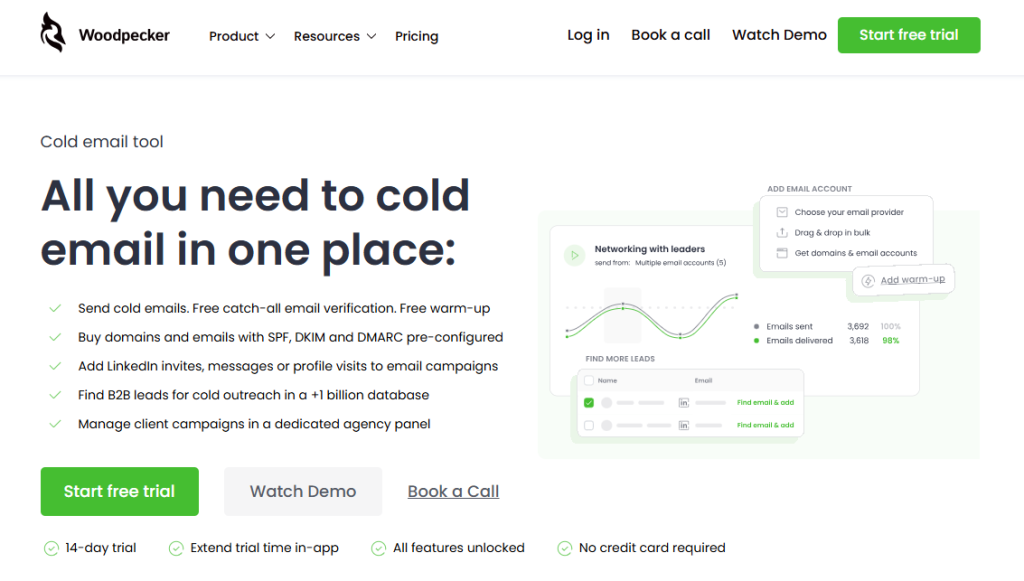
The subject-line patterns above work for one-off sequences. The challenge at volume – running sequences against hundreds or thousands of prospects – is different. Different prospects need different subject lines. Threads need to stay coordinated. Deliverability needs to hold as content similarity accumulates.
Here’s what Woodpecker handles natively for subject-line execution across sequences:
Spintax for subject-line variation. Woodpecker supports native spintax – syntax like {Quick question|Question about|Curious about} – so each prospect in a sequence sees a slightly different subject line variant. This reduces pattern-matching by spam filters and keeps content similarity low across large campaigns.
Merge fields for personalized subjects. Subject lines can pull dynamic data – {{company}}, {{firstname}}, custom fields – so subject specificity scales. “Question about {{company}}’s {{industry}}” becomes unique per prospect without manual work.
Conditional sequence logic. Different follow-up subjects based on whether earlier emails were opened. If email 1 wasn’t opened, email 2 can use a fresh subject testing a new angle. If email 1 was opened but not replied to, email 2 threads to maintain context. The if/then branching handles this automatically.
Auto-stop on reply. When a prospect replies to any email in the sequence, subsequent emails don’t send – regardless of subject line. This matters because the worst subject line in the world is the one you send after the prospect already responded.
AI-based reply detection. Replies are automatically classified (positive interest, negative, out-of-office, question) and routed appropriately, so your subject line work for follow-ups focuses on prospects who haven’t engaged – not prospects who already did.
Deliverability infrastructure. Adaptive Sending, Deliverability, free catch-all email verification, and free email warmup via partnerships with Warmy and Mailivery all work alongside subject-line optimization to keep emails reaching the primary inbox where subject lines actually get a chance to work.
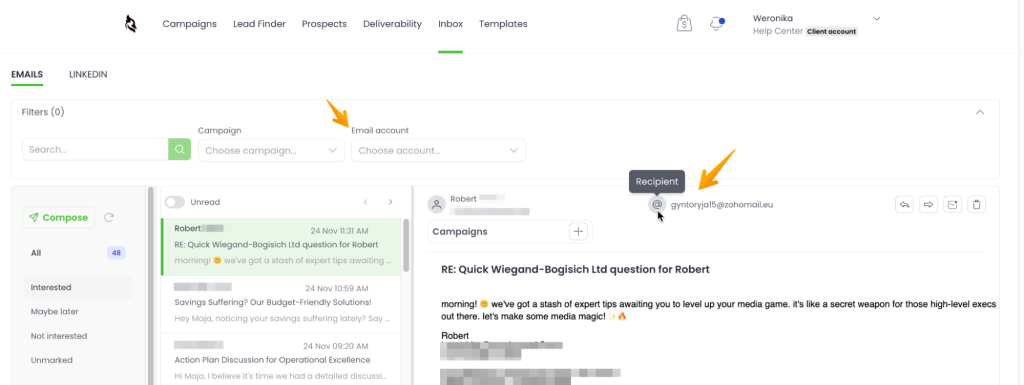
What Woodpecker doesn’t do on the subject-line side: generate full subject lines from scratch via native AI copywriting. The subject lines stay human-written; Woodpecker handles the variation, personalization, and deployment at volume.
For teams running follow-up sequences against meaningful volumes of prospects, sign up to Woodpecker to handle the sequencing and deliverability.
FAQ
What’s the best subject line for a follow-up email?
It depends on the context. For cold outreach follow-ups, specific and novel beats generic and templated – “Your [recent thing] – question” outperforms “Just following up.” For post-meeting follow-ups, reference the conversation directly: “Notes from our [date] meeting.” For breakup emails at the end of a sequence, pressure-removing subjects like “Closing the loop” or “Wrong person at [Company]?” convert surprisingly well. Generic phrases like “Just following up,” “Circle back,” and “Touch base” are the worst performers across every tested context.
Should I use “Re:” in my follow-up subject line?
Usually yes for early follow-ups (emails 2-3 in a sequence). Threading keeps the conversation grouped in the recipient’s inbox and reinforces context. Break the thread with a fresh subject only when the earlier emails weren’t opened (suggesting the original subject didn’t work) or when you’re testing a deliberately different angle. A hybrid approach – threads on emails 1, 2, and the breakup; fresh subject on emails 3-4 – works across most sequences.
How do I politely phrase a follow-up subject line?
Politeness comes from specificity and tone, not softening words. “Gentle nudge on [specific item]” works better than “Just wanted to check.” “Should we go or stay?” works better than “Apologies for the follow-up.” Readers prefer emails that are direct and brief over ones that pad with apologetic language. The best polite follow-ups acknowledge the reality (the person is busy) without making the subject line longer than it needs to be.
How many follow-up emails should I send before giving up?
4-6 emails across 3-4 weeks is the standard range for cold outreach sequences. Fewer than 3 leaves most of the potential reply rate on the table; more than 7 usually generates unsubscribes and complaints without additional replies. Always end with a breakup email – it’s one of the highest-converting emails in any sequence because it removes pressure and gives the recipient an easy path to respond or close the loop.
How does Woodpecker help with follow-up subject lines?
Woodpecker supports native spintax for subject-line variation, merge fields for per-prospect personalization, and conditional sequence logic that picks different follow-up subjects based on prior engagement (opened vs. unopened, clicked vs. not clicked). The platform handles the mechanics of running subject-line variation across hundreds or thousands of prospects without manual campaign management. Subject lines stay human-written; Woodpecker handles the variation and deployment at volume.