
Sales objections are not interruptions to the sales process. They are part of it. A buyer who raises a concern about price, timing, implementation or an existing provider is telling you what still makes the decision difficult.
Good objection handling does not mean having a clever rebuttal ready for every possible pushback. It means listening closely enough to understand what the prospect actually said, asking for context when you need it and responding to the concern without turning the conversation into an argument.
Sometimes an objection can be resolved. Sometimes it reveals that the timing is wrong or another stakeholder needs to join the conversation. And sometimes the prospect is simply saying no. A good sales rep needs to recognize all three situations instead of treating every response as something to overcome.
What is objection handling in sales?
Objection handling is the process of understanding and responding to concerns that make a buyer hesitant to continue. These concerns can appear in a cold email reply, during discovery, after a demo or while commercial terms are being discussed.
The aim is not to pressure the buyer until the objection disappears. It is to find out whether there is a real path forward. That may mean explaining something more clearly, bringing relevant proof, involving another person or agreeing that the opportunity should stop for now.
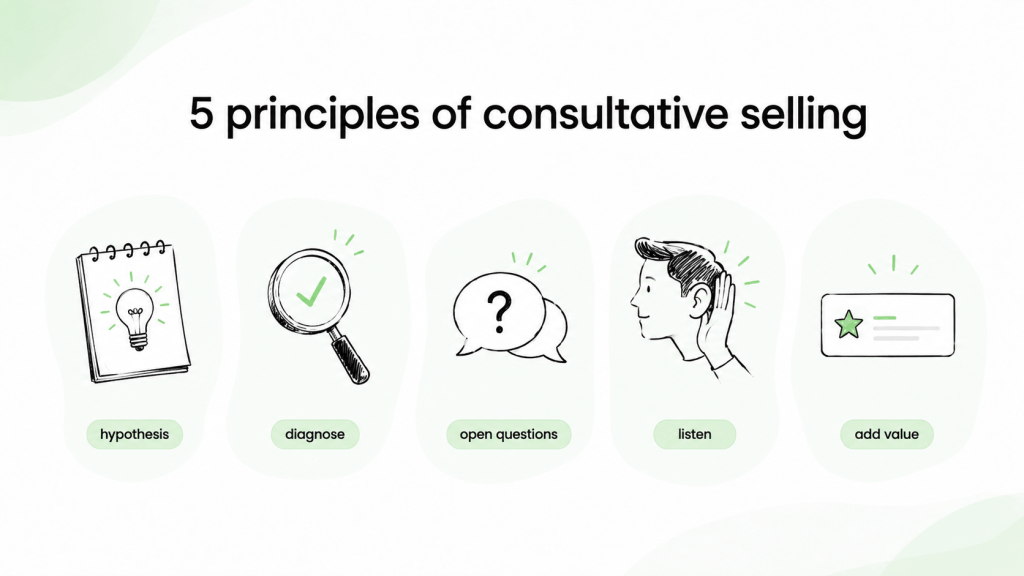
This is closely related to consultative selling. A consultative seller tries to understand the buyer’s situation before prescribing a solution, which makes objection handling less about defending the product and more about diagnosing what is holding the decision back.
First decide: is it an objection, a question or a rejection?
Salespeople sometimes label every difficult response as an objection. That creates bad habits because a buyer asking for clarification needs a different response from someone who has clearly asked you to stop contacting them.
| What you hear | What it may be | Best response |
| “How long would implementation take?” | A question | Answer it directly and check what is driving the concern |
| “This looks useful, but we do not have budget this quarter.” | An objection | Clarify whether the issue is timing, available budget or the business case |
| “Send something over.” | An ambiguous response | Ask what information would actually be useful |
| “Not a priority right now.” | A timing objection or polite decline | Ask one light clarification if appropriate, then respect the answer |
| “No thanks. Please remove me from your list.” | A clear rejection | Stop outreach |
That distinction is especially important in outbound sales because the prospect did not ask to enter a sales conversation. Woodpecker’s guide to handling negative cold email replies is useful here: repeated “not interested” responses can tell you something about targeting or positioning, but an individual prospect still has every right to end the conversation.
A simple four-step framework for handling objections
Most objections become easier to handle when you slow the conversation down. Instead of jumping straight to a defense, work through four steps: acknowledge what the buyer said, clarify anything that is still ambiguous, respond to the actual concern and agree on what happens next.
| Step | What to do | Example |
| 1. Acknowledge | Show that you heard the concern without immediately arguing against it | “That makes sense. I can see why implementation time matters here.” |
| 2. Clarify | Ask one question if you do not yet understand what sits behind the objection | “Is the bigger concern the work involved in setup or the time before the team sees value?” |
| 3. Respond | Give the smallest amount of information needed to address that concern | Share a relevant timeline, customer example or implementation detail |
| 4. Progress | Check whether the concern is resolved and decide if another step makes sense | “Does that answer the concern, or is there another part of the rollout you would want to understand first?” |
The important part is the order. A long answer given before you understand the concern often creates more resistance because the buyer feels that the salesperson is running a script instead of listening.
Ask a better question before giving a better answer
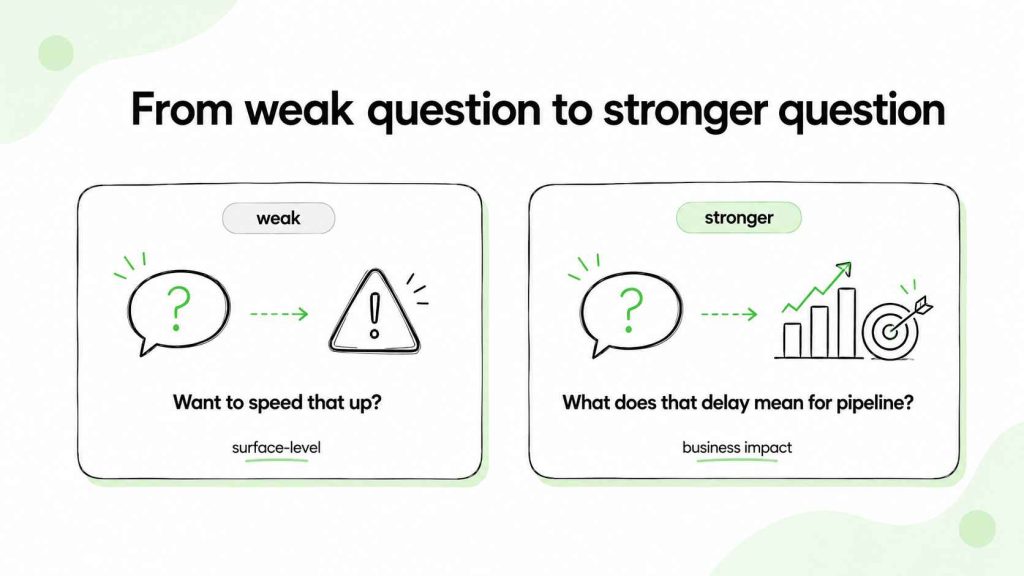
A useful clarification question should make the issue more specific. If a prospect says the product is too expensive, you do not yet know whether the problem is an unavailable budget, a weak business case, another vendor’s lower price or simply that the problem is not important enough to justify the spend.
The same principle applies during discovery. Woodpecker’s guide to discovery call questions recommends moving from surface-level questions toward business impact rather than steering the buyer toward the answer you want.
The most common B2B sales objections
Sales objections take many forms, but most fall into a small number of categories: price, need, timing, trust, authority, implementation and the status quo. The words may change from account to account, while the decision problem underneath is often familiar.
Price: “It is too expensive” or “We do not have budget”
A price objection can genuinely be about money, so do not assume the buyer is hiding another concern. Budgets are real, procurement limits exist and a company may simply be unable to spend what your solution costs.
At the same time, it is worth understanding what kind of price problem you are dealing with. A buyer who has no budget until the next financial year needs a different response from someone who has budget but cannot justify the expected return.
| Prospect says | Useful clarification |
| “It is too expensive.” | “Compared with the budget you had in mind, or compared with another option you are considering?” |
| “We do not have budget.” | “Is the budget already allocated elsewhere, or is this not a priority the team would fund at the moment?” |
| “The competitor is cheaper.” | “What are the main things you are comparing besides price?” |
Do not immediately discount. First understand what the buyer is trying to solve and what they are comparing. Woodpecker has a dedicated guide to price, feature and change objections if you need more examples around those three situations.
Need and priority: “We do not need this”
A prospect may genuinely have no need for the product, and trying to manufacture pain usually makes the conversation worse. Your job is to check whether the buyer is happy with the current situation or simply has not connected the problem you raised with something that matters to the business.
A question such as “How are you handling that today?” gives the prospect room to describe the current process. If they tell you that it works well and there is no meaningful cost or frustration attached to it, that is useful qualification data rather than a challenge to your sales skills.
Status quo: “We already use someone”
An existing provider is not automatically a reason to push harder. The buyer may have a good solution, a long contract or no reason to take on the cost of changing. Instead of launching into a comparison, find out what they value about the current setup and where, if anywhere, it falls short.
You might ask: “What is working well with the current provider, and is there anything you would change if you could?” Their answer tells you far more than a feature battle. It can also show that there is no realistic opportunity, which is equally useful.
Trust and risk: “How do we know this will work?”
Trust objections often appear when the purchase carries implementation, security or operational risk. The buyer may like the idea but need evidence that a company like theirs can adopt the solution successfully.
Respond with evidence that matches the concern. A customer example is useful when the buyer doubts the outcome. An implementation timeline is better when the concern is operational. Security documentation is more relevant than a general case study if a technical stakeholder needs to approve the product.
Authority: “I am not the decision-maker”
Do not pressure a contact to make a decision outside their role. Treat the objection as information about the buying process and ask who normally joins a decision like this, what they care about and what information would help the current contact bring them into the conversation.
This is also a qualification issue. The guide to qualifying sales leads can help you decide when a conversation has enough fit, motivation and buying context to justify more sales time.
Timing: “Not now” or “Call me later”
Timing objections deserve more than an arbitrary reminder three months from now. If the prospect is open to reconnecting, ask what is likely to change: a planning cycle, contract renewal, hiring milestone, budget reset or another project finishing.
That gives you a real reason to follow up later. If the buyer cannot identify any point when the topic may become relevant, “later” may simply be a polite way of ending the conversation, and it is better to respect that than keep a sequence running indefinitely.
Sales objection scripts for common situations
Scripts are useful as prompts, not lines to memorize. The wording should change with the prospect, channel and context, but the examples below show how to respond without immediately pushing back.
| Objection | Possible response |
| “Not interested.” | “Understood. Is that mainly because the topic is not a priority, or because the current process already works well? Either way, I will not keep nudging you.” |
| “No budget.” | “That makes sense. Is the budget already committed elsewhere, or would the team need a stronger business case before funding something in this area?” |
| “We already use another tool.” | “Good to know. What is working best with the current setup, and is there anything you would improve if you could?” |
| “Send me more information.” | “Happy to. Would it be more useful to see how it works, an example from a similar team or what implementation usually involves?” |
| “Not the right time.” | “Understood. Is there a particular project or planning point that would make the conversation more relevant later?” |
| “I need to speak to my manager.” | “Of course. What will they want to understand before deciding whether another conversation is worth having?” |
| “Implementation looks like too much work.” | “Which part worries you most: setup time, getting the team onboard or moving from the current process?” |
“Send me more information” needs a little care
This response can mean several different things. The prospect may genuinely want to review the product, they may need something to share internally or they may be trying to end the call politely without saying no directly.
Instead of sending a generic deck, narrow the request first and then send only what helps. If the person has shown genuine interest, Woodpecker’s guide to responding to an interested cold email reply is useful because it emphasizes answering the prospect’s actual question without overwhelming them with every asset you have.
Handling objections in email vs on a sales call
The same objection can require a different response depending on the channel. A live call gives you room to listen, ask follow-up questions and hear nuance in the buyer’s answer. A cold email reply usually rewards restraint because the prospect has little context and did not sign up for a long exchange.
| Cold email reply | Sales call |
| Keep the response concise | Take time to clarify the concern |
| Ask one question at most | Follow the buyer’s answer with a relevant question |
| Do not send a wall of proof | Choose evidence once you know what matters |
| Respect a clear no immediately | Confirm the buyer’s meaning if the concern is genuinely unclear |
For example, if somebody replies “Already using another platform,” a short response may be enough: “Thanks for letting me know. Is it covering the process well, or is there one part the team still handles manually?” If they do not engage after that, there is little value in sending several more paragraphs trying to prove the competitor wrong.
When good objection handling means stopping
A sales process becomes unhealthy when every objection is treated as evidence that the salesperson needs to try harder. Some buyers do not have the problem. Some cannot afford the product. Some are happy with another solution, and some simply do not want the conversation.
Knowing when to stop protects both the buyer relationship and the sales team’s time. A respectful close can be as simple as: “Thanks for being clear. I will close this out for now. If the situation changes later, I would be happy to reconnect.”
The same principle applies after a longer sales conversation. If the buyer needs time but there is a real reason to reconnect, a focused sales follow-up email should recap the context and agreed next step instead of restarting the original pitch.
Use objections to improve the sales process, not only the individual reply
One objection belongs to one conversation. A pattern of objections belongs to the sales team. If the same concern appears repeatedly, managers should look beyond the rep’s response and ask why the objection is showing up so often.
| Recurring pattern | What to investigate |
| “Too expensive” appears in most late-stage deals | Value positioning, qualification, pricing expectations and competitor context |
| “Not relevant” dominates cold-email replies | ICP, prospect selection and the reason used for outreach |
| Implementation concerns repeatedly stall deals | How early the rollout process is explained and whether the right technical stakeholder is involved |
| Deals repeatedly stall because another decision-maker appears late | Discovery and stakeholder mapping |
| “Already use a competitor” dominates one segment | Market selection, differentiation and switching reasons |
This is where objection handling becomes useful sales data. A team can review calls and replies, group recurring themes and decide whether the answer belongs in sales training, product messaging, qualification or the product itself.
Test a messaging problem instead of debating it
If one segment consistently reacts badly to a particular value proposition or CTA, test a real alternative rather than changing several things at once. For campaigns with enough volume, Woodpecker’s cold email A/B test calculator can help you see whether the difference between two variants is large enough to treat seriously.
Do not overuse statistical testing on a tiny account list, though. When only a small number of highly researched prospects are involved, the actual words used in their objections may be more useful than a percentage calculated from too little data.
Prevent avoidable objections before outreach begins
Not every poor campaign result is an objection-handling problem. If hardly anyone replies, there is nothing for a rep to handle yet. Weak targeting, a confusing message or poor delivery can all make a campaign look like a sales problem when the real issue happened earlier.
Start with the audience. A clear ideal customer profile helps reduce outreach to accounts that were never likely to benefit from the product. Before launch, Woodpecker’s email preview tool can also help catch formatting or copy problems that make a first message unnecessarily difficult to understand.
Once a campaign has enough data, use cold email benchmarks as context for reply performance instead of assuming every low result means reps need stronger objection scripts. Benchmark data is a reference point, not a target, so your own historical results for a similar audience still matter.
Do not confuse a sending problem with rejection
Silence is not an objection. If the technical sending setup is weak, the prospect may never have seen the message. Teams planning larger outbound volume can use Woodpecker’s cold email infrastructure calculator to estimate the domains and mailboxes needed before scaling.
Sales objection handling checklist
Before responding to a difficult email or answering an objection on a call, run through this short checklist. It is deliberately simple because the goal is to keep you from reacting too quickly.
- Did I understand the actual words the prospect used? Do not answer the objection you expected to hear.
- Is this a question, objection, brush-off or clear rejection? Each requires a different level of response.
- Do I need clarification? Ask one useful question instead of guessing at hidden motives.
- What is the smallest useful answer? Respond to the concern rather than giving another complete product pitch.
- What proof fits this concern? Match the evidence to price, trust, implementation or another specific issue.
- Is there a genuine next step? Do not create one just to keep the deal alive.
- Has the prospect clearly said no? If yes, stop.
What not to do when handling sales objections
Do not argue with the buyer. Correcting a factual misunderstanding is reasonable. Trying to prove that the prospect is wrong about their own priorities usually is not.
Do not search for a hidden objection every time. Sometimes “we do not have budget” means exactly that. A useful clarification is fine, but interrogating the buyer because you refuse to accept their answer damages trust.
Do not answer a short email with five paragraphs. Match the effort and context of the conversation. A simple concern often needs one answer and one question, not a miniature proposal.
Do not use the wrong proof. A case study cannot solve an unavailable budget, and a discount does not fix an implementation concern. Find out which problem you are responding to first.
Do not automate persistence after a clear rejection. Automation should help salespeople keep track of relevant follow-up, not make it easier to ignore what prospects have already told them.
Sales objection handling FAQ
What are the most common sales objections?
Common B2B sales objections involve price, lack of need or urgency, timing, an existing provider, trust, implementation effort and decision-making authority. Several of these can overlap. For example, a price objection can also involve weak perceived value or a budget that has already been committed elsewhere.
How do you handle objections in sales?
Acknowledge the concern first, clarify it when necessary and respond to the specific issue rather than defending the entire product. Then check whether there is a useful next step. If the objection reveals that the buyer is not a fit or does not want to continue, respect that.
What should I say when a prospect says “not interested”?
Do not argue. If the situation is genuinely ambiguous, you can ask one low-pressure question such as whether the topic is not a priority or the current process already works well. Make it clear that you will respect the answer rather than turning the question into another sales pitch.
How should I respond to “too expensive”?
First understand what “too expensive” means in context. The prospect may lack budget, compare you with a cheaper option or believe the expected value does not justify the price. Once you know which situation you are dealing with, you can decide whether a business case, different scope or simply ending the conversation is the right response.
Should sales reps memorize objection scripts?
Scripts are useful for training and preparation, but they should not be recited word for word. Buyers phrase similar concerns differently, and a good response should reflect what they actually said. The framework matters more than memorizing a clever line.
When should you stop handling an objection?
Stop when the prospect clearly declines, asks not to be contacted, has no realistic fit or when further discussion would not change the decision. Good objection handling includes recognizing when there is no productive next step.
Good objection handling makes the buying decision clearer
The best objection handlers are not the people with the fastest rebuttals. They are the people who can hear a concern without becoming defensive, ask enough to understand it and give the buyer information that is actually relevant.
That may help an opportunity move forward, but it can also reveal that the timing is wrong or the account should be disqualified. Both are useful outcomes because sales is not about keeping every deal alive. It is about spending time on conversations where the buyer and seller have a realistic reason to continue.