


“Sales” is not one thing.
The word covers a pharmaceutical rep making in-person visits to doctors, an SDR sending cold email sequences to SaaS buyers, a retail associate helping a customer pick a laptop, and an enterprise account executive managing a six-month procurement process. These people share a job title and almost nothing else.
The type of sales you’re doing determines your tools, your tactics, your team structure, your metrics, and what a good day looks like. Getting that classification right – understanding which model you’re actually operating in – is the foundation of building a sales motion that makes sense.
This guide maps every major type of sales, explains what each one actually involves, and gives you a practical framework for figuring out which model fits your situation.
The two fundamental dimensions of sales
Before the full taxonomy, two axes that every sales type sits on:
- Who you’re selling to: B2B (businesses) or B2C (consumers). This shapes deal complexity, decision-making dynamics, and the length of the sales cycle more than almost any other variable.
- How you find buyers: Inbound (they come to you) or outbound (you go to them). This determines your pipeline strategy, your cost of acquisition, and the degree of intent your prospects have when the conversation starts.
Every sales type below sits somewhere on these two axes. Knowing where you are tells you a lot about what you need.
Types of sales by model
1. B2B sales
Selling products or services from one company to another. B2B sales typically involve longer buying cycles, multiple stakeholders, formal evaluation processes, and higher deal values than B2C.
The defining challenge of B2B sales is that you’re rarely selling to one person. You’re navigating a buying committee – economic buyers, technical evaluators, end users, and procurement – each with different priorities and different objections. Account-based sales is specifically designed for this dynamic. It treats the whole account as the unit of analysis rather than the individual contact.
B2B is also where outbound email does its heaviest lifting. Most B2B buyers aren’t actively searching for solutions – they’re running their business. Getting in front of them requires reaching out. More on this in the outbound section below.
2. B2C sales
Selling directly to individual consumers. B2C sales usually involve faster decisions, lower average deal values, higher purchase volumes, and emotion playing a more explicit role than in B2B. The salesperson’s job is often to match, reassure, and close, rather than to navigate organizational complexity.
B2C can still involve significant personal selling (luxury goods, real estate, financial advice) but the dynamic is structurally simpler than enterprise B2B.
3. Inside sales
Selling remotely – by phone, video call, and email – without in-person meetings. Inside sales is now the dominant model in B2B technology, SaaS, and professional services.
The structural advantage of inside sales is efficiency. A good inside sales rep can run 8–12 meaningful conversations a day. The trade-off is that building trust through a screen is harder than building it in person, which puts a premium on preparation, listening, and follow-through.
Email is the connective tissue of inside sales – from initial prospecting to follow-up after demos to re-engagement of stalled deals.
4. Outside sales (field sales)
Selling through in-person meetings – at the client’s office, at trade shows, or over lunch. Outside sales is standard in industries where relationships carry significant weight: enterprise software, manufacturing, pharmaceuticals, financial services.
The conversion rates are typically higher than inside sales. The cost per conversation is also much higher. Outside sales makes economic sense when the deal size justifies the travel and time investment, and when relationship depth matters enough to the buyer that presence creates real value.
5. Inbound sales
Working with leads who have already expressed interest – by downloading content, requesting a demo, filling out a contact form, or starting a free trial. Inbound sales leads have intent. They’ve identified a problem and are actively looking for a solution.
The challenge in inbound sales is speed and qualification. Lead response time matters enormously – the probability of qualifying a lead drops sharply after the first five minutes. And not every inbound lead is worth pursuing: qualification frameworks (BANT, MEDDIC, CHAMP) exist to sort signal from noise quickly.
6. Outbound sales
Proactively reaching out to prospects who haven’t expressed interest yet. Outbound is the engine of new pipeline for most B2B companies – especially those selling to buyers who don’t search for solutions the way consumers search for products.
Effective outbound requires three things that most teams underinvest in:
- a well-built prospect list
- a message that leads with the buyer’s problem rather than the seller’s product
- and a follow-up sequence that’s persistent without being annoying
Woodpecker can help in sequencing – automating multi-step outreach so nothing falls through the cracks and every reply gets caught at the right moment.
7. Direct sales
Selling directly to the end buyer without going through a retailer, distributor, or intermediary. The defining feature is that the company owns the entire customer relationship – from first contact to close to renewal.
Direct sales gives you full control over the customer experience and the highest margin on each sale. It also means you’re building and funding your own sales function entirely, which has real cost and complexity implications.
8. Channel sales (indirect sales)
Selling through partners – resellers, distributors, agencies, or platform marketplaces – rather than directly. Channel sales lets you scale faster than a direct model by leveraging partners who already have relationships with your target buyers.
The trade-off is that you give up margin and some degree of control over how your product is positioned and sold. Managing channel relationships well requires its own playbook: partner training, co-selling support, and clear rules of engagement around account ownership.
9. Enterprise sales (complex sales)
Large deals, long cycles, multiple stakeholders, significant customization. Enterprise sales can take months to close and involve legal, security, procurement, and executive sign-off at the buyer’s side, and a full account team on the seller’s side.
The skills that matter most in enterprise sales are different from other models: stakeholder mapping, multi-threading relationships across the buying committee, managing lengthy negotiation processes, and keeping momentum alive across a deal that might stall a dozen times before it closes.
10. Transactional sales
The opposite of enterprise: high-volume, short-cycle, low-touch. The buyer knows what they want, the salesperson’s job is mostly to facilitate the purchase rather than persuade or customize. SaaS self-serve, e-commerce, and retail fall into this category.
In transactional sales, conversion rate optimization matters more than individual sales skill. The system does the selling; the salesperson (if there is one) handles edge cases and upsell.
11. Consultative sales
A selling approach, not a channel – but worth calling out separately because it cuts across B2B, enterprise, and inside sales contexts. Consultative selling means diagnosing the buyer’s problem before proposing a solution. The salesperson acts as an advisor rather than a pitcher.
This approach is more demanding – it requires genuine expertise, good listening, and the confidence to sometimes tell a prospect that your solution isn’t actually the right fit. It tends to produce higher conversion rates and better retention because the fit is real.
12. Social selling
Building relationships and creating pipeline through social platforms – primarily LinkedIn in B2B contexts. Social selling isn’t posting content and hoping for inbounds. It’s using platform signals (job changes, content engagement, company news) to find warm entry points for outreach, and building credibility over time through consistent visible expertise.
Social selling works best as a complement to outbound email, not a replacement. LinkedIn cold outreach as part of a multi-channel sequence typically outperforms either channel alone.
Which type of sales fits your situation?
This is where most explainers stop: a list of definitions. But the more useful question is which model makes sense for your specific business. Use this checklist to orient yourself.
Sales model selection checklist
Work through each section and note your answers. The pattern will point you toward a model.
Your buyer:
- Buying decision involves more than two people at the buyer’s company → lean B2B enterprise, account-based
- Buying decision is made by one person, often quickly → B2C or transactional B2B
- Buyer is not actively looking for a solution → outbound required
- Buyer is actively searching and comparing options → inbound can carry more weight
- Buyer needs to justify the purchase to finance or legal → longer cycle, more stakeholder management needed
Your deal:
- Average contract value above $10,000 → personal selling justified; consider outside sales or inside + field hybrid
- Average contract value below $1,000 → transactional model; keep human involvement minimal or none until post-trial
- Product requires customization or significant onboarding → consultative approach, longer cycle
- Product is well-understood in the market → transactional or inbound can do more work
- Product has a natural trial or self-serve entry point → let the product qualify; sales follows conversion
Your market:
- Selling to a defined list of target accounts → account-based, outbound, direct
- Selling to a broad market with high search volume → inbound + content can drive a meaningful share of pipeline
- Selling through partners who already serve your buyers → channel sales worth evaluating
- Buyers are concentrated in specific industries or geographies → outside sales and events may have unusually high ROI
Your team:
- Early stage, small team → inside sales or founder-led outbound; avoid outside sales until unit economics are proven
- Scaling → separate SDR (prospecting) and AE (closing) functions; automate what can be automated
- Established → optimize for efficiency; measure cost per opportunity by channel
There’s no single right answer. Most companies operate more than one model simultaneously – a mix of inbound and outbound, inside and field, direct and channel. The goal is to match the model to the buyer, the deal, and the stage of your business, and to be deliberate about where you invest.
Types of sales jobs
The model you choose determines the roles you hire.
- SDR (Sales Development Representative): Outbound prospecting. Owns the top of the funnel – building lists, writing outreach, booking qualified meetings. Doesn’t close. Passes opportunities to AEs.
- BDR (Business Development Representative): Similar to SDR, sometimes with a broader scope that includes partnership and channel development depending on the company.
- AE (Account Executive): Runs the sales process from discovery through close. In enterprise models, this can be a months-long engagement. In transactional models, deals close on the first or second call.
- CSM (Customer Success Manager): Not technically a sales role, but renewal and expansion revenue flows through this function. In SaaS especially, CSMs are a significant source of net revenue retention.
- VP of Sales / CRO: Owns the sales strategy, structure, and targets. Responsible for the system, not the individual deals.
For a deeper look at sales team structure and what different roles actually do day-to-day, read our guide to building an outbound sales team.
The role of email across sales types
Email sits at the center of most modern B2B sales motions – regardless of the specific model. It’s how SDRs generate pipeline, how AEs follow up after calls, how CSMs handle expansion conversations, and how channel managers communicate with partners.
The challenge is that email done badly – generic, mistimed, poorly sequenced – is worse than no email at all. It burns the prospect’s goodwill before a real conversation has a chance to happen.
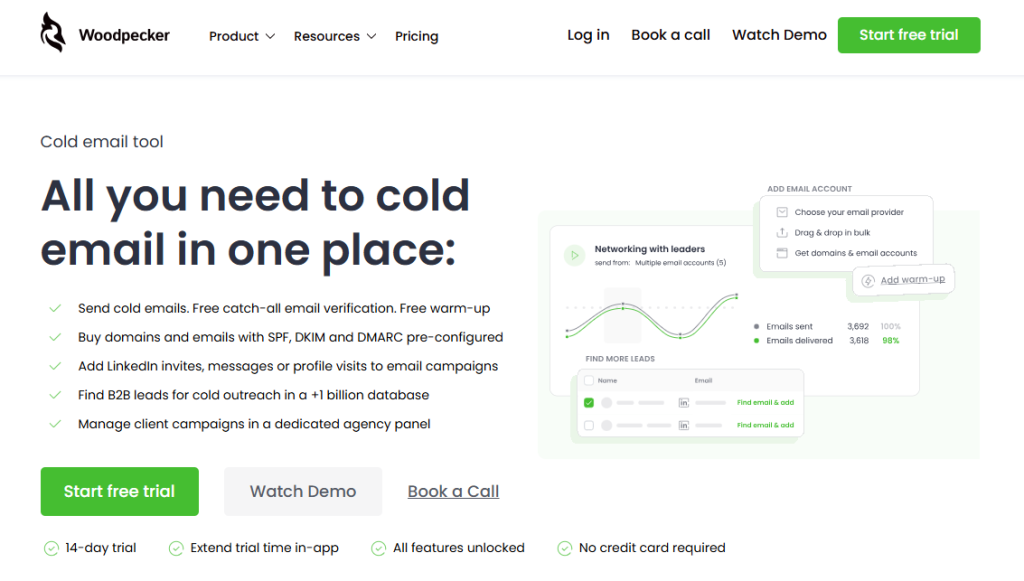
Woodpecker is here specifically for B2B sales email: automated sequences that stop automatically when a prospect replies, deliverability features that keep messages out of spam, and the personalization depth that separates real outreach from mass mail.
Whatever your sales model, the email layer is worth getting right.
Sign up here to run your first outbound sequence.
FAQ
What are the main types of sales?
The broadest categories are B2B vs. B2C (who you’re selling to) and inbound vs. outbound (how you find buyers). Within those, the most commonly referenced models are inside sales, outside sales, direct sales, channel sales, enterprise sales, transactional sales, and consultative sales.
What are the 4 types of sales?
There’s no single canonical answer to this. One common framework: transactional, consultative, enterprise, and channel. Another: B2B, B2C, inbound, and outbound. The right “four” depends on the context you’re working in.
What are the 5 types of sales?
A common five-type framework covers: inside sales, outside sales, B2B, B2C, and direct sales. Others add channel sales or consultative as the fifth. None of these frameworks is definitive – they’re classification tools, not rigid categories.
What is the difference between inside sales and outside sales?
Inside sales is done remotely – phone, video, email. Outside sales involves in-person meetings. The line has blurred significantly since 2020; many “outside” reps now conduct most interactions remotely and use in-person visits selectively for high-stakes moments in a deal.
What types of sales jobs are there?
The main roles in a B2B sales org are SDR (outbound prospecting), BDR (business development), AE (account executive, handles full sales cycle), and CSM (customer success, owns retention and expansion). Larger orgs add sales engineers, solution consultants, and sales ops specialists.
What’s the difference between inbound and outbound sales?
Inbound sales works with leads who have already shown interest – they came to you. Outbound sales means going to them first – before they’ve expressed any interest. Both generate pipeline; the right mix depends on your market, your ACV, and your brand’s search presence.
How does cold email fit into a sales strategy?
Cold email is the primary outbound channel in most B2B inside sales motions. It’s how SDRs reach prospects who aren’t actively looking, warm them up, and book the meetings that AEs then run. Done well, it’s the most cost-effective way to build pipeline at scale. Here’s how it works in practice.