
A warm call is a sales call with context.
The prospect may have replied to an email, accepted a LinkedIn connection, attended an event, requested information or been referred by someone they trust. You are still starting a sales conversation, but you are not starting from zero.
A cold call is different. The prospect has had no meaningful previous interaction with you and may not recognize your name or company.
That difference matters because context changes the opening.
On a cold call, you need to establish relevance quickly. On a warm call, you can build on something that already happened.
The goal is not to make every prospect “warm” before you call. It is to use email, LinkedIn, referrals and real buying signals to make the next conversation more relevant when the opportunity exists.
What is a warm call?
A warm call is a sales call to a prospect where there is already some meaningful context between the prospect and your company, salesperson or offer.
That context might come from:
- a previous email reply
- a LinkedIn conversation or accepted connection
- a referral or mutual contact
- a webinar, event or live conversation
- a request for more information
- an existing relationship with the account
The prospect does not have to be ready to buy.
They simply have more context than somebody receiving a completely cold call.
Warm is a spectrum, not a checkbox
Not every interaction creates the same level of familiarity or intent.
| Signal | How much context it gives you | What it means for a call |
| Referral from a trusted contact | Strong | You have a clear reason to reference the connection |
| Positive email reply | Strong | A call can continue a conversation that already started |
| LinkedIn conversation | Medium to strong | Reference the actual topic discussed |
| Webinar or event attendance | Medium | Useful when the event topic connects to the problem you solve |
| Accepted LinkedIn connection | Light | Creates familiarity but not automatic buying intent |
| Email open or single website visit | Weak | Use as internal context, not as proof that the prospect wants a call |
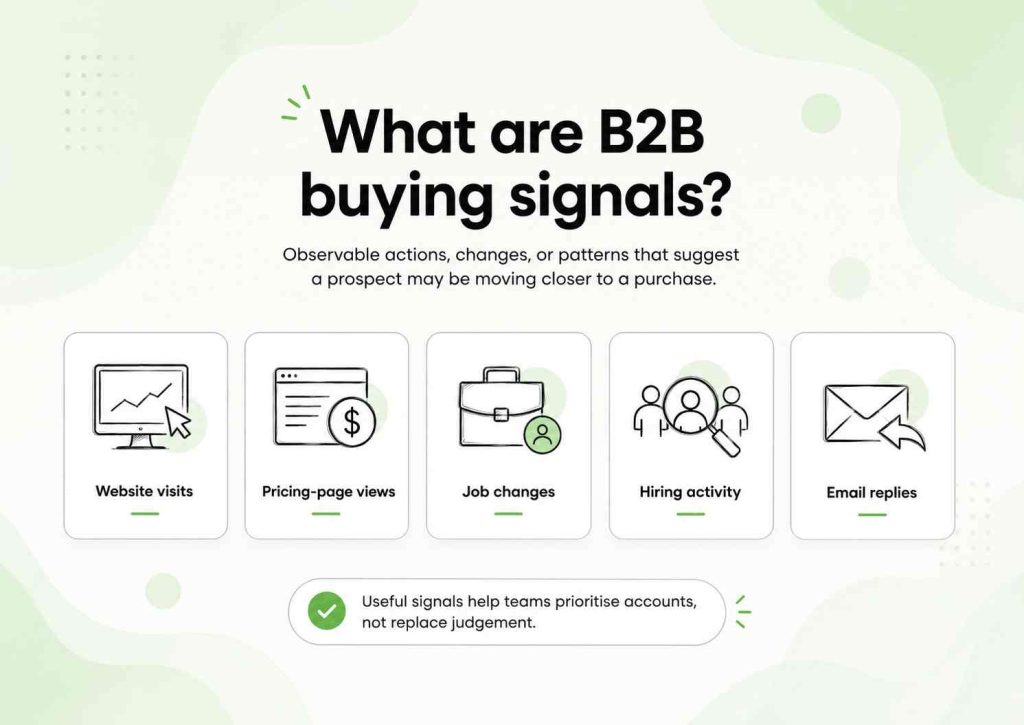
Woodpecker’s guide to B2B buying signals makes this distinction useful. One action may be interesting. Several recent and relevant signals telling the same story are much stronger.
Warm call vs cold call: what is the difference?
The main difference is the context that exists before the salesperson picks up the phone.
| Cold call | Warm call |
| No meaningful prior interaction | Some relevant prior interaction or relationship |
| Prospect may not recognize the sender | Prospect may recognize the sender, company or topic |
| Opening must establish relevance quickly | Opening can build on previous context |
| Often used to create first contact | Often used to continue or deepen contact |
| Research drives the opener | Research plus prior interaction drives the opener |
Neither is automatically better.
Cold calls are useful when you have a strong reason to contact a good-fit prospect but no previous relationship.
Warm calls become useful when previous outreach or engagement gives you a natural reason to continue the conversation.
If you are deciding how phone fits beside email, Woodpecker’s comparison of cold calling and cold emailing covers the trade-offs between both channels.
What is a hot call?
A hot call sits further along the same spectrum.
A prospect who requested a demo, asked to speak with sales or explicitly said they want to discuss the product has shown much clearer intent.
| Cold | Warm | Hot |
| No prior interaction | Some meaningful context | Explicit interest in a sales conversation |
| You create the opening | You continue an opening | The prospect has actively opened the door |
Do not mistake a weak tracking signal for a hot lead. A page view is not the same as a demo request.
How to make a sales call warmer before you dial
You do not need a long nurture campaign before every call.
You need enough context to make the conversation feel connected rather than random.
1. Start with the right prospect
Warming up the wrong prospect does not improve the campaign.
Start with a clear ideal customer profile and a reason the account may care about the problem you solve.
2. Lead with a useful email
Email gives a prospect time to understand who you are and why you are reaching out before a phone conversation.
Keep the message short. Explain the relevant business context and ask a focused question rather than requesting a long meeting immediately.
Before launching the sequence, Woodpecker’s email preview tool can help you check how the message looks before it reaches the prospect.
3. Add LinkedIn when it creates useful familiarity
LinkedIn can make the next touch less unexpected.
That might mean visiting the prospect’s profile, connecting or sending a short message that adds something different from the email.
Do not paste your email pitch into a LinkedIn DM.
The guide to LinkedIn outreach shows how the channel can support a wider prospecting sequence.
4. Call when the context supports it
You do not have to wait for a prospect to reply before calling.
But the reason for the call should be stronger than “they are on my list.”
Useful context can include:
- a relevant business trigger
- previous email or LinkedIn contact
- a referral
- a direct question from the prospect
- several signals that suggest the account is actively exploring the problem
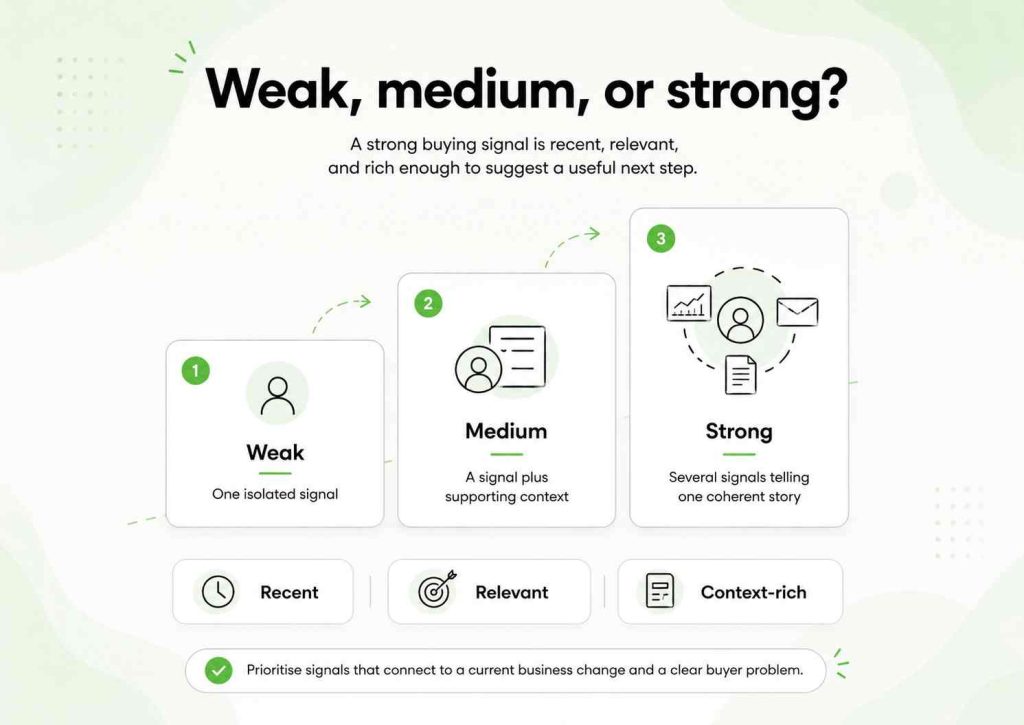
A single weak signal does not require an immediate phone call. Several connected signals may justify moving the account higher in the queue.
A simple email, LinkedIn and call sequence
There is no universal cadence that every sales team should copy.
A simple sequence might look like this:
| Touch | Channel | Purpose |
| 1 | Explain why the prospect is relevant and introduce one problem | |
| 2 | Create light familiarity without repeating the pitch | |
| 3 | Follow-up email | Add another useful angle, example or question |
| 4 | Call | Use the existing context to ask one focused question |
| 5 | Recap a conversation or close the loop if there was no response |
The sequence should adapt when the prospect responds.
If they reply, stop acting as if they are still a cold prospect. If they decline, respect the answer. If a channel adds no value for the audience, leave it out.
Woodpecker’s multichannel sales cadence guide gives a more detailed framework for coordinating email, calls and social touches.
What to say on a warm call
A warm opener has three simple parts:
- Remind the prospect of the genuine context.
- Explain why you are calling now.
- Ask one relevant question.
After an email reply
Example: “Hi Maya, it’s Tom from Acme. You replied to my note about SDR ramp time yesterday. I wanted to understand one thing before I send anything else: where does that process slow down most for your team today?”
After a LinkedIn conversation
Example: “Hi Alex, it’s Priya from Acme. We exchanged a couple of messages on LinkedIn about your team’s expansion. You mentioned that outbound consistency was becoming harder as the team grows. How are you handling that today?”
After a referral
Example: “Hi Daniel, it’s Noor from Acme. Emma Chen suggested I reach out because you are reviewing how the team handles prospect research. I wanted to understand what prompted the review before I assume we can help.”
After an event
Example: “Hi Laura, it’s Sam from Acme. We spoke briefly after the outbound session on Tuesday. You mentioned that your reps are working from several separate inboxes. Is consolidating that workflow something you are actively looking at?”
Notice what is missing from these examples.
There is no fake familiarity, no long introduction and no claim that the salesperson has tracked every action the prospect made.
Do not open a call with tracking data
A prospect may have opened your email or visited a product page.
That information can help your team prioritize accounts. It rarely makes a good opener.
Avoid:
“I saw you opened my email three times and visited our pricing page.”
The information may be technically available, but saying it out loud can make the prospect feel watched rather than understood.
Use the signal to decide that the account deserves another look. Then call about the business problem, not the tracking event.
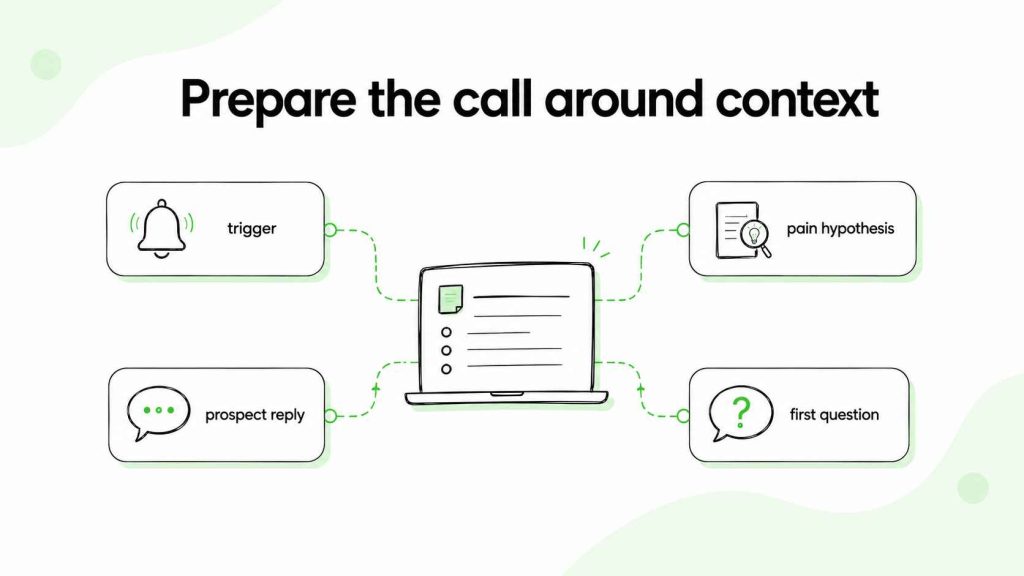
Prepare the call around context, not a script
A warm call still needs preparation.
Before dialing, know:
- why the account is a fit
- what happened before the call
- which problem you think may be relevant
- which first question you want to ask
- what a useful next step could look like
Do not prepare a ten-minute monologue.
Prepare enough context to ask a better question.
Warm call checklist: five questions before you dial
- Is this account actually a fit? Previous engagement does not fix poor targeting.
- What real context do I have? Separate direct interaction from weak tracking signals.
- Why am I calling now? Have a reason stronger than “follow-up.”
- What is my first useful question? Start a conversation rather than a pitch.
- What happens if they are interested? Know the next step before the call begins.
Turn a warm call into discovery, not a product demo
A successful warm call does not need to end in a sale.
Often, its job is to find out whether the conversation deserves a next step.
If the prospect confirms a real problem, move into discovery.
Woodpecker’s guide to discovery call questions recommends working from the current state to pain, impact, stakeholders, timing and a clear next action.
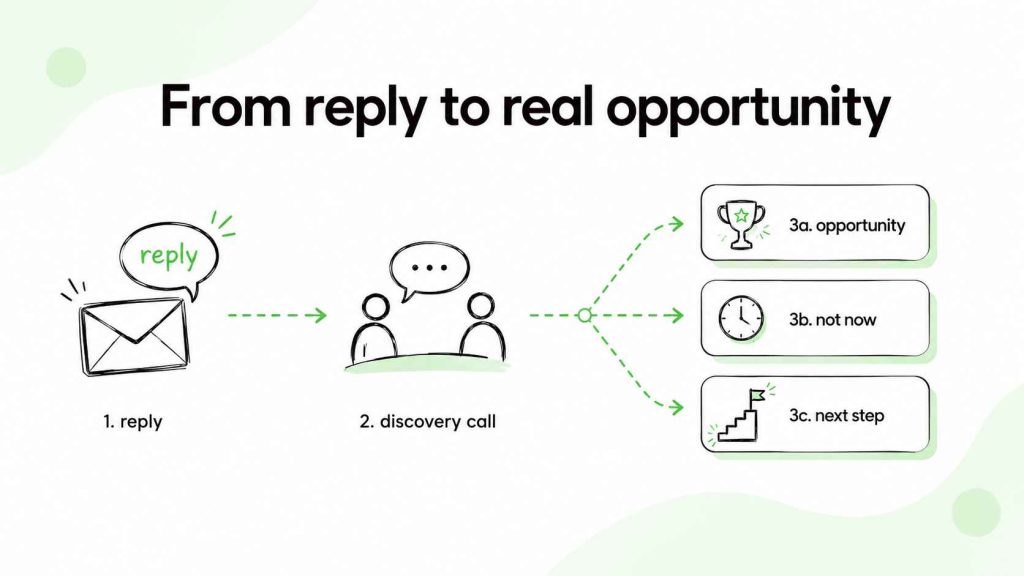
A call can also reveal that the prospect is curious but not qualified.
That is useful information too. The guide to qualifying sales leads can help decide which conversations deserve more sales time.
When should you call, and when should you keep it async?
| A call makes sense when… | Stay with email or LinkedIn when… |
| the prospect asked a question that is easier to discuss live | the prospect explicitly asked for information in writing |
| there is a time-sensitive business trigger | there is no useful reason to interrupt them |
| several signals point to an active problem | the only signal is one passive interaction |
| the conversation has become complex | a short written answer can move things forward |
| the prospect agreed that a call is the next step | the prospect has already indicated that the timing is wrong |
The best channel is the one that makes the next conversation easier, not the one your sales playbook happens to prefer.
What should you do after a warm call?
The follow-up should reflect what actually happened on the call.
A useful recap can include:
- the problem the prospect described
- any useful detail or resource you promised
- the agreed next action
- who else needs to join the next conversation
Do not restart the original pitch in writing.
Woodpecker’s guide to sales follow-up emails can help structure the next message without losing the context from the call.
How to measure a warm-calling process
Do not judge the process only by the number of calls completed.
Track what happens after the dial.
| Metric | What it tells you |
| Conversation rate | How often calls turn into real conversations |
| Qualified meeting rate | How often a conversation deserves a next meeting |
| Opportunity rate | How often the account becomes a real sales opportunity |
| Conversion by prior signal | Which interactions actually make later calls more productive |
| Time from first touch to conversation | How long it takes outreach to create a meaningful interaction |
For the email part of a multichannel sequence, Woodpecker’s cold email benchmarks can provide context for broader campaign results. Do not use an email benchmark as the target for phone performance.
Test email changes only when you have enough data
If email creates the context before your calls, it can be useful to test subject lines, openings or CTAs.
For larger samples, Woodpecker’s cold email A/B test calculator can help determine whether a difference between variants is meaningful.
Do not force statistical testing onto a tiny account list. In a small, highly targeted campaign, qualitative feedback from the actual conversations may be more useful.
If email is part of the sequence, plan the sending setup too
A warm-calling strategy often starts with cold email.
That email still needs to reach the inbox reliably.
For larger outbound programs, Woodpecker’s cold email infrastructure calculator can help estimate how many domains and mailboxes the planned email volume may require.
This is an operational detail, but it matters. You cannot create useful pre-call context with emails the prospect never receives.
How Woodpecker can connect the touches before a call
Woodpecker lets sales teams combine cold email and LinkedIn outreach in a connected campaign workflow.
That makes it easier to create context across channels before a salesperson moves the conversation forward.
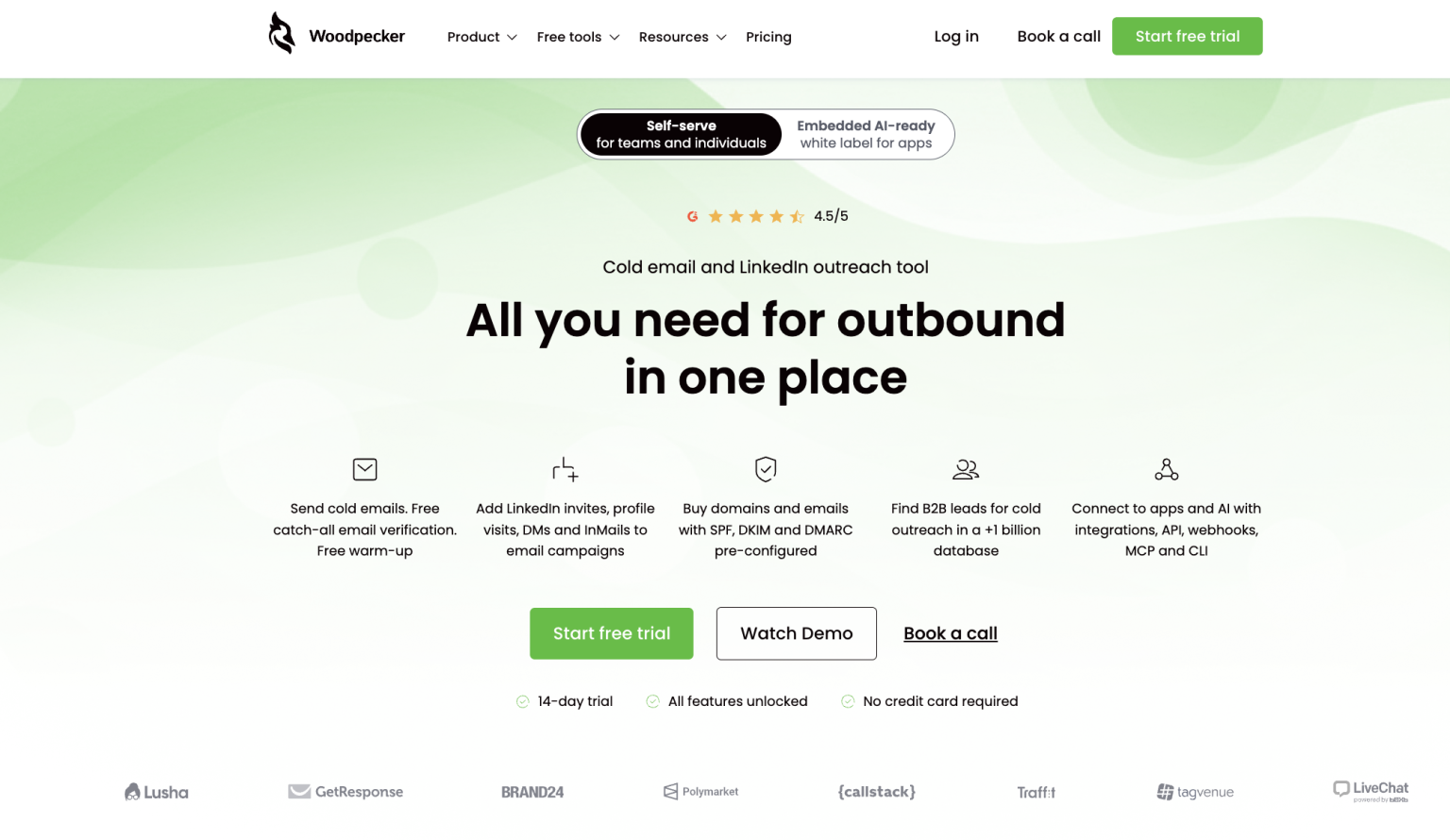
A team might use email to introduce the problem, LinkedIn to add another relevant touch and a call when there is enough context for a live conversation.
The software can organize the sequence. The salesperson still needs to decide when the next touch makes sense.
Common warm-calling mistakes
Calling after one weak signal
One email open is not a request for a phone call.
Look at account fit and the wider context before deciding that a prospect deserves immediate follow-up.
Announcing that you are tracking the prospect
Use behavioral data to improve timing internally.
Do not make the prospect uncomfortable by listing every page, click or open you recorded.
Repeating the email pitch on the phone
The call should move the conversation forward.
Ask a question the email could not answer instead of reading the same value proposition out loud.
Confusing familiarity with intent
Somebody accepting a LinkedIn connection may recognize you. That does not mean they are evaluating your product.
Talking more because the call is warm
Previous contact gives you context. It does not give you permission to turn the call into a monologue.
Warm call FAQ
What is a warm call?
A warm call is a sales call where some meaningful context already exists between the seller and prospect. That may come from an email conversation, LinkedIn interaction, referral, event or another previous relationship.
What is the difference between a warm call and a cold call?
A cold call starts without meaningful previous interaction. A warm call builds on existing context. The prospect may already recognize the seller, company or topic, which changes how the conversation can begin.
Does opening an email make a prospect warm?
Not necessarily. An email open is a weak engagement signal and open tracking itself is imperfect. Use it as one piece of internal context rather than assuming the prospect wants a sales call.
Is an accepted LinkedIn request a warm lead?
It makes the relationship slightly warmer because the prospect may recognize your name, but it does not prove buying intent. The next touch still needs a relevant business reason.
Are warm calls better than cold calls?
Warm calls can be easier to open because some context already exists. Cold calls still make sense when you have a strong prospect and a relevant reason to contact them but no previous relationship.
What should I say on a warm call?
Briefly reference the genuine previous interaction, explain why you are calling and ask one question connected to the prospect’s situation. Avoid opening with a full product pitch.
When should I call after sending an email?
There is no universal timing rule. Call when the account fit, previous outreach and business context give you a sensible reason to continue. A reply or direct question is stronger context than a single tracked open.
Use context to make the next conversation better
Warm calling is not about manufacturing familiarity before a sales pitch.
It is about using real context to make the next interaction more useful.
Start with the right prospect. Use email and LinkedIn when they add value. Pay attention to buying signals without overreacting to them.
Then pick up the phone when you have something worth discussing.
The best warm call does not feel warm because the salesperson knows the prospect clicked something.
It feels warm because the conversation starts where the previous interaction left off.