
Revenue growth gets harder when every target begins with the same instruction: find more leads.
New customer acquisition matters, but it is only one way a company can grow. Existing customers can buy more. Previous buyers can return. Inactive accounts can reactivate. Partners can introduce new customers. Better retention can protect revenue that the acquisition team has already worked to create.
That changes the question from “How do we generate more leads?” to “Which revenue lever has the strongest opportunity right now?”
A useful revenue growth strategy treats acquisition, expansion, retention, repeat purchase, reactivation and partner-led growth as a portfolio. You do not need every lever to perform equally. You need to know which one deserves investment, what customer behavior it depends on and how you will measure whether it works.
The revenue growth map
Start by separating growth into different jobs.
| Growth lever | Who it targets | Main question | Useful metric |
| New customer acquisition | Prospects | Can we create more qualified pipeline? | Pipeline and customers acquired |
| Expansion | Successful current customers | Can we solve another problem or increase usage? | Expansion revenue |
| Repeat purchase | Previous buyers | When should they naturally buy again? | Repeat purchase rate |
| Retention | Existing customers | Are customers continuing to receive value? | Retention / churn |
| Reactivation | Inactive customers or opportunities | Has something changed enough to restart the conversation? | Reactivated accounts |
| Partner and referral growth | Partners, customers, creators | Who already has access to the audience we want? | Partner-sourced revenue |
These levers overlap, but they should not be managed as one giant “growth” bucket. Each one starts with a different audience and requires a different message.
1. Keep new customer acquisition, but make it earn its share of the budget
Acquisition remains the obvious growth engine because every company eventually needs new customers. Problems begin when the business treats acquisition volume as growth regardless of lead quality or conversion.
A healthier model starts with the market you can realistically win, then works backward from qualified pipeline. Woodpecker’s B2B sales lead generation guide covers the wider process, while the SaaS lead generation guide is useful for recurring-revenue companies where acquisition economics depend heavily on lifetime value and retention.
For outbound, pay attention to the quality of the conversation rather than only the number of emails sent. A campaign that reaches 400 carefully selected prospects and creates qualified pipeline can be a better growth asset than one that reaches 10,000 contacts and produces mostly irrelevant replies.
The cold email reply rate is one useful diagnostic, but connect it to later stages such as positive responses, meetings and opportunities. Woodpecker’s cold email statistics provide broader campaign context.
2. Grow the value of customers who already succeeded
Expansion revenue becomes possible when the customer has already received enough value to justify buying more.
That can mean a larger plan, another product, additional seats, more usage, a new service or rolling the solution out to another team. The timing matters. Selling more before the original purchase has delivered value can feel like pressure rather than expansion.
Woodpecker’s existing guide to upselling and cross-selling makes the same distinction: relevance matters more than simply presenting another offer.
A useful expansion trigger might be:
- the team is regularly hitting a plan limit
- another department starts using the same workflow
- the customer asks for functionality available elsewhere in the product
- usage has grown substantially since onboarding
- the original project has succeeded and created a logical next problem
The point is to sell from demonstrated value rather than from a calendar reminder that says “time for an upsell.”
Cross-selling works when the second purchase completes the first one
A cross-sell adds something complementary instead of replacing the original purchase with a larger version.
The easiest examples come from e-commerce because the relationship is visible: a customer buys a console and is offered a game, or buys a camera and needs storage. B2B works similarly. A service, integration or additional product should make the existing outcome easier to achieve.
The same principle should guide B2B account conversations. Customer history gives you context that cold prospects do not. Use it. A relevant expansion email can refer to actual adoption, a recent discussion or a known workflow instead of starting again with a generic pitch.
Good email personalization is useful beyond cold outreach because the underlying idea is the same: context should change the message.
3. Design repeat purchases around the natural buying cycle
Not every business grows through subscriptions or large account expansions.
For consumable or replenishable products, growth can come from getting the timing of the next purchase right. The question is less “How do we sell more?” and more “When will this customer reasonably need the product again?”
That interval may be predictable from previous orders, typical consumption or customer behavior. Strong replenishment email strategies use that timing to remind the customer before they run out rather than sending the same promotional calendar to everybody.
Repeat-purchase growth works especially well when communication follows customer state:
- first purchase completed
- expected usage period begins
- likely replenishment window approaches
- customer receives a useful reminder
- purchase happens or the timing model is adjusted
This is a different workflow from cold prospecting, but the communication principle is familiar: relevance and timing beat generic volume.
4. Use loyalty mechanics to increase reasons to return
Repeat buying is partly about timing and partly about giving customers a reason to choose you again.
A loyalty program can introduce benefits for repeat behavior through rewards, tiers, status, member pricing or loyalty points. The mechanism matters less than the behavior it is designed to encourage.
Before adding rewards, define the target action. Are you trying to increase purchase frequency? Encourage larger baskets? Reward referrals? Move customers toward a higher-value category?
Giving points for everything without connecting them to a commercial goal can create another discount system rather than meaningful loyalty.
Woodpecker’s article on customer experience makes a broader point that applies here: the relationship continues after the initial transaction. Communication, preferences and service all shape whether customers want to continue buying from the brand.
5. Protect revenue before replacing it
Retention is sometimes treated as a customer-success metric rather than a growth metric. Financially, the distinction makes little sense.
If a company adds $50,000 of new recurring revenue while losing $50,000 from existing customers, acquisition activity has not created net growth.
Retention improves when customers continue to experience the value that made the original purchase worthwhile. In SaaS, that often means adoption, onboarding, ongoing product use and communication that reinforces useful outcomes.
Woodpecker’s SaaS customer retention article separates customer communication into onboarding, expansion of perceived value and ongoing reminders of the value being received. That gives retention work more structure than sending a generic “we miss you” email after activity drops.
Watch for behavioral changes before cancellation
The strongest retention intervention often happens before the customer formally leaves.
Useful signals can include lower usage, unfinished onboarding, fewer active users, declining orders, support friction or reduced engagement with previously important features.
The communication should match the cause. A customer who never completed onboarding needs help reaching value. A long-term customer whose needs changed may need another configuration, plan or product. A person who simply wants fewer emails may need preference controls rather than another promotional sequence.
6. Build a deliberate reactivation lane
Inactive does not always mean lost.
A former customer may return because the product changed, their company changed or the original timing problem disappeared. A previous sales opportunity may become relevant after a new hire, funding event or internal project starts.
The reactivation message needs a reason to exist now. “Just checking in” is rarely enough.
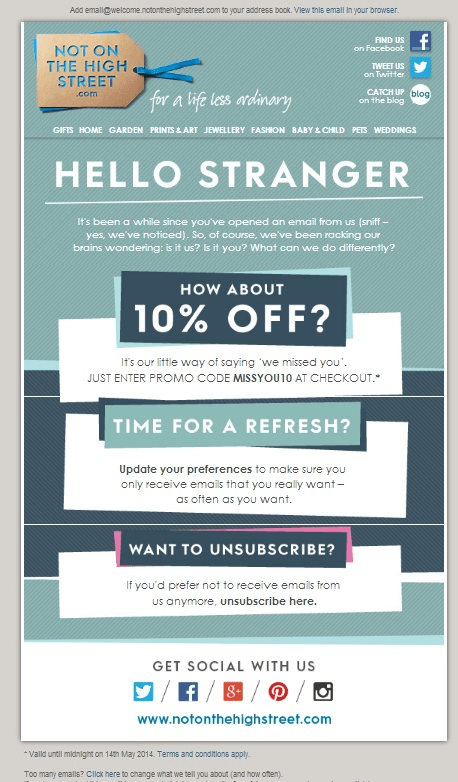
Possible reactivation angles include:
- a meaningful product improvement
- a changed customer requirement
- new pricing or packaging relevant to the previous objection
- a new use case
- a seasonal or replenishment window
For sales opportunities rather than existing customers, use the same discipline found in a good sales follow-up: the new message should add context instead of merely reminding the prospect that an old email exists.
The follow-up after no response examples can also help when the opportunity is still relatively recent. A six-month-old deal usually needs a new trigger, not “following up on my last email.”
Recovery can happen before the transaction disappears
Transactional businesses have another version of reactivation: the customer showed buying intent but stopped before completing the purchase.

Cart recovery, unfinished sign-up, incomplete onboarding and abandoned demo requests all share a useful principle. Respond to the stage the buyer actually reached instead of restarting the whole journey from the top.
7. Let other people create part of the acquisition pipeline
Not every new customer needs to originate from your internal marketing or sales team.
Partner and referral programs create another acquisition path through people or companies that already have access to a relevant audience.
Woodpecker uses this model itself through its Referral Partner Program, where partners can refer customers through tracked links and receive recurring commission. The company’s longer explanation of its partner program model shows how referrals can become a repeatable acquisition source rather than an informal “tell your friends” request.
Affiliate-led growth works best when three things line up:
- the partner already reaches the right audience
- the economics leave room for commission
- the product is easy enough to recommend with confidence
The economics of each affiliate product matter because commission, conversion rate, price and repeat revenue all influence how attractive the offer is to a potential partner.
Do not judge partner growth only by the number of people who register for a program. Track active partners, referred opportunities, customer quality and revenue generated from the channel.
Do not use the same message for every growth lever
A prospect, active customer, churn-risk account and former buyer are not four names in the same email list.
Their context is different, so the communication should be different too.
Cold acquisition: establish why the problem may be relevant.
Expansion: connect another offer to value the customer already receives.
Repeat purchase: use expected need and timing.
Retention: reinforce value or solve a barrier to adoption.
Reactivation: explain what changed.
Referral: give the advocate a clear reason and mechanism to recommend you.
That segmentation principle is why broad automation needs context. Outbound sales automation can coordinate repetitive campaign work, but it should not flatten customers and prospects into the same journey.
Use channels according to the relationship
Cold prospects may need email, LinkedIn or calls. Existing customers may respond better to email, in-product messaging or direct account-manager communication. E-commerce buyers may need behavior-triggered messages around the next transaction.
The multi-channel outreach principle still applies: another channel should add access or context, not repeat the same message everywhere.
For email campaigns, preview real records before launching. The email preview tool can catch personalization and formatting problems before an automated growth campaign reaches customers or prospects.
Measure revenue levers separately before combining them
A company can grow overall while one growth engine quietly deteriorates.
New-logo sales can hide worsening churn. A strong renewal quarter can hide weak acquisition. Partner revenue can increase while the internal outbound channel becomes less efficient.
Give each lever its own operating metrics, then combine them at the revenue level.
- Acquisition: qualified pipeline, opportunities, CAC, new revenue
- Expansion: expansion revenue, account growth, adoption
- Repeat purchase: repeat purchase rate, reorder interval, order value
- Retention: logo retention, revenue retention, churn
- Reactivation: accounts re-engaged, revenue recovered
- Partner: active partners, referred opportunities, partner-sourced revenue
Woodpecker’s overview of sales metrics is a good starting point for the acquisition and pipeline side. Do not force every growth lever into a sales dashboard if customer or revenue data belongs somewhere else.
Build experiments around one lever at a time
“Increase revenue” is too broad to test.
A useful experiment changes one part of one growth engine:
- send an expansion message after a specific adoption milestone
- move a replenishment reminder seven days earlier
- reactivate accounts after a relevant product release
- offer partners a different incentive
- change the CTA for one outbound segment
When email is the test channel, keep the audience and other variables stable enough to learn from the result. Woodpecker’s A/B test calculator can help determine whether differences between two outreach versions are large enough to be meaningful.
For acquisition experiments, compare campaign performance with the cold email benchmarks tool, but keep your primary measure connected to the actual growth objective.
Choose the next revenue lever with a constraint-first review
The best next strategy depends on where growth is currently constrained.
If qualified pipeline is weak, acquisition needs attention. If customers are successful but rarely expand, investigate upsell and cross-sell. If new revenue disappears through cancellations, fix retention before adding more top-of-funnel volume. If buyers naturally need the product again, improve replenishment timing. If strong customers already recommend you informally, a structured referral program may turn that behavior into a measurable channel.
You can use a simple review:
- Where is revenue currently leaking?
- Which customer group has the clearest unrealized opportunity?
- What behavior would create measurable revenue?
- Do we have enough data to identify that group?
- Which message or workflow could influence the behavior?
- What result would make us invest more?
Growth is stronger when several engines work together
A healthy revenue system rarely depends on one channel forever.
Outbound can create new conversations. Successful customers can expand. Good onboarding and customer experience can protect recurring revenue. Replenishment can bring transactional customers back at the right moment. Reactivation can recover opportunities that were not ready the first time. Referral partners can introduce buyers your internal team would never have reached directly.
The goal is not to launch all of those programs next month.
Find the current constraint, choose the lever that matches it and build a measurable workflow around that one problem. Once it works, the business has another revenue engine instead of another growth idea sitting in a planning document.