


A good cold email subject line gives the recipient an honest, specific reason to open your message. It should connect to something they recognize—their company, role, current initiative, published content, or business problem—without sounding like an advertisement.
For most cold outreach, keep the subject line short, use sentence case, and make sure it matches the email body. Avoid fake urgency, misleading “Re:” prefixes, exaggerated promises, and generic personalization that could apply to hundreds of companies.
Here are ten strong starting points:
- Idea for {{company}}’s {{initiative}}
- Question about {{specific_process}}
- Your {{content_title}}
- Reducing {{problem}} at {{company}}
- {{mutual_contact}} suggested I reach out
- Hiring for {{role}}?
- Thought on {{specific_page_or_campaign}}
- {{recent_trigger}} at {{company}}
- A faster way to {{outcome}}
- Can I send the {{resource}}?
Use these as structures rather than finished scripts. Replace every placeholder with something relevant and make sure the email delivers what the subject line promises.
What is a cold email subject line?
A cold email subject line is the short text a recipient sees before opening a message from someone they do not already know.
Its job is not to explain your entire offer or close a sale. It should help the recipient understand why the message may be relevant and give them a credible reason to open it.
A good cold email subject line is:
- Relevant to the recipient
- Connected to the email body
- Specific enough to be credible
- Short enough to scan quickly
- Written in natural language
- Honest about the reason for contacting them
The subject line is only one part of the message. The From line, targeting, introduction, value proposition, call to action, and deliverability also affect whether your campaign earns replies. See the complete guide to writing a cold email for the full process.
Best cold email subject lines: quick-reference table
The following cold outreach subject lines are designed to be adapted. Do not insert a company name or first name without making the rest of the message equally specific.
| Subject line | Why it works | Use case |
|---|---|---|
| Idea for {{company}}’s {{initiative}} | Connects the message to a named company priority | B2B sales |
| Question about {{specific_process}} | Introduces a focused topic without pretending familiarity | Initial outreach |
| Thought on {{company}}’s {{campaign}} | Signals that you reviewed something specific | Agency outreach |
| Your {{content_title}} | Demonstrates genuine familiarity with the recipient’s work | Content-led outreach |
| {{mutual_contact}} suggested I reach out | Establishes legitimate shared context immediately | Referral outreach |
| Reducing {{specific_problem}} at {{company}} | Names a recognizable problem without making a large promise | Problem-led sales |
| {{recent_trigger}} at {{company}} | Connects the email to a current, verifiable event | Trigger-based outreach |
| Hiring for {{role}}? | References a visible hiring need | Recruitment services |
| About your new {{team_or_market}} | Shows awareness of a recent company change | Trigger-based outreach |
| A faster way to {{specific_outcome}} | Introduces one practical benefit | SaaS or consulting |
| Can I send the {{resource}}? | Makes a small, easy-to-understand request | Resource-led outreach |
| Question for the {{team_name}} team | Directs the topic toward a specific function | Role-based outreach |
| Your approach to {{specific_topic}} | Shows that the message concerns the recipient’s work | Expert outreach |
| {{company}}’s {{tool_or_process}} setup | Names the exact operational area being discussed | Technical services |
| Idea for reducing {{specific_cost}} | Connects the message to a measurable concern | Efficiency consulting |
| {{specific_result}} for {{company_type}} teams | Introduces relevant proof for a comparable audience | Case-study outreach |
| A question about {{company}}’s growth | Connects the conversation to an observable business stage | Sales or consulting |
| Saw your {{announcement}} | Gives the recipient a recognizable point of reference | Event-triggered outreach |
| Your expansion into {{market}} | Establishes a timely reason for contacting the company | Market-entry services |
| Supporting the new {{role_or_team}} | Connects the offer to recent hiring or team development | B2B services |
| Improving {{specific_metric}} at {{company}} | Focuses on one outcome connected to the offer | Performance services |
| {{competitor_or_peer}} and {{specific_problem}} | Introduces relevant industry context | Competitive insight |
| Question about your {{software_or_tool}} workflow | Names an existing process the recipient understands | SaaS integration |
| {{company}} + {{your_company}} | Presents a potential connection without overexplaining it | Partnership outreach |
| Partnership idea for {{shared_audience}} | Explains why collaboration could be relevant | Partnership outreach |
| {{mutual_interest}} collaboration | Establishes a specific area of overlap | Partnership outreach |
| Your {{podcast_or_interview}} point about {{topic}} | Proves that the sender engaged with the recipient’s content | Executive outreach |
| Question about the {{role}} opening | Clearly identifies the opportunity being discussed | Candidate outreach |
| {{specific_skill}} experience at {{company}} | Connects the message to a candidate’s actual background | Recruiting |
| {{candidate_name}} for {{role}} | Makes the purpose immediately clear | Recruiter-to-employer |
| Thought on your {{landing_page_or_campaign}} | Shows that an agency reviewed a concrete asset | Marketing agency outreach |
| {{company}}’s {{channel}} results | Introduces a specific marketing channel or performance area | Agency outreach |
| One idea for {{specific_page}} | Promises a focused observation rather than a full sales pitch | SEO or conversion outreach |
| {{local_business}} and {{specific_opportunity}} | Makes local relevance immediately visible | Local services |
| Question about {{location_or_property}} | Gives the recipient concrete geographical context | Real estate or local outreach |
| {{event_name}} follow-up | Re-establishes genuine context from an event | Post-event outreach |
The best option is the one that matches the actual email. For example, do not use “Saw your expansion into Germany” unless the company has genuinely announced that expansion and your message explains why it matters.
If you also need the body of the message, browse these cold email templates organized by use case.
How long should a cold email subject line be?
There is no length that guarantees an open or reply. However, shorter subject lines are generally easier to scan, especially on mobile devices.
Woodpecker’s current cold email benchmark provides a useful starting point:
- Among US companies in the dataset, subject lines containing 10–19 characters produced a 30% median open rate.
- Subject lines containing 20–29 characters had the highest median reply rate in the US comparison, at 0.78%.
- Worldwide, reply rates were strongest for subject lines containing approximately three or four words.
- Longer subject lines did not automatically perform badly, but their median results were generally lower and they were more likely to be truncated.
These figures describe patterns within the analyzed campaigns, not universal rules. A relevant six-word subject line is better than a vague three-word subject line.
As a practical starting point:
- Aim for approximately 3–6 words.
- Put the most meaningful information first.
- Remove introductory filler.
- Preview the subject line on mobile.
- Test different lengths with comparable audiences.
Do not shorten the subject line so aggressively that it loses its meaning. “Question” is short, but “Question about your SDR hiring” provides a much clearer reason to open the email.
How to write a good cold email subject line
1. Start with a real reason for contacting the person
Before writing the subject line, answer this question:
Why am I contacting this particular recipient now?
Your answer could be connected to:
- A recent product launch
- A new job opening
- An expansion into another market
- A change in leadership
- A public interview
- A new article or report
- A visible problem on the company website
- A shared connection
- A technology or process the company uses
Use the most relevant part of that reason in the subject line.
Generic:
Quick question
Specific:
Question about your SDR hiring
The second version gives the recipient context and makes it easier to understand what the message concerns.
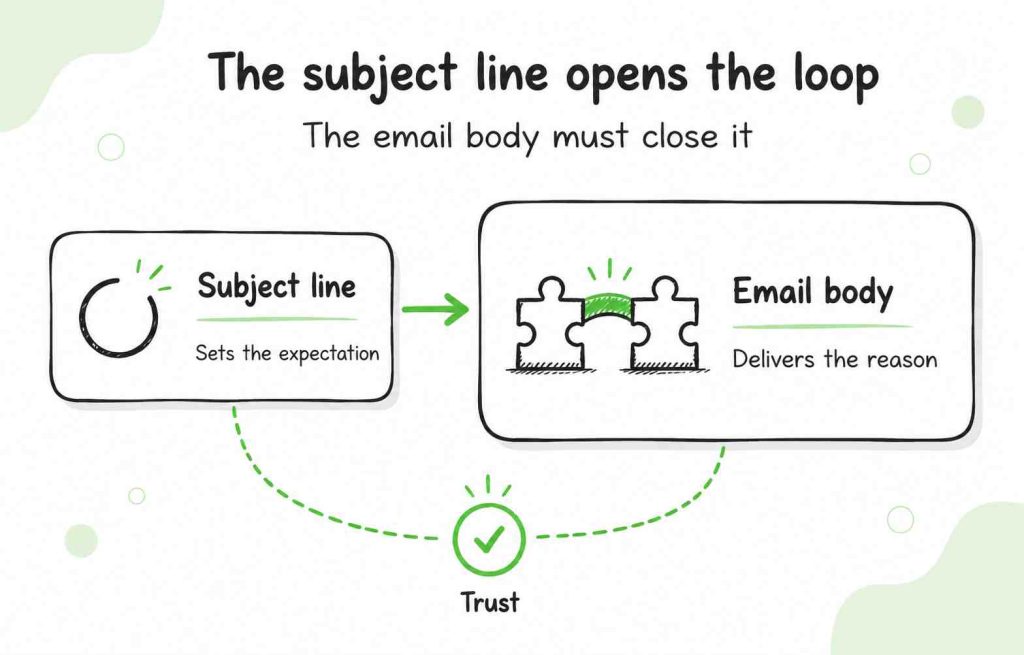
2. Connect the subject line to the email body
The subject line and body should make the same promise.
If the subject line says:
Idea for your webinar follow-up
The opening should immediately explain the idea:
I attended your webinar on outbound forecasting and noticed that the follow-up resource covers pipeline reporting but not reply classification.
Do not use an intriguing subject line and then switch to an unrelated product pitch. The recipient may open the message, but the mismatch damages trust and is unlikely to produce a positive reply.
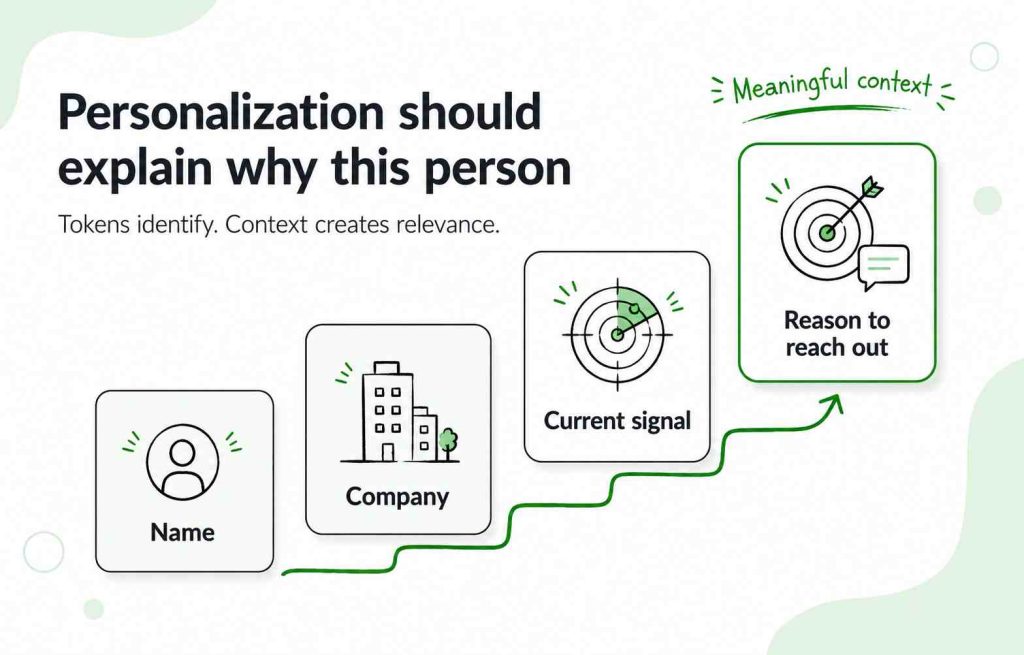
3. Personalize with context, not only a name
Adding {{first_name}} does not automatically make a subject line personal. The same subject could still be sent to thousands of people:
{{first_name}}, want to increase sales?
A stronger subject line reflects something particular about the recipient:
{{first_name}}, your post on SDR onboarding
The second version gives the first name a reason to be there. It also establishes context that the body of the message can continue.
Useful personalization fields include:
- Company initiative
- Published content
- Hiring activity
- Job role
- Market
- Product
- Technology
- Relevant business trigger
- Shared contact
- Specific process or problem
Verify every field before launching the campaign. An incorrect company name or missing placeholder is worse than no personalization.
4. Write like a person
Cold outreach should look like professional one-to-one communication, not a promotional newsletter.
In most situations:
- Use sentence case.
- Avoid capitalizing every word.
- Remove unnecessary exclamation marks.
- Use plain language.
- Avoid exaggerated adjectives.
- Do not add emojis unless they genuinely fit the audience and brand.
Compare:
Revolutionary Opportunity To Transform Your Business!
With:
Idea for your outbound workflow
The second version is easier to understand and places less pressure on the recipient.
5. Be specific without explaining everything
The subject line should provide enough context to earn attention, but it does not need to summarize the entire email.
Too vague:
New opportunity
Too detailed:
New opportunity to automate your prospect follow-ups and improve your sales team’s productivity
More focused:
Automating prospect follow-ups
The focused version names the topic while leaving the explanation for the email body.
6. Use questions selectively
Questions can work when they concern something the recipient recognizes and can answer.
Useful:
Hiring more SDRs?
Using HubSpot for outbound?
Expanding into Germany?
Weak:
Want more revenue?
Need better results?
Looking for a solution?
Broad questions often sound automated because they could be sent to almost any company. Make the question specific enough to demonstrate why you selected that recipient.
7. Use urgency only when it is real
Urgency is appropriate when the email concerns an actual deadline, event, application window, contract renewal, or time-sensitive business situation.
For example:
Speaker confirmation by Friday
Avoid manufactured pressure such as:
- Last chance!
- Act now!
- Urgent response needed
- Exclusive offer today only
- Don’t miss out!
Fake urgency may attract an open, but it begins the conversation by misleading the recipient.
Cold outreach subject lines by use case
Sales prospecting
A sales subject line should connect one business observation to one possible benefit.
Examples:
- Reducing manual follow-ups at {{company}}
- Question about your outbound process
- Idea for the new SDR team
- {{company}}’s lead qualification workflow
- A faster way to verify prospects
Avoid promising a dramatic result before you understand the recipient’s situation.
Marketing agency outreach
Agency subject lines work best when they refer to a specific campaign, channel, asset, or observable opportunity.
Examples:
- Thought on {{company}}’s paid campaigns
- One idea for your pricing page
- {{company}}’s organic search visibility
- Question about the new landing page
- Your webinar follow-up sequence
The corresponding email should contain a useful observation. Simply mentioning the prospect’s website and then delivering a generic agency pitch is not meaningful personalization.
Recruiting
Recruiting subject lines should make the role or relevant experience immediately clear.
Examples:
- {{role}} opportunity at {{company}}
- Your {{specific_skill}} experience
- Question about your work at {{company}}
- {{mutual_contact}} suggested I reach out
- Building the new {{team_name}} team
Avoid vague phrases such as “Exciting opportunity” that provide no information about the position.
Partnership outreach
A partnership subject line should identify the potential area of overlap.
Examples:
- Partnership idea for {{shared_audience}}
- {{company}} + {{your_company}}
- Collaboration around {{specific_topic}}
- Joint resource for {{audience}}
- {{mutual_contact}} suggested an introduction
Make sure the email explains what both parties—and their audiences—would gain from the partnership.
Content and link-building outreach
Reference the exact content or resource that prompted the email.
Examples:
- Your guide to {{specific_topic}}
- Source for your {{article_title}} article
- One addition to {{page_title}}
- Your research on {{specific_finding}}
- Question about the {{resource_name}} report
Do not praise an article you have not read. Mentioning one detailed, relevant point is more credible than saying the content was “amazing.”
Follow-up outreach
When a follow-up stays in the same thread, it normally keeps the original subject line. This preserves context and allows the recipient to see the previous message.
A fresh subject line may be useful when you introduce a genuinely different angle or when earlier messages were not opened. See these follow-up email subject-line examples for the threading-versus-new-subject decision.
Cold email subject lines to avoid
Misleading “Re:” or “Fwd:” prefixes
Do not add “Re:” or “Fwd:” to make a first email look like part of an existing conversation. It may earn an open, but it does so through deception.
Use “Re:” only when the message is genuinely part of the same thread.
Generic automated phrases
Common examples include:
- Quick question
- Reaching out
- Can we talk?
- Business opportunity
- New solution
- Introduction
- Meeting request
These phrases are not always wrong. The problem is that they give the recipient almost no information about why your particular message deserves attention.
If you use “Quick question,” add context:
Quick question about {{company}}’s webinar
Excessively promotional language
Avoid phrases such as:
- Guaranteed results
- Revolutionary solution
- Transform your business today
- Double your revenue
- Exclusive deal
- Best-in-class platform
- Game-changing opportunity
Specific observations are usually more credible than broad claims.
False personalization
Do not use:
Loved your recent post
if you cannot name the post or explain what you found relevant.
Do not use:
Impressed by {{company}}’s growth
if the same sentence could be sent to every prospect.
Personalization should affect the reason for the email, not merely decorate the subject line.
Unsupported urgency
Avoid calling something urgent simply because you want a quick response. If a real deadline exists, explain it clearly in the email.
Do spam-trigger words matter?
A single word does not automatically send every email to spam. Inbox placement depends on a broader combination of factors, including:
- Sender and domain reputation
- Authentication
- Sending patterns
- Bounce and complaint rates
- Recipient engagement
- Message similarity
- Links and tracking
- List quality
- Accuracy of the sender information
Still, excessive capitalization, misleading claims, suspicious links, repeated promotional language, and aggressive punctuation can make an email look untrustworthy to recipients and filtering systems.
A restrained subject line cannot compensate for an unhealthy sending setup. Review these cold email deliverability practices before increasing campaign volume.
How to test cold email subject lines
No example is guaranteed to work for every audience. Testing helps you determine which style fits your market.
Follow this process:
- Choose one element to test.
- Write two meaningfully different subject lines.
- Keep the From line, email body, CTA, audience, and sending conditions unchanged.
- Divide comparable prospects between the versions.
- Run the test with a sufficient number of recipients.
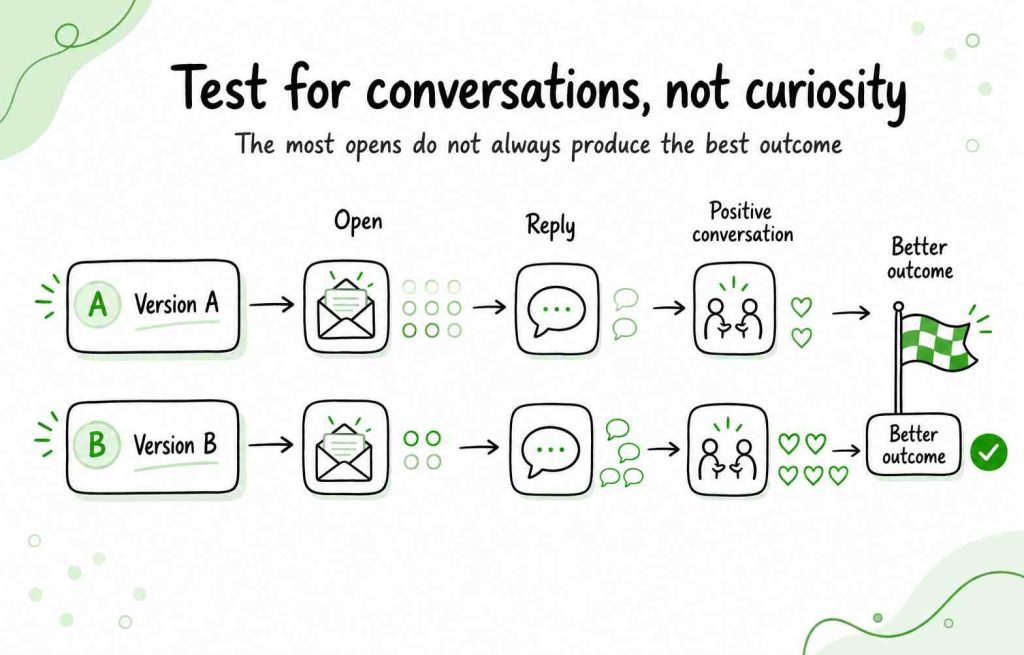
- Compare replies and positive replies—not only opens.
- Document the result and test the next hypothesis.
For example:
Version A: trigger-led
Your new SDR team
Version B: problem-led
Reducing manual follow-ups
Both versions can introduce the same email about helping a growing SDR team manage its outreach. The test determines which angle earns better results from that specific audience.
Open rates are useful for diagnosing whether a subject line earns attention, but they are not perfectly reliable. Privacy features and automatic image loading can affect open tracking. A subject line that generates more opens but fewer positive replies is not necessarily the winner.
Read the complete guide to A/B testing cold email campaigns before running your test.
Test your cold email subject lines with Woodpecker
Woodpecker lets you create campaign versions, personalize subject lines with prospect data, automate follow-ups, and compare how different messages perform.
Start with a small, relevant audience. Test one subject-line hypothesis at a time, review the replies, and use the result to improve the next campaign.
Frequently asked questions
What’s a good cold email subject line?
A good cold email subject line is short, specific, honest, and relevant to the recipient. It should communicate why the message may matter without explaining the entire offer. “Question about your SDR hiring” is stronger than a generic phrase such as “Quick question.”
What are the best cold email subject lines?
Some useful starting points include “Idea for {{company}}’s {{initiative}},” “Question about {{specific_process}},” “Your {{content_title}},” and “{{mutual_contact}} suggested I reach out.” The best option is the one that accurately matches the recipient and email body.
How long should a cold email subject line be?
As a practical starting point, aim for approximately three to six words and place the most meaningful information first. Woodpecker’s benchmark found strong results among shorter subject lines, but relevance is more important than meeting an exact character limit.
Should I include the recipient’s name in the subject line?
Only when it feels natural. Adding a first name does not automatically create meaningful personalization. Referencing a relevant company initiative, piece of content, business trigger, or shared connection is often more useful.
Is “Quick question” a good cold email subject line?
“Quick question” is short but widely used and provides little context. It may still work with some audiences, but a more specific version—such as “Quick question about your SDR hiring”—gives the recipient a clearer reason to open the message.
Should I use “Re:” in a cold email subject line?
Use “Re:” when the email is genuinely part of an existing thread. Do not add it to a first-touch email to make the recipient think a previous conversation occurred.
Should a cold email subject line contain a question?
It can, provided the question is relevant and specific. “Expanding into Germany?” gives the recipient recognizable context. “Want more revenue?” is too broad to demonstrate genuine relevance.
How do I keep a cold email subject line out of spam?
Use accurate sender information, authenticate the sending domain, verify recipient addresses, keep sending patterns consistent, and avoid deceptive or heavily promotional language. Deliverability depends on the complete sending setup—not on removing one supposedly forbidden word.
How many subject lines should I test?
Start with two meaningfully different versions and change only the subject line. Send them to comparable groups, then evaluate replies and positive replies alongside open rates. Avoid testing several unrelated changes at once.