


Email outreach is the targeted process of contacting relevant people by email to start a conversation, build a professional relationship, or achieve a specific business outcome.
It includes more than writing one message. Effective email outreach covers audience research, contact selection, personalization, follow-ups, deliverability, and performance analysis.
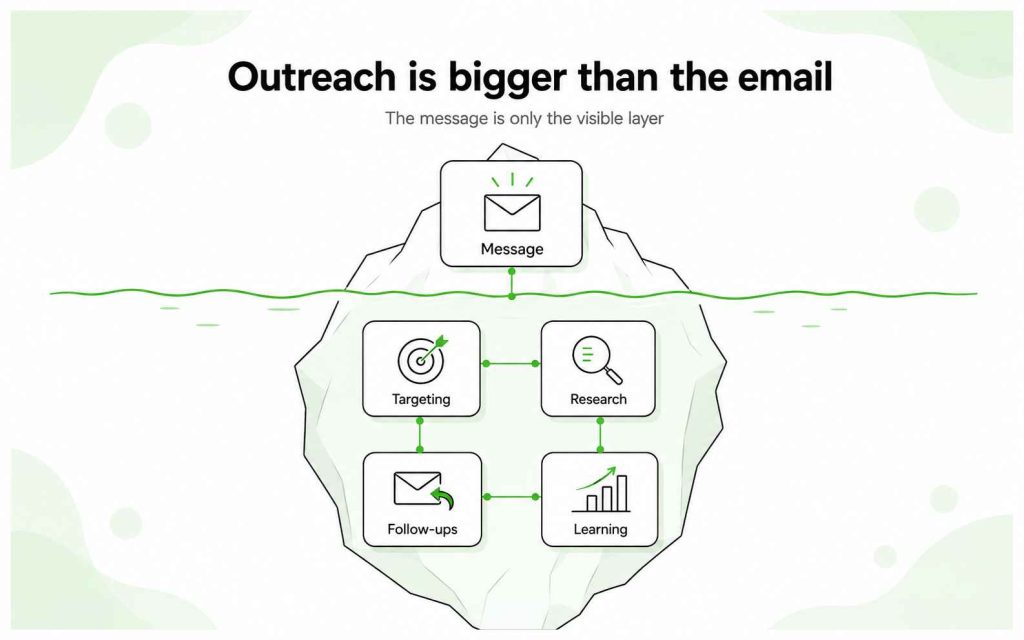
In this guide, you will learn how email outreach works, how to structure an outreach email, and how to build a campaign that earns meaningful replies.
What is email outreach?
Email outreach is the process of identifying relevant people and sending personalized emails to initiate a professional conversation. It may be used to generate sales opportunities, form partnerships, recruit candidates, secure media coverage, build links, or connect with industry experts.
A complete email outreach process usually involves:
- Defining a specific goal
- Identifying the right recipients
- Finding and verifying contact information
- Researching each person or segment
- Writing a relevant outreach email
- Sending appropriate follow-ups
- Measuring replies and outcomes
- Improving the campaign based on results
The purpose is not to send as many emails as possible. It is to reach people who have a credible reason to care about your message.
Email outreach vs. cold email vs. email marketing
These terms overlap, but they describe different parts of an email strategy.
| Approach | What it means | Typical audience | Primary goal |
|---|---|---|---|
| Email outreach | The complete process of researching, contacting, following up with, and building relationships with relevant people | Prospects, partners, journalists, candidates, creators, or industry experts | Start a targeted conversation or earn a specific outcome |
| Cold email | An email sent to a relevant person with whom the sender has no existing relationship | Usually an individual prospect or business contact | Generate a reply, meeting, introduction, or opportunity |
| Email marketing | Messages sent to an audience that has usually subscribed or joined a marketing list | Subscribers, leads, or existing customers | Nurture, educate, promote, or retain |
Cold email is one channel used within email outreach. Email outreach is broader because it includes the research, targeting, follow-up, and relationship-building around the message.
“Outreach email marketing” is sometimes used to describe systematic outreach at scale. However, outreach should still feel relevant to the individual recipient rather than like a general newsletter.
How to do email outreach
A successful outreach campaign starts before you write the first subject line. Follow these steps to build a repeatable process.
1. Choose one clear outcome
Begin by deciding what the campaign should accomplish.
Possible outcomes include:
- Starting conversations with qualified prospects
- Booking product demonstrations
- Finding partners for a joint campaign
- Inviting experts to contribute to an article
- Pitching an original study to journalists
- Recruiting candidates for a specific position
- Requesting feedback from a defined professional group
Keep one primary outcome per campaign. A message that asks for a meeting, product review, introduction, partnership, and backlink at the same time gives the recipient too much to process.
Your goal should also determine your call to action. If you want to start a conversation, ask a simple question. If you need a decision, make the requested decision explicit.
2. Define the right audience
Good outreach begins with relevance.
For sales outreach, your audience definition might include:
- Industry
- Company size
- Location
- Business model
- Technology used
- Current company priority
- Recipient’s role and responsibilities
- A problem your product can realistically address
For partnership, recruitment, or media outreach, use criteria connected to that campaign’s purpose.
Avoid building a list based only on job titles. Two people with the same title may work at completely different businesses and have different priorities.
Create segments when recipients share a meaningful characteristic. For example, operations leaders at recently funded logistics companies may deserve a different message from operations leaders at established financial institutions.
3. Verify the reason for contacting each person
Before adding someone to a campaign, answer this question:
Why is this message relevant to this person now?
A credible reason might be:
- Their company is hiring for a role connected to the problem you solve.
- They recently expanded into a new market.
- They published an article related to your research.
- They use a process your service can improve.
- Their company announced a relevant project.
- They are responsible for the area your message discusses.
This reasoning produces stronger personalization than inserting a first name or company name into a generic template.
Do not manufacture relevance. If there is no clear connection between the recipient and your message, remove them from the campaign.
4. Find and verify contact information
Use current professional contact information and confirm that the address is likely to accept mail before launching the campaign.
Verification helps reduce bounces, but it cannot correct poor targeting. A technically valid address is not automatically a relevant contact.
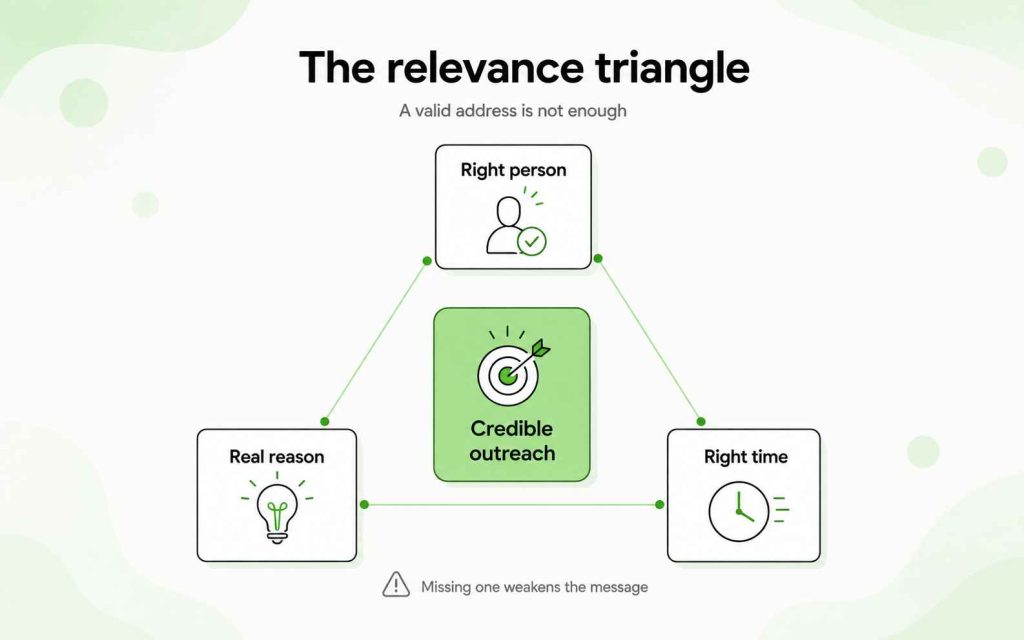
Keep records of where contact information came from, why the person was selected, and any applicable preferences or objections. Remove recipients who ask not to be contacted again.
5. Research without overpersonalizing
Useful research helps you understand the recipient’s situation. It should not make the email sound intrusive.
Relevant research may include:
- The recipient’s role
- Public company announcements
- Recent professional content
- Product or service changes
- Job openings
- Public interviews
- Industry developments affecting their company
Use what you learn to explain why you are writing. Do not turn the opening into a long summary of the recipient’s LinkedIn profile.
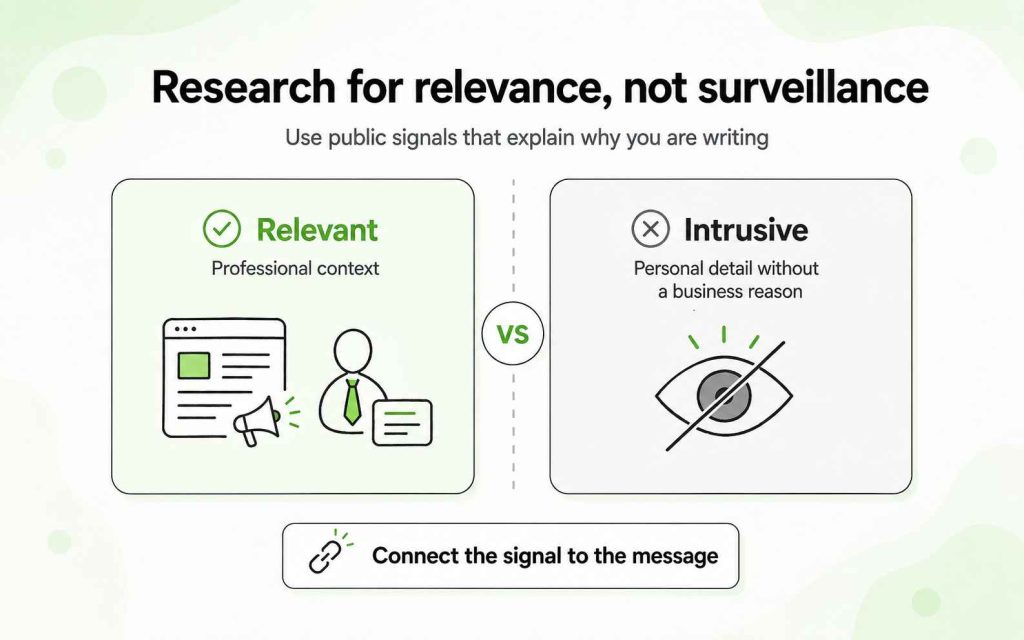
Weak personalization:
I saw that you are the VP of Sales at Northstar.
Stronger relevance:
I noticed Northstar is hiring account executives in three regions, which usually creates more follow-up and coaching work for the sales operations team.
The second version connects public information to a plausible business priority.
6. Write a focused outreach email
An outreach email should help the recipient understand four things quickly:
- Who is contacting them?
- Why did this person choose them?
- Why might the message matter?
- What should happen next?
Use this structure:
| Part | Purpose | Example |
|---|---|---|
| Subject line | Sets an accurate expectation | Follow-up workflows at Northstar |
| Greeting | Addresses the recipient naturally | Hi Maya, |
| Relevant opening | Explains why you selected this person | I noticed Northstar is expanding its partner team across three markets. |
| Main point | Connects the situation to a useful idea or outcome | Woodpecker helps teams personalize outreach and manage follow-ups without tracking every conversation manually. |
| Call to action | Asks for one manageable next step | Would it be useful if I sent a short example based on your partner workflow? |
| Sign-off | Identifies the sender clearly | Best, Alex — Woodpecker |
The strongest outreach emails are specific without becoming unnecessarily long. Give the recipient enough information to evaluate the message, but do not try to complete an entire sales process in the first email.
When you are contacting a prospect who does not know you, the same principles covered in this six-step cold email tutorial apply: relevance, clarity, credibility, and one simple request.
7. Write an accurate subject line
Your subject line should reflect the content of the email.
Useful outreach subject lines often refer to:
- A relevant workflow
- A recognizable project
- A specific question
- A mutual professional interest
- A clear reason for writing
Examples:
- Partner follow-ups at Northstar
- Question about your logistics report
- Possible data contribution for your 2026 study
- Reducing manual prospect research
- Collaboration idea for the September webinar
Avoid deceptive “Re:” or “Fwd:” prefixes, fake urgency, and vague subjects such as “Business proposal” or “Quick question.”
A subject line can earn attention, but it cannot compensate for an irrelevant message.
8. Use one low-friction call to action
Your call to action should match the recipient’s level of familiarity with you.
A stranger may not be ready to accept a 45-minute meeting. They may be willing to answer a focused question or review a short, relevant example.
Instead of:
Let me know if you would like to schedule a demonstration of our platform.
Try:
Would it be useful if I sent a two-minute example based on your current workflow?
Other low-friction calls to action include:
- Is this something your team is working on this quarter?
- Would you be the right person to ask about this?
- Is Tuesday or Wednesday better for a 15-minute conversation?
- May I send the summary?
- Would this data be relevant to the report you are preparing?
Do not hide the request. A recipient should not have to infer what you want them to do.
9. Plan relevant follow-ups
People miss emails for many reasons. A polite follow-up can return the conversation to their attention without repeating the entire first message.
Each follow-up should have a purpose. You can:
- Clarify the original idea
- Add a relevant detail
- Answer a likely objection
- Share a concise example
- Ask a simpler question
- Close the conversation respectfully
A practical email cadence should allow enough space between messages and stop when someone replies, opts out, or clearly indicates that the offer is not relevant.
For wording and timing ideas, these follow-up email examples show how to continue a conversation without sending the same reminder repeatedly.
There is no universal number of follow-ups that works for every audience. Test the sequence against recipient behavior, campaign value, market expectations, and applicable rules.
10. Protect email deliverability
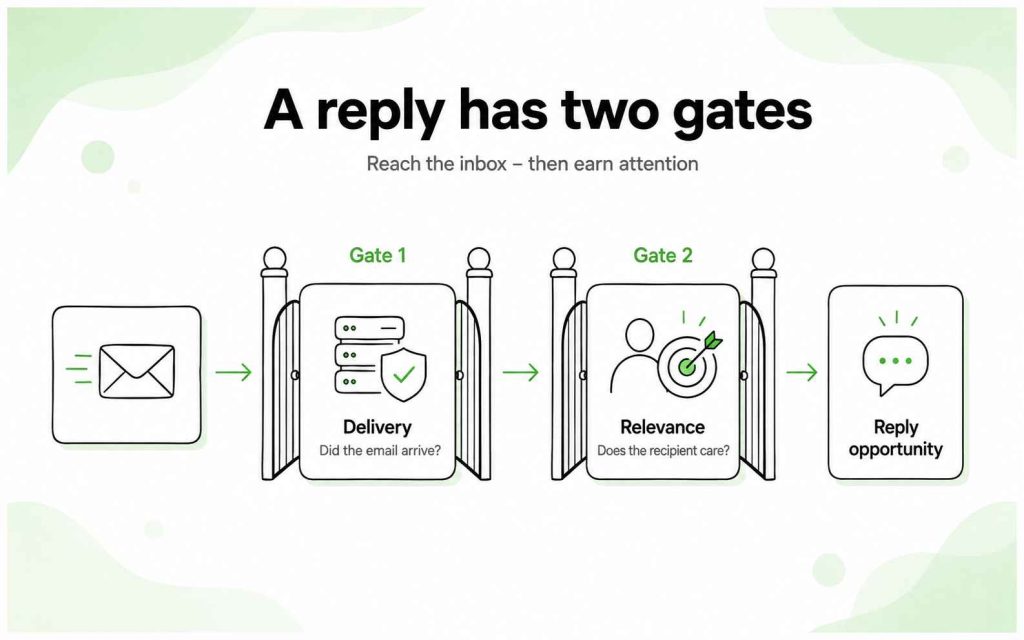
An effective message cannot generate a reply if it does not reach the recipient.
Before scaling outreach:
- Use a domain configured for legitimate business sending.
- Authenticate email with SPF, DKIM, and DMARC.
- Verify addresses before sending.
- Increase volume gradually.
- Avoid sudden sending spikes.
- Remove addresses that repeatedly bounce.
- Make opting out straightforward.
- Monitor spam complaints and provider warnings.
- Stop sequences when a recipient replies.
Woodpecker’s explanation of SPF, DKIM, and DMARC covers how the three authentication mechanisms work together.
Technical setup supports deliverability, but recipient response remains important. Highly targeted messages are less likely to be ignored or reported than indiscriminate campaigns.
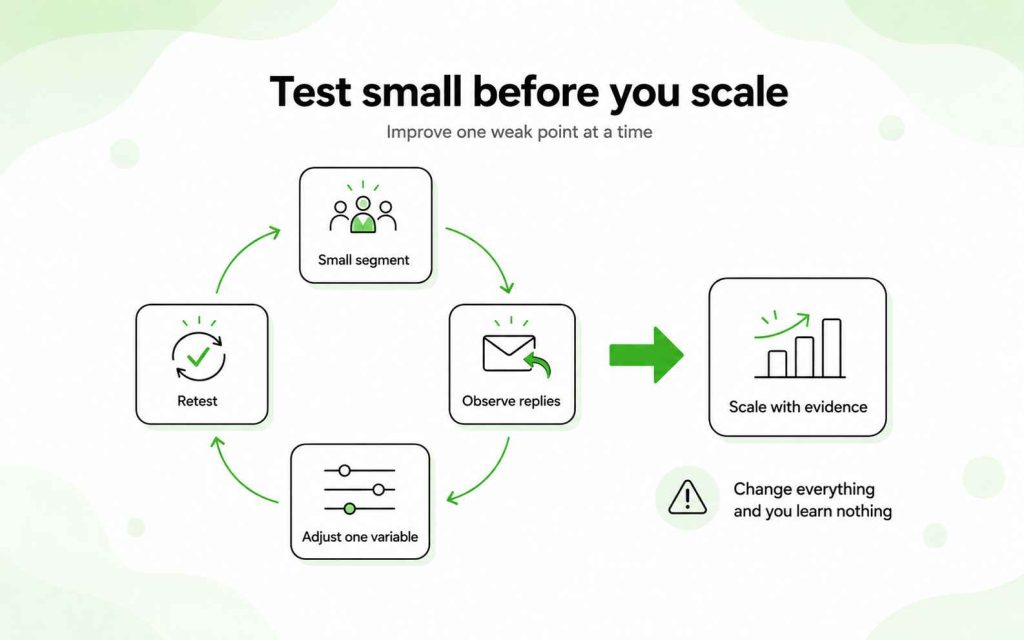
11. Launch with a controlled test
Do not send a new campaign to the entire list immediately.
Start with a smaller, representative segment. Review:
- Whether the selected recipients are genuinely relevant
- Whether the message is easy to understand
- Which questions recipients ask
- Common objections
- Positive and negative replies
- Bounces and opt-outs
- Whether the call to action matches the audience
Use those observations to improve the campaign before increasing volume.
Testing does not mean changing every element at once. If you replace the audience, subject line, offer, and call to action simultaneously, you will not know what caused the result.
Email outreach examples for 2026
The following examples show how the same outreach framework can support different goals. They are intentionally concise and use selectable text rather than screenshots.
More use-case-specific messages are available in these outreach email examples and templates.
Sales outreach example
Subject: Support handoffs at Northstar
Hi Maya,
I noticed Northstar is hiring customer success managers in three markets.
As teams expand, account handoffs and follow-ups often become harder to track consistently. Woodpecker helps customer-facing teams personalize outreach and manage follow-ups from one place.
Would it be useful if I sent a short example based on a multi-market handoff workflow?
Best,
Alex
Woodpecker
Why it works: The message connects a public company development to a specific operational challenge and asks permission before sending more information.
Partnership outreach example
Subject: Joint session for sales operations teams
Hi Daniel,
Your recent session on CRM data quality covered several problems we also see in outbound campaigns, particularly incomplete contact records and inconsistent follow-up.
Would you be open to discussing a joint 30-minute webinar on preparing CRM data for personalized outreach?
We could handle the outreach workflow section and promotion to our audience.
Kind regards,
Nina
Why it works: The sender identifies a genuine area of overlap, proposes a defined collaboration, and explains what they can contribute.
Expert contribution example
Subject: Question for our 2026 outreach study
Hi Priya,
We are preparing a study about how sales teams evaluate positive reply quality instead of relying only on open rates.
Given your work in revenue operations, could I send you three short questions about how your team defines a qualified outreach response?
We would credit you and link to your company if your comments are included.
Best,
Martin
Why it works: The request is limited, the recipient’s expertise is relevant, and the sender explains how the contribution will be used.
Media outreach example
Subject: Original data on follow-up timing
Hi Elena,
Your recent article about changes in B2B buying behavior mentioned how difficult it has become to interpret email engagement.
We have anonymized data comparing reply patterns across first messages and follow-ups. One finding may support your next update: positive replies and total replies do not always peak at the same stage of a sequence.
Would you like the methodology and summary?
Best,
Sam
Why it works: The email refers to relevant published work and offers potentially useful source material without attaching unsolicited files.
How to measure email outreach
Open rates can provide diagnostic information, but they should not be treated as the main measure of campaign success. Privacy features, image blocking, and automated security systems can affect tracking.
Focus on outcomes connected to your campaign goal.
| Metric | What it indicates | What to investigate |
|---|---|---|
| Bounce rate | Contact-data and list quality | Verification, outdated addresses, or targeting sources |
| Reply rate | Whether the message starts conversations | Relevance, clarity, targeting, and call to action |
| Positive reply rate | Whether recipients are interested in the proposed next step | Audience fit, timing, offer, and credibility |
| Conversion rate | Whether replies lead to meetings, partnerships, hires, or another goal | Qualification and the process after a reply |
| Opt-out or complaint rate | Whether recipients consider the messages unwanted | Targeting, frequency, tone, and suppression handling |
| Open rate | A limited signal that may help diagnose delivery or subject-line changes | Treat cautiously and evaluate alongside replies |
Track positive replies separately from automated responses, objections, referrals, and opt-outs. A campaign with fewer replies can be more valuable if a larger share comes from the right people.
Where email outreach software fits
Software can help manage repetitive parts of outreach, including personalization fields, follow-up scheduling, reply detection, stopping conditions, and campaign reporting.
It should not decide who deserves to receive the message or invent a credible reason for contacting them. Those decisions still require human judgment.
When choosing an email sequence tool, evaluate whether it supports:
- Individualized message fields
- Conditional follow-ups
- Automatic stopping after replies
- Bounce and opt-out management
- Clear campaign reporting
- Team collaboration
- Deliverability controls
- Integrations with your existing workflow
This article focuses on outreach strategy. Tool comparisons and pricing belong in the dedicated software hub so the two pages serve different search intents.
Common email outreach mistakes
Targeting too broadly
A large list can create more activity without creating more opportunities. Narrow segments usually make it easier to write a message that addresses a real situation.
Using superficial personalization
A first name and company name do not make a generic pitch relevant. Personalization should explain why the recipient was selected.
Writing the full sales presentation
The first message should create enough interest for the next step. Lengthy feature lists and company histories make the recipient search for the point.
Making several requests
Choose one call to action. Multiple questions, links, attachments, and meeting requests create unnecessary friction.
Using deceptive tactics
Fake reply prefixes, misleading subject lines, invented familiarity, and false urgency can damage trust and create compliance problems.
Automating before validating
Automation magnifies the strengths and weaknesses of a campaign. Test your audience, offer, and message before increasing volume.
Ignoring negative signals
Bounces, opt-outs, complaints, and uninterested replies provide useful feedback. Suppress recipients promptly and investigate whether the targeting or frequency needs to change.
Measuring activity instead of outcomes
A high open rate does not necessarily mean the campaign is generating qualified conversations. Measure progress toward the campaign’s actual goal.
Is email outreach legal?
Email outreach laws depend on the recipient’s location, the sender’s location, the type of message, how the contact data was obtained, and the relationship between the parties. This section provides general information, not legal advice.
In the United States, the FTC’s CAN-SPAM guidance requires commercial email senders to use accurate header information and non-deceptive subject lines, provide a valid postal address and opt-out method, and honor opt-out requests.
In the EU and EEA, organizations need an appropriate legal basis to process personal data. The European Commission explains that legitimate interests require an assessment of the organization’s interests against the individual’s rights. Individuals also have the right to object to personal-data processing for direct marketing, and separate national rules implementing the ePrivacy Directive may apply.
Before launching outreach in a new market:
- Identify the rules that apply to the sender and recipients.
- Document the lawful basis where required.
- Explain who you are.
- Use accurate sender information and subject lines.
- Provide an accessible way to object or opt out.
- Maintain a suppression list.
- Stop contacting people who object.
- Avoid collecting more personal data than necessary.
- Seek qualified legal advice when requirements are unclear.
Legal compliance is the minimum standard. Relevant targeting, reasonable frequency, transparency, and respect for recipient preferences are also essential.
Email outreach checklist
Before sending a campaign, confirm that:
- The campaign has one measurable outcome.
- Every recipient matches a defined audience.
- You can explain why the message is relevant now.
- Contact details have been verified.
- The subject line accurately describes the email.
- The opening provides relevant context.
- The message makes one focused point.
- The call to action is easy to answer.
- Follow-ups add information instead of repeating the same request.
- Sequences stop after replies and opt-outs.
- Authentication and sending settings are configured.
- Applicable legal requirements have been reviewed.
- Success is measured using replies and business outcomes.
Build an email outreach process you can improve
Sustainable email outreach is not a numbers game. It is a repeatable process for identifying the right people, understanding why your message matters to them, and making it easy to start a useful conversation.
Begin with a narrowly defined audience and a clear outcome. Test the campaign with a small segment, study the replies, and improve the weakest part of the process before scaling.
Woodpecker helps teams personalize outreach, automate appropriate follow-ups, manage replies, and evaluate campaign results without losing control over who receives each message.
FAQ
What is email outreach?
Email outreach is the process of identifying relevant people and contacting them by email to start a professional conversation or achieve a defined outcome. It includes targeting, research, message writing, follow-ups, deliverability management, and performance analysis.
How do you do email outreach?
Define one goal, identify a relevant audience, verify contact information, research why the message matters to each recipient, and write a concise email with one call to action. Send appropriate follow-ups, monitor deliverability and replies, honor opt-outs, and improve the campaign based on results.
What is the difference between email outreach and cold email?
Cold email is a message sent to someone with whom the sender has no existing relationship. Email outreach is the broader process surrounding that message, including audience research, list building, personalization, follow-ups, relationship development, and measurement.
How long should an outreach email be?
An outreach email should be long enough to explain why you are writing, why the message is relevant, and what you want the recipient to do. In most cases, several short paragraphs are easier to process than a long presentation.
How many follow-ups should an outreach campaign include?
There is no universal number. The appropriate sequence depends on the audience, campaign purpose, market, recipient behavior, and applicable regulations. Each follow-up should add context or simplify the request, and the sequence should stop after a reply, objection, or opt-out.
What makes an outreach email effective?
Effective outreach combines accurate targeting, a credible reason for contacting the recipient, a clear message, and a low-friction call to action. Deliverability, timing, follow-ups, and respectful handling of recipient preferences also affect results.