


Most guides on ending cold emails give you a list of sign-offs (“Best,” “Thanks,” “Regards”), a few CTA templates, and call it done. That’s not wrong exactly – it’s just aimed at the wrong problem. The place where cold email endings fail isn’t the sign-off. It’s the twenty words before the sign-off that most senders treat as filler.
The honest truth about ending a cold email: the sign-off almost never changes whether someone replies. What changes reply rates is the setup sentence before the CTA, the specific ask the CTA makes, and whether those two things match the recipient’s situation. Sign-offs matter at the margins – “Cheers!” is slightly too casual for a first cold email to a C-suite contact, for example – but the margin is narrow.
This rewrite covers what actually matters when ending a cold email: the three distinct layers of an email ending, which one usually breaks, what each one should do, specific examples by scenario, and how the ending changes across a sequence. By the end you’ll have a framework you can apply to any cold email, not a list of stock phrases to copy.
The three layers of a cold email ending
Every cold email ending contains three working parts. Most guides conflate them. Treating them separately is what makes the difference between an ending that converts and one that doesn’t.
Layer 1: The setup sentence
The second-to-last sentence before your CTA. Its job: transition from the body of your email to the ask, and give the recipient a reason to take the next step.
This is the layer that breaks most often. Common failures: bland connector sentences (“So, yeah, let me know what you think”), unearned assumptions (“I’m sure this would be valuable for you”), or just missing the layer entirely and jumping straight from body to CTA with no transition.
A good setup sentence does one of three things:
- Frames the ask – tells the recipient what the next step will do for them
- Lowers the stakes – acknowledges that the ask is small or that no is fine
- Creates curiosity – makes them want to find out more
Examples:
If you want the two-minute version of what we’ve found with similar teams, a quick call would do it. [frames the ask]
If any of this is relevant, great. If not, no hard feelings – just wanted to put it on your radar. [lowers the stakes]
There’s a specific pattern I’ve noticed across three companies in your space that might be worth 15 minutes to walk through. [creates curiosity]
Layer 2: The CTA (call to action)
The sentence that asks for something. The most scrutinized part of the email for most writers, but the one that’s usually less broken than the setup.
The job of the CTA is to make a specific ask that’s small enough to say yes to. The most common mistake isn’t writing a bad CTA – it’s writing a CTA that’s vague, or asking for too much too early.
Bad: “Let me know if this sounds interesting.” (vague, no specific action) Bad: “Would you like to schedule a 45-minute demo this week?” (too big an ask for cold) Good: “Open to a 15-minute call next week to see if it’s worth exploring?”
The right scale for a first cold email: 10-15 minutes on a specific day range, or a single-sentence reply to a simple question. Anything bigger signals you don’t understand cold outreach.
What makes cold email work across the whole message? Read 10 factors that make cold emails work (or not).
Layer 3: The sign-off
Your name and the word before it (“Best,” “Thanks,” “Cheers,” etc.). The part that most guides treat as the main event, but which actually matters least.
Sign-offs don’t win or lose cold emails. They can make an email feel slightly off if poorly matched to tone (a “Sincerely yours” at the end of a startup-casual cold email, or a “Cheers!” at the end of an email to a Fortune 500 CFO). But within the range of reasonable options, the sign-off choice isn’t what’s changing your reply rate.
The reasonable options for cold email sign-offs:
- Thanks – versatile, neutral, works in most contexts
- Thanks for your time – slightly more deferential, good for senior contacts
- Best – slightly more formal, works across industries
- Best regards – formal end, appropriate for enterprise or first-time outreach to senior people
- Cheers – slightly casual, works in startup/tech contexts
- [Just your first name] – the most casual, works when the rest of the email is already warm
Avoid for cold email: “Sincerely” (too formal, signals template), “Warmly” (tries too hard), “Regards” (neutral to the point of cold), “Yours” (weird for first contact), anything with an emoji in a first cold email.
For a deeper breakdown on sign-offs specifically, how to end a business email: 15 good and a few bad email sign-offs covers the register choices in detail.
Which layer usually breaks
Across cold emails that underperform, the failure points show up in a predictable order.
Most common failure: the setup sentence. 60-70% of weak cold email endings have a weak or missing setup sentence. The body of the email might be fine, the CTA might be reasonable, but the connector between them is “So let me know what you think” or similar – which adds nothing and signals templated copy.
Second most common: the CTA is too big or too vague. “Let me know if interested” or “Would you be open to a 30-minute demo?” kills reply rates. The first is too vague to act on; the second is too big for someone who just learned you exist.
Least common: the sign-off itself. Unless you’re using something genuinely off-register for the context, the sign-off isn’t what’s hurting the email.
The implication: when you’re trying to improve a cold email ending, work on the setup sentence first, the CTA second, and only worry about the sign-off if something is clearly wrong. This is the opposite of how most teams approach the problem.
What typically breaks in cold outreach beyond the ending? check bad cold email to good cold email examples – they covers the broader diagnostic.
Examples by scenario: first cold email
First touch. You’re introducing yourself and asking for a small next step. The ending should be low-pressure and specific.
Scenario: selling B2B software to a VP or Director
Setup: Worth a quick look at whether the approach would fit your current stack.
CTA: Open to a 15-minute call next Tuesday or Wednesday to walk through how it’s worked at similar companies?
Sign-off: Thanks
Why this works: setup frames the ask around “fit with your situation” rather than “buy our product.” CTA is specific on timing and scope. Sign-off is neutral.
Scenario: cold pitching to a senior executive (VP+)
Setup: No pressure to respond if the timing’s off – happy to circle back next quarter.
CTA: If relevant now, a brief intro call this week or next would cover the essentials in under 15 minutes.
Sign-off: Best regards
Why this works: executives get too much cold email; removing pressure disarms the defensive filter. Time-bounded CTA respects their time. Sign-off matches the seniority register.
Scenario: agency outreach to a small business owner
Setup: Figured I’d send this over – worth maybe five minutes to see if it’s relevant.
CTA: Just hit reply with “yes” or “no” if you’d like to see a short video walkthrough.
Sign-off: Thanks
Why this works: casual register matches SMB context. CTA is the smallest possible ask (reply with one word). Setup is honest about not expecting much.
Scenario: cold outreach following a trigger event (funding, launch, hire)
Setup: Since [trigger event] typically changes [specific thing] for teams at your stage, figured it was worth flagging.
CTA: 15 minutes next week to share how three similar companies handled the transition?
Sign-off: Thanks
Why this works: setup ties the ask directly to the trigger – relevance is earned, not claimed. CTA offers specific value (hearing about three similar companies). Sign-off is neutral.
Read what the body of these emails should contain in our 9 cold email templates that actually work in 2026. It covers the full template structures these endings attach to.
How endings change across a cold email sequence
The same principles that work for a first email shift across a sequence. Here’s what changes.
Email 1 (initial outreach)
Standard three-layer ending as covered above. Setup frames, CTA is small and specific, sign-off is neutral.
Email 2 (first follow-up, 3-4 days later)
The assumption here is your first email didn’t get a response – so the ending should acknowledge reality without being pushy. Common failure: repeating the same CTA from email 1, which reads as robotic.
Setup: Know inboxes get busy, so happy to simplify.
CTA: If a quick call isn’t right, would a 2-minute loom walkthrough be more useful? Or a different time to revisit?
Sign-off: Thanks
Why this works: setup acknowledges the likely reason for no response (busy, not disinterested). CTA offers multiple paths instead of the same path as email 1.
Email 3 (deeper value follow-up)
By email 3, the recipient has heard from you twice. The ending needs to justify why they should engage now when they didn’t before.
Setup: Since you haven’t replied, maybe this isn’t the right angle – but worth trying once more with something specific.
CTA: If I’m in the wrong lane, would you point me to whoever handles [specific thing]? Or if it’s worth 10 minutes, this week or next?
Sign-off: Thanks
Why this works: setup is honest about the previous silence (not pretending it didn’t happen). CTA offers a face-saving alternative – redirect me to the right person. Asking for a referral is often the easiest “yes” in a stalled sequence.
Email 4+ (breakup or near-breakup)
The ending here should signal you’re wrapping up. Counter-intuitively, breakup endings are high-converting because they remove pressure.
Setup: Going to close this out unless I hear otherwise.
CTA: Should I archive this, or is there a better time to reach back out?
Sign-off: Thanks
Why this works: setup removes pressure by signaling the ask will stop. CTA offers a clean either/or that requires almost no effort to answer. The “wrong person?” variant from Layer 2 CTAs also works well here.
Here’s the full picture on follow-up cadence: follow-up email subject lines covers the subject-line pairing that works with these endings, and how to send a follow-up email after no response shows the broader strategy.
The specific mistakes that sink cold email endings
Patterns that show up across failing sequences. Each one has a specific fix.
Mistake: “Looking forward to your response”
The single most overused phrase in cold email endings. Problems: presumptuous (assumes they want to respond), passive (signals you have nothing specific to ask), and so templated that spam filters recognize it.
Fix: Replace with a specific ask or an acknowledgment that a response isn’t guaranteed. “Open to a quick call?” or “No rush if timing’s off – happy to circle back” both outperform.
Mistake: Asking for too many things at once
“Would you like to hop on a call, or see a demo, or get the deck, or join our next webinar?” Paradox of choice – multiple options produces no response more often than one specific option.
Fix: Pick one ask per email. The other options can appear in later emails in the sequence.
Mistake: “Please feel free to reach out if you have any questions”
Passive. The recipient isn’t going to generate questions on their own about an email they barely remember reading. This is a fake CTA that produces zero action.
Fix: Propose the specific next step you actually want them to take. “Want me to send the case study?” or “Worth 10 minutes to walk through?” – both require a decision and therefore trigger a response (yes, no, or maybe).
Mistake: Generic sign-offs that don’t match the email
“Best regards, [Name]” at the end of a three-sentence casual cold email reads as inconsistent. “Cheers!” at the end of an email to a VP at a Fortune 500 company reads as unprofessional.
Fix: Match the sign-off to the email’s register. Casual email → “Thanks” or just your name. Formal email → “Best regards” or “Best.”
Mistake: The signature block that overwhelms the email
A 10-line signature with three addresses, every social icon, a quote, and a mobile disclaimer at the end of a 50-word cold email unbalances the message. The signature becomes the most prominent part of the email.
Fix: Keep cold email signatures minimal – name, title, company, website. Four lines maximum.
Want to learn more? A little big thing: what do I put in my email signature is written for you.
Mistake: Signing off with your legal name when the email is casual
“Best, Jonathan Michael Thompson III” at the end of an email that starts “Hey!” reads as weird. Name format should match the register of the greeting.
Fix: Casual greeting → first name only. Formal greeting → first and last. Company signature below handles the formal identity anyway.
Mistake: PS lines that contradict the main message
“PS: Would love to chat soon!” after a CTA that says “no pressure, totally fine if not a fit” undoes the low-pressure framing. PS lines work when they add something (a relevant link, a specific data point) but not when they re-assert urgency.
Fix: Use PS lines for genuine value-add or remove them. Don’t use them to re-ask what the CTA already asked.
Mistake: Implying you’ve been waiting for their response
“Waiting to hear back,” “circling back,” “still hoping to connect” all signal you’re prioritizing them more than they’re prioritizing you. Even when true, it reads as needy.
Fix: Assume they’ve been busy, not avoiding you. “Know your inbox is busy – happy to simplify” or “If the timing’s off, no pressure” are both face-saving alternatives.
Cold email endings for specific situations
Beyond the sequence stage, specific scenarios call for specific patterns.
When you’re asking for a referral to someone else
Setup: Totally fine if I’m in the wrong lane – often am in first outreach.
CTA: Would you be willing to point me to the right person at [Company], or is that not something you can do?
Sign-off: Thanks
Why this works: explicit permission for them to not be the right contact, and a clear ask that’s easy to answer with a name or a no.
When you’re following up on a specific trigger event
Setup: Since [specific event] usually creates [specific consideration], figured it was worth reaching out now rather than later.
CTA: Open to 15 minutes in the next two weeks while it’s still fresh?
Sign-off: Thanks
Why this works: the setup creates urgency from the trigger, not manufactured pressure. CTA matches the urgency with a two-week window.
When you’re ending a breakup email
Setup: Going to stop emailing – sounds like this isn’t a priority right now, and I don’t want to be noise.
CTA: If that changes, my door’s open. Otherwise, best of luck with [specific thing about their company].
Sign-off: Thanks
Why this works: breakup endings often generate responses because they remove pressure. The “best of luck with [specific thing]” is a warm touch that separates good breakups from passive-aggressive ones.
When you’re re-engaging after long silence
Setup: Know it’s been a while – figured I’d circle back since [specific reason that makes the re-engagement make sense].
CTA: If the original thing has moved on, fair enough – or if it’s still live, happy to pick it up where we left off?
Sign-off: Thanks
Why this works: acknowledges the gap honestly. CTA offers both paths (still relevant or not) without requiring justification.
How Woodpecker handles cold email endings at scale
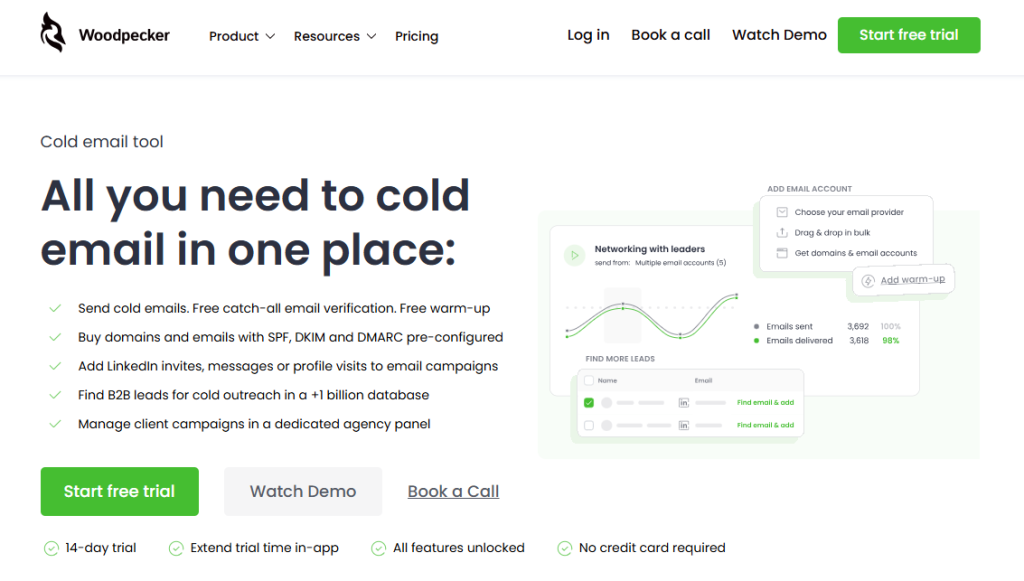
Writing one cold email ending thoughtfully is doable. Writing hundreds or thousands with the three-layer structure intact requires some tooling.
Here’s what Woodpecker provides for the ending-specific workflow:
Conditional sequence logic for different endings. Email 1 uses a first-touch ending with neutral CTA. Email 2 uses a follow-up ending that acknowledges silence. Email 4 uses a breakup ending. Woodpecker’s if/then branching handles this automatically – different prospects get different ending styles based on how they engaged with earlier emails.
Spintax for sign-off and CTA variation. Native spintax syntax like {Thanks|Best|Thanks for your time} means each prospect sees slightly different sign-offs and CTAs across a campaign. Reduces content similarity that spam filters pattern-match on.
Merge fields for personalized CTAs. The CTA can reference specific prospect data – {{first_name}}, {{company}}, custom fields for their specific situation. “Open to 15 minutes to walk through how this worked at [similar_company]?” becomes unique per prospect.
Auto-stop on reply. When a prospect replies to any email in the sequence, the rest doesn’t send – no matter how clever the later endings were. Critical for sequences where a thoughtful breakup email would otherwise land after someone already said yes.
AI-based reply detection. Replies get classified (positive, negative, out-of-office, question) so your ending work pays off – genuine replies flow to your primary inbox immediately, and sequences stop automatically for non-engagement signals.
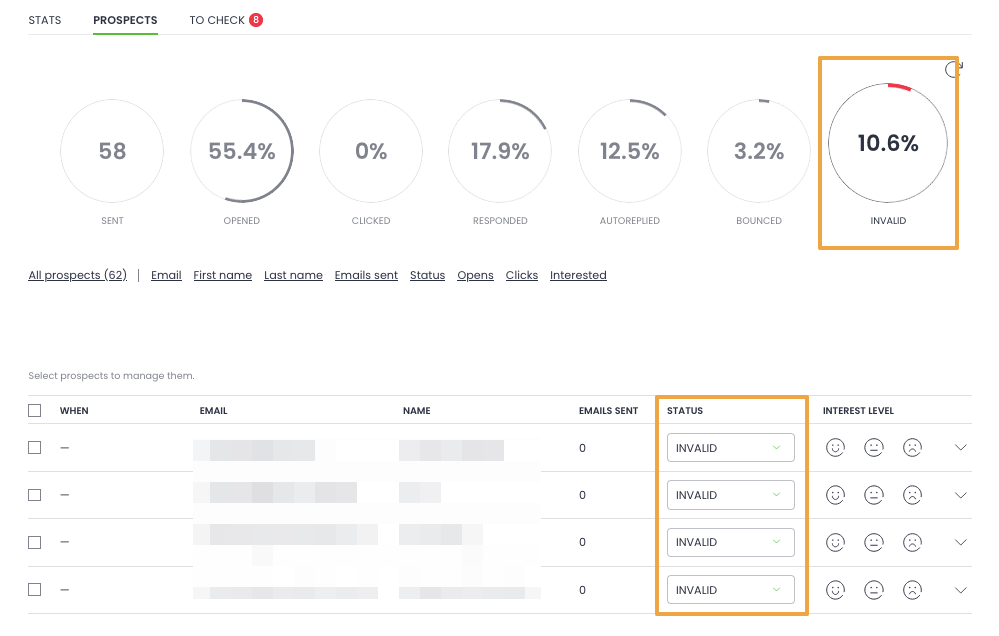
Deliverability infrastructure. Centralized inbox, Deliverability, free catch-all email verification, and free email warmup via partnerships with Warmy and Mailivery – all working to make sure your carefully-crafted endings actually reach the inbox where they can do their job.
What Woodpecker doesn’t do: generate endings from scratch via native AI copywriting. The endings remain human-written; the platform handles variation, personalization, and deployment at volume.
For teams running cold email as a primary outbound motion, sign up to Woodpecker to handle the sequencing and deliverability layer that makes every ending count.
FAQ
How should I end a cold email?
With a three-layer structure: a setup sentence that transitions from the body to the ask, a CTA that makes a small specific ask (usually 10-15 minutes of time, or a single-sentence reply to a question), and a neutral sign-off like “Thanks” or “Best regards.” The setup is what most cold emails miss; without it, the transition from body to CTA feels abrupt and templated.
What’s the best sign-off for a cold email?
“Thanks,” “Thanks for your time,” and “Best” all work in most cold email contexts. “Best regards” fits formal first outreach to senior contacts. “Cheers” works in casual B2B contexts like startup/tech but lands awkwardly with Fortune 500 CFOs. Avoid “Sincerely” (too formal, signals template), “Warmly” (tries too hard), and emoji sign-offs in first cold outreach.
What’s the best CTA for a cold email?
A small, specific ask with a time window. “Open to a 15-minute call next Tuesday or Wednesday?” works. “Would you like to schedule a demo?” doesn’t (too big an ask for cold). “Let me know if interested” doesn’t (too vague). The right scale for a first cold email: 10-15 minutes of time, or a single-sentence reply to a simple question.
How long should a cold email ending be?
Three lines: setup sentence, CTA, sign-off. Together they should account for maybe 25-35 words. Longer endings feel padded; shorter endings feel abrupt. The three-line structure gives you enough room to transition, ask, and close without overloading the reader.
What should I avoid in a cold email ending?
“Looking forward to your response” (presumptuous and templated), multiple CTAs asking for different things at once (paradox of choice kills replies), passive requests like “feel free to reach out with questions” (fake CTAs produce zero action), and signatures longer than the email body (unbalances the message). The biggest mistake isn’t in the sign-off – it’s the setup sentence most guides treat as filler.